Battlefield Atlas
World War II · 26 May – 4 June 1940

Dunkirk, 26 May – 4 June 1940

Also known as Dunkirk evacuation, Operation Dynamo, Bataille de Dunkerque

Accuracy70 /100 · good
Stages8 · over 10 days
On the map34 photos pinned
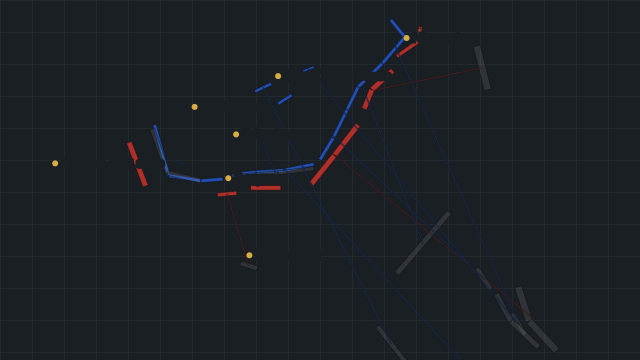
Drawing of the units and movements at DunkirkStages 1–3 freeOpen the interactive map

The first 3 stages are free. No account needed to start.

Between 26 May and 4 June 1940, Operation Dynamo lifted about 338,000 British and French soldiers from Dunkirk's East Mole and the beaches of Malo-les-Bains, Bray-Dunes and La Panne (Admiral Ramsay's despatch; Ellis's official history gives 338,226, of them 123,095 French by Ramsay's count). It was made possible by the German halt on the canal line of 24–26 May, by the British and French corridor fights at Cassel, Wormhoudt, Hazebrouck and the Ypres–Comines canal, by the French First Army's hold-out at Lille, and by a canal-line perimeter from Nieuport through Furnes and Bergues to Mardyck. As the BEF embarked, French divisions took over the perimeter and held it until 4 June, when about 40,000 of them surrendered. Nearly 900 vessels took part (Ramsay), from destroyers and steamers to the 'little ships.' Side A (red) is the German Army; side B (blue) is the British Expeditionary Force, the French forces and the Allied ships.

Battlefield Explorer opens stages 4–8 and every other battle. See the free battles.

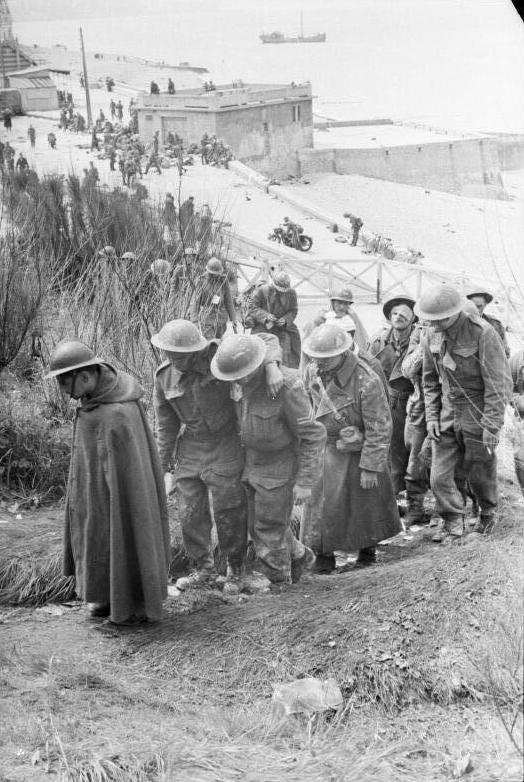
British troops line up on the beach
British troops line up on the beach — Unknown photographer (IWM NYP 68075) · public domain

The battle, stage by stage

  1. 23–26 May 1940

    The halt order and the corridor

    German armor has reached the Channel and cut the Allied armies in two. On the evening of 23 May Rundstedt's Army Group A orders its panzers to halt; on 24 May Hitler endorses the order: the canal line Lens–Béthune–Aire–St Omer–Gravelines 'will not be passed,' though Kleist's divisions already hold bridgeheads over the Aa. Ellis's official history stresses that the decision was originally Rundstedt's, taken while Kleist Group reported more than half its tanks out of action. Inside the pocket the BEF, the French First Army and the Belgians hold a corridor to the sea. The 2nd and 44th Divisions and the 48th Division's strongpoints at Cassel, Wormhoudt and Hazebrouck face west and south, the French 68th Division holds the Aa near Gravelines, and on 25 May Gort sends the 5th and 50th Divisions to the Ypres–Comines canal with what Ellis calls a 'hunch' that the Belgian front was about to break. Shortly before 7 p.m. on 26 May the Admiralty signals 'Operation Dynamo is to commence.' London hopes to bring home perhaps 45,000 men; by the IWM's account Churchill expected only 20,000–30,000.

  2. 27–28 May 1940

    Fighting for the corridor

    After what Ellis calls an enforced two-day halt, the armor attacks again on 27 May. The French are forced back south of Gravelines on 27 May and give it up that night. At Wormhoudt the 2nd Royal Warwickshire is attacked by tanks and infantry from 8 a.m. on 28 May; by evening Wormhoudt can no longer be held and Cassel and Hazebrouck are cut off, and the 1st Buckinghamshire's keep in Hazebrouck falls at about 6:30 p.m. That day at the Plaine au Bois near Esquelbecq, according to the Dunkerque tourist office's remembrance guide, 80 British prisoners of the Royal Warwickshire, the Cheshire Regiment and the Royal Artillery are locked in a barn and executed by members of the SS Leibstandarte. Near Béthune the 2nd Division's brigades, attacked by tanks on 27 May, are reduced to less than a brigade's strength (Ellis). On the Ypres–Comines canal the 5th Division, reinforced from three other divisions (the 48th, 4th and 1st) and I Corps artillery, holds against three German divisions. The Belgian Army ceases fire at midnight on 27/28 May, opening a gap of some twenty miles between II Corps and the sea; German troops reach Nieuport at 11 a.m. on the 28th, where the 12th Lancers and gunners fighting as infantry stop them. Much of the French First Army, ordered to stand on the Lys, is cut off around Lille. That afternoon the German XIX Corps diary calls further armored attacks a 'useless sacrifice,' and Kleist Group withdraws Guderian's three armored divisions, leaving the Grossdeutschland Regiment and infantry on the Aa.

  3. 29–30 May 1940

    Manning the canal line

    The BEF files into the bridgehead along roads jammed with British and French columns. The perimeter, about thirty miles long by Ellis's count, follows the canals: from the sea at Nieuport along the canal to Furnes, then the Basse-Colme canal past Bulscamp and Hondschoote to the walled town of Bergues; west of the Bergues canal the French hold Spycker and Mardyck, and the low ground south of Dunkirk is flooded against tanks. By Ellis's allotment II Corps holds the east (the 4th Division at Nieuport, the 3rd at Furnes, the 50th inland to the French frontier), I Corps the center and III Corps the west from Bergues to Warhem, III Corps being the first to embark. No division is complete; the 4th Royal Berkshire is about one company strong. The Germans reach the canal outside Furnes and bomb the town, but fail to cross at Bergues or enlarge their foothold at Nieuport. At about 10 p.m. on 30 May they break across north of Furnes, and a company of the 1st Coldstream Guards counter-attacks and restores the line. French troops of the First Army gather in the dunes; the French 12th Motorized Infantry Division comes in behind the eastern sector.

  4. 28 May – 1 June 1940

    Lille holds out

    Sixty kilometers inland, a large part of the French First Army (by one count about 40,000 men of IV and V Corps) is surrounded west of Lille when German armor closes the ring. Under General Jean-Baptiste Molinié they hold Haubourdin, Loos and the western suburbs against panzer and infantry divisions; Ellis's official history records that the force held out for four more days before surrendering, tying down German divisions while the Dunkirk perimeter was manned. Fighting ends around midnight on 31 May/1 June. Britannica puts those taken at about 35,000. By several accounts General Wäger of XXVII Corps granted the garrison the honors of war, and it marched past on the Grand Place before going into captivity.

  5. 29–31 May 1940

    The beaches and the East Mole

    Bombing has wrecked Dunkirk's docks, so Captain William Tennant, the senior naval officer ashore, turns to the East Mole, a breakwater about 1,600 yards long with a narrow planked walkway, never built for ships. Destroyers and steamers berth alongside it and it becomes the main exit; the Navy keeps using it despite the danger. Admiral Ramsay divides the beach from a mile east of Dunkirk to a mile east of La Panne into three sectors (La Panne, Bray and Malo), where the gently shelving sand keeps big ships offshore and boats ferry men out; sappers build lorry piers at Bray. From late afternoon on 29 May heavy air attack hits the ships at the mole, with Grenade, Jaguar and Canterbury on its inner side and Fenella and Crested Eagle on the outer side (Ellis): the destroyer Grenade and the steamer Fenella sink, Jaguar and Canterbury are put out of the operation, and the burning paddle steamer Crested Eagle is beached near Zuydcoote, where more than 300 soldiers die (Dunkerque tourist office). That night the destroyers Wakeful and Grafton are torpedoed on the way home. Yet the numbers climb: 47,310 men landed on 29 May, 53,823 on the 30th and 68,014 on 31 May, the biggest day of all (Ellis). An Admiralty appeal to the owners of small boats brings the 'little ships.'

  6. 31 May – 1 June 1940

    The British line contracts

    From 2 a.m. on 31 May the German Eighteenth Army takes over the attack with four corps: in Ellis's list the 14th, 18th, 56th, 216th, 254th and 256th Infantry Divisions, the 61st coming up, and the 20th Motorized Division and SS Leibstandarte in reserve. It strikes hardest at Nieuport, Furnes and the 50th Division's front; ground is lost and won back by counter-attack. Gort hands over to Major-General Harold Alexander, and that night II Corps leaves the Belgian sector; about 6,000 men of the 4th Division march some ten miles from La Panne to Dunkirk. On 1 June about 39,000 British hold a shortened line from Bergues to the frontier, with about 50,000 French in position and 80,000 more in the dunes. The Germans attack at Bergues and Hoymille; the 1st Loyals withdraw from Bergues itself to the canal on the northern outskirts. A first Loyals counter-attack fails; a second, at 5:30 p.m., drives the enemy back and re-establishes the line on the canal bank (Ellis). Captain Harold Ervine-Andrews of the 1st East Lancashire wins the Victoria Cross. Over the beaches the Luftwaffe sinks the destroyers Keith, Basilisk and Havant, the minesweeper Skipjack and the French destroyer Foudroyant, yet 64,429 men are landed that day by Ellis's count. Ship positions here are approximate.

  7. 2 June 1940

    The French take over

    After dark on 1 June the British fall back behind a French intermediate line and by morning are all on the coast. Ramsay stops daylight sailings; at 11:30 p.m. on 2 June Tennant signals 'B.E.F. evacuated.' The perimeter is now French. Admiral Jean Abrial and General Marie-Bertrand-Alfred Fagalde command from Bastion 32; the 68th Infantry Division holds the west and the 12th Motorized Infantry Division the east around Ghyvelde and Bray-Dunes, with elements of the 32nd Division, reconnaissance groups and troops of the Secteur fortifié des Flandres between. Attacked on the intermediate line, the French are pushed back on their right but counter-attack and stop the advance; at Téteghem the 7th GRDI fights at the Boomkens farm, where the farming family suffers heavy losses. Bergues, its ramparts now ahead of the French line, is lost on or about 2 June. Dive-bombers hit the Fort des Dunes at Leffrinckoucke, the 12th Division's headquarters, and General Louis Janssen is killed by bombs in its courtyard. The French line here is approximate.

  8. 3–4 June 1940

    The last night and the surrender

    On 3 June the French are forced back to the Dunkirk–Furnes canal, less than two miles from the beach, and the Fort des Dunes is bombed again. That afternoon Abrial orders a final lift, and about 50 vessels come in: 26,476 French are embarked before midnight and 26,175 more before dawn (Ellis). Fewer men reach the harbor than expected, and thousands are still waiting when the ships must leave. The destroyers Express (3:18 a.m.) and Shikari (3:40 a.m.) are the last away (Ramsay), and blockships are sunk in the entrance channel. Abrial and the French generals cross to England. At about 9 a.m. on 4 June (9:30 by the Imperial War Museums) the remaining French troops surrender: about 40,000 by Ellis's estimate, which he notes has no authoritative count (the Imperial War Museums give about 90,000 left to be taken prisoner). The Admiralty ends Dynamo at 2:23 p.m. Ramsay's despatch puts the total landed in Britain at about 338,000, including 123,095 French; Ellis gives 338,226. Positions shown are those of the night of 3/4 June, before the surrender.

At a glance

When
26 May – 4 June 1940
Where
Dunkirk (Dunkerque) and the beaches east to La Panne, Nord, northern France, on the Belgian border.
Forces
On 1 June about 39,000 British and 50,000 French held the shrinking perimeter, with 80,000 more French waiting in the dunes, against the infantry divisions of the German Eighteenth Army; close on 900 vessels lifted about 338,000…
Casualties
The cost fell hardest on the French: about 35,000 captured at Lille and about 40,000 at Dunkirk by Ellis's estimate (the IWM says 90,000), against some 228 Allied ships lost and heavy air losses on both sides.
On the map
8 stages, 34 photos pinned where they were taken

Who fought

  • German Army (Army Groups A and B)
  • British Expeditionary Force and French forces

Accuracy score

70/100 · good

Good confidence in where units stood and moved, scored on the quality of the source map, how well independent fixed points agree, the level of detail and corroboration. How scores work

Places on the map

  • East Mole (Jetée de l'Est), root
  • East Mole, head (approximate)
  • Bastion 32: Abrial and Fagalde HQ
  • Fort des Dunes, Leffrinckoucke
  • Zuydcoote coastal battery
  • Bergues: Vauban ramparts
  • Malo-les-Bains beach
  • Bray-Dunes beach
  • La Panne beach
  • Nieuport
  • Furnes (Veurne)
  • Hondschoote
  • Hoymille
  • Téteghem
  • Cassel
  • Wormhoudt
  • Hazebrouck
  • Plaine au Bois, Esquelbecq (28 May massacre)
  • Cochon Noir stele, Gravelines
  • Lille, Grand Place
  • Haubourdin

Forces

On 1 June about 39,000 British and 50,000 French held the shrinking perimeter, with 80,000 more French waiting in the dunes, against the infantry divisions of the German Eighteenth Army; close on 900 vessels lifted about 338,000 men. Allied figures come from Ellis and Ramsay; German troop numbers are not given in these sources, only the divisions.

German Army (Army Groups A and B)

Divisions attacking the perimeter from 31 May6 infantry divisions, a 7th arriving, 2 motorized formations in reserve

Ellis lists the Eighteenth Army's four corps with the 14th, 18th, 56th, 216th, 254th and 256th Infantry Divisions, the 61st coming up, and the 20th Motorized Division and SS Leibstandarte in reserve; no troop totals are given. L. F. Ellis, The War in France and Flanders 1939–1940 (HMSO), ch. XV (HyperWar)

Kleist Group tanks, 23 Maymore than half out of action

Kleist Group's own report when the halt was ordered, as given by Ellis; on 28 May Guderian advised that the armored divisions had only 50 percent of their armored strength left (Ellis, ch. XIII). L. F. Ellis, The War in France and Flanders 1939–1940 (HMSO), ch. IX (HyperWar); L. F. Ellis, The War in France and Flanders 1939–1940 (HMSO), ch. XIII 'After the Belgian Surrender' (HyperWar)

British Expeditionary Force and French forces

In the perimeter, morning of 1 Juneabout 39,000 British; about 50,000 French in position

Ellis; a further 80,000 French had gathered in the dunes for evacuation, of whom 30,000 had already sailed. L. F. Ellis, The War in France and Flanders 1939–1940 (HMSO), ch. XVI 'Last Days at Dunkirk' (HyperWar)

Lifted to England, 26 May–4 Juneabout 338,000 (338,000–366,162)

Ramsay gives about 338,000, including 123,095 French (Appendix IV); Ellis gives 338,226 for Dynamo, or 366,162 counting the 27,936 taken off before it began, including 224,320 men of the BEF; the IWM says a third of those lifted were French. Admiral Sir Bertram Ramsay, despatch, London Gazette no. 38017 (1947); L. F. Ellis, The War in France and Flanders 1939–1940 (HMSO), ch. XVI 'Last Days at Dunkirk' (HyperWar); Imperial War Museums, 'What you need to know about the Dunkirk evacuations'

Ships and boats taking partclose on 900 (over 800–over 1,400)

Ramsay says close on 900; the IWM over 800; Britannica about 1,000, some 700 of them civilian craft; the French Ministry of the Armed Forces over 1,400. Admiral Sir Bertram Ramsay, despatch, London Gazette no. 38017 (1947); Imperial War Museums, 'What you need to know about the Dunkirk evacuations'; Encyclopaedia Britannica, 'Timeline of the Dunkirk evacuation'; French Ministry of the Armed Forces, Chemins de mémoire, 'Bastion 32 Remembrance Memorial'

Final lift, night of 3/4 Juneabout 50 vessels; 26,476 + 26,175 French embarked

Ellis: 26,476 embarked before midnight and 26,175 in the early hours of 4 June. L. F. Ellis, The War in France and Flanders 1939–1940 (HMSO), ch. XVI 'Last Days at Dunkirk' (HyperWar)

Casualties

The cost fell hardest on the French: about 35,000 captured at Lille and about 40,000 at Dunkirk by Ellis's estimate (the IWM says 90,000), against some 228 Allied ships lost and heavy air losses on both sides. Total killed on either side is not recorded in the main sources, and the prisoner counts are estimates. Certainty: fair.

German Army (Army Groups A and B)

Killed, wounded and missingunknown

Neither Ellis's official history nor Ramsay's despatch gives a total for German ground losses around the Dunkirk pocket and perimeter. L. F. Ellis, The War in France and Flanders 1939–1940 (HMSO), ch. XVI 'Last Days at Dunkirk' (HyperWar)

British Expeditionary Force and French forces

French troops captured at Dunkirk, 4 Juneabout 40,000 (35,000–90,000)

Ellis calls about 40,000 'the most detailed estimate' and says no authoritative record exists; the French Ministry of the Armed Forces also gives 40,000 and USNI Proceedings 35,000–40,000, while the Imperial War Museums say 90,000 remained to be taken prisoner. L. F. Ellis, The War in France and Flanders 1939–1940 (HMSO), ch. XVI 'Last Days at Dunkirk' (HyperWar); French Ministry of the Armed Forces, Chemins de mémoire, 'Bastion 32 Remembrance Memorial'; U.S. Naval Institute Proceedings, 'The French Navy at Dunkirk' (February 1959); Imperial War Museums, 'What you need to know about the Dunkirk evacuations'

French First Army captured in the Lille pocket, 31 May–1 Juneabout 35,000

Britannica gives 35,000 captured at Lille; Lloyd Clark (Blitzkrieg, 2016), as cited by Wikipedia, counts seven generals, 350 officers and 34,600 men. Encyclopaedia Britannica, 'Timeline of the Dunkirk evacuation'; Wikipedia, 'Siege of Lille (1940)' (leads; citing Lloyd Clark, Blitzkrieg)

Prisoners killed at the Plaine au Bois, Esquelbecq, 28 May80 British (80–81)

British prisoners of the Royal Warwickshire, Cheshire Regiment and Royal Artillery, executed in a barn by members of the SS Leibstandarte (Dunkerque tourist office); the French Ministry of the Armed Forces gives 80 British and one French soldier killed and 13 British survivors. Dunkerque tourist office, 'Guide on the paths of remembrance' (2021); French Ministry of the Armed Forces, Chemins de mémoire, 'La Plaine au Bois'

Soldiers killed aboard Crested Eagle, 29 Maymore than 300

The paddle steamer, set on fire in the air attacks of 29 May, was beached near Zuydcoote; some of the bodies were never found (Dunkerque tourist office). Dunkerque tourist office, 'Guide on the paths of remembrance' (2021)

Casualties among those evacuated8,061 British; 1,230 Allied

Ellis's count of casualties among the 338,226 men lifted during Dynamo; it is not a count of the dead, and no total for British and French killed in the perimeter fighting is given. L. F. Ellis, The War in France and Flanders 1939–1940 (HMSO), ch. XVI 'Last Days at Dunkirk' (HyperWar)

Civilians

Civilians killed at the Cochon Noir crossroads, Gravelines, 24 Maymore than 200

Mostly Belgian refugees caught in crossfire, commemorated by a stele (Dunkerque tourist office). Dunkerque tourist office, 'Guide on the paths of remembrance' (2021)

Civilians in the pocket overallunknown

No total is given in these sources; the tourist office records that the Vandamme family at the Boomkens farm, Téteghem, 'paid a heavy toll' in the fighting of 2 June. Dunkerque tourist office, 'Guide on the paths of remembrance' (2021)

Equipment and ships

Allied ships lost228 lost, 45 badly damaged (more than 200–about 240)

Ellis's figure, plus 'a considerable number of smaller vessels and boats'; Britannica gives about 240 lost and 45 damaged, the Dunkerque tourist office more than 200 boats sunk, nearly 140 of them among some 600 little ships. L. F. Ellis, The War in France and Flanders 1939–1940 (HMSO), ch. XVI 'Last Days at Dunkirk' (HyperWar); Encyclopaedia Britannica, 'Timeline of the Dunkirk evacuation'; Dunkerque tourist office, 'Shipwrecks on the beaches'

Destroyers sunk6 British sunk, 23 damaged

Ramsay's despatch (Appendix I); Britannica gives 6 British and 3 French destroyers sunk and 26 damaged. Admiral Sir Bertram Ramsay, despatch, London Gazette no. 38017 (1947); Encyclopaedia Britannica, 'Timeline of the Dunkirk evacuation'

RAF aircraft, 26 May–3 June177 destroyed and damaged

Ellis's figure for the nine days; Britannica says the RAF lost 84 planes. L. F. Ellis, The War in France and Flanders 1939–1940 (HMSO), ch. XVI 'Last Days at Dunkirk' (HyperWar); Encyclopaedia Britannica, 'Timeline of the Dunkirk evacuation'

German aircraft, 26 May–3 June240 destroyed and damaged

Ellis's figure for German air losses from all causes over France and Belgium in the same nine days; Britannica says the Luftwaffe lost 78. L. F. Ellis, The War in France and Flanders 1939–1940 (HMSO), ch. XVI 'Last Days at Dunkirk' (HyperWar); Encyclopaedia Britannica, 'Timeline of the Dunkirk evacuation'

BEF equipment abandonedall but personal equipment

Ellis says the army 'lost all except their personal equipment'; the Imperial War Museums say the BEF left behind the bulk of its tanks and heavy guns. Neither gives a count. L. F. Ellis, The War in France and Flanders 1939–1940 (HMSO), ch. XVI 'Last Days at Dunkirk' (HyperWar); Imperial War Museums, 'What you need to know about the Dunkirk evacuations'

Then and now: how the ground has changed

The beaches and dunes from the East Mole to the Belgian border are now protected nature land, and the Moëres, flooded in 1940, are drained polder again. Dunkirk itself was largely destroyed in the war and rebuilt on a new plan, and its port has grown into a deepwater harbor and heavy-industry zone west of the town around Mardyck, where the French 68th Division held the western flank.

Weapons

German Army (Army Groups A and B)

Karabiner 98k

Karabiner 98k

Bolt-action rifle · 1935–1945

At Dunkirk: Standard rifle of the German infantry divisions on the perimeter.

A shortened, modernized descendant of the Gewehr 98, the Kar98k was the standard rifle of the German armed forces in World War II. Accurate and robust, it was produced in the millions.

Caliber
7.92×57mm Mauser
Effective range
about 500 m (iron sights)
Magazine
5-round internal box
Photo: Armémuseum (Swedish Army Museum) · Public domain
10.5 cm leichte Feldhaubitze 18 (leFH 18)

10.5 cm leichte Feldhaubitze 18 (leFH 18)

Light field howitzer · 1935–1945

At Dunkirk: Divisional field howitzer of the German infantry divisions.

The standard German divisional light howitzer of the Second World War; the leFH 18/40 put the barrel on a lighter carriage. At Brécourt four 105 mm pieces dug in along a hedgerow fired toward Utah Beach until Easy Company destroyed them.

Caliber
105 mm
Max range
about 10,600 m (leFH 18)
Shell
about 14.8 kg
Photo: George Chernilevsky · public domain
Heinkel He 111 and Dornier Do 17

Heinkel He 111 and Dornier Do 17

Medium bombers · 1936–1945

At Dunkirk: He 111 bombers struck the ships, harbor and beaches alongside the Ju 87 and Ju 88.

The Luftwaffe's twin-engined bombers carried the daylight raids on airfields and London and, from September, the night Blitz. Lightly armed, they depended on fighter escort in daylight.

Bomb load
up to about 2,000 kg (He 111); about 1,000 kg (Do 17)
Defensive guns
a few hand-held machine guns
Crew
4–5
Photo: Unknown photographer · Public domain
Messerschmitt Bf 109 E

Messerschmitt Bf 109 E

Single-seat fighter · 1939–1941 (E 'Emil')

At Dunkirk: Escort fighter over the beaches.

The Luftwaffe's main fighter was a match for the Spitfire, but its short range tied it to the bombers it escorted and left only minutes of fighting time over London.

Armament
two 7.92 mm machine guns and two 20 mm cannon
Top speed
about 350 mph
Limit
about 20 minutes' fighting time over London
Photo: B. Huber · CC BY-SA 2.0 de

British Expeditionary Force and French forces

Bren light machine gun

Bren light machine gun

.303 light machine gun · 1938–1990s

At Dunkirk: Section light machine gun of the BEF's infantry.

The British section light machine gun, accurate and reliable, with a quick-change barrel. Every infantry section, including the airborne sections at Arnhem, was built around its Bren.

Caliber
.303 British
Magazine
30 rounds (top-mounted)
Rate
about 500–520 rounds a minute
Photo: Bren Mk 1, Athens War Museum · George E. Koronaios · CC BY-SA 4.0
Hotchkiss M1914

Hotchkiss M1914

Heavy machine gun · 1914–1940s

At Dunkirk: Standard heavy machine gun of the French divisions holding the perimeter.

The air-cooled, gas-operated Hotchkiss was France's standard heavy machine gun in World War I and was known for its ruggedness. The American Expeditionary Forces adopted it in large numbers while US production of its own machine guns caught up.

Caliber
8mm Lebel
Rate of fire
about 450 rounds/min
Feed
24- or 30-round strips, or 249-round articulated belt
Weight
about 50 kg with tripod
Photo: historicair · CC BY-SA 3.0
Canon de 75 modèle 1897 (French 75)

Canon de 75 modèle 1897 (French 75)

Field gun · 1898–1940s

At Dunkirk: Field gun of the French divisional artillery.

The French 75 was the first field gun with an effective hydro-pneumatic recoil system, letting it stay on target and fire very rapidly. The AEF received about 2,000 of them, and they became the main light gun of American artillery in France.

Caliber
75 mm
Max range
about 11,000 m
Rate of fire
15+ rounds/min in bursts
Weight
about 1,540 kg
Photo: Jean-Pol Grandmont · CC BY 4.0
Hawker Hurricane Mk I

Hawker Hurricane Mk I

Single-seat fighter · 1937–1944

At Dunkirk: Fighter Command's Hurricane squadrons patrolled over the beaches.

Sturdier and easier to repair than the Spitfire, the Hurricane equipped most Fighter Command squadrons in 1940 and was credited with most of the RAF's victories, usually against the bombers.

Armament
eight .303 in Browning machine guns
Top speed
about 320 mph
Share of the battle
most RAF fighters and most victories claimed
Photo: Press agency photographer, IWM · Public domain
Supermarine Spitfire Mk I

Supermarine Spitfire Mk I

Single-seat fighter · 1938–1941 (Mk I)

At Dunkirk: Spitfires flew patrols over Dunkirk from bases in England.

Fast and agile, the Spitfire was the RAF's best fighter in 1940 and, with the Hurricane, met the Luftwaffe's raids. Dowding and Park tried, where they could, to set Spitfires against the escorting Bf 109s.

Armament
eight .303 in Browning machine guns
Top speed
about 360 mph
Squadrons, 15 Sep 1940
19 of Fighter Command's squadrons
Photo: Royal Air Force official photographer · Public domain

Paintings and photographs

British troops line up on the beach
British troops line up on the beach British troops line up on the beach at Dunkirk to await evacuation, 26–29 May 1940 (IWM NYP 68075). Place not recorded; pinned at Malo-les-Bains beach, approximate. Unknown photographer (IWM NYP 68075) · public domain · source
Fortified gate of Bergues
Fortified gate of Bergues A fortified gate in the Vauban walls of Bergues, photographed between about 1925 and 1935; the ramparts were held by the Bergues garrison in 1940. Which gate is not recorded; pinned at the Bergues ramparts, approximate. Unknown photographer (Gallica) · public domain · source
Royal Ulster Rifles at Bray Dunes
Royal Ulster Rifles at Bray Dunes Men of the 2nd Battalion, Royal Ulster Rifles, awaiting evacuation at Bray Dunes, May 1940 (IWM HU 1137). Unknown photographer (IWM HU 1137) · public domain · source
Royal Ulster Rifles officers at Bray Dunes
Royal Ulster Rifles officers at Bray Dunes Officers of the Royal Ulster Rifles awaiting evacuation at Bray Dunes, May 1940 (IWM HU 1135). Unknown photographer (IWM HU 1135) · public domain · source
The beach from the air, four miles east of Dunkirk
The beach from the air, four miles east of Dunkirk RAF aerial view of about 700 yards of beach roughly four miles east of the town, where some 300 to 400 men await evacuation, 26–29 May 1940 (IWM C 1718). Pinned on the beach about four miles east of Dunkirk, approximate. Royal Air Force official photographer (IWM C 1718) · public domain · source
Boarding HMS Vanquisher from the Mole
Boarding HMS Vanquisher from the Mole British troops climb scaling ladders from the Mole at low tide to board the destroyer HMS Vanquisher, May 1940 (IWM HU 1153). Unknown photographer (IWM HU 1153) · public domain · source
French soldiers on the Mole
French soldiers on the Mole French soldiers on the Mole at Dunkirk awaiting evacuation, May 1940 (IWM HU 1150). Unknown photographer (IWM HU 1150) · public domain · source
Destroyer beside a sunken trawler
Destroyer beside a sunken trawler A Royal Navy V-class destroyer (IWM records it as HMS Vivacious or Vanquisher) alongside a sunken trawler at Dunkirk, 1940 (IWM HU 1149). Spot not recorded in the IWM caption; pinned at the East Mole, where the destroyers berthed, approximate. Unknown photographer (IWM HU 1149) · public domain · source
Fenella at the East Mole
Fenella at the East Mole The personnel ship SS Fenella under air attack at the East Mole during the evacuation (dated 29 May on the file; the year is given as 1941 in error). Royal Navy official photographer · public domain · source
Mona's Queen sinking
Mona's Queen sinking The Isle of Man steam ferry SS Mona's Queen sinking after striking a mine off Dunkirk, 29 May 1940 (IWM HU 1145). Exact place not recorded; pinned at the head of the East Mole, approximate. Unknown photographer (IWM HU 1145) · public domain · source
Bourrasque sinking
Bourrasque sinking The French destroyer Bourrasque sinking off Dunkirk, loaded with troops, 30 May 1940 (IWM HU 2280). Exact place not recorded; pinned off the harbor entrance, approximate. Unknown photographer (IWM HU 2280) · public domain · source
Firing at low-flying aircraft
Firing at low-flying aircraft Soldiers of the British Expeditionary Force fire their rifles at low-flying German aircraft during the evacuation, late May 1940. Place not recorded; pinned at Malo-les-Bains beach, approximate. Unknown photographer · public domain · source
Officers in a beach trench
Officers in a beach trench British officers in a trench dug into the beach at Dunkirk, May 1940 (IWM HU 1529). Place not recorded; pinned at Malo-les-Bains beach, approximate. Unknown photographer (IWM HU 1529) · public domain · source
Troops under fire on the beaches
Troops under fire on the beaches Troops under fire on the beaches of Dunkirk, seen from a ship offshore, 1940 (IWM HU 104617). Place not recorded; pinned at Malo-les-Bains beach, approximate. Press agency photographer (IWM HU 104617) · public domain · source
Dunkirk Beaches, 1940 (Eurich)
Dunkirk Beaches, 1940 (Eurich) Richard Eurich's painting of lines of soldiers wading through the surf to small boats under a black pall of smoke, with bomb craters in the sand, 1940 (IWM ART LD 2277). The painting shows the Dunkirk beaches in general; pinned at Malo-les-Bains beach, approximate. Richard Eurich (IWM ART LD 2277) · public domain · source
Museum plan of the Bray-Dunes embarkation points
Museum plan of the Bray-Dunes embarkation points A plan in the Mémorial du Souvenir museum showing the Devonia and Crested Eagle evacuation points around Bray-Dunes used during Operation Dynamo. Pinned at Bray-Dunes beach, the area it covers. Claus Ableiter · CC BY-SA 4.0 · source
Embarkation of Wounded (Bawden, bombed site)
Embarkation of Wounded (Bawden, bombed site) Edward Bawden's drawing of a heavily bombed site with large hangar-like buildings, soldiers standing in groups and some lying on stretchers, Dunkirk, May 1940 (IWM ART LD 177). Place in Dunkirk not recorded; pinned at the harbor by the root of the East Mole, approximate. Edward Bawden (IWM ART LD 177) · public domain · source
Embarkation of Wounded (Bawden, quayside)
Embarkation of Wounded (Bawden, quayside) Edward Bawden's drawing of soldiers on a quayside beside a ship, with two ambulances parked and a man on a stretcher carried up the gangplank, Dunkirk, May 1940 (IWM ART LD 6337). Quay not recorded; pinned at the harbor by the root of the East Mole, approximate. Edward Bawden (IWM ART LD 6337) · public domain · source
Boys serving coffee (Bawden)
Boys serving coffee (Bawden) Edward Bawden's drawing of two boys serving coffee to a British officer in a room at Dunkirk, watched by two British soldiers, May 1940 (IWM ART LD 174). Place in Dunkirk not recorded; pinned in the town near Bastion 32, approximate. Edward Bawden (IWM ART LD 174) · public domain · source
Graphic photo: Burning lorry and victims of shelling. This photograph may show victims of German shelling. Tap to view.
Burning lorry and victims of shelling
Burning lorry and victims of shelling A column of British troops files past French firemen dealing with a burning lorry and the victims of German shelling in Dunkirk, 1940 (IWM HU 104611). Street not recorded; pinned in Dunkirk town near Bastion 32, approximate. Press agency photographer (IWM HU 104611) · public domain · source
Ships off the beaches, 3 June
Ships off the beaches, 3 June RAF view of ships off the beaches at Dunkirk, about 3 June 1940, with smoke billowing from burning oil storage tanks (IWM C 1720). Place not recorded; pinned at Malo-les-Bains beach, approximate. Royal Air Force official photographer (IWM C 1720) · public domain · source
Beached patrol craft and abandoned carrier
Beached patrol craft and abandoned carrier German troops reach the Dunkirk beach hours after the evacuation, 4 June 1940: a beached French coastal patrol craft armed with a 75 mm gun lies at low tide, with a British Universal Carrier and a bicycle abandoned half buried in the sand. Place not recorded; pinned on the beach east of the harbor, approximate. Hermann Weper, German propaganda company · public domain · source
Lorry pier after the evacuation
Lorry pier after the evacuation German troops inspect an improvised pier made of lorries and other abandoned vehicles on the beach at Dunkirk, about June 1940 (IWM HU 1860). The beach is not named; pinned at the lorry pier at Bray, approximate. Unknown German photographer (IWM HU 1860) · public domain · source
Graphic photo: Abandoned anti-aircraft guns. This photograph shows the dead. Tap to view.
Abandoned anti-aircraft guns
Abandoned anti-aircraft guns British anti-aircraft guns lie abandoned at Dunkirk, 1940 (IWM HU 2286). Place not recorded; pinned at Malo-les-Bains beach, approximate. Unknown photographer (IWM HU 2286) · public domain · source
'Retreat of the British at Dunkirk' (Boesig)
'Retreat of the British at Dunkirk' (Boesig) German war reporter Heinz Boesig's photograph captioned 'Retreat of the British at Dunkirk, France, June 1940' (Library of Congress, Lot 2787). Place not recorded; pinned on the Dunkirk shore east of the harbor, approximate. Heinz Boesig (Library of Congress, via National Museum of the U.S. Navy) · public domain · source
British and French prisoners
British and French prisoners British and French prisoners at Dunkirk, June 1940, photographed by Heinz Boesig (Bundesarchiv Bild 101I-126-0339-19A). The archive title and Picture Post's 1940 legend placed it at Veules-les-Roses in Normandy; the Commons description calls that legend wrong. Place in Dunkirk not recorded; pinned with the French troops left behind, approximate. Heinz Boesig (Bundesarchiv) · public domain · source
Defense of Dunkirk (West Point map)
Defense of Dunkirk (West Point map) Detail of the U.S. Military Academy map of northwest France, 21 May to 4 June 1940, showing the defense of the Dunkirk perimeter. Pinned at the center of the perimeter it covers, approximate. History Department, U.S. Military Academy · public domain · source
Bastion 32 today
Bastion 32 today Outside of the Dunkirk 1940 museum in Bastion 32, the French headquarters of Admiral Abrial and General Fagalde in 1940, photographed in 2016. Hispalois · CC BY-SA 4.0 · source
Mémorial du Souvenir, Bastion 32
Mémorial du Souvenir, Bastion 32 The Mémorial du Souvenir museum in Bastion 32, Dunkirk, photographed in 2024. Roehrensee · CC BY 4.0 · source
Operation Dynamo plaque
Operation Dynamo plaque A plaque about Operation Dynamo at a casemate entrance in Dunkirk (filed with the Mémorial du Souvenir at Bastion 32), photographed in 2015. Exact entrance not recorded; pinned at Bastion 32, approximate. Les Meloures · CC BY-SA 4.0 · source
Division Janssen memorial, Bray-Dunes
Division Janssen memorial, Bray-Dunes The memorial at Bray-Dunes to the French 12th Motorized Infantry Division (General Janssen), which held the eastern perimeter, photographed in 2013. Exact site not given; pinned at the division position at Bray-Dunes, approximate. Marc Ryckaert (MJJR) · CC BY 3.0 · source
Division Janssen memorial (2015)
Division Janssen memorial (2015) The Division Janssen memorial at Bray-Dunes, photographed in 2015. Exact site not given; pinned at the 12th Motorized Division position at Bray-Dunes, approximate. Marc Ryckaert (MJJR) · CC BY 3.0 · source
Division Janssen memorial (2019)
Division Janssen memorial (2019) The Division Janssen memorial at Bray-Dunes, photographed in 2019. Exact site not given; pinned at the 12th Motorized Division position at Bray-Dunes, approximate. Pierre André Leclercq · CC BY-SA 4.0 · source
Bergues today
Bergues today The walled town of Bergues, nine kilometers south of Dunkirk, photographed in 2011; its ramparts marked the western end of the British canal line in 1940. Viewpoint not recorded; pinned at the Vauban ramparts, approximate. troye owens · CC BY-SA 2.0 · source

Free for everyone every year on its anniversary: May 26 and June 4.

Accuracy score: 70/100 (good)

  • Sources30/40

    Ellis's official history (The War in France and Flanders), Ramsay's despatch and IWM; the French side rests on the Ministry of the Armed Forces, Dunkerque tourist-office guides and USNI Proceedings rather than a French official history.

  • Fixed points22/30

    The East Mole, Bastion 32, Fort des Dunes, Bergues ramparts, the Zuydcoote battery, the Esquelbecq barn and the beached wrecks are fixed from surveyed or published coordinates; canals and the French intermediate line are drawn from descriptions.

  • Movement detail12/20

    Daily stages with divisions and brigades by sector from Ellis; German division sectors on the perimeter are not recorded and are labeled by army.

  • Corroboration6/10

    Ellis, Ramsay, IWM and Britannica agree on the figures; the positions mostly rest on Ellis alone.

How the accuracy score works

Sources and method

Dunkirk, 26 May – 4 June 1940. Key sources: Major L. F. Ellis, The War in France and Flanders 1939–1940 (HMSO, official history), chapters IX, XI, XII, XIII, XIV, XV and XVI (HyperWar): halt order, perimeter sectors, divisions and dates, daily landing figures, the French rearguard and the 4 June surrender. Admiral Sir Bertram Ramsay's despatch, The Evacuation of the Allied Armies from Dunkirk and Neighbouring Beaches, London Gazette no. 38017 (1947): beach sectors, the mole, last ships, totals and ship losses. Imperial War Museums, What you need to know about the Dunkirk evacuations. Encyclopaedia Britannica, Timeline of the Dunkirk evacuation. French Ministry of the Armed Forces, Chemins de mémoire, The Battle of Dunkirk. Dunkerque tourist office, Guide mémoire and Guide on the paths of remembrance (sites, GPS positions, Fort des Dunes, Bastion 32, Téteghem). U.S. Naval Institute Proceedings, The French Navy at Dunkirk (1959). Robert Kershaw, Dünkirchen 1940: The German View, as summarized in The Past. Réseau Vauban, Bergues. Lille pocket figures from Lloyd Clark, Blitzkrieg (2016), with leads from Wikipedia. Unit lines are drawn by sector from Ellis at division and brigade level; exact traces, German division sectors on the perimeter, the French intermediate line and ship positions are approximate. No U.S. Army staff ride handbook covers this battle.

Where the positions come from

  • Official history L. F. Ellis, The War in France and Flanders 1939–1940 (HMSO), chapters IX and XI–XVI: perimeter sectors, divisions and brigades by date
  • Primary source Admiral Ramsay's despatch, London Gazette no. 38017 (1947): beach sectors from a mile east of Dunkirk to a mile east of La Panne, the East Mole and ship losses
  • Published coordinates GPS positions in the Dunkerque tourist office guides (East Mole root, Plaine au Bois, Zuydcoote battery, Cochon Noir stele, Crested Eagle and Devonia wrecks); Bastion 32 and Fort des Dunes from published coordinates; Bergues from Réseau Vauban
  • Note Canals, the French intermediate line, German division sectors on the perimeter and ship positions are approximate; the East Mole head is computed along the mole's bearing

Further reading