Battlefield Atlas
World War II · 1944 Members · from $3

Siege of Bastogne, 19-27 December 1944

On 16 December 1944 the German armies opened their Ardennes offensive. Bastogne, a market town where seven roads met in the Belgian Ardennes, stood in the path of the XLVII Panzer Corps, and from 19 December the U.S. 101st Airborne Division under Brig. Gen. Anthony C. McAuliffe, with Combat Command B of the 10th Armored Division, remnants of the 9th Armored Division's Combat Command R, a tank destroyer battalion, artillery and stragglers, held it. After costly delaying fights at Noville, Longvilly and Wardin, the town was surrounded on 21 December. McAuliffe answered a German demand for surrender on 22 December with the single word 'Nuts!'; clearing weather on the 23rd brought supply drops by C-47 transports and air attacks on the besiegers; and a Christmas Day attack in the north-west was beaten off. On 26 December the 4th Armored Division broke through from the south at Assenois. The siege, the airlift and the reply became one of the best-known episodes of the U.S. Army in the Second World War. Fighting around the town went on into January 1945, and Bastogne and its villages suffered heavily from shelling and bombing.

Open the interactive map7 stages on modern satellite imagery and terrain, with 3D elevation

This battle opens with Battlefield Enjoyer ($3 a month on Patreon), which unlocks every battle in the atlas and every one added later. Free battles include Thermopylae, Actium, Hattin, Agincourt, Vítkov Hill, Bosworth, Fort William Henry, Yorktown, Waterloo, The Alamo, Antietam, Little Bighorn, Belleau Wood, Omaha Beach, Inchon, Ia Drang, 73 Easting, Wanat, Najaf, Avdiivka.

Airdropped supplies, Bastogne
Airdropped supplies, Bastogne — U.S. Army Signal Corps · public domain

The battle, stage by stage

  1. 19 December 1944

    Noville, Longvilly, Neffe and Wardin

    Three days into the German Ardennes offensive, Bastogne's road junction lies in the path of the XLVII Panzer Corps. Three armored teams of Col. William Roberts' Combat Command B, 10th Armored Division, have gone out to block the roads: Team Desobry at Noville to the north, Team Cherry toward Longvilly to the east, and Team O'Hara near Wardin to the south-east. The 101st Airborne Division, rushed up by truck under Brig. Gen. Anthony McAuliffe, assembles near Mande-Saint-Etienne. At 0600 Col. Julian Ewell's 501st Parachute Infantry marches east on the Longvilly road and meets Panzer Lehr near the Neffe railroad station; its battalions take Bizory and Mont. East of Mageret, Team Cherry's main body and the remnants of Combat Command R, 9th Armored Division, are caught on the road and largely destroyed; Team Ryerson holds the edge of Mageret until night, then breaks out to Bizory. At Noville the fog lifts at about 1000 on some thirty German tanks of the 2d Panzer Division; Desobry's tanks and tank destroyers and Lt. Col. James LaPrade's 1st Battalion, 506th Parachute Infantry, hold the village. LaPrade is killed and Desobry wounded. In the afternoon Company I, 501st, is badly hurt at Wardin and its commander killed.

  2. 20 December

    Noville given up; Foy, Marvie and Neffe

    Before dawn German grenadiers attack Noville from three sides, and by one report the garrison is 'all reserves committed.' McAuliffe and Roberts order a withdrawal. The 3d Battalion, 506th, retakes Foy at 1400 to open the road, the 3d Battalion, 502d, pushes north-east from Longchamps, and 705th Tank Destroyer Battalion guns cover the column, which is back inside the lines by 1700. The 1st Battalion, 506th, had lost 13 officers and 199 men at Noville. To the east the 26th Volksgrenadier Division's 77th and 78th Regiments probe toward Foy and Bizory, and the 902d Panzergrenadier Regiment attacks Neffe in the evening; at Marvie the 2d Battalion, 327th Glider Infantry, and Team O'Hara drive out a 901st Panzergrenadier advance guard. The 2d Panzer Division turns away north-west toward the Meuse, and that night Panzer Lehr and 26th VGD units begin to swing round Bastogne to the south and west.

  3. 21 December

    Surrounded

    By mid-morning the 501st's journal records the last road cut; by evening the town is ringed. Inside, the 101st Airborne, Roberts' CCB (about 40 operable medium tanks with CCR) and attached artillery, tank destroyer and engineer units form a perimeter: the 502d in the north around Longchamps, the 506th at Foy and on the Bourcy railroad, the 501st facing east, the 2d Battalion, 327th, at Marvie, the 1st Battalion, 327th, and the 326th Airborne Engineers in the south, and the 3d Battalion, 327th, from the Marche highway to Champs. Col. Roberts gathers stragglers into 'Team SNAFU.' In the south-west, Kampfgruppe Kunkel turns north from Sibret, scatters an artillery battalion near Villeroux and is stopped short of Senonchamps by Task Force Browne, the displaced 155-mm battalions and .50-caliber fire from an antiaircraft battery. The 2d Panzer and the main body of Panzer Lehr bypass the town toward the Meuse, leaving the 26th Volksgrenadier Division, with Panzer Lehr's 901st Regiment, to reduce it.

  4. 22 December

    "Nuts!"

    Snow begins to fall. At about 1130 four Germans under a white flag come up the Arlon road from Remoifosse into the lines of the 2d Battalion, 327th Glider Infantry, near the Kessler farm, carrying a typed demand from 'the German Commander' that the 'encircled town' surrender within two hours or be annihilated by artillery. The paper is taken to McAuliffe's headquarters in the Heintz Barracks; his written reply reads 'To the German Commander: NUTS! The American Commander,' and Col. Joseph Harper of the 327th carries it back, explaining to the envoys that it means 'Go to hell.' The pressure goes on: Kampfgruppe Kunkel again attacks toward Senonchamps, and ammunition, especially for the artillery, runs low.

  5. 23 December

    Supplies from the sky

    The weather clears. At first light two IX Troop Carrier Command aircraft drop pathfinder teams, who mark a drop zone stretching from Senonchamps north to Hemroulle and Savy. From about midday C-47 transports come over in waves; by one Army account some 260 aircraft drop 334 tons that day, and over the following days the airlift brings in more than 1,000 tons by parachute, followed by gliders. Fighter-bombers attack the German ring. On the ground the attacks go on: an outpost at Flamierge in the north-west is given up after a night attack, and from that evening into Christmas Eve Panzer Lehr's 901st Regiment, with tanks, attacks Marvie from the south-east and reaches the brook that divides the burning village.

  6. 25 December

    Christmas morning: Champs and Hemroulle

    Col. Heinz Kokott, commanding the 26th Volksgrenadier Division, throws in the newly arrived 115th Regiment of the 15th Panzergrenadier Division to break into Bastogne from the north-west. Before dawn men of the 77th Grenadier Regiment get into the northern part of Champs, held by Company A, 502d Parachute Infantry, and are cleared out with the help of two tank destroyers. At about 0530 the 115th's I Battalion and 18 Panzer IVs take Mande-Saint-Etienne and break through the 3d Battalion, 327th Glider Infantry, west of Hemroulle. Seven tanks swing north toward the 502d's headquarters at the Rolle chateau and are destroyed by tank destroyers, bazookas and an improvised line of clerks, cooks and walking wounded; the rest run into a crossfire of tank destroyers, tanks, glidermen and the 463d Parachute Field Artillery Battalion near Hemroulle. By the defenders' count all 18 tanks are knocked out or captured. Kokott calls off the attack that afternoon.

  7. 26 December

    Relief through Assenois

    Patton's Third Army has been attacking north since 22 December, the 4th Armored Division leading. On the afternoon of the 26th Combat Command R, with Lt. Col. Creighton Abrams' 37th Tank Battalion (down to about 20 Shermans) and Lt. Col. George Jaques' 53d Armored Infantry Battalion, reaches the high ground at Clochimont and, rather than go on to Sibret, turns for Assenois. After an artillery concentration, Capt. William Dwight's column, led by 1st Lt. Charles Boggess in the Sherman 'Cobra King,' dashes through the village and the woods beyond, and at 1650 meets men of the 326th Airborne Engineer Battalion on the perimeter; Abrams soon shakes hands with McAuliffe. The infantry clears Assenois by midnight, taking more than 350 prisoners; Pvt. James R. Hendrix of the 53d earns the Medal of Honor there that night. The narrow corridor opens the way for trucks and ambulances from the 27th, though the fighting around Bastogne goes on into January 1945.

Then and now: how the ground has changed

The rolling Ardennes farmland, the woods and the ring of villages around Bastogne are much as they were in 1944, and places such as Foy and the Bois Jacques still look much as they did. The main changes are a larger town, the E25 motorway and N4 bypass, small business parks along the main roads, railway lines that have closed and been lifted, and the memorials and museums built since the war, above all the Mardasson Memorial.

The interactive map can show the period landscape (3 shapes: Bois Jacques (woodland then and now; foxholes protected since 2017), Mardasson Memorial and Bastogne War Museum (built since 1946), Business area along the N30, Luzery-Foy (developed since the war)) under the units. Open the map.

Weapons

German

Panzer IV (long-barrelled)

Panzer IV (long-barrelled)

Medium tank · 1939–1945

At Bastogne: Panzer IVs of the 2nd Panzer and Panzer Lehr divisions, and of the 15th Panzergrenadier on Christmas Day.

The long-gunned Panzer IV 'Special' formed the hitting power of the 10th and 21st Panzer Divisions in Tunisia. With Panzer IIIs it caught Alger's Shermans in the open near Sidi Bou Zid on 15 February.

Crew
5
Armament
7.5 cm KwK 40 L/43 (Ausf. F2/G)
Weight
about 23–25 metric tons
Photo: Bundesarchiv, Bild 101I-788-0017-20 / Dullin · CC BY-SA 3.0 de
Karabiner 98k

Karabiner 98k

Bolt-action rifle · 1935–1945

At Bastogne: Standard Volksgrenadier rifle.

A shortened, modernized descendant of the Gewehr 98, the Kar98k was the standard rifle of the German armed forces in World War II. Accurate and robust, it was produced in the millions.

Caliber
7.92×57mm Mauser
Effective range
about 500 m (iron sights)
Magazine
5-round internal box
Photo: Armémuseum (Swedish Army Museum) · Public domain
MG 42

MG 42

General-purpose machine gun · 1942–1945 (German service; derivatives still in use)

At Bastogne: Main German infantry machine gun.

Built largely from stamped steel parts, the MG 42 was cheap to make and fired so fast that its sound was often likened to ripping cloth. Its quick-change barrel let a crew keep up heavy fire, and its design lives on in postwar guns such as the MG3.

Caliber
7.92×57mm Mauser
Rate of fire
about 1,200 rounds/min
Weight
about 11.6 kg (gun on bipod)
Photo: baku13 · CC BY-SA 3.0

American

M1 Garand

M1 Garand

Semi-automatic rifle · 1936–1958 (US standard rifle)

At Bastogne: Standard rifle of the 101st Airborne.

The M1 Garand was the first semi-automatic rifle adopted as a nation's standard infantry weapon. It gave the American rifleman much more firepower than a bolt-action rifle, and General George Patton called it "the greatest battle implement ever devised."

Caliber
.30-06 Springfield
Effective range
about 460 m (500 yd)
Feed
8-round en-bloc clip
Photo: Armémuseum (Swedish Army Museum) · Public domain
M1/M1A1 Bazooka

M1/M1A1 Bazooka

Shoulder-fired rocket launcher · 1942–1950s

At Bastogne: Paratroopers used bazookas against tanks at Noville and Champs.

The bazooka was one of the first shoulder-fired anti-tank weapons to use a shaped-charge warhead. Infantry used it against tanks and also against bunkers, gun pits and fortified buildings.

Caliber
2.36 in (60 mm)
Range
effective about 140 m
Weight
about 6 kg
Photo: Daderot · CC0
M4 Sherman

M4 Sherman

Medium tank · 1942–1950s (US service)

At Bastogne: Shermans of Team Desobry, Team Cherry and the 4th Armored's relief column.

The Sherman was the most widely used American tank of World War II, valued for its reliability and ease of production. Specialized versions included the Duplex Drive (DD) amphibious tank and flamethrower conversions.

Crew
5
Armament
75 mm gun M3 (most early versions)
Weight
about 30 metric tons
Photo: Public domain · Wikimedia Commons
M1 carbine

M1 carbine

Semi-automatic carbine · 1942–1970s (US); much longer in allied armies

At Bastogne: Carried by officers, gunners and support troops.

The light M1 carbine was designed in World War II for soldiers who needed something handier than a full rifle. After the war it was supplied in large numbers to allied armies, and its small size made it popular with South Vietnamese troops.

Caliber
.30 Carbine
Magazine
15- or 30-round box
Weight
about 2.4 kg
Photo: Armémuseum (Swedish Army Museum) · CC BY-SA 4.0

Paintings and photographs

Airdropped supplies, Bastogne
Airdropped supplies, Bastogne Men of the 101st Airborne collect supplies dropped by C-47s near Bastogne, December 1944. U.S. Army Signal Corps · public domain · source
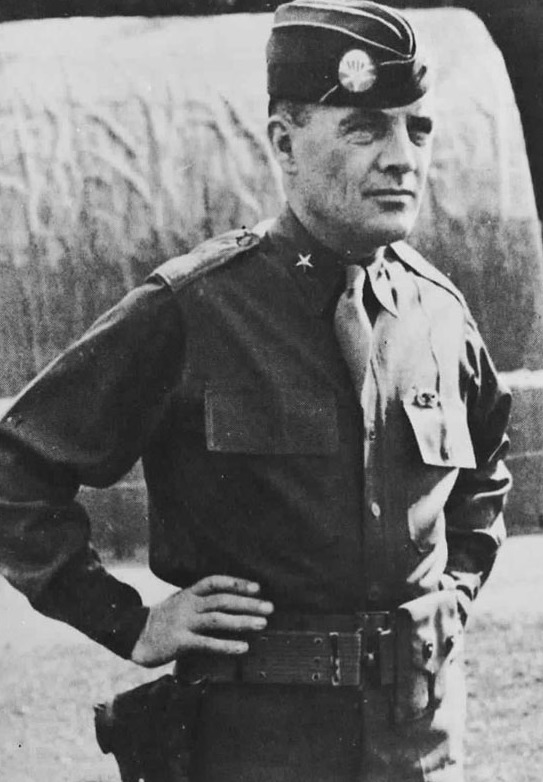
Brig. Gen. Anthony McAuliffe
Brig. Gen. Anthony McAuliffe Brig. Gen. Anthony McAuliffe, acting commander of the 101st Airborne, who answered the German surrender demand of 22 December with "Nuts!" U.S. Army · public domain · source
Mardasson Memorial
Mardasson Memorial The Mardasson Memorial (1946–50), built to honor the American soldiers of the Battle of the Bulge. Marc Ryckaert · CC BY 3.0 · source

★ Medal of Honor 1 recipient found so far (list may be incomplete)

Links go to the official records: the Congressional Medal of Honor Society and, where they exist, the service's own pages.

Free for everyone every year on its anniversary: December 19–27.

Accuracy score: 64/100 (moderate)

How the accuracy score works

Sources and method

Siege of Bastogne, 19-27 December 1944. The course of the fighting, unit designations, times and figures follow the U.S. Army's official history, Hugh M. Cole, The Ardennes: Battle of the Bulge (U.S. Army in World War II, Office of the Chief of Military History, 1965), HyperWar edition and CMH contents; chapter XIX, 'The Battle of Bastogne', was read in the Sons of Liberty Museum transcription. S. L. A. Marshall's Bastogne: The First Eight Days (Infantry Journal Press, 1946; CMH reprint) is the classic combat-interview account (GPO edition). The Christmas Day attack follows 'Close Call near Bastogne' (HistoryNet); the relief follows the historical overview of the Fire and Fury 'Assenois' scenario (after Cole and the 4th Armored Division history) and Veterans of the Battle of the Bulge, 'Assenois'. Airlift figures: U.S. Army, 'Air Borne to the Airborne'; drop zone: Europe Remembers, 'The dropping zone'. Medal of Honor: National WWII Museum, 'James Hendrix's Medal of Honor'. Village positions and local detail: the Historical Route Bastogne boards as recorded by TracesOfWar (Noville, Neffe, Marvie, Rue du Fortin, Assenois, Senonchamps, Champs, Longchamps, Hemroulle, Bastogne Barracks). Places marked 'approx.' are placed from published distances and directions and are approximate; unit traces are interpretive at battalion, team and regiment scale. Images from Wikimedia Commons.

Where the positions come from

Further reading