Battlefield Atlas
World War II · 1942 Members · from $3

Guadalcanal: Mount Austen and the Gifu, 1942-43

Lieutenant John George, a champion Illinois long-range rifle shot, fought on Guadalcanal with the 2nd Battalion, 132nd Infantry, Americal Division, reportedly carrying his own scoped Winchester Model 70. This map follows his regiment from its landing on 8 December 1942 through the struggle for Mount Austen, the jungle-covered ridge south-west of Henderson Field, where a horseshoe of Japanese log pillboxes called the Gifu held out between Hills 31 and 27. The 132nd's 2nd Battalion seized Hill 27 by a long flanking march on 2 January 1943; the 25th Division's 35th Infantry surrounded and destroyed the Gifu by 23 January; and George's battalion joined the final linkup at Tenaro on 9 February, when the island was declared secure.

Open the interactive map7 stages on modern satellite imagery and terrain, with 3D elevation

This battle opens with Battlefield Enjoyer ($3 a month on Patreon), which unlocks every battle in the atlas and every one added later. Free battles include Yorktown, Waterloo, The Alamo, Antietam, Little Bighorn, Belleau Wood, Omaha Beach, Ia Drang.

The Americal Division lands
The Americal Division lands — U.S. Army - public domain

The battle, stage by stage

  1. 8 December 1942

    The Army arrives

    The 132nd Infantry of the Americal Division - an Illinois National Guard regiment - comes ashore at Kukum and Lunga Point, joining the force relieving the 1st Marine Division, which has held the perimeter around Henderson Field since August. Second Lieutenant John George, a former Illinois state 1,000-yard rifle champion, comes with it, reportedly with his own scoped Winchester Model 70 deer rifle in .30-06. His 2nd Battalion first holds positions near Lunga Point. Inland, Japanese naval observers on Mount Austen, about six miles south-west of the airfield, have watched the field and its shipping since September; Colonel Oka's men are digging in on its western slopes.

  2. 17-26 December 1942

    Up Wright Road

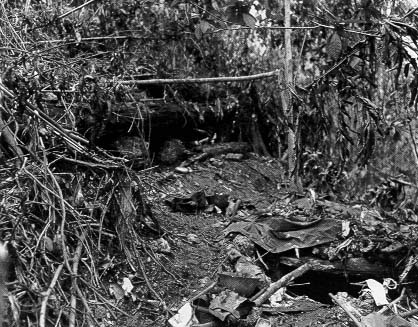
    Ordered to take Mount Austen, the 3rd Battalion climbs the new jeep track to its end at Hill 35 on 18 December; next morning its commander, Lieutenant Colonel William C. Wright, is killed by machine-gun fire and the road is named for him. The Japanese observers have slipped away from the summit toward a strongpoint the Americans will call the Gifu, after the Japanese prefecture many of its defenders come from: a horseshoe of some 45-50 coconut-log pillboxes, roofed three logs thick and covered with earth, between Hill 31 and Hill 27. The 3rd Battalion reaches Hill 31 on 24 December and is stopped cold; the 1st Battalion takes the open knolls of Hills 20, 29 and 30. Christmas attacks toward Hill 27 fail.

  3. 1-3 January 1943

    Ferry's march to Hill 27

    With the frontal attacks stalled, Lieutenant Colonel George F. Ferry's 2nd Battalion - John George's battalion - marches up Wright Road to Hill 11, then on 1 January sets off on a wide hook through the jungle to the south: less than a mile as the crow flies, but about 6,000 yards on foot. Behind an artillery barrage, its leading men reach the bare crest of Hill 27 at 09:07 on 2 January without firing a shot; by 11:30 the whole battalion is on top. Then the Japanese react: six counterattacks that afternoon, and by Miller's count 8 killed and 70 wounded in the first 40 minutes of digging in. The battalion holds, and Mount Austen now lies inside American lines.

  4. January 1943 (place and dates approximate)

    The rifleman's war

    This is the war John George described in Shots Fired in Anger: jungle so thick that most fights happen well inside 100 yards, heat shimmer in the scope, and Japanese marksmen who are patient, well hidden and nearly smokeless. Whenever he can, George volunteers to snipe, usually with a spotter on binoculars, hunting the enemy riflemen with his Model 70. On at least one occasion a Japanese bullet passes so close to his head that its crack damages his hearing. Popular retellings say he killed 11 snipers in four days while men laughed at his 'toy rifle'; those figures are not confirmed here. The positions shown - George on the western slope of Hill 27, a sniper in the jungle edge about 150 m away - are illustrative only.

  5. 9-18 January 1943

    Surrounding the Gifu

    Its strength worn down - about 112 killed in 22 days on the mountain, by Miller's count - the 132nd is relieved by the 2nd Battalion, 35th Infantry, 25th Division, under Major Stanley R. Larsen. Attacks from 10 January make little headway against the pillboxes. On 15 January loudspeakers broadcast an appeal to surrender; there is no real response (by one account a handful come out). Larsen chooses to surround the position, and by 18 January the ring is closed and the weak western side is under attack.

  6. 22-23 January 1943

    One tank, one last charge

    A single Marine light tank, the only one of three to survive the trail, goes in on 22 January covered by 16-18 riflemen. It knocks out three pillboxes, crosses the position and destroys more, opening a gap about 200 yards wide. At about 02:30 on 23 January Major Takeyoshi Inagaki leads most of the remaining defenders in a final charge; he and, by Pacific Wrecks' account, the last 85 Japanese are killed and buried in a mass grave on Hill 31. By the end of the day the Gifu is clear.

  7. 1-9 February 1943

    Verahue to Tenaro

    George's 2nd Battalion has one more job. On 1 February it lands unopposed at Verahue on the south-west coast with Colonel Alexander M. George's force, about 1,500 men, and pushes north round the end of the island while the 161st Infantry comes west along the north coast. They meet at Tenaro on 9 February: the Japanese have already evacuated about 10,000 men by night, and the island is declared secure. The fighting ashore has cost about 1,600 American soldiers and Marines killed; the Japanese have lost more than 20,000. John George goes on to Merrill's Marauders in Burma.

Weapons

Winchester Model 70

Winchester Model 70

Bolt-action sporting rifle · 1936–present (pre-1964 pattern)

DOPE HISTORY — A deer rifle on Guadalcanal: John George, a pre-war rifle champion, reportedly brought his own scoped Winchester Model 70 in .30-06 to the island. In the jungle around the Gifu he hunted Japanese snipers with it, working with a spotter and binoculars; the claim of eleven snipers in four days is unconfirmed.

Winchester's premium bolt-action hunting rifle, introduced in 1936 and later nicknamed "the Rifleman's Rifle". Its fine trigger and stiff action made it a favourite of target shooters; some were taken to war privately or bought for snipers in the Second World War and Korea.

Calibre
.30-06 among many
Magazine
5-round internal box
Effective range
600 yd and beyond with a scope
Photo: Alaska Senate Majority · CC BY-SA 2.0

Japanese

Type 96 light machine gun

Type 96 light machine gun

Light machine gun · 1936–1945

At Guadalcanal: Mount Austen: The Gifu's 45–50 log pillboxes were sited for interlocking fire from light machine guns, which stopped attack after attack.

The Type 96 was a standard Japanese squad light machine gun of World War II, alongside its 7.7 mm successor, the Type 99. Its curved box magazine fed from the top, and it could even mount a bayonet.

Calibre
6.5×50mm Arisaka
Rate of fire
about 550 rounds/min
Magazine
30-round top-mounted box
Weight
about 9 kg
Photo: BrokenSphere · CC BY-SA 3.0
Type 89 grenade discharger

Type 89 grenade discharger

Light mortar / grenade discharger · 1929–1945

At Guadalcanal: Mount Austen: The "knee mortar" grenade dischargers lobbed grenades onto American troops in the ravines below the pillboxes.

Nicknamed the "knee mortar" by Americans because of its curved base plate, the Type 89 was a light, accurate weapon carried at squad level. Firing it braced against the thigh could cause serious injury; it was meant to be set on the ground.

Calibre
50 mm
Range
up to about 670 m
Weight
about 4.7 kg
Photo: Public domain · Wikimedia Commons

US Army

M1903 Springfield

M1903 Springfield

Bolt-action rifle · 1903–1936 as standard rifle (sniper use into the Vietnam era)

At Guadalcanal: Mount Austen: The 132nd Infantry fought with bolt-action Springfields; the M1 Garand was only beginning to reach Army units on the island.

Based closely on the Mauser action, the Springfield M1903 was the US service rifle from the early 1900s through the 1930s. Its fine adjustable rear sight made it well suited to the precise marksmanship the Marine Corps emphasized in training.

Calibre
.30-06 Springfield
Action
Bolt, 5-round internal magazine
Weight
about 3.9 kg (8.7 lb)
Photo: Curiosandrelics · CC BY-SA 3.0
Winchester Model 70

Winchester Model 70

Bolt-action sporting rifle · 1936–present (pre-1964 pattern)

At Guadalcanal: Mount Austen: George's privately owned scoped rifle was far from standard issue.

Winchester's premium bolt-action hunting rifle, introduced in 1936 and later nicknamed "the Rifleman's Rifle". Its fine trigger and stiff action made it a favourite of target shooters; some were taken to war privately or bought for snipers in the Second World War and Korea.

Calibre
.30-06 among many
Magazine
5-round internal box
Effective range
600 yd and beyond with a scope
Photo: Alaska Senate Majority · CC BY-SA 2.0

Paintings and photographs

The Americal Division lands
The Americal Division lands Americal Division troops come ashore at Lunga, from the Army's official history. U.S. Army - public domain · source
A Japanese bunker in the Gifu
A Japanese bunker in the Gifu One of the log-and-earth pillboxes of the Gifu strongpoint, from the Army's official history. U.S. Army - public domain · source
Maj. Gen. Alexander Patch
Maj. Gen. Alexander Patch Major General Alexander M. Patch, commander of the Americal Division and later of XIV Corps on Guadalcanal. U.S. Army - public domain · source

Sources and method

Guadalcanal: Mount Austen and the Gifu, December 1942 - February 1943. Units and dates follow John Miller Jr., Guadalcanal: The First Offensive (U.S. Army in World War II, 1949), chapters X, XIII and XIV and its Mount Austen map; the Pacific Wrecks site histories of Mount Austen, the Gifu, Hill 27, Hill 35, Barana, Verahue and Tenaro; the Wikipedia article on the Battle of Mount Austen, the Galloping Horse, and the Sea Horse; and John B. George, Shots Fired in Anger (1947; NRA 1981). Fixed points: Barana village (Pacific Wrecks coordinates), Henderson Field (modern airport), Verahue invasion beach (TracesOfWar), Cape Esperance (Pacific Wrecks). Hill positions around the Gifu are placed from Miller's distances and directions relative to Barana and are approximate to a few hundred metres. John George's sniping position is illustrative: his book does not tie it to a mapped point. The '11 snipers in 4 days' figure comes from an online video and is unconfirmed. Images from Wikimedia Commons.

Where the positions come from

Approximate locations