Battlefield Atlas
World War II · 1943 Locked

Battle of Tarawa (Betio), 20–23 November 1943

From 20 to 23 November 1943 the 2nd Marine Division under Maj. Gen. Julian C. Smith stormed Betio, the fortified islet at the southwest corner of Tarawa Atoll in the Gilbert Islands, in the first American amphibious assault of the Pacific War against a strongly defended coral atoll. A neap tide left too little water over the fringing reef for loaded landing boats, so only the first waves, in amphibian tractors, reached the Red Beaches on the lagoon shore; the rest waded hundreds of yards under fire. Col. David M. Shoup's men clung to a narrow strip behind the seawall on the first day, seized Green Beach and cut the island in two on the second, and broke the last organized resistance after Japanese night counterattacks on the third. In 76 hours almost all of Rear Adm. Keiji Shibasaki's garrison of about 4,800 Japanese naval troops, construction troops and Korean laborers was killed; 146 men were captured. The 2nd Marine Division lost about 1,000 Marines and sailors killed and about 2,300 wounded. Four Marines received the Medal of Honor: Shoup, 1st Lt. William D. Hawkins, 1st Lt. Alexander Bonnyman Jr. and SSgt. William J. Bordelon, the last three posthumously. The losses shocked the American public, and the lessons learned, above all the need for more amphibian tractors, better reef reconnaissance and heavier, more accurate preliminary fire, shaped every later landing in the Central Pacific.

Open the interactive map7 stages on modern satellite imagery and terrain, with 3D elevation

This battle opens with Battlefield Explorer ($4.99 a month or $39 a year), which unlocks every battle in the atlas and every one added later. Lifetime access and war packs are one-time options. Free battles include Thermopylae, Actium, Hattin, Agincourt, Vítkov Hill, Bosworth, Fort William Henry, Yorktown, Waterloo, The Alamo, Antietam, Little Bighorn, Belleau Wood, Omaha Beach, Inchon, Ia Drang, 73 Easting, Wanat, Baghdad Thunder Runs, Battle of Raqqa, Battle of Kyiv, Battle of Hostomel Airport, Siege of Mariupol, Kharkiv counteroffensive, Kherson counteroffensive, Bakhmut, Avdiivka.

Betio from the air, 24 November 1943
Betio from the air, 24 November 1943 — U.S. Navy, public domain

The battle, stage by stage

  1. 20 Nov 1943, about 05:00–09:00

    Bombardment and the reef

    Betio, the largest islet of Tarawa Atoll, is about two miles long and no more than 800 yards wide, with an airfield down its middle. Rear Adm. Keiji Shibasaki's garrison, about 4,800 men by the Marine Corps' estimate (the 3rd Special Base Force, the Sasebo 7th Special Naval Landing Force, and construction troops and Korean laborers), holds roughly 500 pillboxes, blockhouses and emplacements, including four 8-inch Vickers coast-defense guns sold to Japan in 1905 (not, as legend had it, captured at Singapore). A gun duel opens before dawn, then hours of naval gunfire and air strikes. The minesweeper Pursuit, as control ship, and the destroyers Ringgold and Dashiell enter the lagoon. Everything depends on the tide: a loaded Higgins boat needs about four feet of water over the fringing reef, and a neap tide gives less. Only the amphibian tractors (LVTs) of the first three waves, carrying LT 3/2, LT 2/2 and LT 2/8, can be counted on to crawl over the reef; they cross the line of departure, 6,000 yards out, at 08:24. H-hour slips from 08:30 to 09:00, and a cease-fire at 08:54 gives the defenders time to man their positions. Just before H-hour 1st Lt. William D. Hawkins' scout-snipers storm the end of the long pier. (The approach arrow is interpretive.)

  2. 20 Nov, 09:10–about 15:00

    Red Beaches 1, 2 and 3

    The LVTs touch down on Red 1 at about 09:10, Red 3 at 09:17 and Red 2 at 09:22, against fire that the bombardment has not suppressed. On Red 1 most of Maj. John F. Schoettel's LT 3/2 is shredded near the re-entrant, a cove whose strongpoints enfilade the beaches on both sides; Maj. Michael P. Ryan gathers survivors at the island's western tip and pushes about 500 yards down the west shore. On Red 2 Lt. Col. Herbert R. Amey Jr. is killed wading in and Lt. Col. Walter I. Jordan takes over LT 2/2's scattered survivors. On Red 3 Maj. Henry P. 'Jim' Crowe's LT 2/8, beside the pier, gets the best start, with modest penetration toward the airfield by 09:45. Behind the tractors, later waves in Higgins boats ground on the reef and must wade 500 to 1,000 yards under fire; Maj. Robert H. Ruud's LT 3/8 loses most of two companies trying to reach Red 3. SSgt. William J. Bordelon, of an assault engineer platoon of the 1st Battalion, 18th Marines, attached to the 2nd Marines, destroys several positions before he is killed; he is awarded the Medal of Honor posthumously.

  3. 20 Nov, noon to nightfall

    Shoup's command post and the seawall

    Col. David M. Shoup, commanding the assault, wades in and at about noon sets up his command post some 50 yards inland from the pier, on the blind side of a Japanese bunker that is still occupied. Most of the Marines ashore are pinned behind a log seawall about four to five feet high; the few tanks that get ashore and the men who climb over the wall in small groups make the only gains. Maj. Wood B. Kyle's LT 1/2 lands on Red 2 piecemeal through the afternoon, many of its men not ashore until the next morning, and Ruud's survivors join Crowe on Red 3; Schoettel comes ashore at sunset. By nightfall about 5,000 Marines have landed and roughly 1,500 are dead, wounded or missing, holding less than a quarter of a square mile. LT 1/8 spends the night in its boats at the line of departure. The expected Japanese night counterattack never comes; Shibasaki's communications have been wrecked. By one account he and his staff were killed that afternoon by a destroyer's shellfire; Alexander has his last message to Tokyo going out early on 22 November.

  4. 21 Nov (D+1)

    Green Beach and the south shore

    At dawn Hays' LT 1/8 wades in from the reef to Red 2 under crossfire from the re-entrant strongpoints and from snipers in hulks offshore, losing more than 300 men before reaching Shoup. Kyle's and Jordan's battalions, down to small parties, cross the airfield and seize a strip of the south shore, cutting the island in two. On the west end Ryan, with a repaired Sherman and naval gunfire called in by his attached naval officer, attacks at 11:20 and holds all of Green Beach within about an hour — the first beach where reinforcements can land dry. Hawkins is mortally wounded attacking pillboxes and is awarded the Medal of Honor posthumously; the airfield is later named for him. Lt. Col. Raymond L. Murray's LT 2/6 lands on Bairiki, the next islet east, at 16:55, and Maj. William K. Jones's LT 1/6 paddles ashore on Green Beach in rubber rafts after dark. Col. Merritt A. Edson comes ashore to take command at about 20:30. Smith later summed up the first two days: 'we were losing until we won.'

  5. 22 Nov (D+2)

    The bombproof and the drive east

    At 08:00 Jones's LT 1/6, with two Shermans borrowed from Ryan, attacks east along the south shore, joins Kyle's and Jordan's lines within about three hours and gains some 800 yards by noon and about half that again in the afternoon. In the north, Hays attacks west against the re-entrant strongpoints with little gain. On the left of Red 3, Crowe's and Ruud's battalions take the coconut-log emplacement and the steel pillbox (the Sherman 'Colorado' breaches it), and 1st Lt. Alexander Bonnyman Jr., executive officer of the 2/8 shore party, leads engineers onto the top of the great sand-covered bombproof, driving its occupants into the open; he is killed there and is awarded the Medal of Honor posthumously. Lt. Col. Kenneth F. McLeod's LT 3/6 lands on Green Beach, and 2/10's pack howitzers fire from Bairiki. By evening about 7,000 Marines are ashore against perhaps 1,000 defenders.

  6. 22–23 Nov, 19:30 to dawn

    The night counterattacks

    Facing destruction in their bunkers, the surviving defenders attack. At 19:30 about 50 Japanese infiltrate south of the airstrip; 1/6's reserve under 1st Lt. Lyle Specht kills them in two hours of close fighting. At 23:00 one group makes a noisy feint against Jones's Company A while another rushes Company B in silence; both are thrown back. At 03:00 Japanese machine guns open from wrecked trucks in front of the lines and are knocked out with grenades. At 04:00 about 300 men charge the same two companies, met by artillery on Red 2 and Bairiki and by the destroyers Schroeder and Sigsbee, which fire on the flanks of Jones's line until they have emptied their magazines of 5-inch shells. At first light the Marines count 200 dead within 50 yards of their lines and 125 more beyond; 1/6 has lost 40 killed and 100 wounded. Alexander judges that Jones's advance on D+2 and the repulse of the night counterattacks helped break the back of Japanese resistance.

  7. 23 Nov (D+3), to 13:05

    Betio secured

    McLeod's fresh LT 3/6 passes through Jones's lines and drives down the narrow tail of the island behind tanks, engineers and flamethrowers, bypassing one bunker complex on the north shore that a rifle company later overruns; it reaches the eastern tip by 13:00, killing more than 450 Japanese for 34 Marines lost. In the west, Hays's 1/8 from the east and Schoettel's 3/2 from the west and south close on the re-entrant strongpoints, while Shoup sends an infantry platoon and two 75 mm half-tracks out onto the reef to fire into them from the lagoon; by 13:00 'it was all over.' Rear Adm. Harry W. Hill comes ashore at 12:45, and at 13:05 he and Maj. Gen. Julian C. Smith report the end of organized resistance, about 76 hours after the first landing. Of roughly 4,800 defenders, 146 are taken prisoner, all but 17 of them Korean laborers. Murray's 2/6 goes on to clear the rest of the atoll by 28 November.

Forces

About 4,800 Japanese naval troops, construction troops and Korean laborers held Betio; about 5,000 Marines landed on the first day and about 7,000 were ashore by the evening of the third. Japanese totals come from the Marine Corps' own estimate and are fairly firm; the breakdown by unit rests on secondary accounts.

Imperial Japanese Navy garrison (3rd Special Base Force, Sasebo 7th Special Naval Landing Force)

Present on Betio, 20 NovemberAlexander gives an estimated 4,856 men on D-Day (4,836 elsewhere): the 3rd Special Base Force (formerly the 6th Yokosuka SNLF), the 7th Sasebo SNLF with 200 men of the Tateyama Naval Gunnery School, the 111th Pioneers and the 4th Construction Unit; the pre-battle U.S. estimate was 4,800, about 2,600 of them first-rate naval troops. Alexander, Across the Reef (1993), Project Gutenberg textabout 4,800 (4,836–4,856)
Defenders left on the evening of 22 NovemberAlexander's estimate of the defenders still fighting when about 7,000 Marines were ashore. Alexander, Across the Reef (1993), 'The Third Day'perhaps 1,000

2nd Marine Division (Julian C. Smith)

Landed on D-DayAbout 5,000 Marines reached Betio on 20 November (Alexander). Alexander, Across the Reef (1993), USMC University PDFabout 5,000
Ashore by the evening of 22 NovemberAlexander: about 7,000 Marines ashore at 19:30 on D+2. Alexander, Across the Reef (1993), 'The Third Day'about 7,000
Medium tanksOnly two were operational at the end of D-Day; four M3 light tanks were lost when their LCMs were sunk (Alexander). Alexander, Across the Reef (1993), Project Gutenberg text14 M4 Shermans

Casualties

In 76 hours nearly 6,000 Japanese, Koreans and Americans died on an island of about 1.5 square kilometers. Almost the whole garrison was killed and 146 men were captured; the 2nd Marine Division lost about 1,000 killed and about 2,300 wounded, with small differences between the official counts. Certainty: good.

Imperial Japanese Navy garrison (3rd Special Base Force, Sasebo 7th Special Naval Landing Force)

KilledNHHC gives 4,690 killed; Alexander puts the dead at about 97 percent of the 4,836 men estimated on Betio, including Japanese construction troops and Korean laborers. Naval History and Heritage Command, 'Tarawa: Breaking into the Gilberts'; Alexander, Across the Reef (1993), 'Completing the Task'about 4,690
Captured17 Japanese (only one officer, Special Duty Ensign Kiyoshi Ota of the 7th Sasebo Special Naval Landing Force) and 129 Korean laborers (Alexander; NHHC gives 17 soldiers and 129 laborers). Alexander, Across the Reef (1993), 'Completing the Task'; Naval History and Heritage Command, 'Tarawa: Breaking into the Gilberts'146
Killed in the night counterattacks of 22–23 NovemberAt first light 1/6 counted 200 dead within 50 yards of its lines and 125 more farther out (Alexander). Alexander, Across the Reef (1993), 'The Third Day'about 325 counted

2nd Marine Division (Julian C. Smith)

KilledAlexander lists 997 Marines and 30 Navy medical personnel dead plus 88 Marines missing and presumed dead for Operation Galvanic; NHHC gives 1,009 Marines killed. Alexander, Across the Reef (1993), epilogue; Naval History and Heritage Command, 'Tarawa: Breaking into the Gilberts'about 1,000–1,100 (1,009–1,115)
WoundedAlexander gives 2,233 Marines and 59 sailors wounded (3,407 casualties in all for the division); NHHC gives 2,101 Marines wounded. Alexander, Across the Reef (1993), epilogue; Naval History and Heritage Command, 'Tarawa: Breaking into the Gilberts'about 2,100–2,300 (2,101–2,292)
Casualties by nightfall on D-DayOf about 5,000 Marines landed on 20 November, roughly 1,500 were dead, wounded or missing by nightfall (Alexander). Alexander, Across the Reef (1993), USMC University PDFabout 1,500
Navy losses in the wider operationNot part of the Betio fighting: the escort carrier Liscome Bay was torpedoed off Makin on 24 November (Alexander gives 644 lost; NHHC 646 Navy dead in the operation). Naval History and Heritage Command, 'Tarawa: Breaking into the Gilberts'644–646 killed, mostly in Liscome Bay

Equipment and ships

Amphibian tractors (LVTs) lostThe 2nd Amphibian Tractor Battalion lost over half its men and all but 35 of the 125 LVTs it employed (Alexander). Alexander, Across the Reef (1993), epilogue90 of 125
Medium tanks (M4 Sherman) operational at the end of D-DayOf 14 Shermans landed or attempted, only two were operational at the end of the first day; all four LCMs carrying light tanks were sunk before reaching the reef (Alexander). Alexander, Across the Reef (1993), Project Gutenberg text2 of 14

Then and now: how the ground has changed

Betio is no longer an open, palm-covered airfield island: it is Kiribati's main port and one of the most densely populated places in the Pacific, joined to Bairiki by a causeway, with new port land built out into the lagoon north of the old Red Beach 3. The airfield has gone under roads and housing, but Shibasaki's command bunker, the 8-inch gun emplacements and wrecks on the reef survive, and the shoreline has shifted with erosion and accretion.

The interactive map can show the period landscape (2 shapes: Modern port reclamation north of the 1943 Red Beach 3 shore (approximate), Betio–Bairiki causeway (built early 1980s; route approximate)) under the units. Open the map.

Weapons

Imperial Japanese Navy garrison (3rd Special Base Force, Sasebo 7th Special Naval Landing Force)

Type 92 heavy machine gun

Type 92 heavy machine gun

Heavy machine gun · 1932–1945

At Tarawa: Japanese heavy machine guns fired from pillboxes along the seawall and, on the last night, from wrecked trucks in front of 1/6's lines.

The Type 92 was Japan's standard heavy machine gun in World War II, derived from the Hotchkiss design. Its slow, steady rate of fire earned it the nickname "Woodpecker" from American troops.

Caliber
7.7×58mm SR
Rate of fire
about 450 rounds/min
Feed
30-round strips
Weight
about 55 kg with tripod
Photo: Gary Todd · CC0
Type 96 light machine gun

Type 96 light machine gun

Light machine gun · 1936–1945

At Tarawa: Light machine guns covered the reef and the beaches from the re-entrant, the pier and the Burns-Philp strongpoints.

The Type 96 was a standard Japanese squad light machine gun of World War II, alongside its 7.7 mm successor, the Type 99. Its curved box magazine fed from the top, and it could even mount a bayonet.

Caliber
6.5×50mm Arisaka
Rate of fire
about 550 rounds/min
Magazine
30-round top-mounted box
Weight
about 9 kg
Photo: BrokenSphere · CC BY-SA 3.0
Type 89 grenade discharger

Type 89 grenade discharger

Light mortar / grenade discharger · 1929–1945

At Tarawa: Grenade dischargers added to the fire on Marines pinned behind the seawall.

Nicknamed the "knee mortar" by Americans because of its curved base plate, the Type 89 was a light, accurate weapon carried at squad level. Firing it braced against the thigh could cause serious injury; it was meant to be set on the ground.

Caliber
50 mm
Range
up to about 670 m
Weight
about 4.7 kg
Photo: Public domain · Wikimedia Commons

2nd Marine Division (Julian C. Smith)

M1 Garand

M1 Garand

Semi-automatic rifle · 1936–1958 (US standard rifle)

At Tarawa: Standard rifle of the 2nd Marine Division's riflemen.

The M1 Garand was the first semi-automatic rifle adopted as a nation's standard infantry weapon. It gave the American rifleman much more firepower than a bolt-action rifle, and General George Patton called it "the greatest battle implement ever devised."

Caliber
.30-06 Springfield
Effective range
about 460 m (500 yd)
Feed
8-round en-bloc clip
Photo: Armémuseum (Swedish Army Museum) · Public domain
M1918 Browning Automatic Rifle (BAR)

M1918 Browning Automatic Rifle (BAR)

Automatic rifle · 1918–1960s

At Tarawa: The automatic rifle carried by every Marine fire team that reached the beaches.

John Browning's BAR first reached the front in September 1918 and became the automatic weapon at the heart of the US rifle squad in World War II. The M1918A2 version added a bipod and a two-speed rate of fire.

Caliber
.30-06 Springfield
Magazine
20-round box
Rate of fire
M1918A2: selectable slow/fast, roughly 300–650 rounds/min
Weight
about 8.8 kg (M1918A2)
Photo: Public domain · Wikimedia Commons
M2 flamethrower

M2 flamethrower

Man-portable flamethrower · 1943–1950s

At Tarawa: Flamethrowers, with demolitions, were the main tools for reducing pillboxes and the bombproof; Hays's battalion lost all of its own when it landed on D+1.

The backpack M2 flamethrower projected thickened fuel at bunkers, caves and pillboxes. It was the US Marines' key tool for clearing Japanese fortifications in the Pacific, though its operators were prime targets.

Fuel capacity
about 4 US gal (15 L)
Range
about 20–40 m
Burn time
roughly 7–9 seconds of fire
Photo: U.S. Army · Public domain
M4 Sherman

M4 Sherman

Medium tank · 1942–1950s (US service)

At Tarawa: Of 14 Shermans, two were operational after D-Day; 'Cecilia' backed Ryan's attack on Green Beach and 'Colorado' breached the steel pillbox near the Burns-Philp wharf.

The Sherman was the most widely used American tank of World War II, valued for its reliability and ease of production. Specialized versions included the Duplex Drive (DD) amphibious tank and flamethrower conversions.

Crew
5
Armament
75 mm gun M3 (most early versions)
Weight
about 30 metric tons
Photo: Public domain · Wikimedia Commons
M3 75 mm Gun Motor Carriage

M3 75 mm Gun Motor Carriage

Tank destroyer (half-track) · 1941–1944

At Tarawa: Two 75 mm half-tracks fired into the re-entrant strongpoints from the reef on the last morning.

A First World War-pattern 75 mm field gun mounted on a half-track, used as a stopgap tank destroyer. Tank destroyer battalions with M3 GMCs fought at Sidi Bou Zid and Kasserine; the thin armor left crews exposed.

Crew
5
Armament
75 mm M1897 gun
Base
M3 half-track
Photo: Office of War Information · Public domain

Paintings and photographs

Betio from the air, 24 November 1943
Betio from the air, 24 November 1943 Betio photographed from a Navy SBD Dauntless the day after the island was secured. U.S. Navy, public domain · source
Marines wade ashore
Marines wade ashore Marines wading ashore under fire after their boats grounded on the reef, 20 November 1943. USMC Archives (Julian C. Smith Collection), CC BY 2.0 · source
Marines on Red Beach 3
Marines on Red Beach 3 2nd Marine Division men advancing along Red Beach 3 toward the Burns-Philp pier. USMC Archives (Julian C. Smith Collection), CC BY 2.0 · source
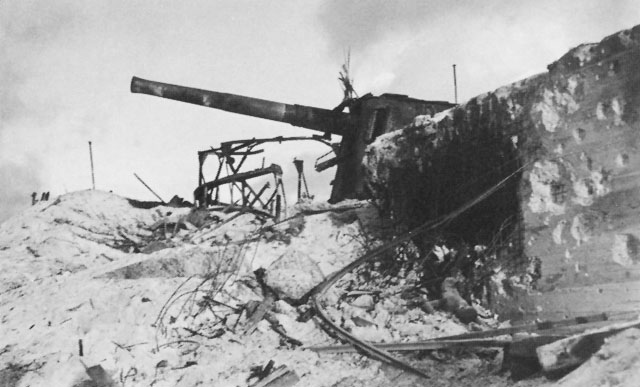
Wrecked 8-inch gun
Wrecked 8-inch gun One of Betio's four Japanese 8-inch Vickers guns, wrecked by naval gunfire and air strikes. U.S. Navy, public domain · source

★ Medal of Honor 4 recipients

Links go to the official records: the Congressional Medal of Honor Society and, where they exist, the service's own pages.

Free for everyone every year on its anniversary: November 20–23.

Accuracy score: 68/100 (moderate)

How the accuracy score works

Sources and method

Battle of Tarawa (Betio), 20–23 November 1943. Col. Joseph H. Alexander, Across the Reef: The Marine Assault of Tarawa (Marines in World War II Commemorative Series, USMC History and Museums Division, 1993; USMC University PDF, Project Gutenberg text, and the NPS-hosted sections 'The Third Day', 'Completing the Task' and epilogue): garrison and defenses, beach lengths, the reef and tide, H-hour and touchdown times, battalion commanders and beaches, Shoup's command post, the 22–23 November counterattacks, the end of resistance at 13:05 and the casualty figures (997 Marines and 30 sailors killed, 88 missing presumed dead, 2,233 Marines and 59 sailors wounded). Capt. James R. Stockman, The Battle for Tarawa (USMC Historical Section, 1947), 'The Third Day' on HyperWar. Naval History and Heritage Command, 'Tarawa: Breaking into the Gilberts' (1,009 Marines killed and 2,101 wounded; 4,690 Japanese killed; 17 soldiers and 129 laborers captured). Medal of Honor summaries from the USMC History Division: Shoup, Hawkins, Bonnyman, Bordelon. Dirk H. R. Spennemann, '8-inch Coastal Defense Guns' (battery lay-outs on Betio). Fixed points: the airfield center from the Wikipedia article on Hawkins Field, and the Japanese command bunker, the lagoon ferry pier and the 1988 Marine memorial from Plizio place records; the coastline is fitted to modern map data (Mapbox Streets water), leaving out the post-war port fill and causeway; the beaches, pier, wharf, batteries and unit positions are reconstructed from the distances in the monographs and are approximate (about 100–200 m; ship stations and the Bairiki positions are interpretive). No U.S. Army staff ride handbook covers Tarawa.

Where the positions come from

Further reading