Battlefield Atlas
World War II · 1943 Members

Prokhorovka, 10-12 July 1943

Prokhorovka, on 12 July 1943, was the climax of the German Operation Citadel on the southern face of the Kursk salient. Hausser's II SS Panzer Corps (Leibstandarte, Das Reich and Totenkopf), which had driven some 30 km into the Soviet defenses, turned toward the railway station of Prokhorovka. On 11 July it took the anti-tank ditch, Hill 252.2 and the Oktyabrsky state farm. Next morning Rotmistrov's 5th Guards Tank Army counterattacked, with the 5th Guards Army's rifle divisions. Its 18th and 29th Tank Corps charged down the narrow corridor between the Psel river and the railway embankment. They lost very heavily to German tanks and anti-tank guns, and in their own anti-tank ditch. North of the river, Totenkopf attacked out of its bridgehead from Hill 226.6. Neither side reached its objective. Soviet histories long called it the greatest tank battle in history, claiming some 1,500 tanks and 400 German tanks destroyed. Modern archival research (Zamulin, Frieser, Nipe) shows German losses were small: a few tanks written off and several dozen damaged. Soviet tank losses were heavy, about 340 tanks and self-propelled guns by Zamulin's count. Even so, the German drive on Prokhorovka was halted, and Citadel was called off the next day.

Open the interactive map7 stages on modern satellite imagery and terrain, with 3D elevation

This battle opens with Battlefield Explorer ($9.99 a month on Patreon), which unlocks every battle in the atlas and every one added later. Free battles include Thermopylae, Actium, Hattin, Agincourt, Vítkov Hill, Bosworth, Fort William Henry, Yorktown, Waterloo, The Alamo, Antietam, Little Bighorn, Belleau Wood, Omaha Beach, Inchon, Ia Drang, 73 Easting, Wanat, Baghdad Thunder Runs, Battle of Kyiv, Siege of Mariupol, Bakhmut, Avdiivka.

Tiger I during Operation Citadel
Tiger I during Operation Citadel — Bundesarchiv / Friedrich Zschäckel · CC BY-SA 3.0 de

The battle, stage by stage

  1. 10 July 1943

    Turning toward Prokhorovka

    Five days into Operation Citadel, the German offensive against the southern face of the Kursk salient, the II SS Panzer Corps under SS-Obergruppenfuehrer Paul Hausser turns north-east toward the railway station of Prokhorovka. Leibstandarte SS Adolf Hitler (LSSAH) attacks from the Teterevino area at about 10:45, overruns a battalion of the Soviet 183rd Rifle Division at the Komsomolets state farm and pushes toward Hill 241.6, where the 26th Tank Brigade counterattacks. On its left, Totenkopf's engineers bridge the Psel river and its panzergrenadiers cross into a bridgehead on the steep northern bank against the 52nd Guards Rifle Division, at a cost of some 430 casualties that day by one account; its ten Tigers cross that afternoon. Das Reich covers the right flank toward Ivanovsky Vyselok and Storozhevoe. That night the Soviet 5th Guards Army's divisions arrive to man the Prokhorovka line, and Lieutenant General Pavel Rotmistrov's 5th Guards Tank Army, which has marched some 300 km from the Steppe Front reserve, begins assembling north-east of the town.

  2. 11 July 1943

    The ditch and Hill 252.2

    At 08:50 the LSSAH crosses a deep Soviet anti-tank ditch at the foot of Hill 252.2, capturing the road bridge intact, and fights its way up against the 9th Guards Airborne Division and its artillery. By 14:10 the hill and the Oktyabrsky state farm beside it are in German hands, about 3 km from the edge of Prokhorovka. A probe toward the town by Joachim Peiper's half-track battalion with self-propelled guns is driven back to the hill by heavy Soviet fire by about 20:15 (Wheatley). North of the river Totenkopf widens its bridgehead and takes Hill 226.6; south of the railway the 183rd Rifle Division and the 2nd Tank Corps hold Das Reich near Storozhevoe. That evening Rotmistrov, reconnoitering west of Prokhorovka, sees German armor gathering. The positions on the map are drawn from distances in the sources; the farm, the ditch and the villages are approximate.

  3. Night of 11-12 July 1943

    Start lines

    Overnight the 5th Guards Tank Army moves to its start lines. The 18th Tank Corps (181st, 170th and 110th Tank Brigades, with Churchill heavy tanks) takes the strip between the Psel and the Oktyabrsky farm; the 29th Tank Corps (32nd, 31st and 25th Tank Brigades, 53rd Motorized Rifle Brigade and a self-propelled gun regiment) sits astride the railway embankment south-west of Prokhorovka; the 2nd Guards Tank Corps and 2nd Tank Corps face Das Reich to the south, with the 5th Guards Mechanized Corps in reserve. By the German records cited by Frieser, the LSSAH has 56 battle tanks (only four of them Tigers), 10 assault guns and 20 tank destroyers fit for action; it holds the hill and the farm, its 1st Panzergrenadier Regiment south of the embankment and its reconnaissance battalion screening a gap of several kilometers toward the river. Frieser counts more than 400 Soviet armored vehicles moving against the LSSAH, roughly five to one.

  4. 12 July 1943, 08:30-10:30

    Into the corridor

    After a short barrage from 08:00, Rotmistrov's attack goes in at about 08:30, without proper reconnaissance or air cover. The 32nd Tank Brigade drives down the corridor along the railway embankment and the 31st follows on the right of the road; German reports put the first Soviet tanks on Hill 252.2 at about 10:15. Coming over the crest at speed, they meet the LSSAH's Panzer IV company of Rudolf von Ribbentrop on the reverse slope and anti-tank guns firing at short range. East of the railway the 25th Tank Brigade crosses open ground near Yamki toward Storozhevoe; one of its battalions reportedly loses 26 of 32 T-34s within minutes. On the right, the 170th and 181st Tank Brigades strike toward the farm and the Psel valley. German dive bombers of the VIII Air Corps attack the Soviet columns throughout the day.

  5. 12 July 1943, 11:00-15:00

    The ditch fills

    Soviet tanks that crest the hill run into their own anti-tank ditch; the SS engineers had blown only one narrow passage, and many T-34s plunge in or mill about under fire. Around 100 wrecks are later counted on the slope of Hill 252.2 (Frieser). The 31st Tank Brigade breaks into the Oktyabrsky farm only around 13:00, and both 29th Tank Corps brigades are halted by early afternoon. Along the river the 18th Tank Corps pushes deepest, toward Andreyevka and Vasilyevka, until the 170th Tank Brigade has lost up to 60 percent of its tanks and the 181st is checked by the LSSAH's Tigers. Totenkopf attacks north-east from Hill 226.6 at 09:30 toward Veselyi and Hill 236.7, sending some armor back across the Psel at Mikhailovka; south of the railway the LSSAH takes the southern part of Storozhevoe and Das Reich fends off the 2nd Guards Tank Corps.

  6. 12 July 1943, evening

    Neither side breaks through

    Around 18:00 the 170th and 181st Tank Brigades break into the gap between the LSSAH and Totenkopf near the river and are thrown back. Rotmistrov commits part of his reserve, the 5th Guards Mechanized Corps. Totenkopf's panzer group fights its way to about 1 km north-west of Polezhaev by evening, short of the Kartashevka-Prokhorovka road, while Soviet brigades are sent after dark to block the road to Petrovka. The 32nd Tank Brigade has 12 T-34s left in line the next morning out of the 60 it started with (29th Tank Corps reports). The LSSAH still holds Hill 252.2 and the farm, and the Soviets still hold Prokhorovka. A Soviet General Staff study later concluded that 'on 12 July, the 5th Guards Tank Army failed to accomplish its assigned mission.' The German attack, too, has been stopped.

  7. 13-17 July 1943

    Aftermath and myth

    On 13 July Totenkopf is pushed back to Hill 226.6 and later leaves its bridgehead; an LSSAH attempt north of the Oktyabrsky farm that morning finds no weak spot. That day Hitler tells Manstein that Citadel is to be called off. In Operation Roland from 14 July, Das Reich pushes east toward Belenikhino to join the III Panzer Corps, before the sector is evacuated on 16-17 July. Soviet accounts long described 'the greatest tank battle in history', with some 1,500 tanks and more than 400 German tanks destroyed. Archival research (Zamulin, Frieser, Nipe, Wheatley) shows the II SS Panzer Corps lost very few tanks for good on 12 July: Frieser finds none written off in the German logistics files and at most three. By Zamulin's count, the 5th Guards Tank Army lost about 340 tanks and self-propelled guns damaged or destroyed, many of them repairable. Even so, the Soviet defense held. On 17 July the 5th Guards Tank Army still had 444 operational vehicles (Wheatley).

Forces

The 5th Guards Tank Army brought roughly two to three times as many tanks as the II SS Panzer Corps (about 800 against about 300). In the Psel corridor, Frieser counts more than 400 Soviet vehicles against the LSSAH, roughly five to one. Soviet histories claimed 1,200-1,500 tanks in all, a figure modern research has cut sharply.

German (II SS Panzer Corps)

Tanks and assault guns operational, evening 11 JulyZetterling and Frankson give 294, 15 of them Tigers; Frieser gives 211 battle tanks, 58 assault guns and 43 tank destroyers; Nipe gives 211 tanks, 117 of them south of the Psel. Zetterling & Frankson (2000), as cited in Wikipedia 'Battle of Prokhorovka'; Frieser et al., Germany and the Second World War, vol. VIII; G. Nipe, 'Prochorovka, 12 July 1943'294 (211-312)
Tigers fit for action in the Psel corridorFrieser and Nipe agree that only four LSSAH Tigers were in the corridor; Totenkopf's ten Tigers were north of the river. No Panthers took part. Frieser et al., vol. VIII; Nipe, reviewed by D. Nash (Armchair General)4

Soviet (5th Guards Tank Army, 5th Guards Army)

5th Guards Tank Army tanks and self-propelled gunsZetterling and Frankson, Glantz and House, and Nipe give 793 tanks and 37-57 self-propelled guns; Frieser gives 838 operational that morning, plus 96 tanks brought in. Wikipedia 'Battle of Prokhorovka' (citing Zetterling & Frankson, Glantz & House, Nipe); Frieser et al., vol. VIIIabout 840 (793-934)
Engaged against the II SS Panzer Corps, 12 JulyThe Tank Museum and Wikipedia give about 616 facing the II SS Panzer Corps; Frieser gives about 672 engaged, more than 400 of them against the LSSAH and about 200 against Das Reich. The Tank Museum; Frieser et al., vol. VIIIabout 616-672

Casualties

Prokhorovka cost the Soviet side several times what it cost the Germans. On 12 July the 5th Guards Tank Army lost about 3,500 men and some 340 tanks and self-propelled guns, many of them repairable. The II SS Panzer Corps lost about 850 men and a few dozen tanks damaged, with almost none written off. Figures differ with each source's period and its definition of 'lost'. Certainty: fair.

German (II SS Panzer Corps)

Personnel casualties, 12 July (killed, wounded and missing)Zetterling and Frankson (2000), from German archival returns, give 842 killed, wounded or missing for the II SS Panzer Corps on 12 July (as cited in the Wikipedia summary of the literature). Zetterling & Frankson, Kursk 1943: A Statistical Analysis (2000), as cited in Wikipedia 'Battle of Prokhorovka'842
Personnel casualties, 10-16 JulyGerman archival figures cited in Zamulin's work give about 4,178 casualties for the II SS Panzer Corps from 10 to 16 July; the Tank Museum gives 503 killed and 57 missing for 12-16 July. Zamulin, via Russian Wikipedia 'Prokhorovka battle' (dic.academic.ru mirror); The Tank Museum, 'Prokhorovka and the Myth of the Largest Tank Battle'about 4,178

Soviet (5th Guards Tank Army, 5th Guards Army)

5th Guards Tank Army casualties, 12 JulyZamulin (2017) gives 3,563 casualties for the 5th Guards Tank Army on 12 July, including 1,505 killed and missing. Valeriy Zamulin (2017), as cited in Wikipedia 'Battle of Prokhorovka'3,563
29th Tank Corps casualties, 12 JulyFrieser, after Zamulin: 1,991 casualties, 1,033 of them dead or missing, for the corps that attacked Hill 252.2. Frieser et al., Germany and the Second World War, vol. VIII, 'Prokhorovka: Legend and Reality'1,991
5th Guards Tank Army casualties, 12-16 JulyA Soviet document of 17 July (Zamulin) lists 2,940 killed, 3,510 wounded and 1,157 missing for 12-16 July; Frieser argues most fell on 12 July. A Rotmistrov report for 12-24 July gives 14,393 killed, wounded and missing. Zamulin (2011) and Frieser (2017), as cited in Wikipedia 'Battle of Prokhorovka'; The Dupuy Institute, 31st Tank Brigade (Rotmistrov-Grishin report, 30 Sept. 1943)7,607

Equipment and ships

German tanks and assault guns written off, 12 JulyFrieser finds no tank confirmed written off on 12 July in the German logistics files, and at most three (two Panzer IVs and a Tiger); a U.S. Army Center for Strategy and Force Evaluation study (Bauman, 1998) gives 6; Wheatley's photo analysis allows at most 16 lost in the battle. Soviet claims of 350-400 German tanks are not supported. Frieser (2017) and Bauman (1998), as cited in Wikipedia 'Battle of Prokhorovka'; Ben Wheatley, 'The Soviet Victory at Prokhorovka' (Osprey)0-3 (0-6)
German tanks and assault guns damaged, 12 JulyGlantz and House, and Nipe, estimate 60-80 damaged or destroyed, most of them repaired; Totenkopf fell from 139 to 82 operational vehicles over 12-13 July (Dupuy Institute, Kursk Data Base), and Lawrence counts 19 LSSAH tanks lost on 12 July. Glantz & House (1999); Nipe (2012), as cited in Wikipedia 'Battle of Prokhorovka'; The Dupuy Institute, 'What About Totenkopf's Losses?'; The Dupuy Institute, 'Tank Losses on 12/13 July 1943'about 60-80
Soviet tanks and self-propelled guns damaged or destroyed, 12 JulyZamulin gives 340 for the 5th Guards Tank Army; Lawrence counts 240 for the 18th and 29th Tank Corps alone; the Tank Museum gives 359, 207 of them beyond repair; Glantz and House gave at least 400. Zamulin (2017); Glantz & House (1995), as cited in Wikipedia 'Battle of Prokhorovka'; The Dupuy Institute, 'Tank Losses on 12/13 July 1943'; The Tank Museumabout 340 (240-400)
29th Tank Corps tanks lost, 12 JulyFrieser, after Zamulin: 172 of 219 tanks and assault guns lost, 118 of them total losses. 29th Tank Corps reports show the 32nd Tank Brigade with 12 T-34s left in line next day out of 60 it started with. Frieser et al., Germany and the Second World War, vol. VIII; The Dupuy Institute, losses of the 32nd and 31st Tank Brigades172 of 219
Aircraft, 12 JulyThe German VIII Air Corps reported 19 aircraft damaged or destroyed; Bergstrom gives 14 Soviet 2nd Air Army fighters damaged or destroyed. Bergstrom (2007), as cited in Wikipedia 'Battle of Prokhorovka'19 German, 14 Soviet

Then and now: how the ground has changed

The corridor between the Psel and the railway embankment is still largely open farmland with the same villages, road and railway. The biggest changes are on Hill 252.2 itself, where a memorial belfry and the Prokhorovka Field museum-reserve now stand, and in the growth of Prokhorovka.

Weapons

German (II SS Panzer Corps)

Panzer VI Tiger I

Panzer VI Tiger I

Heavy tank · 1942–1945

At Prokhorovka: Only a handful of Tigers were in the Psel corridor on 12 July.

Tigers of the 501st Heavy Panzer Battalion came through Faid Pass with Group Reimann on 14 February 1943, among the first Tigers to meet American troops. Their 88 mm gun outranged every Allied tank in Tunisia.

Crew
5
Armament
8.8 cm KwK 36 gun
Weight
about 57 metric tons
Armor
up to 100 mm (front)
Photo: Bundesarchiv, Bild 101I-554-0872-35 / Pirath, Helmuth · CC BY-SA 3.0 de
Panzer IV (long-barrelled)

Panzer IV (long-barrelled)

Medium tank · 1939–1945

At Prokhorovka: Most of the SS divisions' tanks.

The long-gunned Panzer IV 'Special' formed the hitting power of the 10th and 21st Panzer Divisions in Tunisia. With Panzer IIIs it caught Alger's Shermans in the open near Sidi Bou Zid on 15 February.

Crew
5
Armament
7.5 cm KwK 40 L/43 (Ausf. F2/G)
Weight
about 23–25 metric tons
Photo: Bundesarchiv, Bild 101I-788-0017-20 / Dullin · CC BY-SA 3.0 de

Soviet (5th Guards Tank Army, 5th Guards Army)

PPSh-41

PPSh-41

7.62 mm submachine gun · 1941–1950s (Chinese Type 50 copy in Korea)

At Prokhorovka: Standard Soviet submachine gun.

The Soviet wartime submachine gun, simple to make and fast-firing. China copied it as the Type 50, and Chinese assault troops used it in great numbers in the night attacks of the Korean War.

Caliber
7.62×25 mm
Magazine
71-round drum or 35-round box
Rate
about 900–1,000 rounds a minute
Photo: PPSh-41, National Museum of Scotland · 501ghost · CC0

Paintings and photographs

Tiger I during Operation Citadel
Tiger I during Operation Citadel A Waffen-SS Tiger I during the Battle of Kursk, July 1943, photographed by SS war correspondent Friedrich Zschaeckel. The LSSAH had only four Tigers fit for action at Prokhorovka on 12 July. Bundesarchiv / Friedrich Zschäckel · CC BY-SA 3.0 de · source
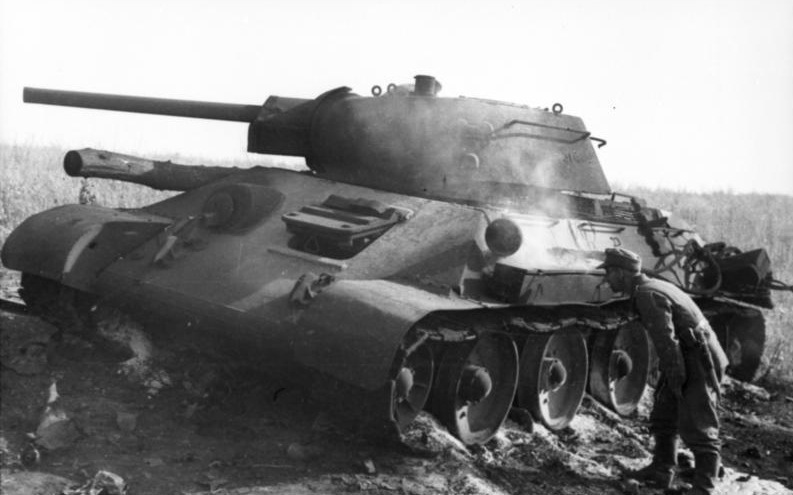
Soviet T-34 near Pokrovka
Soviet T-34 near Pokrovka A Soviet T-34 near Pokrovka on the southern face of the Kursk salient, July 1943. T-34s and light T-70s made up most of the 5th Guards Tank Army. Bundesarchiv / Lutz Koch · CC BY-SA 3.0 de · source
Pavel Rotmistrov
Pavel Rotmistrov Lieutenant General Pavel Rotmistrov, commander of the 5th Guards Tank Army. His memoir figures, 700-800 tanks a side and over 400 German losses, shaped the legend of Prokhorovka. Russian Ministry of Defence · CC BY 4.0 · source
Kursk memorial, Prokhorovka
Kursk memorial, Prokhorovka Marshal Zhukov on the Kursk memorial at Prokhorovka. The museum-reserve opened in 1995; its 59 m belfry stands on Hill 252.2. Adam Jones · CC BY-SA 3.0 · source

Free for everyone every year on its anniversary: July 12.

Accuracy score: 60/100 (moderate)

How the accuracy score works

Sources and method

Prokhorovka, 10-12 July 1943. Course of the battle, units, times and figures: Karl-Heinz Frieser et al., Germany and the Second World War, vol. VIII, The Eastern Front 1943-1944 (Militaergeschichtliches Forschungsamt / Oxford UP), section 'Prokhorovka: Legend and Reality' (excerpt): corridor width, 4.5 m ditch, German and Soviet strengths, 29th Tank Corps losses (after Zamulin), about 100 wrecks on Hill 252.2. Valeriy Zamulin, Demolishing the Myth: The Tank Battle at Prokhorovka, Kursk, July 1943 (Helion, 2011) and Prokhorovka: The Unknown Battle (2013), with 29th Tank Corps combat reports translated by Richard Harrison and analyzed by Christopher A. Lawrence, the Dupuy Institute (31st Tank Brigade, losses of the 32nd and 31st Tank Brigades, Totenkopf, tank losses 12-13 July; Lawrence, Kursk: The Battle of Prokhorovka, 2015). George M. Nipe Jr., Blood, Steel, and Myth: The II. SS-Panzer-Korps and the Road to Prochorowka (RZM, 2011; review by Douglas Nash) and Nipe's 'Prochorovka, 12 July 1943'. David M. Glantz and Jonathan M. House, The Battle of Kursk (University Press of Kansas, 1999), and Glantz, Soviet Defensive Tactics at Kursk (CSI Report 11, U.S. Army Combat Studies Institute). Ben Wheatley, 'The Soviet Victory at Prokhorovka' (from The Panzers of Prokhorovka, Osprey, 2023) and 'Prokhorovka and the fight for Hill 252.2' (History of War 122): 11 July timings and Luftwaffe reconnaissance photographs. 'Ribbentrop at Prokhorovka' (Warfare History Network), A. Kravchenko, 'Prokhorovka: the counterstroke of 12 July 1943' (battlefield.ru; 18th Tank Corps and 25th Tank Brigade), 183rd Rifle Division (Wikipedia, used for leads), and The Tank Museum, 'Prokhorovka and the Myth of the Largest Tank Battle'. Ground: the Prokhorovka Field state military-historical museum-reserve (belfry on Hill 252.2; museum.ru; museum story on Google Arts & Culture; 9th Guards Airborne Division at Oktyabrsky and Hill 252.2), belfry coordinates from sobory.ru and culttourism.ru, Andreyevka from the Russian Wikipedia article (via dic.academic.ru). The positions of the Oktyabrsky farm, the anti-tank ditch and the smaller villages, and every unit trace, are approximate reconstructions from distances given in these sources.

Where the positions come from

Further reading