Battlefield Atlas
World War II · 1945 Locked

Okinawa, 1 April - 22 June 1945

The Battle of Okinawa (Operation Iceberg), 1 April - 22 June 1945, was the largest amphibious operation of the Pacific War and its last great land battle. Lt. Gen. Simon B. Buckner Jr.'s U.S. Tenth Army - 182,000 assault troops in two Marine and four Army divisions, with a third Marine division afloat and more than 1,600 ships of the Fifth Fleet offshore - landed unopposed on the Hagushi beaches, cut the island in two and cleared the north in three weeks. In the south Lt. Gen. Mitsuru Ushijima's 32nd Army, over 100,000 men including 17,000 to 20,000 Okinawan home guards (Boeitai), held the Shuri line of caves and reverse-slope positions for nearly two months - Kakazu Ridge, the Maeda escarpment, Sugar Loaf Hill - before withdrawing to a last stand on the Kiyamu Peninsula, while air attacks, chiefly by kamikazes, sank 36 American ships and damaged 368. Buckner was killed on 18 June and Ushijima took his own life on 22 June. U.S. battle casualties were 49,151 (12,520 killed or missing); about 110,000 Japanese soldiers died; and between about 42,000 (U.S. Tenth Army estimate) and 94,000 (Okinawa Prefecture) Okinawan civilians were killed, among them people driven to group suicide; the Associated Press reports that the battle killed a quarter of the island's population.

Open the interactive map7 stages on modern satellite imagery and terrain, with 3D elevation

This battle opens with Battlefield Explorer ($4.99 a month or $39 a year), which unlocks every battle in the atlas and every one added later. Lifetime access and war packs are one-time options. Free battles include Thermopylae, Actium, Viking raid on Lindisfarne, Hastings, Hattin, Agincourt, Vítkov Hill, Bosworth, Fort William Henry, Yorktown, Waterloo, The Alamo, Antietam, Little Bighorn, Belleau Wood, Omaha Beach, Inchon, Ia Drang, Goose Green, 73 Easting, Wanat, Baghdad Thunder Runs, Battle of Raqqa, Donetsk Airport, Battle of Kyiv, Battle of Hostomel Airport, Siege of Mariupol, Kharkiv counteroffensive, Kherson counteroffensive, Bakhmut, Vuhledar, Mala Tokmachka and Robotyne, Avdiivka.

Shuri Castle in ruins
Shuri Castle in ruins — U.S. Navy — public domain

The battle, stage by stage

  1. 1 April 1945 (L-Day, Easter Sunday)

    L-Day on the Hagushi beaches

    At 8:30 AM (H-Hour) more than 1,400 amphibian tractors carry the assault waves of Lt. Gen. Simon B. Buckner Jr.'s Tenth Army onto the Hagushi beaches on Okinawa's west coast, after a heavy naval bombardment in which the battleship USS Idaho is among the ships firing. The Bishi River divides the two corps: Maj. Gen. Roy Geiger's III Amphibious Corps (6th and 1st Marine Divisions; 22nd, 4th, 7th and 5th Marines from north to south) lands north of it, and Maj. Gen. John Hodge's XXIV Corps (7th and 96th Infantry Divisions) south of it. Lt. Gen. Mitsuru Ushijima's 32nd Army has chosen not to defend the beaches. By nightfall about 60,000 troops hold a beachhead eight miles long and two deep, and Yontan and Kadena airfields are taken, for 28 killed, 104 wounded and 27 missing (Alexander). Off the southeast coast the 2nd Marine Division feints at Minatoga; kamikazes hit two of its ships, and it loses more men that day than any other division.

  2. 2-20 April 1945

    North to Hedo Misaki; south to the Shuri line

    The 7th Division reaches the east coast on the second day and the 1st Marine Division takes the Katchin Peninsula on the third, cutting the island in two. The 6th Marine Division sweeps north: the 22nd Marines reach Hedo Misaki, about 55 miles from the beaches, on 13 April, while the 4th and 29th Marines fight a five-day battle from 14 April for Yae-Take on the Motobu Peninsula against Col. Takehiko Udo's Kunigami Detachment, about 2,000 men, supported by the guns of USS Tennessee; Motobu is declared secure on 20 April at a cost of 207 Marines killed and 757 wounded. The 77th Division takes Ie Shima (16-21 April), where the correspondent Ernie Pyle is killed. In the south, XXIV Corps runs into the outer Shuri defenses. Cpl. Richard E. Bush of the 4th Marines smothers a grenade on Yae-Take on 16 April and survives (Medal of Honor). Offshore the kamikaze campaign is in full swing: on 16 April about 30 aircraft attack the destroyer Laffey at Radar Picket Station 1, hitting her with six kamikazes and four bombs and killing 32 men; she survives (NHHC). The battleship Yamato, sent on a one-way sortie, is sunk by carrier aircraft on 7 April far to the north.

  3. 9-19 April 1945

    Kakazu Ridge

    On 9 April the 383rd Infantry of the 96th Division attacks Kakazu Ridge, the first of the main defenses guarding Shuri, held by the 62nd Division. Companies reach the crest across a deep gorge but are driven off by mortars and counterattacks; one company of 89 men loses 15 killed, and only three men come through unhurt by enemy fire (National WWII Museum). Pfc. Edward J. Moskala of the 383rd, covering his company's withdrawal, is killed and receives the Medal of Honor. A Japanese night counterattack on 12-13 April fails. On 19 April Buckner opens a general offensive behind fire from 27 artillery battalions (324 guns), 18 ships and 650 aircraft (Appleman), but the defenders have gone deeper underground; around Kakazu the 27th Division loses 22 of 30 Shermans in a day (Alexander). The defenders slip away on the night of 23-24 April, and American troops occupy Kakazu Ridge on 24 April (Appleman).

  4. 3-5 May 1945

    The Japanese counteroffensive

    Against the advice of his operations officer, Col. Hiromichi Yahara, Ushijima backs his chief of staff, Lt. Gen. Isamu Cho, and throws the 24th Division (about 15,000 men, Appleman) and the 27th Tank Regiment into a counteroffensive on the night of 3-4 May. Its 32nd Regiment strikes the 77th Division near Maeda, where the medic Pfc. Desmond Doss of the 307th Infantry has already been saving the wounded since 29 April; its 89th Regiment is thrown back in front of the 7th Division, while about 450 men of the 1st Battalion, 32nd Regiment slip through to Tanabaru behind the American lines and hold it until 7 May (Appleman). Shipping engineers in barges try to land behind both coasts: in the west several hundred come ashore near Kuwae and are destroyed by the 1st Marine Division, and in the east most are killed at sea by naval gunfire. Appleman puts Japanese losses at about 5,000; Yahara called the defeat the decisive action of the campaign. Offshore, kamikazes sink or damage 17 ships on 3-4 May, among them the Aaron Ward.

  5. 12-18 May 1945

    Sugar Loaf Hill and the Shuri line

    Buckner renews the general offensive on 11 May. In the west the 6th Marine Division attacks Sugar Loaf, a hill rising only about 50 feet above its northern approaches, which with Half Moon and Horseshoe Hills anchors the western end of the Shuri line, held by Col. Seiko Mita's 15th Independent Mixed Regiment of the 44th Independent Mixed Brigade (Alexander). Company G, 2nd Battalion, 22nd Marines goes in on 12 May with 215 men and has 75 left that night (National WWII Museum). Maj. Henry A. Courtney Jr. leads a night assault to the top on 14-15 May and is killed (Medal of Honor); Cpl. James L. Day holds a shell hole on the western shoulder for days (Medal of Honor, awarded in 1998). Dog Company, 2/29, takes and holds the hill on 18 May. The 1st Marine Division grinds through Dakeshi and Wana Ridge, losing about 200 Marines for every 100 yards gained from 11 to 30 May (Alexander); the 77th Division presses Shuri from the north and the 96th takes Conical Hill in the east.

  6. 22-31 May 1945

    Shuri falls; the 32nd Army slips south

    With his line about to be turned, Ushijima decides in late May not to die at Shuri and withdraws south under cover of the heavy rains that resumed on 22 May, leaving a rear guard. The bulk of the 32nd Army reaches a final line on the Kiyamu Peninsula - Kunishi Ridge, Yaeju-Dake and Yuza-Dake - and its headquarters moves to a cave in Hill 89 at Mabuni. The 4th Marines and 22nd Marines enter the ruins of Naha. On 29 May Company A, 1st Battalion, 5th Marines walks into Shuri Castle against little resistance (the castle lies in the 77th Division's zone), and its commander raises a Confederate flag. The American colors go up at the end of the month, placed on the parapet by Lt. Col. Richard P. Ross Jr. of 3/1 (Alexander gives 30 and 31 May). Okinawan civilians who had taken refuge in the south are now caught in the path of the battle as it moves into the crowded villages and caves.

  7. 4-22 June 1945

    Oroku, Kunishi and the end at Mabuni

    On 4 June the 4th Marines land on the Oroku Peninsula, where Rear Adm. Minoru Ota's naval troops fight from tunnels until Shepherd declares it secure on 13 June; Ota and six of his staff officers take their own lives in the headquarters tunnels on the night of 13 June (Naval Underground HQ museum). The 7th Marines take Kunishi Ridge in a night attack, and the 96th and 7th Divisions climb the Yaeju-Dake-Yuza-Dake escarpment. At 1:15 PM on 18 June Buckner, watching from a forward observation post of the 8th Marines, is mortally wounded by coral fragments thrown up by a Japanese shell (Appleman); Geiger takes command until Gen. Joseph Stilwell arrives on 23 June. On 22 June (around 0300 by the Marine Corps history; Japanese accounts often give 23 June) Ushijima and Cho take their own lives at Hill 89, and organized resistance ends on 21-22 June. Okinawan civilians die in great numbers in these last weeks - in caves, under fire and in coerced group suicides, a practice already seen at Chibichiri Gama in Yomitan, where 83 residents died on 2 April (Ryukyu Shimpo); about 80,000 civilians come out of the caves in the last two weeks of June (Appleman). Tenth Army intelligence estimated about 42,000 civilian dead; the Okinawa Prefectural Peace Memorial Museum counts about 94,000 Okinawan civilians among 200,656 dead in the battle. U.S. battle casualties were 49,151, including 12,520 killed or missing, and about 110,000 Japanese soldiers were killed (Appleman).

Forces

The Tenth Army landed 182,000 assault troops against a Japanese garrison of over 100,000, including 17,000 to 20,000 Okinawan home guards; American intelligence had first estimated 60,000 to 70,000. Totals are well documented; few unit strengths are published.

Imperial Japanese Army (32nd Army, Ushijima)

32nd Army, presentAlexander gives more than 100,000 troops; the National WWII Museum gives over 67,000 defenders, apparently regular army only. Alexander, The Final Campaign (USMC); National WWII Museumover 100,000 (about 67,000 (regular army) to over 100,000)
Okinawan home guard (Boeitai)Plus about 1,700 Okinawan schoolboys aged 14 and older in the Blood and Iron (Tekketsu) units (Alexander). Alexander, The Final Campaign (USMC)17,000–20,000
Naval troopsOnly about 35 percent regular navy (Alexander). Alexander, The Final Campaign (USMC)about 10,000

U.S. Tenth Army (Buckner)

Assault troops landedSix divisions (four Army, two Marine) plus the 2nd Marine Division afloat; about 60,000 ashore by the end of L-Day (Alexander). Alexander, The Final Campaign (USMC)182,000
Ships and naval personnelNHHC. NHHCmore than 1,600 ships; 350,000 sailors
Landing craft on L-DayAlexander. Alexander, The Final Campaign (USMC)over 1,400 LVTs, 360 LVT(A)s, about 700 DUKWs

Casualties

The costliest battle of the Pacific War: about 12,500 Americans and some 110,000 Japanese soldiers died, and Okinawan civilian deaths are put at anywhere from about 42,000 (U.S. estimate) to 94,000 or more (Okinawa Prefecture). Military figures are well documented; civilian figures remain uncertain. Certainty: fair.

Imperial Japanese Army (32nd Army, Ushijima)

KilledThe Army official history gives about 110,000 killed; the Marine official history counts 107,539 dead plus an estimated 23,764 sealed in caves or buried. Both figures include Okinawan home guards and conscripts. Appleman et al., Okinawa: The Last Battle, ch. XVIII (CMH); Nichols & Shaw, Okinawa: Victory in the Pacific, ch. 11 (USMC)about 110,000 (about 107,500–131,300)
PrisonersAppleman gives about 7,400 taken prisoner; Nichols & Shaw give 10,755 prisoners of war. Appleman et al. (CMH); Nichols & Shaw (USMC)about 7,400 (7,400–10,755)
Lost in the 4–5 May counteroffensiveAppleman puts Japanese losses in the attack at about 5,000 (not a body count); Alexander says more than 6,000 first-line troops and 59 guns. Appleman et al., ch. XII (CMH); Alexander, The Final Campaign (USMC)about 5,000 (5,000–6,000+)

U.S. Tenth Army (Buckner)

Battle casualties (all services)12,520 killed or missing and 36,631 wounded, Army, Marines and Navy combined (Appleman; also NHHC). Appleman et al. (CMH); NHHC, Battle of Okinawa overview49,151
Army killed / missing / woundedPlus 15,613 non-battle casualties (Appleman). Appleman et al. (CMH)4,582 / 93 / 18,099
Marines killed and missing / woundedIncluding the Tactical Air Force; plus 10,598 non-battle casualties (Appleman). Tenth Army as a whole: 7,374 killed or died of wounds, 31,807 wounded, 239 missing (Nichols & Shaw). Appleman et al. (CMH); Nichols & Shaw (USMC)2,938 / 13,708
Navy killed and missing / woundedMostly from kamikaze attacks; NHHC notes that for the first time in a Navy campaign deaths exceeded wounded. Appleman et al. (CMH); NHHC4,907 / 4,824
Lt. Gen. Simon B. Buckner Jr.Mortally wounded at 1:15 PM at a forward observation post of the 8th Marines; Brig. Gen. Claudius Easley was killed the next day (Appleman). Appleman et al. (CMH)killed 18 June

Civilians

Okinawan civilians killedTenth Army intelligence estimated about 42,000 civilian dead and Japanese sources about 50,000 (Nichols & Shaw); the Okinawa Prefectural Peace Memorial Museum counts about 94,000 Okinawan civilians among 200,656 dead in the battle; the AP reports that half of more than 188,000 Japanese dead were Okinawan civilians and that the battle killed a quarter of the island's population. Nichols & Shaw (USMC); Hiroshima Peace Media Center on the Okinawa Prefectural Peace Memorial Museum; Associated Press via Arab News (23 June 2025)about 42,000 to 94,000 (42,000–94,000+)
Coerced group suicide, Chibichiri Gama (Yomitan), 2 April83 residents died in the cave the day after the landing; the Ryukyu Shimpo describes it as a compulsory group suicide. Ryukyu Shimpo (2020)83
Civilians who came out of the caves, late JuneBetween a third and a half of them wounded (Appleman). Appleman et al. (CMH)about 80,000

Equipment and ships

U.S. ships sunk / damagedMostly by air attack (Appleman); NHHC gives 36 sunk and more than 350 damaged; Alexander gives 34 ships and craft sunk. Appleman et al. (CMH); NHHC36 / 368
Aircraft lost1 April–1 July (Appleman); NHHC says about 700 U.S. aircraft. Appleman et al. (CMH)U.S. 763; Japanese about 7,800
Japanese shipsYamato was sunk on 7 April with about 3,665 Japanese sailors killed in her group, for 12 U.S. aviators (NHHC). Appleman et al. (CMH); NHHC16 sunk, including Yamato
U.S. tanksAlexander. Alexander, The Final Campaign (USMC)22 of 30 Shermans lost on 19 April (27th Div.); 51 Marine Shermans knocked out

Then and now: how the ground has changed

Much of the 1945 battlefield in central and southern Okinawa is now dense city: Sugar Loaf stands among the towers of Naha Shintoshin, the Hagushi shore has been reclaimed in places, and Shuri Castle has been rebuilt twice. The southern escarpments and the Mabuni cliffs survive as memorial parks.

The interactive map can show the period landscape (2 shapes: Naha Shintoshin (built over the Sugar Loaf battlefield), Mihama reclaimed shore, Chatan (sea in 1945)) under the units. Open the map.

Weapons

Imperial Japanese Army (32nd Army, Ushijima)

Type 92 heavy machine gun

Type 92 heavy machine gun

Heavy machine gun · 1932–1945

At Okinawa: Heavy machine guns sited in caves and tombs covered the approaches to Kakazu, the Maeda escarpment and Sugar Loaf with grazing fire.

The Type 92 was Japan's standard heavy machine gun in World War II, derived from the Hotchkiss design. Its slow, steady rate of fire earned it the nickname "Woodpecker" from American troops.

Caliber
7.7×58mm SR
Rate of fire
about 450 rounds/min
Feed
30-round strips
Weight
about 55 kg with tripod
Photo: Gary Todd · CC0
Type 96 light machine gun

Type 96 light machine gun

Light machine gun · 1936–1945

At Okinawa: Light machine guns fought from the reverse-slope positions of the Shuri line.

The Type 96 was a standard Japanese squad light machine gun of World War II, alongside its 7.7 mm successor, the Type 99. Its curved box magazine fed from the top, and it could even mount a bayonet.

Caliber
6.5×50mm Arisaka
Rate of fire
about 550 rounds/min
Magazine
30-round top-mounted box
Weight
about 9 kg
Photo: BrokenSphere · CC BY-SA 3.0
Type 89 grenade discharger

Type 89 grenade discharger

Light mortar / grenade discharger · 1929–1945

At Okinawa: Grenade dischargers ('knee mortars') added to the preregistered mortar fire that smothered American penetrations.

Nicknamed the "knee mortar" by Americans because of its curved base plate, the Type 89 was a light, accurate weapon carried at squad level. Firing it braced against the thigh could cause serious injury; it was meant to be set on the ground.

Caliber
50 mm
Range
up to about 670 m
Weight
about 4.7 kg
Photo: Public domain · Wikimedia Commons

U.S. Tenth Army (Buckner)

M1 Garand

M1 Garand

Semi-automatic rifle · 1936–1958 (US standard rifle)

At Okinawa: Standard rifle of the Army and Marine riflemen.

The M1 Garand was the first semi-automatic rifle adopted as a nation's standard infantry weapon. It gave the American rifleman much more firepower than a bolt-action rifle, and General George Patton called it "the greatest battle implement ever devised."

Caliber
.30-06 Springfield
Effective range
about 460 m (500 yd)
Feed
8-round en-bloc clip
Photo: Armémuseum (Swedish Army Museum) · Public domain
M1918 Browning Automatic Rifle (BAR)

M1918 Browning Automatic Rifle (BAR)

Automatic rifle · 1918–1960s

At Okinawa: The fire team's automatic rifle in both the Army and Marine divisions.

John Browning's BAR first reached the front in September 1918 and became the automatic weapon at the heart of the US rifle squad in World War II. The M1918A2 version added a bipod and a two-speed rate of fire.

Caliber
.30-06 Springfield
Magazine
20-round box
Rate of fire
M1918A2: selectable slow/fast, roughly 300–650 rounds/min
Weight
about 8.8 kg (M1918A2)
Photo: Public domain · Wikimedia Commons
M2 flamethrower

M2 flamethrower

Man-portable flamethrower · 1943–1950s

At Okinawa: Flamethrowers and demolitions - Buckner's 'blowtorch and corkscrew' - were the main tools against the caves.

The backpack M2 flamethrower projected thickened fuel at bunkers, caves and pillboxes. It was the US Marines' key tool for clearing Japanese fortifications in the Pacific, though its operators were prime targets.

Fuel capacity
about 4 US gal (15 L)
Range
about 20–40 m
Burn time
roughly 7–9 seconds of fire
Photo: U.S. Army · Public domain
M4 Sherman

M4 Sherman

Medium tank · 1942–1950s (US service)

At Okinawa: The 27th Division lost 22 of 30 Shermans around Kakazu on 19 April; 51 Marine Shermans were knocked out in the campaign (Alexander).

The Sherman was the most widely used American tank of World War II, valued for its reliability and ease of production. Specialized versions included the Duplex Drive (DD) amphibious tank and flamethrower conversions.

Crew
5
Armament
75 mm gun M3 (most early versions)
Weight
about 30 metric tons
Photo: Public domain · Wikimedia Commons

Paintings and photographs

Shuri Castle in ruins
Shuri Castle in ruins The shattered walls of Shuri Castle, headquarters of the Japanese 32nd Army, in 1945 (U.S. Navy photograph). U.S. Navy — public domain · source
Sugar Loaf Hill, 26 May 1945
Sugar Loaf Hill, 26 May 1945 The 1st Battalion, 4th Marines command post dug in on Sugar Loaf Hill during the rains, 26 May 1945. USMC Archives — CC BY 2.0 · source
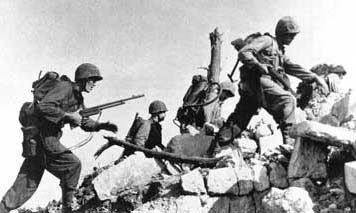
Marine assault team
Marine assault team A heavily armed Marine assault team moves out on Okinawa, spring 1945 (exact location not recorded). U.S. government — public domain · source

★ Medal of Honor 5 recipients

Links go to the official records: the Congressional Medal of Honor Society and, where they exist, the service's own pages.

Free for everyone every year on its anniversary: April 1 – June 22.

Accuracy score: 60/100 (moderate)

How the accuracy score works

Sources and method

Okinawa, 1 April - 22 June 1945. The order of battle, dates, losses and the course of the fighting follow the U.S. Army's official history, Roy E. Appleman, James M. Burns, Russell A. Gugeler and John Stevens, Okinawa: The Last Battle (Center of Military History, 1948; chapters XII, 'The Japanese Counteroffensive', and XVIII, 'The Battle Ends'); the Marine Corps official history, Chas. S. Nichols Jr. and Henry I. Shaw Jr., Okinawa: Victory in the Pacific (1955; campaign summary and Medal of Honor appendix); Col. Joseph H. Alexander, The Final Campaign: Marines in the Victory on Okinawa (USMC History and Museums Division, 1996); A Brief History of the 4th Marines (USMC); the Naval History and Heritage Command's Okinawa overview and H-Gram 045 on USS Laffey; the National WWII Museum's articles on Kakazu Ridge and Sugar Loaf Hill; Appleman's chapter XII on the counteroffensive; the Former Japanese Navy Underground Headquarters museum (Ota's death); and Medal of Honor citations from the Congressional Medal of Honor Society. Civilian figures: Okinawa Prefectural Peace Memorial Museum (via Hiroshima Peace Media Center), the Associated Press (2025) and the Ryukyu Shimpo (Chibichiri Gama). Site positions are from coordinates published by Stars and Stripes Okinawa (landing monuments, Kakazu, the Maeda escarpment, Sugar Loaf, Half Moon and Horseshoe Hills, Shuri, the naval headquarters, Himeyuri, Mabuni Hill and the Buckner Memorial) and PeakVisor (Yae-Take). A Marine Corps University Okinawa staff ride guide exists but could not be consulted. Unit blocks are schematic at regiment and division scale; Kunishi Ridge, Yaeju-Dake, Conical Hill, Wana Ridge and Tanabaru are placed approximately; Sugar Loaf's defenders are identified from Alexander.

Where the positions come from

Further reading