Battlefield Atlas
American Revolution · 1781 First 3 stages free

Guilford Courthouse, 15 March 1781

On 15 March 1781, at Guilford Courthouse in the North Carolina Piedmont, Lord Cornwallis's army of about 1,900–2,100 British, Hessian and Guards regulars attacked Nathanael Greene's army of about 4,400 Continentals and militia, drawn up in three lines along the Great Salisbury Road. The British broke the North Carolina militia at the fence, fought their way through the Virginia militia in the woods, and after a savage fight with the Continentals around the courthouse — the 1st Maryland's counterattack and William Washington's charge on the Guards — held the field when Greene withdrew. The victory cost Cornwallis over a quarter of his army; he abandoned the Carolinas for Virginia, and seven months later surrendered at Yorktown.

Play the first 3 stages free7 stages on modern satellite imagery and terrain, with 3D elevation

The first 3 of its 7 stages are free to play. The rest opens with Battlefield Explorer ($4.99 a month or $39 a year), which unlocks every battle in the atlas and every one added later. Lifetime access and war packs are one-time options. Free battles include Thermopylae, Plataea, Actium, Viking raid on Lindisfarne, Hastings, Hattin, Agincourt, Vítkov Hill, Kutná Hora, Fall of Constantinople, First St Albans, Lützen, Siege of Buda, Culloden, Fort William Henry, Yorktown, Lake Erie, Waterloo, The Alamo, Monterrey, Antietam, Little Bighorn, Manila Bay, Belleau Wood, Saint-Mihiel, Omaha Beach, Inchon, Ia Drang, Goose Green, 73 Easting, Wanat, Baghdad Thunder Runs, Manbij, Battle of Raqqa, Donetsk Airport, Ilovaisk, Debaltseve, Battle of Kyiv, Battle of Hostomel Airport, Siege of Mariupol, Bilohorivka (Siverskyi Donets crossing), Kharkiv counteroffensive, Kherson counteroffensive, Bakhmut, Vuhledar, Mala Tokmachka and Robotyne, Avdiivka, Kursk incursion.
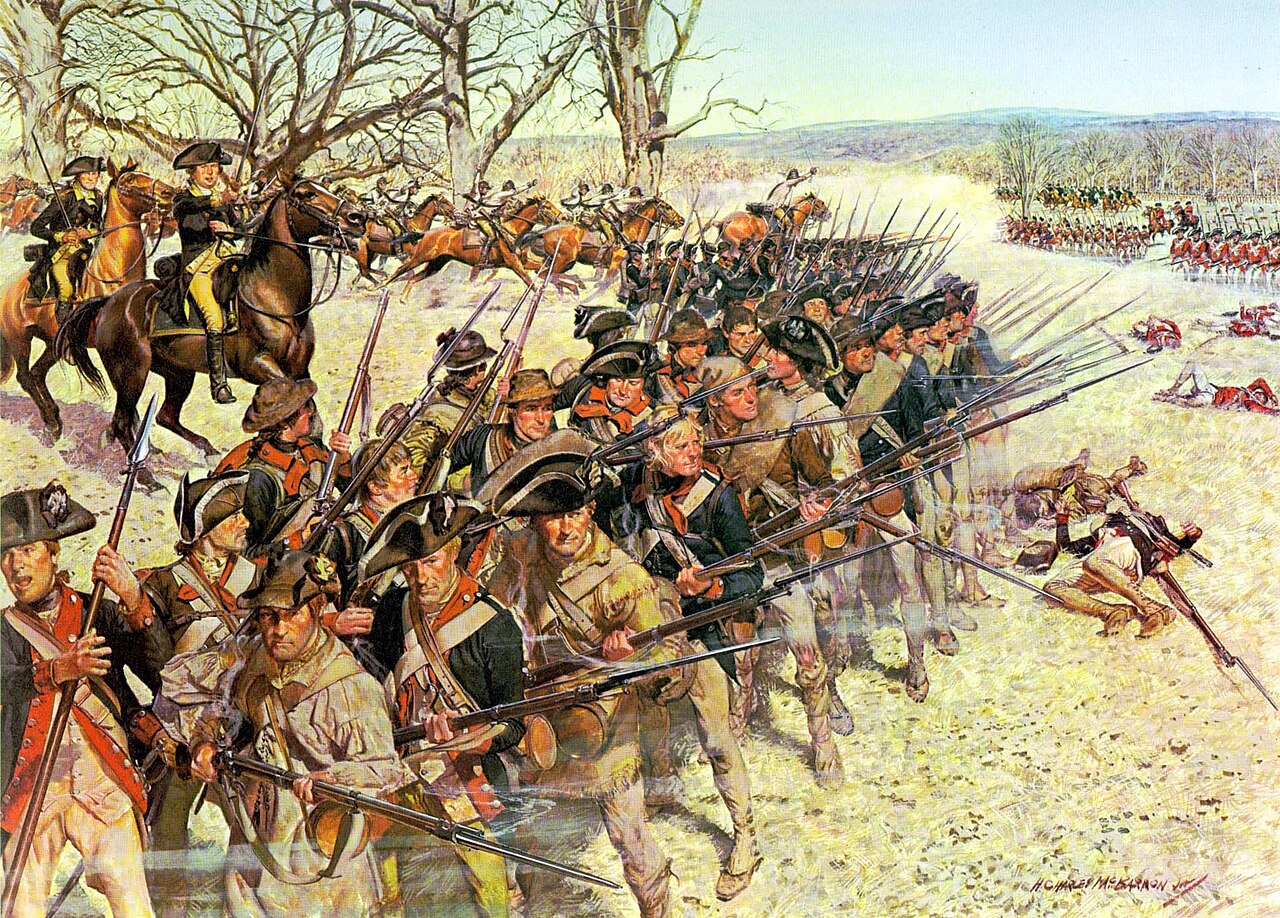
The Battle of Guilford Court House (McBarron)
The Battle of Guilford Court House (McBarron) — H. Charles McBarron, U.S. Army · public domain

The battle, stage by stage

  1. 15 March 1781, about 1 PM

    Greene's three lines

    Near Guilford Courthouse in the North Carolina Piedmont, Major General Nathanael Greene, reinforced to about 4,400 men (sources give about 4,400–4,500), waits for Lord Cornwallis on ground he chose himself, astride the Great Salisbury (New Garden) Road. His first line is two brigades of North Carolina militia, John Butler's north of the road and Thomas Eaton's south of it, behind a rail fence at the edge of the cleared Hoskins fields, with two 6-pounders on the road; Charles Lynch's Virginia riflemen, Robert Kirkwood's Delaware Continentals and William Washington's dragoons cover the right, and William Campbell's riflemen with Henry Lee's Legion the left. About 350–400 m back in the woods stand the Virginia militia brigades of Robert Lawson and Edward Stevens; farther back, on high ground near the courthouse, the Continentals — the Maryland brigade and Isaac Huger's Virginians. Cornwallis, with about 1,900–2,100 regulars (British, Highland, Hessian and Guards), deploys east of the Hoskins farm about 12:30–1 PM after a short artillery duel on the road, holding the German jägers and Guards light infantry back in the wood beside the guns. Positions of all three lines are approximate.

  2. About 1:30 PM

    The volley at the fence

    The British line — Webster's 23rd and 33rd on the left, Leslie's 71st Highlanders and the Hessian Regiment von Bose on the right, the Guards coming up behind — advances across the muddy fields under fire. The North Carolina militia, asked by Greene for two volleys, fire at least one at long range; by the park's account the British close ranks, return fire at close range and charge with the bayonet. Most of the militia, many raw, break and stream back through the woods; some stand — Captain Arthur Forbis of the Guilford County militia is mortally wounded at the fence line. The riflemen and Continentals on both flanks hold on and fire into the British flanks, forcing Cornwallis to commit the 33rd, the jägers and Guards light infantry to the north and the 1st Guards to the south.

  3. About 1:45–2:30 PM

    The woods fight

    In thick, broken woods the British meet the Virginia militia of the second line, many led by former Continental officers — Lawson's brigade north of the road, Stevens's to the south, where Stevens has posted sentries to shoot men who run. The fight dissolves into separate firefights behind trees. On the American right, Lynch, Kirkwood and Washington probably fall back onto Lawson's flank, harried by the 33rd and the jägers. On the left, Lee's Legion and Campbell's riflemen, disoriented in the woods, drift south-east, and the 1st Guards and the von Bose regiment follow them — splitting the battle in two. Stevens is shot through the thigh; after a long, costly fight the second line gives way, some units retiring in order, others scattering.

  4. About 2:45 PM

    Webster at the third line

    Lieutenant Colonel James Webster, leading the 33rd, the jägers and the Guards light infantry, is first out of the woods. He crosses the open ground and the valley of Richland Creek and climbs toward the Continentals on the ridge near the courthouse — the 1st Maryland and the 2nd Virginia — who hold their fire and then deliver a heavy volley. Webster is badly wounded (he dies weeks later) and his men fall back across the ravine. Half a mile to the south, out of sight, Lee and Campbell fight a separate battle against the 1st Guards and the Hessians. Where exactly the third line stood is debated: the park now places it about 300–400 m east of the 1890 Regulars' Monument, on the ridge west of the courthouse junction, along today's Third Line Trail, with the 2nd Maryland on its left thrown back across the road; the courthouse stood on a hillock north-east of the junction with the Reedy Fork Road. The revised site is not yet confirmed by archaeology.

  5. About 3–3:10 PM

    The Guards and the 1st Maryland

    Brigadier General Charles O'Hara's 2nd Battalion of Guards, under Lieutenant Colonel James Stuart, attacks the left of the third line. The 2nd Maryland, full of recruits, breaks and runs, and the Guards take two American 6-pounders. The veteran 1st Maryland — Colonel John Gunby, with Lieutenant Colonel John Eager Howard — wheels and charges with the bayonet, and Washington's dragoons ride through the Guards from the rear, sabers swinging, driving them back from the guns. Stuart is killed in the hand-to-hand fighting; tradition and the park marker credit Captain John Smith of the 1st Maryland. O'Hara, wounded twice during the battle, stays in command. The park's 'Death of Stewart' monument is placed symbolically, not where he fell. Peter Francisco, a Virginian riding with Washington's horse, is credited with eleven kills on his monument, though his own account claims four.

  6. About 3:15 PM

    'A whiff of grape'

    Cornwallis rides up with his 3-pounders, which open with grapeshot to drive off Washington's dragoons and the Maryland infantry. By a well-known account — told by Henry Lee, who was not on that part of the field — he orders the guns to fire into the struggling mass knowing it will kill some of his own Guards, over O'Hara's protests. The grape may have hit Guardsmen, but whether Cornwallis deliberately fired on his own men is disputed: the American Battlefield Trust calls Lee's story questionable, and the Marine Corps staff ride study, after Babits and Howard, rejects it. In the swirl the Americans retake the two 6-pounders, only to lose them again; they fall back to their line as the 71st and 23rd come out of the woods and the Guards re-form. Cornwallis sends Tarleton to investigate heavy gunfire to the south, where the Hessians have already restored the 1st Guards' fight against Lee and Campbell.

  7. About 3:30–4 PM

    A costly victory

    Rather than risk his only army, Greene orders a withdrawal. Green's 1st Virginia covers the Reedy Fork Road while Hawes's 2nd Virginia delays the British from the west and south — Huger is wounded in this phase — and the Continentals and Washington's horse march off by the Reedy Fork Road to the Speedwell Iron Works (the route shown is approximate). In the south Lee withdraws; Tarleton arrives after he has gone and cuts up the exposed riflemen and light infantry. The British hold the field, the courthouse and all four of Greene's 6-pounders, abandoned for lack of horses. By the staff ride study's figures Cornwallis lost 93 killed, 413 wounded and 26 missing — over a quarter of about 1,900 engaged — against 79 American dead, 184 wounded and over 1,000 missing, mostly militia who went home. 'Another such victory would ruin the British army,' Charles James Fox reportedly told Parliament. Cornwallis fell back to Wilmington and then marched into Virginia, toward Yorktown.

Forces

Greene had about 4,400 men, more than twice Cornwallis's roughly 1,900 engaged, but over half of them were militia, many raw; the British were veteran regulars. The army totals agree well across sources; unit figures come mainly from the Marine Corps staff ride's order of battle, whose numbers do not always add up, and are shown only where it or the Park Service gives them.

British army (Lord Cornwallis)

Engagedabout 1,900 (1,900–2,400)

The staff ride study gives 1,924 engaged (about 2,200 present), and the NPS and Mount Vernon about 1,900; the American Battlefield Trust says 2,100, the NPS handbook about 2,000 and Britannica about 2,400. Harold Allen Skinner Jr., A Game of Hare & Hounds (Marine Corps University Press, 2021), Stand 14 and Appendix B; National Park Service, Guilford Courthouse NMP, 'Frequently Asked Questions'; American Battlefield Trust, 'Guilford Courthouse'; Encyclopaedia Britannica, 'Battle of Guilford Courthouse'

American army (Nathanael Greene)

Presentabout 4,400 (4,400–4,500)

The NPS brochure, the staff ride study, Mount Vernon and Britannica give about 4,400 (the staff ride about 4,000 actually engaged); the NPS FAQ and the American Battlefield Trust say about 4,500. Cornwallis told Lord Germain Greene had over 7,000. National Park Service, Guilford Courthouse NMP brochure (2023), via NPS History; Harold Allen Skinner Jr., A Game of Hare & Hounds (Marine Corps University Press, 2021), Stand 14 and Appendix B; National Park Service, Guilford Courthouse NMP, 'Frequently Asked Questions'; American Battlefield Trust, 'Guilford Courthouse'

First line (North Carolina militia)over 1,000

The NPS brochure and the staff ride text put the two North Carolina brigades at over or around 1,000; the staff ride's order of battle lists 600 each, and the NPS 'Patriot Soldiers' page about 1,500 on the whole first line. National Park Service, Guilford Courthouse NMP brochure (2023), via NPS History; Harold Allen Skinner Jr., A Game of Hare & Hounds (Marine Corps University Press, 2021), Stand 4 and Appendix B; National Park Service, Guilford Courthouse NMP, 'Patriot Soldiers'

Second line (Virginia militia)about 1,200 (1,200–1,400)

The NPS gives 1,200 Virginia militia; the staff ride's brigade figures (Lawson 650, Stevens 750) total 1,400. National Park Service, Guilford Courthouse NMP, 'Patriot Soldiers'; Harold Allen Skinner Jr., A Game of Hare & Hounds (Marine Corps University Press, 2021), Appendix B

Third line (Continentals)about 1,500–1,700

The staff ride text says Webster faced two Continental brigades of some 1,500; the NPS gives about 1,700 for the third line. Harold Allen Skinner Jr., A Game of Hare & Hounds (Marine Corps University Press, 2021), Stand 10; National Park Service, Guilford Courthouse NMP, 'Patriot Soldiers'

Casualties

Cornwallis won the field but lost 532 men (93 killed, 413 wounded, 26 missing), over a quarter of his army; Greene lost about 79 killed and 184 wounded, plus about 1,046 missing, mostly militia who went home. British losses agree across sources; American killed and wounded vary only slightly. Certainty: good.

British army (Lord Cornwallis)

American army (Nathanael Greene)

Killed79 (70–80)

The staff ride study (after Babits and Howard) gives 79; Britannica gives 70–80. Cornwallis reported to Lord Germain that 200–300 American dead were left on the field. Harold Allen Skinner Jr., A Game of Hare & Hounds (Marine Corps University Press, 2021), Stand 14; Encyclopaedia Britannica, 'Battle of Guilford Courthouse'

Missing1,046

Mostly North Carolina militia who left the field and went home rather than men killed or captured; the NPS handbook says most of the missing returned within a few days. Harold Allen Skinner Jr., A Game of Hare & Hounds (Marine Corps University Press, 2021), Stand 14; Encyclopaedia Britannica, 'Battle of Guilford Courthouse'; National Park Service, Historical Handbook No. 30, Guilford Courthouse, via NPS History

Total casualties (not counting the missing)about 300

The National Park Service gives about 300 American casualties, 6–7 percent of the force; Mount Vernon also gives about 300. National Park Service, Guilford Courthouse NMP, 'Frequently Asked Questions'; George Washington's Mount Vernon Digital Encyclopedia, 'Battle of Guilford Courthouse'

Then and now: how the ground has changed

The rolling Piedmont ground is unchanged in shape, but in 1781 the field was a mix of fenced farm clearings and open hardwood forest; today the park's 220 acres, about a quarter of the battlefield, are mostly woods, and the rest of the field is covered by Greensboro's homes, shops and roads.

Weapons

British army (Lord Cornwallis)

Short Land Pattern musket ("Brown Bess")

Short Land Pattern musket ("Brown Bess")

Smoothbore flintlock musket · 1768–1790s pattern

At Guilford Courthouse: Cornwallis's regiments, the Guards and the Hessians advanced across open fields against the fence line and came on with the bayonet.

The British infantryman's musket for most of the 18th century. Accuracy beyond about 100 yards was poor, so the tactics were volleys at close range followed by the bayonet, which the Brown Bess was built to carry.

Caliber
.75 (ball about .69)
Effective range
about 50–100 yd against a formed line
Rate of fire
3 rounds a minute, drilled
Photo: Tower (British Ordnance) · Public domain

American army (Nathanael Greene)

American long rifle

American long rifle

Rifled flintlock (Pennsylvania / "Kentucky" rifle) · about 1730–1840

At Guilford Courthouse: Lynch's and Campbell's Virginia riflemen held the flanks of the first line and fought on in the woods to the south.

Made by German-American gunsmiths in Pennsylvania for hunting on the frontier. The spiral rifling and a greased patch around the ball made it far more accurate than a musket, but slow to load and too delicate for a bayonet, so riflemen fought as skirmishers and sharpshooters rather than in the line.

Caliber
typically .45–.54
Effective range
200–300 yd in skilled hands
Rate of fire
about 1 round a minute
Photo: Long rifle of William Clark · Missouri Historical Society · Public domain
Short Land Pattern musket ("Brown Bess")

Short Land Pattern musket ("Brown Bess")

Smoothbore flintlock musket · 1768–1790s pattern

At Guilford Courthouse: The 1st Maryland's musket volley and bayonet counterattack, with Washington's dragoons, threw back the 2nd Guards at the third line.

The British infantryman's musket for most of the 18th century. Accuracy beyond about 100 yards was poor, so the tactics were volleys at close range followed by the bayonet, which the Brown Bess was built to carry.

Caliber
.75 (ball about .69)
Effective range
about 50–100 yd against a formed line
Rate of fire
3 rounds a minute, drilled
Photo: Tower (British Ordnance) · Public domain

Paintings and photographs

The Battle of Guilford Court House (McBarron)
The Battle of Guilford Court House (McBarron) H. Charles McBarron's painting of the 1st Maryland's counterattack at the third line, from Soldiers of the American Revolution. H. Charles McBarron, U.S. Army · public domain · source
Lord Cornwallis (Gainsborough)
Lord Cornwallis (Gainsborough) Charles, 2nd Earl Cornwallis, by Thomas Gainsborough. Pinned at the Hoskins farm, the British staging ground. Thomas Gainsborough (Royal Collection) · public domain · source
Tannenbaum Historic Park
Tannenbaum Historic Park Tannenbaum Historic Park, the Hoskins farmstead where the British formed before the battle, 2012. Greensboro, NC (Panoramio) · CC BY-SA 3.0 · source
Battle of Guildford (manuscript map, 1781)
Battle of Guildford (manuscript map, 1781) British manuscript map "Battle of Guildford fought on the 15th of March 1781", pen-and-ink and watercolor, scale about 1:18,600 (Library of Congress). Pinned at the center of the area it covers, approximate. Unknown British cartographer (Library of Congress) · public domain · source
Battle of Guildford (pencil manuscript, 1781)
Battle of Guildford (pencil manuscript, 1781) A second manuscript map of the battle, pen-and-ink and pencil, scale about 1:10,800 (Library of Congress). Pinned at the center of the area it covers, approximate. Unknown British cartographer (Library of Congress) · public domain · source
Battle of Guildford (engraved, 1787)
Battle of Guildford (engraved, 1787) Hand-colored engraved map of the battle published in 1787, engraved from manuscript no. 52 in the Faden collection (Library of Congress). Pinned at the center of the area it covers, approximate. Faden collection engraving (Library of Congress) · public domain · source
Nathanael Greene (Peale)
Nathanael Greene (Peale) Maj. Gen. Nathanael Greene, by Charles Willson Peale, 1783. Pinned at the Greene Monument. Charles Willson Peale · public domain · source
Nathanael Greene Monument
Nathanael Greene Monument The 1915 equestrian monument to General Nathanael Greene by Francis Herman Packer, on the second line, 2010. MarmadukePercy · CC BY-SA 3.0 · source
Greene statue (NPS)
Greene statue (NPS) National Park Service photograph of the statue of General Nathanael Greene in Guilford Courthouse National Military Park. National Park Service · public domain · source
Joseph Winston Monument
Joseph Winston Monument Monument to Major Joseph Winston of the North Carolina riflemen, at Tour Stop 4, 2010. MarmadukePercy · CC BY-SA 3.0 · source
Regulars' Monument
Regulars' Monument The Regulars' Monument of 1890 on Schenck's third line, 2015. Upstateherd · CC BY-SA 4.0 · source
1st Virginia Cavalry Monument
1st Virginia Cavalry Monument Monument to the cavalry commanded by Lieutenant Colonel William Washington at Guilford Court House, 2010. MarmadukePercy · CC BY-SA 3.0 · source
Stuart Monument
Stuart Monument The monument to Lieutenant Colonel James Stuart of the 2nd Battalion of Guards, at the park's symbolic site of his death, 2015. Upstateherd · CC BY-SA 4.0 · source

Free for everyone every year on its anniversary: March 15.

Accuracy score: 79/100 (good)

How the accuracy score works

Sources and method

Guilford Courthouse, 15 March 1781. Units are placed from the National Park Service waysides and monuments of Guilford Courthouse National Military Park — 'The Battle Begins', 'Local Hero' (Forbis), Tour Stops 2–6, the Greene Monument, 'Legend vs. Reality', the Regulars' Monument and 'The British Perspective', the 1st Virginia Cavalry and 'Death of Stewart' monuments, the 'Third Line Trail' and 'Backcountry Courthouse' waysides — and the Hoskins Farmstead marker at Tannenbaum Historic Park, with positions from the Historical Marker Database. As a key source for order of battle, stands, positions and timings: Harold Allen Skinner Jr., A Game of Hare & Hounds: An Operational-level Command Study of the Guilford Courthouse Campaign (Marine Corps University Press, 2021; a staff ride study — no U.S. Army staff ride handbook covers this battle), which draws on Lawrence E. Babits and Joshua B. Howard, Long, Obstinate, and Bloody: The Battle of Guilford Courthouse (University of North Carolina Press, 2009). The road, field and line positions follow the NPS Cultural Landscape Report for the park, including the revised third-line location east of Richland Creek (still debated), with the 2nd Maryland's left thrown back across the road after Otho Williams and Babits and Howard (the older view in NPS Historical Handbook No. 30, Guilford Courthouse, puts the whole third line north of the road); Cornwallis's dispatch of 17 March 1781 (American Battlefield Trust primary sources) for the jägers and Guards light infantry held back in the wood, O'Hara's two wounds and the four abandoned guns; the NPS tour stop pages and the 'Expanding Battle' wayside (HMdb 11578) for Tarleton's ride south; the American Battlefield Trust battle page (strengths, casualties, and its doubts about Lee's grapeshot story), and J. Odell, 'Many Were Sore Chased' (Lawson north and Stevens south of the road). Strengths are given as ranges because sources differ; the line of the 1781 road is interpolated between park landmarks, the separate fight south of the park and the Reedy Fork Road withdrawal are placed schematically, and all line traces are approximate. Images from Wikimedia Commons.

Where the positions come from

Further reading