Battlefield Atlas
American Revolution · 1776 Members · from $3

Trenton, 26 December 1776

On the morning of 26 December 1776, after crossing the ice-choked Delaware River on Christmas night, George Washington's army of about 2,400 men surprised the Hessian garrison of Trenton — three regiments under Colonel Johann Rall, about 1,500 men in all. Greene's division came down the Pennington Road and Sullivan's along the River Road; Henry Knox's guns swept King and Queen Streets (today's Warren and Broad Streets). In about an hour Rall was mortally wounded and nearly 900 Hessians surrendered. The small victory came at the lowest point of the Revolution and revived the American cause, followed within days by the actions at the Assunpink Creek and Princeton.

Open the interactive map7 stages on modern satellite imagery and terrain, with 3D elevation

This battle opens with Battlefield Enjoyer ($3 a month on Patreon), which unlocks every battle in the atlas and every one added later. Free battles include Yorktown, Waterloo, The Alamo, Antietam, Little Bighorn, Belleau Wood, Omaha Beach, Ia Drang.

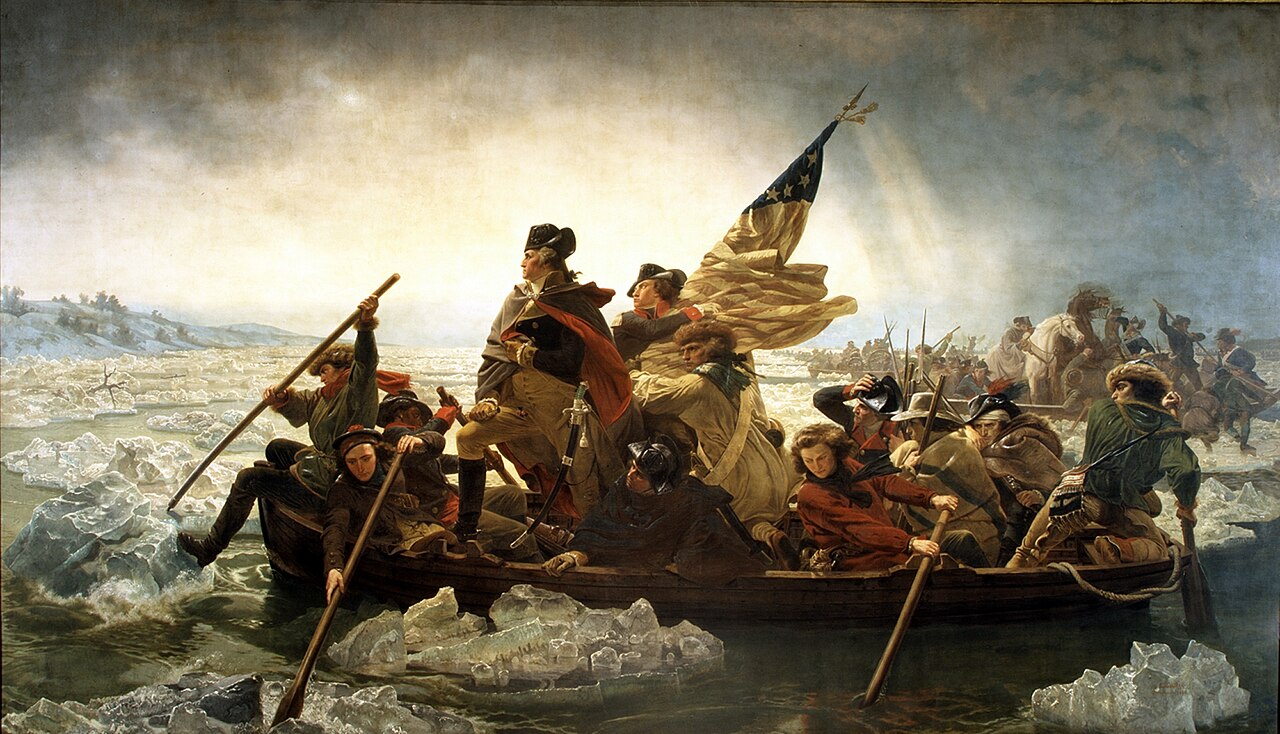
Washington Crossing the Delaware (Leutze, 1851)
Washington Crossing the Delaware (Leutze, 1851) — Emanuel Leutze — public domain

The battle, stage by stage

  1. 26 December 1776, 3–7 AM

    Across the Delaware

    After a winter retreat across New Jersey, Washington strikes back at the Hessian brigade holding Trenton. Through a nor'easter of snow and sleet, Colonel John Glover's Marblehead mariners ferry about 2,400 men, horses and 18 guns over the ice-choked Delaware at McConkey's Ferry; the crossing finishes about 3 AM, hours behind schedule, and the march begins about 4. Two supporting crossings, Ewing's at Trenton Ferry and Cadwalader's at Bristol, fail in the ice. At the Birmingham crossroads the army splits: Greene's division, with Washington, takes the Scotch and Pennington roads, and Sullivan's division the River Road.

  2. About 8 AM

    The outposts driven in

    Both columns strike Trenton within minutes of each other. On the Pennington Road, Washington personally leads the attack on Lieutenant Andreas Wiederholdt's picket in a cooper's house; it fires and falls back on the town shouting 'Der Feind!'. On the River Road, Sullivan's lead brigade drives the jägers from the Hermitage, and the British dragoons gallop across the Assunpink bridge for Princeton. Greene's brigades fan out to envelop the north of the town while Fermoy and Hand's riflemen swing east to cut the Princeton road.

  3. About 8:15 AM

    Guns at the head of the streets

    Henry Knox places his guns on the high ground where King and Queen Streets meet — today's Battle Monument — and fires straight down both streets; Captain Thomas Forrest's battery covers Queen Street. The Rall and Lossberg regiments try to form on King Street with two 3-pounders in the road, and the Knyphausen regiment in Queen Street. Mercer's brigade works through the houses and yards west of King Street while Sullivan's men pour in past the Old Barracks along Front Street. The storm at the Americans' backs blows into the Hessians' faces and soaks their priming.

  4. About 8:30–8:45 AM

    Rall's counterattack

    Captain William Washington and Lieutenant James Monroe charge down King Street and take the Hessian guns; both are wounded, Monroe with a severed artery. Colonel Johann Rall pulls his own and the Lossberg regiment out into the fields east of the town, then leads them back towards Queen Street to retake it, band playing. Caught in fire from the houses and the heights, the attack stalls, and Rall falls from his horse mortally wounded near today's Broad and Academy Streets. Sullivan's men seize the Assunpink bridge, closing the road south.

  5. About 9 AM

    Surrender in the orchard

    Leaderless, the Rall and Lossberg regiments fall back into an apple orchard on the east side of town, near the Friends Meeting House. American brigades close in on three sides and guns, among them Alexander Hamilton's two 6-pounders, are brought to bear. With wet muskets and no way out, the Hessian officers lower their colours and the men ground their arms.

  6. About 9:10 AM

    Knyphausen surrenders by the Assunpink

    The Knyphausen regiment, in the low ground by the Assunpink, finds the bridge held and the fords covered. John Stark's New Hampshire men press it with the bayonet, and its commander, Major von Dechow, mortally wounded, advises surrender; the regiment gives up to Sullivan minutes after the rest of the brigade. Captain von Biesenrodt refuses and gets about 50 men across a ford — among the few hundred of the garrison who escape.

  7. 26 December, noon onwards

    Aftermath

    In about an hour of fighting the Hessians lose 22 killed and 83 seriously wounded, and 896 officers and men are taken, with six guns, about 1,000 muskets and the brigade's colours. American losses are a handful of wounded, though at least two men froze to death on the march. Rall dies of his wounds in his headquarters that night. With Cadwalader and Ewing unable to cross, Washington will not risk staying: the army and its prisoners march back to McConkey's Ferry and recross the Delaware the same day.

Weapons

Hessian garrison

Socket bayonet

Socket bayonet

Edged weapon (musket attachment) · c. 1690s-1860s

At Trenton: The three Hessian regiments carried German flintlock muskets with bayonets. The storm had soaked their powder, and Rall's attempt to counterattack through the streets came apart under fire from the houses and the guns.

The socket bayonet slipped over the outside of the musket barrel and locked in place, turning every musket into a short pike without blocking the muzzle. It made the pike obsolete and let infantry defend themselves against cavalry and finish an assault at close quarters. For a century and a half, a determined bayonet charge often decided fights that musketry could not.

Length
Triangular blade, about 17 in on the Brown Bess
Use
Fitted over the muzzle so the musket could still be fired
Photo: Rama · CC BY-SA 2.0 fr
Light 3-pounder ("grasshopper")

Light 3-pounder ("grasshopper")

Smoothbore muzzle-loading cannon · 18th century

At Trenton: Each Hessian regiment had a pair of small field guns. The two on King Street got off a few rounds before their crews were shot down, and William Washington and James Monroe led the rush that took them; both were wounded.

The smallest field gun of the era, light enough to be hauled by a few men or a single horse and to keep up with infantry. British gunners nicknamed it the "grasshopper" from the way it jumped when fired. Each infantry battalion often had a pair attached.

Shot
3 lb iron round shot, or canister
Range
canister to about 300 yd
Crew
about 5–6 men
Photo: National Park Service · Public domain

Continental Army

Light 6-pounder field gun

Light 6-pounder field gun

Smoothbore muzzle-loading cannon · 18th century

At Trenton: Washington insisted on bringing Knox's 18 guns across the river. Fired down King and Queen Streets from the head of the town, they swept the Hessians out of the open, and they still worked when wet muskets would not.

The workhorse of 18th-century field artillery: light enough to move with infantry, heavy enough to break up an attack. At close range the gunners switched to canister, a tin can of musket balls that turned the gun into a giant shotgun.

Shot
6 lb iron round shot, or canister
Range
round shot to about 1,200 yd; canister about 300 yd
Crew
about 6–8 men
Photo: Photojunkie · Public domain
French Model 1766 musket ("Charleville")

French Model 1766 musket ("Charleville")

Smoothbore flintlock musket · 1766–1777 pattern

At Trenton: Many Continentals carried French or older British muskets, often soaked by the sleet. Sullivan sent word that his men's powder was wet; Washington's reply was to use the bayonet.

France shipped tens of thousands of these muskets to the Continental Army from 1777, quietly, before it entered the war. Lighter and slightly smaller-bored than the Brown Bess, it became the pattern for America's first national musket, the Springfield Model 1795.

Calibre
.69
Effective range
about 100 yd
Rate of fire
2–3 rounds a minute
Photo: Charleville Arsenal · Public domain

Paintings and photographs

Washington Crossing the Delaware (Leutze, 1851)
Washington Crossing the Delaware (Leutze, 1851) Emanuel Leutze's famous, much-romanticised painting of the Christmas-night crossing at McConkey's Ferry (Metropolitan Museum of Art). Emanuel Leutze — public domain · source
Battle of Trenton (McBarron)
Battle of Trenton (McBarron) H. Charles McBarron's painting for the U.S. Army of the Continentals fighting in the streets of Trenton. H. Charles McBarron Jr., U.S. Army Center of Military History — public domain · source
The Capture of the Hessians at Trenton (Trumbull)
The Capture of the Hessians at Trenton (Trumbull) John Trumbull's painting of the mortally wounded Colonel Rall brought before Washington (Yale University Art Gallery). John Trumbull — public domain · source
Surrender of Col. Johann Rall (Library of Congress print)
Surrender of Col. Johann Rall (Library of Congress print) A nineteenth-century print of the wounded Rall surrendering, from the Library of Congress. Library of Congress — public domain · source

Sources and method

Trenton, 26 December 1776. Units are placed on today's streets from fixed points: the Trenton Battle Monument, which marks the American gun position at the head of King and Queen Streets; the sites of Rall's headquarters (Stacy Potts house) and St Michael's Church on Warren Street; the Old Barracks; the First Presbyterian Church and Friends Meeting House; the Assunpink Creek bridge on South Broad Street; Petty's Run; the Hermitage; and the Johnson Ferry House landing (positions from the Historical Marker Database and Wikipedia/NRHP). Rall's wounding follows the 1905 Trenton High School plaque (Broad and Academy Streets), now at Ellarslie, the Trenton City Museum; the orchard of the surrender lay east of Montgomery Street beside the Friends Meeting House. 1776 street names follow the Trenton Historical Society's Battles of Trenton walking tour. Strengths, timings and losses follow David Hackett Fischer, Washington's Crossing (2004), the American Battlefield Trust, Wikipedia's Battle of Trenton and its order of battle, and the Journal of the American Revolution ('The Hessians Who Escaped Washington's Trap at Trenton', 2018). The outpost at the cooper's house, the orchard, Knyphausen's surrender and the routes outside the town are approximate. Paintings from Wikimedia Commons.

Where the positions come from

Approximate locations