Battlefield Atlas
American Revolution · 1778 Locked

Monmouth, 28 June 1778

On Sunday, 28 June 1778, Washington's army caught the rear of Sir Henry Clinton's column near Monmouth Court House (Freehold), New Jersey, as the British marched from Philadelphia toward New York. Charles Lee's advance corps attacked the rear guard, fell back when Cornwallis turned on it, and was rallied by Washington, who formed the army on Perrine Hill behind Spotswood Middle Brook. Delaying fights at the Point of Woods and a hedgerow, a long artillery duel in near-100-degree heat, and late attacks around the Parsonage farm followed. Clinton slipped away that night and reached Sandy Hook, so the battle was a draw on the field. But it was one of the longest and largest of the war, and it showed that the Continentals trained at Valley Forge could stand up to British regulars.

Open the interactive map8 stages on modern satellite imagery and terrain, with 3D elevation

This battle opens with Battlefield Explorer ($4.99 a month or $39 a year), which unlocks every battle in the atlas and every one added later. Lifetime access and war packs are one-time options. Free battles include Thermopylae, Actium, Viking raid on Lindisfarne, Hastings, Hattin, Agincourt, Vítkov Hill, Bosworth, Fort William Henry, Yorktown, Waterloo, The Alamo, Antietam, Little Bighorn, Belleau Wood, Omaha Beach, Inchon, Ia Drang, Goose Green, 73 Easting, Wanat, Baghdad Thunder Runs, Battle of Raqqa, Donetsk Airport, Battle of Kyiv, Battle of Hostomel Airport, Siege of Mariupol, Kharkiv counteroffensive, Kherson counteroffensive, Bakhmut, Vuhledar, Mala Tokmachka and Robotyne, Avdiivka.

Washington Rallying the Troops at Monmouth
Washington Rallying the Troops at Monmouth — Emanuel Leutze, 1857 — public domain

The battle, stage by stage

  1. 18-27 June 1778

    Across New Jersey

    With France now in the war, Sir Henry Clinton is ordered to give up Philadelphia and concentrate at New York. The British evacuate the city on 16-18 June and march across New Jersey, about 20,000 strong including camp followers (the American Battlefield Trust's figure; the state park's marker counts 20,000 troops), with a baggage train that accounts put at roughly 1,500 wagons, by way of Haddonfield, Mount Holly and Crosswicks to Allentown, then east toward Monmouth Court House. Washington leaves Valley Forge on 19 June (the park's date) with an army trained over the winter under von Steuben, crosses the Delaware at Coryell's Ferry and shadows the British from the north through Hopewell and Kingston. The British reach Monmouth Court House (Freehold) on 26 June; on the 27th Washington's advance corps is at Englishtown, about six miles to the north-west. Routes are drawn as straight legs between the towns named in the sources.

  2. 28 June, about 4-8 AM

    The British move off

    Before dawn on Sunday, 28 June, Clinton's army leaves Monmouth Court House in two divisions. Knyphausen's, about 4,000 troops guarding the baggage, starts between 3 and 4 AM north-east on the Middletown road; Clinton and Cornwallis follow at about 5 with roughly 6,000, mostly British, as the rear division (figures from the editors of the Washington Papers). Washington orders Maj. Gen. Charles Lee, who accepted command of the advance corps only at the last moment (NHL nomination), to attack the rear. Lee marches from Englishtown at about 7 with some 5,000 men (later estimates run to about 6,000), down the Freehold road past Tennent Meeting House. Washington's main army follows from its camps near Manalapan Bridge (the park brochure; the Washington Papers say Penelopen). New Jersey militia under Philemon Dickinson are already shadowing the British; the march order shown is schematic.

  3. About 9-11:30 AM

    Lee strikes the rear guard

    At about 9 AM Dickinson's militia burst out of the East Ravine onto the Middletown road and plunder a few wagons before the guards drive them off. Lee's column leaves the road, crosses the Perth Amboy road and moves east along the ravine, leaving the court house to the south. By mid-morning his men, in a ragged line facing the Briar Hill road, are skirmishing with a British covering force of three brigades and the Queen's Rangers. The heat is already severe. After about two hours Lee tries to envelop the rear guard, but his columns become tangled and the plan collapses. Meanwhile Knyphausen and the baggage escape down the Middletown road and Clinton turns Cornwallis's whole division back toward Lee. Positions on this morning field are reconstructed from written descriptions and are approximate.

  4. About 11:30 AM-12:45 PM

    Cornwallis turns; Lee's retreat

    Clinton sends the Guards, the two grenadier battalions, the 16th Light Dragoons, the light infantry and the 42nd Highlanders against Lee. As some American units shift position, others take the moves for a retreat and fall back, and soon the whole advance corps is withdrawing south-west through the village and then west along the Englishtown road, with Lee unable to control it. It was not a rout, by modern accounts (Lender and Stone): most regiments keep their order, and Wayne's battalions and Oswald's guns cover the rear. Wayne and Scott, furious with Lee, act largely on their own. The British follow, but in near-100-degree heat they can barely keep up. Washington, riding ahead of the main army past Tennent Meeting House, begins to meet stragglers who cannot tell him why they are retreating.

  5. About 1-1:45 PM

    Washington meets Lee; the hedgerow

    Washington meets Lee, demands an explanation and takes charge. Tradition puts the meeting on the Rhea farm by Wemrock Road, where the 1928 marker stands; Gary Ecelbarger argues from court-martial testimony, backed by a 1778 map, that it was on Oswald's Knoll near the Middle Brook bridge, more than 600 yards to the west, at about 1:15. Stories that Washington cursed Lee are probably untrue. To buy time, Wayne's picked men, upwards of 700 with Stewart and Ramsey, fight the Guards and dragoons at close quarters at the Point of Woods, where Ramsey is cut down and captured. About 800 of Lee's men under Varnum's brigade and Livingston then hold a hedged fence for a few minutes of point-blank firing (the park's markers put the hedgerow fight at 12:45-1:00); the grenadiers lose heavily before dragoons break through south of the line. The 2nd Grenadiers push toward the bridge and are stopped by grapeshot; their commander, Lt. Col. Henry Monckton, is mortally wounded (Lender and Stone). Behind the brook, Washington and Lord Stirling form the army in lines on Perrine Hill, with Lafayette's reserve over the ridge, while Greene swings south. Lee's battered units are sent to the rear toward Englishtown.

  6. About 1:30-4 PM

    The great cannonade

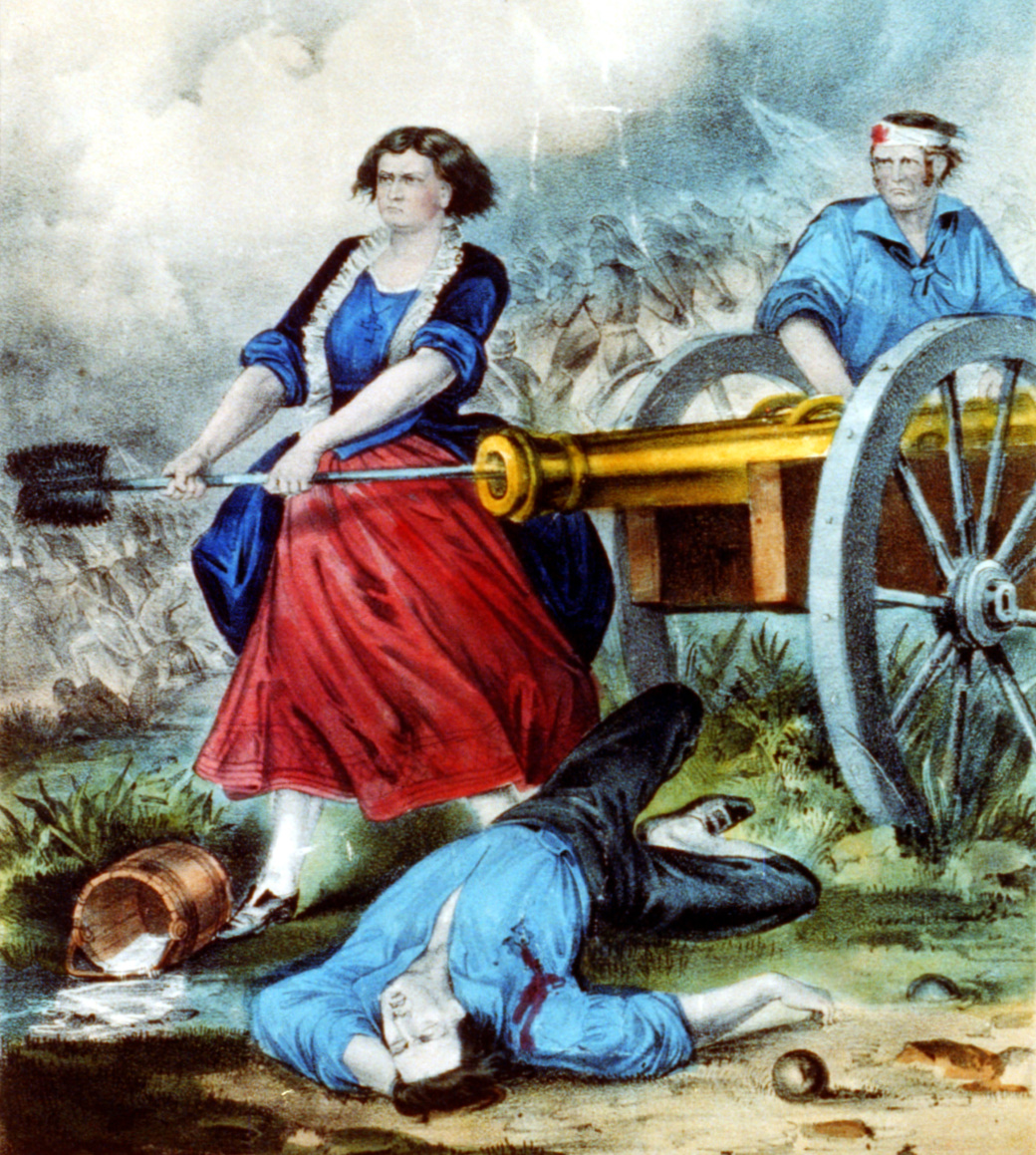
    Unable to cross the brook, Clinton brings up his guns along the hedgerow, and what the park calls the largest land artillery battle of the war begins. Ten Continental guns on Perrine Hill (the park's count; the Trust's Wickersty puts it near sixteen) duel with the British pieces across the valley for some two hours or more, while Washington rides the line. On the advice of Lt. Col. David Rhea, who grew up nearby, Washington sends Greene with a Virginia brigade (the park brochure) and four guns under the Chevalier du Plessis-Mauduit to Combs Hill, south of the hedgerow; archaeologists located the battery from nearly 50 recovered shot. Caught in the crossfire, the British guns pull back and their infantry follows. Temperatures are near 100 degrees in the fields, water is scarce, and heat kills men on both sides. Tradition holds that Mary Hays, the 'Molly Pitcher' of legend, brought water and served a gun of Proctor's artillery here; the private Joseph Plumb Martin describes an unnamed woman working a gun with her husband, and historians differ on how much of the story can be tied to one person.

  7. About 4-6 PM

    Fighting on the flanks

    Older accounts describe British attacks on both American flanks in the late afternoon: Cornwallis tries to dislodge Greene from Combs Hill, and attacks swing back and forth across the brook for about an hour before both sides return to their positions. The state park's current interpretation stresses Washington's own cautious counteroffensive. Two light infantry battalions, including Cilley's, work round the valley against the 42nd Highlanders in the Sutfin orchard; about 300 Highlanders decline a needless firefight and withdraw across the brook. Near 5 PM Wayne takes about 400 men across the bridge and strikes the 1st Grenadiers; driven back, his men hold the parsonage buildings and yards until fire from Combs Hill forces the grenadiers to fall back. By 6 both armies are spent, and Clinton pulls back about half a mile out of range. Washington orders Poor's and Woodford's brigades round the British flanks, but darkness stops them.

  8. Night of 28-29 June; 5-6 July

    Withdrawal to Sandy Hook

    The Continentals sleep on their arms on the field, Washington wrapped in his cloak, planning to attack at dawn. But at about midnight (the park says around 11 PM) Clinton leaves his campfires burning and marches off so quietly that Poor's men, lying close, do not notice. By sunrise the British are on the road to Middletown. A bridge of boats to Sandy Hook is laid on 1-2 July, and on 5-6 July the army is ferried to the transports for New York (Monmouth County Historical Association). Both sides claim the victory; the battle is usually judged a tactical draw, but the Continental Army has held the field against the best British regulars. Lee demands an apology, is court-martialed, found guilty on all three charges on 12 August and suspended for a year, a verdict Congress confirmed in December. Old Tennent Meeting House serves as the main American field hospital, and Monckton is buried in its churchyard.

Forces

Clinton's whole column was much larger than either American force, but only his rear division of about 6,000 to 10,000 fought. Against it came Lee's advance corps of about 5,000 to 6,000 and then Washington's main army of a similar size. Published totals vary by several thousand.

British (Clinton, Cornwallis)

Column crossing New JerseyThe state park's marker gives about 20,000 British, German and Loyalist troops. The American Battlefield Trust's figure of about 20,000 Crown troops includes women and children. Monmouth Battlefield State Park marker (HMdb); American Battlefield Trust (Wickersty)about 20,000
Rear division (Clinton and Cornwallis), engagedThe editors of the Washington Papers give about 6,000, mostly British. The American Battlefield Trust gives 10,000 British engaged. Papers of George Washington, editorial note (Founders Online); American Battlefield Trustabout 6,000–10,000 (6,000–10,000)
Knyphausen's division (with the baggage, not engaged) Papers of George Washington, editorial note (Founders Online)about 4,000

Continental Army (Washington, Lee)

Army in New JerseyThe state park's marker says Washington set out with 13,000. Gary Ecelbarger counts 17,703 Continentals leaving Valley Forge and about 21,293 Continentals and militia in New Jersey by 23 June. Monmouth Battlefield State Park marker (HMdb); Ecelbarger, 'The Monmouth Campaign by the Numbers' (JAR, 2025)about 13,000–21,000 (13,000–21,300)
Lee's advance corps (marched from Englishtown)The Washington Papers editors and the state park give about 5,000. Ecelbarger counts 6,490 at Englishtown, of whom about 6,000 marched. Papers of George Washington, editorial note (Founders Online); Ecelbarger, 'The Monmouth Campaign by the Numbers' (JAR, 2025); NJ DEP park brochureabout 5,000–6,000 (4,000–6,500)
Washington's main armyThe Washington Papers editors give about 6,000 in Stirling's and Greene's divisions. The park brochure gives about 8,500, and Ecelbarger puts it at no more than 10,000 to 10,500. Papers of George Washington, editorial note (Founders Online); NJ DEP park brochure; Ecelbarger, 'The Monmouth Campaign by the Numbers' (JAR, 2025)about 6,000–10,000 (6,000–10,500)
American Battlefield Trust figure (engaged)The Trust's battle page gives 5,400 Americans and 10,000 British engaged, about 15,400 in all. American Battlefield Trustabout 5,400

Casualties

Each side lost a few hundred men: about 325 Americans and 381 British by the usual counts. Heat killed dozens on each side. Washington's burial count suggests British losses were higher than Clinton reported, and the missing on both sides included many stragglers and some deserters. Certainty: fair.

British (Clinton, Cornwallis)

Killed (including deaths from heat)The editors of the Washington Papers read Clinton's official report as 147 killed. The American Battlefield Trust's Jason Wickersty gives the same report as 65 killed plus 59 dead 'with fatigue', meaning heat and exhaustion. Papers of George Washington, editorial note (Founders Online); American Battlefield Trust (Wickersty, 'Heat of the Moment')about 124–147 (124–147)
WoundedClinton's official report as given by the editors of the Washington Papers. The American Battlefield Trust's Wickersty gives 140. Washington reported that four officers and about 40 men too badly wounded to move were left behind. Papers of George Washington, editorial note (Founders Online); American Battlefield Trust (Wickersty); Washington to Henry Laurens, 1 July 1778 (Founders Online)170 (140–170)
MissingFrom Clinton's official report. Papers of George Washington, editorial note (Founders Online)64
Total casualties (estimate)The American Battlefield Trust gives 381, the total of Clinton's figures. Washington wrote that his men buried 4 British officers and 245 privates and that the British buried others, which suggests the official return is too low. American Battlefield Trust; Washington to Henry Laurens, 1 July 1778 (Founders Online)about 381 (381 to 500 or more)

Continental Army (Washington, Lee)

KilledWashington's enclosed return of 1 July totals 69 (8 officers, 1 sergeant and 60 men), and Howard Peckham's modern count (The Toll of Independence), cited by the editors of the Washington Papers, gives the same. Papers of George Washington, editorial note (Founders Online); Washington to Henry Laurens, 1 July 1778, with return (Founders Online)69 (69)
Died of heatstrokePeckham's figure, counted apart from the battle dead. Several more men had died of heat on the march the day before (Washington). Papers of George Washington, editorial note (Founders Online)37
WoundedPeckham and Washington's return agree. Papers of George Washington, editorial note (Founders Online)161
MissingPeckham gives 95. Washington's return listed 132 missing, and he noted that many later rejoined. The American Battlefield Trust's heat article gives 140. Papers of George Washington, editorial note (Founders Online); Washington to Henry Laurens, 1 July 1778 (Founders Online); American Battlefield Trust (Wickersty)95–140 (95–140)
Total casualties (estimate)The Trust gives 325 (Peckham's killed, wounded and missing, without his 37 heat deaths); Washington's own return totals 362 and Wickersty's figures 370. American Battlefield Trust; Washington to Henry Laurens, 1 July 1778, with return (Founders Online); American Battlefield Trust (Wickersty)about 325 (325–370)

Civilians

Civilian lossesThese sources record no civilian deaths. Farms on the field were stripped. At the Craig farm, Ann Craig fled with her child and two enslaved people, the British found the valuables she had hidden in the well, and the house was used as a hospital. The Tennent meetinghouse became the main Continental field hospital. Crossroads of the American Revolution, Craig House; Old Tennent Church marker (HMdb)property, not lives

Then and now: how the ground has changed

The western battlefield, from Perrine Hill and the Sutfin farm to the hedgerow, the Parsonage and Combs Hill, is still open farmland and orchard inside Monmouth Battlefield State Park. The boggy brook bottoms have been drained, the bridge and the hedgerow are gone, and the eastern ground where Lee's advance began now lies under Freehold, U.S. 9 and other roads.

The interactive map can show the period landscape (5 shapes: Middle Brook morass west of the bridge (approximate), Swamp at the foot of Combs Hill (approximate), Railroad beside the old Englishtown road (approximate), U.S. Route 9 (approximate), Freehold, built over (approximate)) under the units. Open the map.

Weapons

British (Clinton, Cornwallis)

Short Land Pattern musket ("Brown Bess")

Short Land Pattern musket ("Brown Bess")

Smoothbore flintlock musket · 1768–1790s pattern

At Monmouth: The standard musket of the British Guards, grenadiers, light infantry and line regiments who made up Clinton's rear division.

The British infantryman's musket for most of the 18th century. Accuracy beyond about 100 yards was poor, so the tactics were volleys at close range followed by the bayonet, which the Brown Bess was built to carry.

Caliber
.75 (ball about .69)
Effective range
about 50–100 yd against a formed line
Rate of fire
3 rounds a minute, drilled
Photo: Tower (British Ordnance) · Public domain
Socket bayonet

Socket bayonet

Edged weapon (musket attachment) · c. 1690s-1860s

At Monmouth: The grenadiers and Guards attacked the Point of Woods and the hedgerow with the bayonet, and fought hand to hand there.

The socket bayonet slipped over the outside of the musket barrel and locked in place, turning every musket into a short pike without blocking the muzzle. It made the pike obsolete and let infantry defend themselves against cavalry and finish an assault at close quarters. For a century and a half, a determined bayonet charge often decided fights that musketry could not.

Length
Triangular blade, about 17 in on the Brown Bess
Use
Fitted over the muzzle so the musket could still be fired
Photo: Rama · CC BY-SA 2.0 fr
Light 6-pounder field gun

Light 6-pounder field gun

Smoothbore muzzle-loading cannon · 18th century

At Monmouth: Clinton brought field guns and howitzers up to the hedgerow for the long duel with the Continental guns on Perrine Hill.

The workhorse of 18th-century field artillery: light enough to move with infantry, heavy enough to break up an attack. At close range the gunners switched to canister, a tin can of musket balls that turned the gun into a giant shotgun.

Shot
6 lb iron round shot, or canister
Range
round shot to about 1,200 yd; canister about 300 yd
Crew
about 6–8 men
Photo: Photojunkie · Public domain

Continental Army (Washington, Lee)

French Model 1766 musket ("Charleville")

French Model 1766 musket ("Charleville")

Smoothbore flintlock musket · 1766–1777 pattern

At Monmouth: Many Continental regiments carried French-supplied muskets by 1778.

France shipped tens of thousands of these muskets to the Continental Army from 1777, quietly, before it entered the war. Lighter and slightly smaller-bored than the Brown Bess, it became the pattern for America's first national musket, the Springfield Model 1795.

Caliber
.69
Effective range
about 100 yd
Rate of fire
2–3 rounds a minute
Photo: Charleville Arsenal · Public domain
Light 6-pounder field gun

Light 6-pounder field gun

Smoothbore muzzle-loading cannon · 18th century

At Monmouth: Continental field guns, many of them light French 4-pounders, fought the great cannonade from Perrine Hill and Combs Hill.

The workhorse of 18th-century field artillery: light enough to move with infantry, heavy enough to break up an attack. At close range the gunners switched to canister, a tin can of musket balls that turned the gun into a giant shotgun.

Shot
6 lb iron round shot, or canister
Range
round shot to about 1,200 yd; canister about 300 yd
Crew
about 6–8 men
Photo: Photojunkie · Public domain
Canister Shot

Canister Shot

Close-range artillery ammunition · Used throughout the Civil War

At Monmouth: Grapeshot and canister from Perrine Hill threw back the grenadiers at the bridge and broke up the attack near the Sutfin orchard. Archaeologists have recovered lead canister and iron grapeshot there.

Canister turned a cannon into a giant shotgun: the tin can split open at the muzzle and sprayed iron balls across the front. In emergencies gunners loaded double or even triple canister. It was the deadliest round in a battery's limber chest whenever infantry charged the guns.

Contents
A tin can packed with iron balls (27 in a 12-pounder round)
Range
Most effective inside about 400 yd
Use
Against infantry and cavalry at close range
Photo: Minnesota Historical Society · CC BY-SA 3.0

Paintings and photographs

Washington Rallying the Troops at Monmouth
Washington Rallying the Troops at Monmouth Emanuel Leutze's 1857 painting of Washington rallying the army after Lee's retreat, a romantic imagining (Monmouth County Historical Association). Emanuel Leutze, 1857 — public domain · source
"Molly Pitcher" (Currier & Ives)
"Molly Pitcher" (Currier & Ives) A Currier & Ives print of the "Molly Pitcher" story, a tradition that grew from accounts of women carrying water and serving guns at Monmouth. Currier & Ives — public domain · source
Craig House
Craig House The Craig House, an eighteenth-century farmhouse on the battlefield, now part of Monmouth Battlefield State Park. Public domain · source

Free for everyone every year on its anniversary: June 28.

Accuracy score: 66/100 (moderate)

How the accuracy score works

Sources and method

Monmouth, 28 June 1778. No U.S. Army staff ride handbook covers Monmouth. Units are placed on the New Jersey Division of Parks and Forestry wayside exhibits of Monmouth Battlefield State Park, with positions from the Historical Marker Database: Perrine Hill (The Great Cannonade, Perrine Hill Front Line, Battlefield Archaeology, Perrine Hill Spring, Washington Resumes the Offensive), the Sutfin orchard (Highlanders Decline Combat), the hedgerow (Hold the Hedgerow!, The British Grenadiers), the Parsonage, Combs Hill (Locating the Continental Artillery on Combs Hill, after E. and D. Sivilich's 2015 BRAVO archaeology), the traditional meeting place of Washington and Lee (Retreat?), Old Tennent Church, Englishtown and the Monmouth Battle Monument. The course of the day follows the park's interpretation and Lender and Stone, Fatal Sunday (the basis for the not-a-rout reading and Monckton's mortal wound), with the editorial note in the Papers of George Washington (Founders Online), Washington's report to Congress of 1 July 1778, the National Historic Landmark nomination (NPS), the American Battlefield Trust (battle page, J. R. Wickersty on the heat), and Gary Ecelbarger in the Journal of the American Revolution (Washington confronts Lee, the campaign by the numbers, Ramsey in the Point of Woods), the park's battlefield marker (19 June departure, 20,000 troops), the Monmouth County Historical Association on the embarkation at Sandy Hook, the Washington Papers on Lee's court-martial (verdict 12 August, confirmed 5 December 1778), with Colin Zimmerman on the march to Crosswicks. The standard modern study is Mark Edward Lender and Garry Wheeler Stone, Fatal Sunday (University of Oklahoma Press, 2016), whose maps (Friends of Monmouth) underlie the park's interpretation. On 'Molly Pitcher', see Emily J. Teipe in Prologue (National Archives, 1999). The Middle Brook bridge, Oswald's Knoll and the Point of Woods are placed from written descriptions, and the morning positions near the court house and all regional routes are schematic. Times differ between accounts by up to three-quarters of an hour.

Where the positions come from

Further reading