Battlefield Atlas
American Civil War · 1861 First 3 stages free

Fort Sumter, 12–14 April 1861

After South Carolina seceded on 20 December 1860, Major Robert Anderson moved the small U.S. garrison of Charleston Harbor from Fort Moultrie to the unfinished Fort Sumter on the night of 26 December. A relief ship, the Star of the West, was fired on and turned back on 9 January. When Lincoln sent a relief expedition under Gustavus Fox in April, the Confederate government ordered the fort taken. At 4:30 AM on 12 April 1861, Brig. Gen. P. G. T. Beauregard's batteries around the harbor opened fire. After 34 hours, with the fort's quarters on fire and Fox's ships unable to cross the bar in a gale, Anderson's roughly 85 soldiers and 43 workmen agreed to evacuate. No one was killed in the bombardment. Private Daniel Hough died in an accidental explosion during the 100-gun salute on 14 April, the first soldier to die in the war. The fall of Fort Sumter began the American Civil War, which would decide whether the Union survived and whether slavery would end.

Play the first 3 stages free8 stages on modern satellite imagery and terrain, with 3D elevation

The first 3 of its 8 stages are free to play. The rest opens with Battlefield Explorer ($4.99 a month or $39 a year), which unlocks every battle in the atlas and every one added later. Lifetime access and war packs are one-time options. Free battles include Thermopylae, Plataea, Actium, Viking raid on Lindisfarne, Hastings, Hattin, Agincourt, Vítkov Hill, Kutná Hora, Fall of Constantinople, First St Albans, Lützen, Siege of Buda, Culloden, Fort William Henry, Yorktown, Lake Erie, Waterloo, The Alamo, Monterrey, Antietam, Little Bighorn, Manila Bay, Belleau Wood, Saint-Mihiel, Omaha Beach, Inchon, Ia Drang, Goose Green, 73 Easting, Wanat, Baghdad Thunder Runs, Manbij, Battle of Raqqa, Donetsk Airport, Ilovaisk, Debaltseve, Battle of Kyiv, Battle of Hostomel Airport, Siege of Mariupol, Bilohorivka (Siverskyi Donets crossing), Kharkiv counteroffensive, Kherson counteroffensive, Bakhmut, Vuhledar, Mala Tokmachka and Robotyne, Avdiivka, Kursk incursion.

Fort Sumter, 15 April 1861
Fort Sumter, 15 April 1861 — Alma A. Pelot, 1861 · public domain

The battle, stage by stage

  1. 26 December 1860, evening

    Across to Sumter

    Six days after South Carolina secedes, Major Robert Anderson decides to leave Fort Moultrie, which can easily be attacked from the land side, for the unfinished Fort Sumter in the harbor mouth. He has two companies of the 1st U.S. Artillery, about 85 officers and men, and acts under orders of 11 December. After dark, Doubleday's and Seymour's companies are rowed across in boats hidden near Moultrie. The men hide their muskets under their coats to pass as laborers, and they slip past the South Carolina guard steamer Nina. Lt. Norman Hall brings the families and stores over on lighters. Lt. Jefferson C. Davis's rear guard spikes Moultrie's guns, and the next day it burns the carriages of the guns that bear on Sumter. Castle Pinckney, held only by a Federal caretaker, is seized by South Carolina volunteers the next day, 27 December, along with Moultrie.

  2. 9 January 1861, soon after daylight

    Star of the West

    The government has chartered the merchant steamer Star of the West to carry about 200 troops and supplies to Sumter. Doubleday watches with a spyglass from the parapet as she crosses the bar and steams up the Morris Island channel. A new battery manned by Citadel cadets, set to command the channel and out of reach of Sumter's guns, fires a shot to bring her to, and she hoists a large U.S. garrison flag. When she comes within range of Fort Moultrie, one or two of its guns open fire as well. Two shots hit her but do little damage. Anderson has no order to answer and holds his fire, and the unarmed ship turns back to New York. The next day Washington tells him to stay strictly on the defensive. The battery's exact site is not known; its position here is approximate.

  3. 11 April 1861, 4 PM

    The ring of batteries

    Brig. Gen. P. G. T. Beauregard took command of Confederate forces at Charleston on 3 March. By 12 April, by the National Park Service's count, about 6,000 troops ring the harbor, with batteries at Fort Johnson on James Island, on Cummings Point (an inclined, iron-plated Columbiad battery and a 12-pounder Blakely rifle), at Fort Moultrie (11 guns bearing on Sumter) and elsewhere on Sullivan's Island, at Mount Pleasant (two 10-inch mortars), and in a floating battery moored off the western tip of Sullivan's Island. Capt. J. G. Foster's engineer report gives 30 guns and 17 mortars firing on Sumter. Sumter itself has 60 guns mounted, but too few men to work them. At 4 PM Beauregard's aides, Col. James Chesnut, Capt. Stephen D. Lee and Lt. Col. A. R. Chisolm, row out with a demand for surrender, and the officers' council refuses. Anderson remarks that if the fort is not battered to pieces, it will be starved out in a few days. After midnight the aides return, now with Roger A. Pryor, and Anderson offers to leave by noon on 15 April unless he gets new orders or supplies. The offer is rejected, and at 3:20 AM the aides give notice that the batteries will open in one hour.

  4. 12 April 1861, 4:30 AM

    The signal shell

    At 4:30 AM a 10-inch mortar of Capt. George S. James's battery outside Fort Johnson fires the signal shell, which bursts over Fort Sumter. The Park Service says it is uncertain whether James fired it or ordered it fired; one account credits Lt. Henry S. Farley with pulling the lanyard, and Roger Pryor, offered the honor, reportedly declined. Within minutes the fire becomes general: the Park Service handbook counts 43 guns and mortars in action. Edmund Ruffin, the Virginia secessionist serving with the Palmetto Guard at the Cummings Point iron battery, fires that battery's first shot; the old claim that he fired the war's first shot is mistaken. Out at sea, after three days of storms, Gustavus Fox's Baltic reaches the rendezvous off Charleston at 3 AM, where she finds only the revenue cutter Harriet Lane. The relief ships carry supplies and men meant for the fort. Between them and Sumter lie the bar, a heavy sea and every Confederate battery in the harbor.

  5. 12 April, 7 AM

    Sumter replies

    The garrison breakfasts and then goes to the guns. At about 7 AM Capt. Abner Doubleday fires the first Union shot, from a 32-pounder at the right gorge angle, against the iron battery on Cummings Point. It glances off the sloped iron roof without visible effect. Anderson keeps his men off the open barbette tier, where his heaviest guns stand, and fights only from the lower casemates. By Foster's report the men work in three two-hour reliefs, and nearly all of the 43 engineer workmen volunteer to serve the guns or carry shot. Cartridges run short, and blankets, shirts and hospital sheets are sewn into new bags. Later in the day only six guns can be kept firing. The Pawnee arrives at 7 AM by Fox's report (6 AM in another account) and anchors near the bar with the Harriet Lane. Fox stands in with the Baltic, sees the fort under fire and turns back. Cmdr. Rowan's orders say to wait for the Powhatan, which has been sent elsewhere. He offers to take the Pawnee in and share the garrison's fate, and Fox persuades him that the government does not expect such a sacrifice. The tugs and the Pocahontas have not arrived.

  6. Night of 12–13 April

    A gale and a long night

    Sumter falls silent at dark while the Confederate mortars keep up a slow fire through the night. The barracks catch fire three times on the 12th, and the garrison puts out each fire. Fox reports that the weather is 'during the whole time a gale.' The captains agree to wait for the Powhatan and try to put boats in with supplies in the morning, but the heavy sea and the missing gunboats rule out a night attempt: 'the attempt was to be made in the morning,' Fox reports. All night it blows strong, with a heavy sea.

  7. 13 April, mid-morning to 2 PM

    Fire, the flagstaff, and Wigfall

    The fire resumes at dawn. Around mid-morning hot shot, by the NPS account from Fort Moultrie, sets the officers' quarters alight. The flames spread to the barracks, and by noon the fort is nearly uninhabitable. Some of the roughly 300 barrels of powder are carried to the casemates, about 50 by one Park Service account and 96 by Doubleday's, and as the fire spreads most are thrown into the sea; the magazines are shut. At about 1 PM the flagstaff is shot down (accounts range from 12:48 to 1:30), and the flag is soon raised again on a makeshift staff. Col. Louis T. Wigfall, a former U.S. senator from Texas, rows over from Cummings Point on his own initiative, with a private soldier and two enslaved men at the oars. He offers terms in Beauregard's name, and Anderson agrees to evacuate. The firing stops between about 1:30 and 2 PM. Beauregard's authorized aides then arrive and say that Wigfall had no authority. By evening the terms are confirmed, and Beauregard grants the salute to the flag. Off the bar the Baltic has run onto a shoal in fog, the Pawnee has seized an ice schooner for a boat attempt that night, and the Pocahontas arrives at about 2 PM.

  8. 14 April 1861, 2 PM

    The salute and the first death

    No one has been killed in 34 hours of bombardment, though more than 3,000 shells have been fired at the fort. At 2 PM on the 14th Anderson begins a 100-gun salute to the flag. A spark sets off a charge too early, and the explosion kills Private Daniel Hough of Company E instantly, on the 50th round by the Park Service handbook, and wounds five others. Hough is the first soldier to die in the war, and he is buried on the fort's parade ground. Private Edward Gallway, mortally hurt, dies days later in a hospital. Anderson stops the salute at 50 rounds. The garrison marches out with drums beating and colors flying and boards the steamer Isabel. On the 15th the men go aboard the Baltic, raise Sumter's flag at her masthead and sail for New York. Lincoln's call for 75,000 volunteers follows that day.

Forces

About 6,000 Confederate troops and some 47 guns and mortars ringed the harbor against a Union garrison of about 85 soldiers and 43 civilian workmen in a fort with 60 guns mounted. The totals are well attested; the battery counts differ slightly between accounts.

Confederate (Beauregard; South Carolina forces)

Troops around the harborabout 6,000

NPS estimate for the morning of 12 April. NPS, Battle of Fort Sumter, April 1861

Guns and mortars firing on Sumter43-47

Capt. J. G. Foster's engineer report gives 30 guns and 17 mortars; the NPS handbook says 43 guns and mortars were firing within minutes of the signal shell. Official Records I/1 p. 18 (Foster); NPS Historical Handbook No. 12 (Barnes)

Union (Anderson's garrison and Fox's relief expedition)

Garrison (soldiers)about 85

Two companies of the 1st U.S. Artillery, about 85 officers and men (NPS Handbook 12). NPS Historical Handbook No. 12 (Barnes)

Engineer workmen43

Civilian laborers; nearly all volunteered to serve the guns or carry shot and cartridges (Foster's report). Official Records I/1 p. 18 (Foster)

Guns mounted in Fort Sumter60

60 guns by 12 April, but the garrison worked only some of the lower-tier casemate guns; later on the 12th only six were kept firing (NPS Handbook 12). NPS Historical Handbook No. 12 (Barnes)

Star of the West troops (9 January)about 200

The troops the chartered steamer carried; they never landed (NPS Handbook 12; NPS wayside). NPS Historical Handbook No. 12 (Barnes); Star of the West wayside (HMdb 30724)

Casualties

The 34-hour bombardment killed no one on either side. The war's first deaths came by accident, when an explosion during Anderson's salute to the flag on 14 April killed Pvt. Daniel Hough and mortally wounded Pvt. Edward Gallway. These figures are well documented. Certainty: good.

Confederate (Beauregard; South Carolina forces)

Killed in the bombardment0

The National Park Service handbook says the only deaths of the engagement were the two Union soldiers lost in the salute; no Confederate was killed by Sumter's fire. NPS Historical Handbook No. 12 (Barnes)

Woundednone reported

The NPS sources consulted report no Confederate killed and give no Confederate wounded; Sumter's few guns fired mainly at the Cummings Point and Moultrie batteries. NPS, Battle of Fort Sumter, April 1861

Union (Anderson's garrison and Fox's relief expedition)

Killed in the bombardment0

No one in the garrison was killed by the more than 3,000 shells fired at the fort in 34 hours (NPS Handbook 12). NPS Historical Handbook No. 12 (Barnes)

Killed in the salute, 14 April1 killed, 1 mortally wounded

A premature discharge during the 100-gun salute killed Pvt. Daniel Hough instantly; Pvt. Edward Gallway died of his wounds days later. The NPS article places Gallway's death at a hospital in Charleston, while Five Flags Over Fort Sumter says New York. NPS, Battle of Fort Sumter, April 1861; NPS, Five Flags Over Fort Sumter

Wounded in the salute5

Five other men of Company E were wounded; Pvt. George Fielding lost an eye (NPS). NPS, Battle of Fort Sumter, April 1861; NPS, Five Flags Over Fort Sumter

Surrendered and evacuatedthe whole garrison

About 85 officers and men and the engineer workmen marched out with their arms and colors and sailed for New York on the Baltic; they were not held as prisoners. NPS Historical Handbook No. 12 (Barnes); Naval History magazine, Eyewitness to the Fall of Fort Sumter

Equipment and ships

Fort Sumter's quarters (Union)burned

Hot shot set the officers' quarters and barracks on fire on 13 April; most of the powder was thrown into the sea as the fire spread (NPS; Five Flags Over Fort Sumter). NPS, Battle of Fort Sumter, April 1861; NPS, Five Flags Over Fort Sumter

Star of the West (9 January)2 hits, little damage

Two shots struck the unarmed steamer before she turned back (Doubleday). Doubleday, Reminiscences of Forts Sumter and Moultrie

Then and now: how the ground has changed

The harbor's forts are still in place, but Fort Sumter is a ruin cut down to its lower tier around an 1898 battery. Morris Island's north end and outer beach have washed away since the harbor jetties were built, so the 1861 site of Cummings Point is lost.

Weapons

Confederate (Beauregard; South Carolina forces)

Siege and sea-service mortar (10- and 13-inch)

Siege and sea-service mortar (10- and 13-inch)

Siege artillery · 1600s-1860s

At Fort Sumter: Ten-inch seacoast mortars at Fort Johnson (the signal shell), Mount Pleasant (two, under Capt. Robert Martin, 81 shells in two days) and Cummings Point lobbed shells into the fort.

Mortars threw explosive shells in a high arc over walls and parapets. At Louisbourg in 1758 British shells set French warships and the bastion barracks on fire and fell on the hospitals and casemates.

Shell
Hollow iron shell with a fuse, up to about 200 lb for a 13-inch
Fire
High-angle, over walls into the works and the harbor
Crew
Several men per piece
Photo: Royal Museums Greenwich (an 1825 example), public domain
Columbiad (8- and 10-inch)

Columbiad (8- and 10-inch)

Smoothbore seacoast gun · 1840s–1860s

At Fort Sumter: Three 8-inch Columbiads fired from under the sloping iron roof of the Cummings Point battery, and Fort Moultrie had three more among its 11 guns bearing on Sumter.

Heavy American coast-defense guns that could fire solid shot or explosive shell at a high angle. Confederate forts around Charleston harbor, Battery Wagner among them, mounted columbiads to keep Union ships and batteries at bay.

Shot
10-inch: about 128 lb shot or shell
Range
about 1–3 miles depending on elevation
Mount
barbette carriage on a fort's rampart
Photo: Michael Rivera · CC BY-SA 3.0
Blakely rifle (12-pounder)

Blakely rifle (12-pounder)

Rifled muzzle-loading cannon · 1860s

At Fort Sumter: A 12-pounder Blakely rifle at Cummings Point, a gift from a Charlestonian in London, damaged an embrasure wall at Sumter.

A British-made rifled gun with a reinforced breech, imported by the Confederacy and its supporters. The one at Cummings Point, a gift from a Charlestonian in London, was among the first rifled cannon fired in the war; its bolts damaged an embrasure at Fort Sumter (NPS Historical Handbook 12).

Maker
Alexander Blakely's designs, made in Britain
Projectile
about 12 lb rifled bolt or shell
Use at Sumter
one gun at Cummings Point, April 1861
Photo: Library of Congress (a larger Blakely at Charleston, 1865), public domain
Heated shot (hot shot)

Heated shot (hot shot)

Incendiary solid shot · 1700s–1860s

At Fort Sumter: Heated shot, by the NPS account from Fort Moultrie, set the officers' quarters on fire on the 13th and made the fort nearly uninhabitable.

Solid iron balls heated red-hot in a furnace and fired into wooden structures to set them alight. On 13 April 1861 hot shot set Fort Sumter's officers' quarters and barracks on fire, and the flames and the danger to the magazines helped force the surrender (NPS).

Heated in
a shot furnace beside the battery
Target
wooden ships, roofs and barracks
Photo: U.S. National Archives (the hot-shot furnace at Fort Moultrie), public domain

Union (Anderson's garrison and Fox's relief expedition)

32- and 42-pounder seacoast guns

32- and 42-pounder seacoast guns

Smoothbore seacoast gun · 1820s–1860s

At Fort Sumter: Sumter's casemate guns, mostly 32-pounders with some 42-pounders, were the only ones Anderson let his men work. Doubleday fired the first shot from a 32-pounder.

The standard heavy smoothbores of American coastal forts before the war. Most of Fort Sumter's guns in December 1860 were 32-pounders, and 42-pounders were added by April 1861 (NPS Historical Handbook 12). Doubleday fired the first Union shot of the war from a 32-pounder.

Shot
32 or 42 lb solid shot
Mount
casemate or barbette carriage
Photo: U.S. National Archives, public domain
Columbiad (8- and 10-inch)

Columbiad (8- and 10-inch)

Smoothbore seacoast gun · 1840s–1860s

At Fort Sumter: Heavy Columbiads stood on Sumter's open barbette tier, too exposed to man, and five more were set in the parade as mortars.

Heavy American coast-defense guns that could fire solid shot or explosive shell at a high angle. Confederate forts around Charleston harbor, Battery Wagner among them, mounted columbiads to keep Union ships and batteries at bay.

Shot
10-inch: about 128 lb shot or shell
Range
about 1–3 miles depending on elevation
Mount
barbette carriage on a fort's rampart
Photo: Michael Rivera · CC BY-SA 3.0

Paintings and photographs

Fort Sumter, 15 April 1861
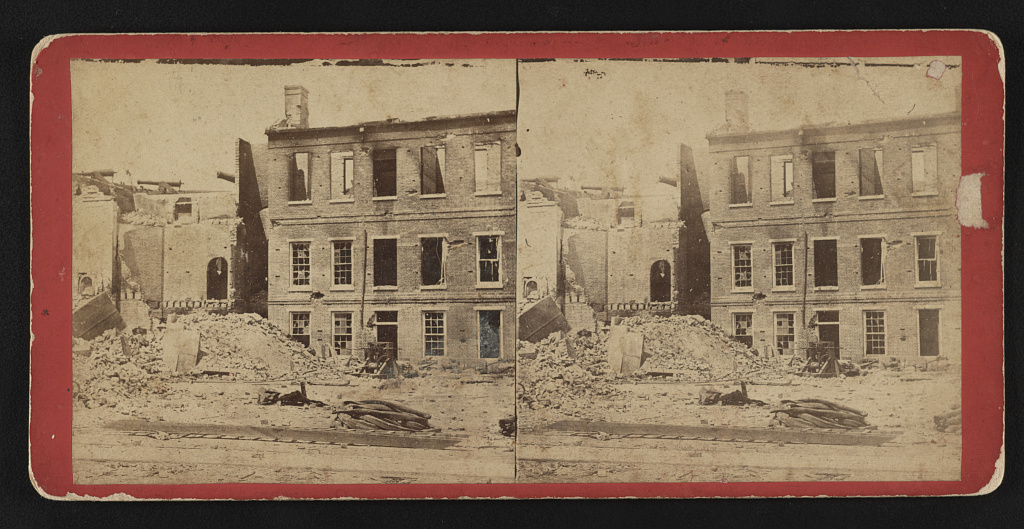
Fort Sumter, 15 April 1861 Fort Sumter on the morning of 15 April 1861, the day after the evacuation, with the Confederate flag over the ruins. Detail of a stereo view by Alma A. Pelot. Alma A. Pelot, 1861 · public domain · source
Bombardment of Fort Sumter (Currier & Ives)
Bombardment of Fort Sumter (Currier & Ives) Currier & Ives's 1861 lithograph of the bombardment of Fort Sumter, 12 and 13 April 1861 (Library of Congress). Viewpoint not recorded; pinned in the harbor west of the fort, approximate. Currier & Ives, 1861 (Library of Congress) · public domain · source
Interior of Fort Sumter during the bombardment
Interior of Fort Sumter during the bombardment A hand-colored popular lithograph of the garrison working the casemate guns inside Fort Sumter during the bombardment, 12 April 1861 (Library of Congress). Library of Congress, Popular Graphic Arts · public domain · source
The First Gun at Fort Sumter (Conant)
The First Gun at Fort Sumter (Conant) Alban Jasper Conant's 1861 painting The First Gun at Fort Sumter, showing Maj. Robert Anderson (Smithsonian American Art Museum). Pinned at Anderson's headquarters in the fort. Alban Jasper Conant (Smithsonian American Art Museum) · public domain · source
Bombardment of Fort Sumter (Perine engraving)
Bombardment of Fort Sumter (Perine engraving) The bombardment of Fort Sumter, 1861: an engraving by George Edward Perine made in 1863 for Abbott's history of the Civil War (courtesy National Park Service). George Edward Perine (National Park Service) · public domain · source
The Attack on Fort Sumter (Bobbett)
The Attack on Fort Sumter (Bobbett) Print by Bobbett of Confederate artillerymen firing their guns with Fort Sumter in the background, 1861 to 1865. The battery is not named; pinned at the fort it shows, approximate. Bobbett · public domain · source
Bombardment of Fort Sumter by the Confederate batteries
Bombardment of Fort Sumter by the Confederate batteries Bombardment of Fort Sumter by the batteries of the Confederate states, a print published by Currier & Ives in 1861 (Library of Congress LC-USZ62-90258). Currier & Ives (Library of Congress) · public domain · source
Bombardment of Fort Sumter, 13 April 1861 (wood engraving)
Bombardment of Fort Sumter, 13 April 1861 (wood engraving) Bombardment of Fort Sumter by the batteries of the Confederate states, 13 April 1861: a two-page wood engraving of 1861 (Library of Congress). Popular Graphic Arts (Library of Congress) · public domain · source
Bombardment of Fort Sumter, 13 April 1861 (Crafts, 1868)
Bombardment of Fort Sumter, 13 April 1861 (Crafts, 1868) Engraving of the bombardment of Fort Sumter on 13 April 1861, from an 1868 illustrated history by Crafts. Artist not recorded. Unknown artist (Crafts, 1868) · public domain · source
On the floating battery
On the floating battery Scene on the floating battery in Charleston Harbor during the bombardment of Fort Sumter, a wood engraving of 1861 from a sketch by an officer (Library of Congress). Pinned at the floating battery off Sullivan's Island. Unknown engraver, after a sketch by an officer (Library of Congress) · public domain · source
Moultrie shot furnace
Moultrie shot furnace The hot-shot furnace at Fort Moultrie, photographed by Osborn & Durbec of Charleston in 1861. Osborn & Durbec (Library of Congress) · public domain · source
Moultrie gun bearing on Sumter
Moultrie gun bearing on Sumter A Fort Moultrie gun trained on Fort Sumter, photographed by Osborn & Durbec in 1861. Osborn & Durbec (Library of Congress) · public domain · source
Fort Moultrie, no. 1
Fort Moultrie, no. 1 Fort Moultrie in 1861, from the stereo series by Osborn & Durbec of Charleston. Osborn & Durbec (Library of Congress) · public domain · source
Harbor face of Fort Moultrie
Harbor face of Fort Moultrie The harbor face of Fort Moultrie after the bombardment, April 1861 (Osborn & Durbec). Osborn & Durbec (Library of Congress) · public domain · source
Morris Island battery
Morris Island battery A Confederate battery on Morris Island, photographed by Osborn & Durbec of Charleston (dated 1860 to 1861). The battery is not named; pinned at Cummings Point, approximate. Osborn & Durbec (Library of Congress) · public domain · source
Fort Sumter the day after Anderson left
Fort Sumter the day after Anderson left A crew clearing debris in front of the sally port of Fort Sumter in April 1861, the day after Anderson's garrison left (Osborn & Durbec). Osborn & Durbec, 1861 · public domain · source
Fort Sumter after the bombardment
Fort Sumter after the bombardment Fort Sumter after the bombardment, April 1861 (Osborn & Durbec). Osborn & Durbec (Library of Congress) · public domain · source
Exterior of damaged Fort Sumter
Exterior of damaged Fort Sumter An exterior view of the damaged fort, April 1861 (Osborn & Durbec). Camera position not recorded; pinned at the fort. Osborn & Durbec (Library of Congress) · public domain · source
Fort Sumter interior after the bombardment
Fort Sumter interior after the bombardment The interior of Fort Sumter after the bombardment, 1861 (Osborn & Durbec). Osborn & Durbec (Library of Congress) · public domain · source
Interior of damaged Fort Sumter
Interior of damaged Fort Sumter An interior view of the damaged fort, April 1861 (Osborn & Durbec). Osborn & Durbec (Library of Congress) · public domain · source
Interior with the flagstaff
Interior with the flagstaff The interior of Fort Sumter with the flagstaff after the bombardment, 1861 (Osborn & Durbec). Osborn & Durbec (Library of Congress) · public domain · source
Soldier by the guns in Fort Sumter
Soldier by the guns in Fort Sumter A soldier standing near the artillery inside Fort Sumter, 1861 (Osborn & Durbec). Osborn & Durbec (Library of Congress) · public domain · source
Guns on the parapet
Guns on the parapet Guns on the parapet of Fort Sumter, 1861 (Osborn & Durbec). Osborn & Durbec (Library of Congress) · public domain · source
Fort Sumter casemates
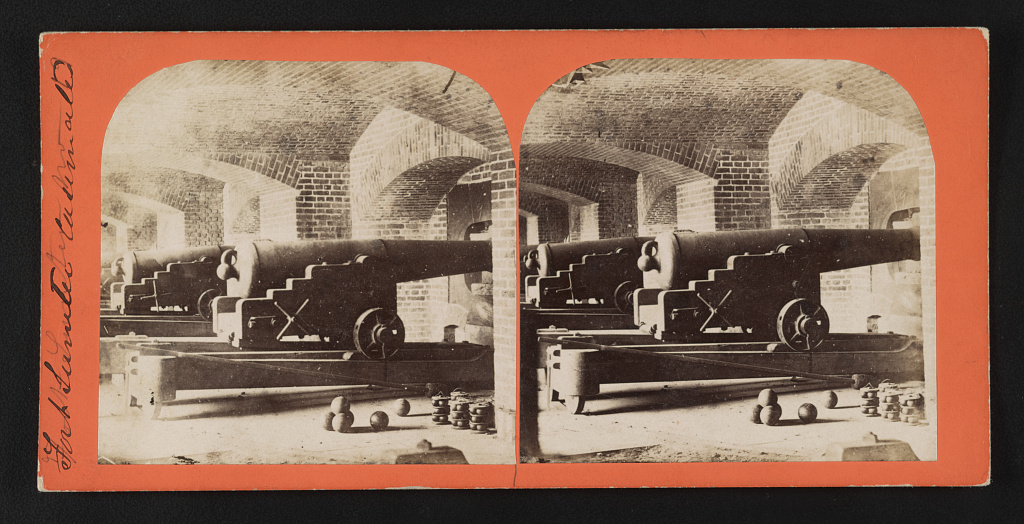
Fort Sumter casemates The casemates of Fort Sumter, photographed by Osborn & Durbec (dated 1860s; part of their 1861 harbor series). Osborn & Durbec (Library of Congress) · public domain · source
Salient with northwest casemates
Salient with northwest casemates The salient and northwest casemates of Fort Sumter, April 1861: a carte-de-visite from Osborn's Gallery, Charleston (Metropolitan Museum of Art DP266616). J. M. Osborn, Osborn's Gallery (Metropolitan Museum of Art) · CC0 · source
Interior after the surrender
Interior after the surrender Interior of Fort Sumter in April 1861 after its surrender by the U.S. garrison; albumen print (Library of Congress, no. 4799). Unknown photographer (Library of Congress) · public domain · source
Ruins of Fort Sumter today
Ruins of Fort Sumter today An interpreter walks among the ruins of Fort Sumter, Fort Sumter National Monument, January 2004. National Park Service · public domain · source
Flags at Fort Sumter today
Flags at Fort Sumter today The flags flown over Fort Sumter today: the United States flag, a Confederate flag, the 1861 U.S. flag, the South Carolina flag and the Confederate battle flag, 2009. fw_gadget · CC BY-SA 2.0 · source
Fort Moultrie today
Fort Moultrie today A cannon and the exterior of Fort Moultrie, Fort Sumter National Monument, January 2004. National Park Service · public domain · source

Free for everyone every year on its anniversary: April 12–14.

Accuracy score: 72/100 (good)

How the accuracy score works

Sources and method

Bombardment of Fort Sumter, 12–14 April 1861. No U.S. Army staff ride handbook covers Fort Sumter. The key sources are the National Park Service's Historical Handbook No. 12, Frank Barnes, Fort Sumter National Monument, South Carolina (rev. 1962), for the garrison, the batteries, times and the salute, and the NPS articles 'Battle of Fort Sumter, April 1861' and 'A Single Shot Over' (Fort Johnson). Primary sources: Capt. J. G. Foster's engineer report in the Official Records, Series I, Vol. 1 (30 guns and 17 mortars; the 4:30 AM signal shell; the 7 AM reply; the three reliefs and the volunteering workmen), Fox's report of 19 April 1861 and Beauregard's report of 16 April (transcribed at dotcw.com), and Abner Doubleday, Reminiscences of Forts Sumter and Moultrie in 1860–'61 (1876). Also used: the National Park Civil War Series booklet Five Flags Over Fort Sumter (the signal shell, Pryor, Ruffin, the powder and the salute), the NPS article 'The Palmetto Guard Flag', George Skoch's 'First Round at Fort Sumter' (HistoryNet; Cummings Point just over 1,300 yards from Sumter), the Naval History magazine article 'Eyewitness to the Fall of Fort Sumter' (U.S. Naval Institute, 2011), the Tulane University Fort Sumter chronology, HistoryNet's 'Floating Fire' (the floating battery), and the Mount Pleasant Historical Commission (Mount Pleasant mortar battery). Fixed points come from National Park Service waysides at Fort Sumter and Fort Moultrie and other markers recorded in the Historical Marker Database (hmdb.org), from the American Battlefield Trust (Fort Moultrie) and from FortWiki (Cummings Point). The positions of the Cummings Point and Mount Pleasant batteries, the floating battery's mooring and the Star of the West battery are approximate, and the 1861 shorelines of Morris Island differ greatly from today's. The relief ships, which actually lay up to ten miles off, are drawn schematically at the bar. Arrows for the signal shell and Doubleday's first shot show lines of fire, not movement.

Where the positions come from

Further reading