Battlefield Atlas
American Civil War · 1863 Members · from $3

Siege of Vicksburg, 18 May - 4 July 1863

From 18 May to 4 July 1863 Maj. Gen. Ulysses S. Grant's Army of the Tennessee, with Rear Adm. David D. Porter's Mississippi Squadron on the river, besieged Lt. Gen. John C. Pemberton's Army of Vicksburg in the last great Confederate stronghold on the Mississippi. Two general assaults, on 19 and 22 May, failed against a nine-mile ring of earthworks and nine forts - at the Railroad Redoubt the attackers briefly broke in - and cost the Union more than 4,000 men. Grant then dug toward the forts, exploded mines under the 3rd Louisiana Redan on 25 June and 1 July, and starved the city. Pemberton surrendered about 29,500 men on 4 July, the day after Gettysburg ended; with Port Hudson's fall five days later the Union controlled the whole Mississippi.

Open the interactive map8 stages on modern satellite imagery and terrain, with 3D elevation

This battle opens with Battlefield Enjoyer ($3 a month on Patreon), which unlocks every battle in the atlas and every one added later. Free battles include Teutoburg Forest, Hattin, Agincourt, Vítkov Hill, Bosworth, Fort William Henry, Yorktown, Waterloo, The Alamo, Antietam, Little Bighorn, Belleau Wood, Omaha Beach, Inchon, Ia Drang, 73 Easting, Wanat, Najaf.

Siege of Vicksburg (lithograph)
Siege of Vicksburg (lithograph) — Middleton, Strobridge & Co. — public domain

The battle, stage by stage

  1. 18 May 1863

    Into the lines

    Beaten at Champion Hill on 16 May and at the Big Black River bridge on the 17th, Lt. Gen. John C. Pemberton's Army of Vicksburg files back into the city's fortifications: a line of earthworks on the ridges east of the town, running about nine miles from the river above Vicksburg (Fort Hill) to the river below it (South Fort), with nine large forts covering the six roads and one railroad that enter the city. Maj. Gen. Martin L. Smith's division holds the left (north), Maj. Gen. John H. Forney's the center and Maj. Gen. Carter L. Stevenson's the right, with Maj. Gen. John S. Bowen's division and Waul's Texas Legion in reserve. The army numbers about 30,000, but Pemberton reportedly counted only about 18,500 effectives for the line. On the 18th Grant's Army of the Tennessee (about 50,000 effectives, by Grant's later figure) comes up behind it: Sherman's XV Corps down the Graveyard Road from the north-east, McPherson's XVII Corps on the Jackson Road, McClernand's XIII Corps on the Baldwin's Ferry Road. Union columns here are schematic.

  2. 19 May 1863, 2 PM

    First assault: the Stockade Redan

    Hoping to strike before the defenders recover, Grant orders an assault. Only Sherman's corps is in position. After a morning bombardment, Maj. Gen. Frank Blair's division goes forward at 2 PM against the Stockade Redan, a fort with a log stockade across the Graveyard Road, held by Louisiana and Mississippi troops and reinforced by Col. Francis Cockrell's Missouri brigade. Ravines and felled-tree abatis break up the lines. The 1st Battalion, 13th U.S. Infantry plants its colors on the exterior slope of the redan, but can go no further; its commander, Capt. Edward Washington, is mortally wounded. McPherson and McClernand press their skirmishers forward but make little progress. Sherman's men pull back after dark: about 1,000 Union casualties, against perhaps 200 Confederate (National Park Service figures).

  3. 22 May 1863, 10 AM

    The general assault

    Grant tries again, this time all along the line. After a four-hour bombardment, and with watches synchronised, the infantry of three corps attack at 10 AM on a front of about three miles. At the Stockade Redan a 'Forlorn Hope' of about 150 unmarried volunteers from Blair's division, led by Capt. John H. Groce, runs down the Graveyard Road carrying logs and ladders to bridge the ditch, with Ewing's brigade behind; they reach the ditch and are cut down or pinned. Thayer's brigade climbs against Shoup's works to the west. McPherson's men attack on the Jackson Road: John E. Smith's brigade at the 3rd Louisiana Redan, John D. Stevenson's at the Great Redoubt, where the 7th Missouri and 81st Illinois reach the ditch. To the south McClernand's XIII Corps hits the 2nd Texas Lunette (Burbridge's and Benton's brigades) and the Railroad Redoubt (Lawler's brigade, Landram's behind it), while Osterhaus advances toward the Square Fort. Below the city, Porter's gunboats Benton, Mound City, Carondelet and Tuscumbia engage the water batteries for about two hours, at Grant's request.

  4. 22 May 1863, afternoon to sunset

    Breach at the Railroad Redoubt

    Only McClernand's men break in. Within about 20 minutes Lawler's Iowans are over the wall of the Railroad Redoubt; Sgt. Joseph Griffith and about a dozen men of the 22nd Iowa get inside and bring out prisoners, but the 30th Alabama and Lee's brigade hold the rear of the work and the breach cannot be widened. McClernand reports that he holds two forts and asks for help; Grant, reportedly doubtful, orders renewed attacks. Sherman sends Mower's brigade down the Graveyard Road (the 11th Missouri plants its flag on the Stockade Redan's parapet), and Quinby's brigades go to McClernand; Col. George Boomer is killed leading his brigade against the curtain near the Railroad Redoubt. Green's Arkansans clear the 2nd Texas Lunette, and at sunset Waul's Texas Legion retakes the Railroad Redoubt. Union losses on the 22nd are 3,199 killed, wounded and missing (War Department tablet); Confederate losses, under 500, were never fully reported.

  5. 26 May - 24 June 1863

    Pick and shovel

    Grant turns to a siege. From 26 May his men dig thirteen approaches (zigzag saps) toward the main forts, protected by sharpshooters and massed batteries; Battery DeGolyer alone mounts up to 22 guns opposite the Great Redoubt. Reinforcements close the ring: Lauman's division of the XVI Corps on the Hall's Ferry Road and Herron's division on the far left by 11 June, while the IX Corps and other troops hold an outer line against Gen. Joseph E. Johnston's relief army (off the map). By 30 June about 73,000 Union troops are present for duty. On the river Porter's squadron besieges the city by water: ironclads and mortar boats fire some 11,500 projectiles and his heavy guns, landed for the army, about 4,500 more. On 27 May the ironclad USS Cincinnati attacks the upper batteries and is sunk in the river bend, her crew keeping her guns in action and nailing the flag to the stump of the staff. Townspeople live in caves dug in the hillsides; rations in the trenches shrink.

  6. 25 June 1863, 3:30 PM

    The crater

    At the head of Logan's Approach, miners under Capt. Andrew Hickenlooper, McPherson's chief engineer, have tunneled 40 feet under the 3rd Louisiana Redan and packed the gallery with 2,200 pounds of black powder. It is fired at about 3:30 PM, blowing a crater about 12 feet deep and 40 feet wide. Leggett's brigade of Logan's division is ordered in, the 45th Illinois first, but the defenders, warned by the sound of digging, have built a second line behind the redan. For 26 hours regiments relieve one another in the crater, fighting with bayonets, clubbed muskets and short-fused shells thrown by hand, while Missouri regiments of Bowen's division reinforce the 3rd Louisiana. The 124th Illinois holds on until 5 PM on the 26th, when the crater is given up; Leggett's brigade loses 207 men (War Department tablet).

  7. 1 - 3 July 1863

    Under the oak

    On 1 July a second mine is exploded under the same redan; no assault follows. In Vicksburg, rations are nearly gone and sickness and casualties have thinned the garrison, while Johnston's relief force, more than 30,000 strong, begins to move toward the Big Black only on 1 July. On the evening of 3 July (by the NPS account), after white flags appear in the morning, Pemberton rides out along the Jackson Road; at 3 PM he and Grant meet in the shade of an oak tree midway between the lines near the 3rd Louisiana Redan. They cannot agree, but that night Grant sends terms: instead of the unconditional surrender he first demanded, the garrison will be paroled. Pemberton's council of war accepts. The oak was soon carried off by souvenir hunters; an upturned cannon (1867) now marks the spot.

  8. 4 July 1863, 10 AM

    Surrender

    At 10 AM on Independence Day the Confederates march out in front of their works, stack their arms, lay down their equipment and furl their flags. About 29,500 men are surrendered and paroled, with 172 cannon and some 50,000 shoulder arms. By Grant's account, Logan's division, which had come closest to the enemy's works, leads the Union march into the city. Port Hudson surrenders five days later, and the Mississippi is open to the Union from source to mouth; with Gettysburg on 1-3 July, the fall of Vicksburg is often called the turning point of the war.

Weapons

Confederate

Pattern 1853 Enfield rifle-musket

Pattern 1853 Enfield rifle-musket

Rifled percussion musket · 1853–1867

At Siege of Vicksburg: Common Confederate infantry rifle.

Britain's standard infantry rifle of the 1850s and, after the Springfield, the most common long arm of the Civil War. Both sides imported it by the hundreds of thousands; it fired the same family of hollow-based Minié bullets as the Springfield.

Caliber
.577
Effective range
about 300–500 yd (sighted to 900+)
Rate of fire
2–3 rounds a minute
Photo: Smithsonian Institution (NMAH) · Public domain
Columbiad (8- and 10-inch)

Columbiad (8- and 10-inch)

Smoothbore seacoast gun · 1840s–1860s

At Siege of Vicksburg: Heavy river batteries on the bluffs.

Heavy American coast-defense guns that could fire solid shot or explosive shell at a high angle. Confederate forts around Charleston harbor, Battery Wagner among them, mounted columbiads to keep Union ships and batteries at bay.

Shot
10-inch: about 128 lb shot or shell
Range
about 1–3 miles depending on elevation
Mount
barbette carriage on a fort's rampart
Photo: Michael Rivera · CC BY-SA 3.0
Heavy siege guns (18- and 24-pounders)

Heavy siege guns (18- and 24-pounders)

Siege artillery · 1600s-1860s

At Siege of Vicksburg: Heavy guns in the land works.

Siege guns were long, heavy cannon built to smash fortifications from close-range batteries dug behind trenches. They were too heavy for ordinary field maneuver, so they were brought up by road or water and fired for days on end. Paired with mortars and howitzers, they turned a siege into a slow but methodical demolition.

Shot
18 lb or 24 lb iron ball
Use
Battering earthworks from dug-in batteries
Mobility
Very heavy; hauled by large teams
Photo: DrStew82 · CC BY-SA 4.0
M1857 12-pounder "Napoleon"

M1857 12-pounder "Napoleon"

Smoothbore field gun (bronze) · 1857-1865 (U.S. service into the 1870s)

At Siege of Vicksburg: Field artillery in the redans.

A U.S. copy of a French gun-howitzer named for Emperor Napoleon III, the Napoleon fired a 12-pound ball but was light enough for field batteries. Rifled guns outranged it, but at the short ranges of most Civil War fighting its heavy canister made it the most trusted gun on both sides. It became the most common field piece of the war.

Caliber
4.62 in
Range
About 1,600-1,700 yd (solid shot at 5°)
Shot
Solid shot, shell, case shot, canister
Crew
9
Photo: Hal Jespersen · Public domain

Union

Springfield Model 1861 rifle-musket

Springfield Model 1861 rifle-musket

Rifled percussion musket · 1861–1865

At Siege of Vicksburg: Standard Union rifle.

The Union's standard infantry weapon, made in the hundreds of thousands at Springfield Armory and by contractors. Its Minié bullet expanded into the rifling, giving rifle accuracy at musket loading speed, one reason Civil War assaults on prepared works were so costly.

Caliber
.58
Effective range
about 200–400 yd (sighted to 500)
Rate of fire
2–3 rounds a minute
Photo: Smithsonian Institution (NMAH) · Public domain
Pattern 1853 Enfield rifle-musket

Pattern 1853 Enfield rifle-musket

Rifled percussion musket · 1853–1867

At Siege of Vicksburg: Many western regiments carried Enfields.

Britain's standard infantry rifle of the 1850s and, after the Springfield, the most common long arm of the Civil War. Both sides imported it by the hundreds of thousands; it fired the same family of hollow-based Minié bullets as the Springfield.

Caliber
.577
Effective range
about 300–500 yd (sighted to 900+)
Rate of fire
2–3 rounds a minute
Photo: Smithsonian Institution (NMAH) · Public domain
10-pounder Parrott Rifle

10-pounder Parrott Rifle

Rifled field gun (cast iron, reinforcing band) · 1861-1865

At Siege of Vicksburg: Rifled guns in the siege batteries.

Robert Parrott's field gun was a cast-iron tube with a heavy wrought-iron band shrunk over the breech, making it cheap and quick to build. It was accurate at long range and both armies used it widely, though Parrotts had a reputation for occasionally bursting near the muzzle.

Caliber
2.9 in (3.0 in on later guns)
Shot
About 10 lb shell
Range
About 1,850 yd at 5°
Photo: Hal Jespersen · Public domain
M1857 12-pounder "Napoleon"

M1857 12-pounder "Napoleon"

Smoothbore field gun (bronze) · 1857-1865 (U.S. service into the 1870s)

At Siege of Vicksburg: Field batteries along the siege line.

A U.S. copy of a French gun-howitzer named for Emperor Napoleon III, the Napoleon fired a 12-pound ball but was light enough for field batteries. Rifled guns outranged it, but at the short ranges of most Civil War fighting its heavy canister made it the most trusted gun on both sides. It became the most common field piece of the war.

Caliber
4.62 in
Range
About 1,600-1,700 yd (solid shot at 5°)
Shot
Solid shot, shell, case shot, canister
Crew
9
Photo: Hal Jespersen · Public domain
Canister Shot

Canister Shot

Close-range artillery ammunition · Used throughout the Civil War

At Siege of Vicksburg: Fired at close range during the assaults.

Canister turned a cannon into a giant shotgun: the tin can split open at the muzzle and sprayed iron balls across the front. In emergencies gunners loaded double or even triple canister. It was the deadliest round in a battery's limber chest whenever infantry charged the guns.

Contents
A tin can packed with iron balls (27 in a 12-pounder round)
Range
Most effective inside about 400 yd
Use
Against infantry and cavalry at close range
Photo: Minnesota Historical Society · CC BY-SA 3.0

Paintings and photographs

Siege of Vicksburg (lithograph)
Siege of Vicksburg (lithograph) A period lithograph of Logan's division at Vicksburg during the siege. Middleton, Strobridge & Co. — public domain · source
Battle of Vicksburg (Kurz & Allison)
Battle of Vicksburg (Kurz & Allison) Kurz and Allison's 1888 chromolithograph of the assaults, a popular rather than accurate picture. Kurz and Allison — public domain · source
The fight in the crater
The fight in the crater Union troops fight in the crater blown under the 3rd Louisiana Redan on 25 June 1863 (Battles and Leaders). Harry Fenn — public domain · source
USS Cincinnati
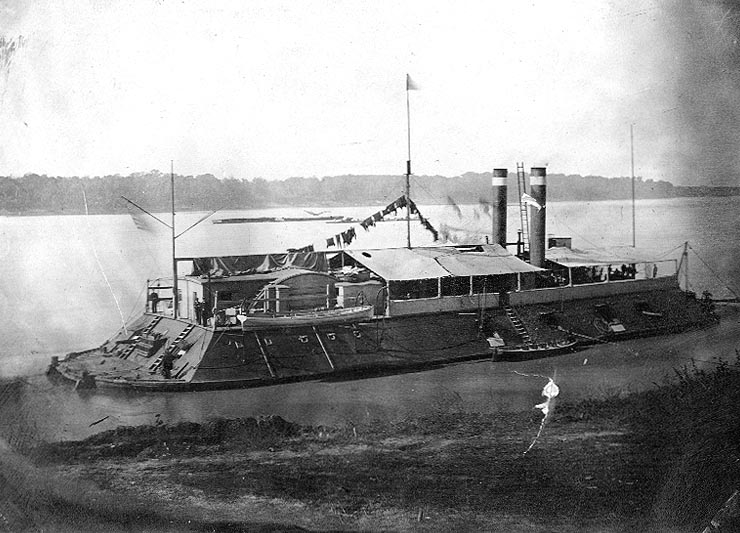
USS Cincinnati The ironclad USS Cincinnati, sunk by the upper batteries on 27 May 1863 and later raised. Naval History and Heritage Command — public domain · source
The Shirley House today
The Shirley House today The Shirley House, the 'White House' of the siege, where Logan's Approach began. Mike Gaylard — CC BY 2.0 · source

Free for everyone every year on its anniversary: May 18 – July 4.

Accuracy score: 72/100 (good)

How the accuracy score works

Sources and method

Siege of Vicksburg, 18 May - 4 July 1863. Works and units are placed from the monuments and War Department tablets of Vicksburg National Military Park, whose tour road follows the lines, with positions from the Historical Marker Database (Fort Hill, Vaughn's, Baldwin's and Shoup's tablets, the Stockade Redan and lunette tablets, Ewing's, Giles A. Smith's, Thayer's and Logan's approaches, the 3rd Louisiana Redan and crater tablets, the Great Redoubt, the Stevenson's, Boomer's, Lawler's, Landram's and Mower's assault tablets, Waul's Legion, the Railroad Redoubt, Battery DeGolyer, Fort Garrott, South Fort and the River Batteries tablet). Key source: Christopher R. Gabel and the staff of the Combat Studies Institute, Staff Ride Handbook for the Vicksburg Campaign, December 1862 - July 1863 (Army University Press / CSI) - strengths (73,095 Union present for duty on 30 June; about 29,500 surrendered), artillery (247 Union guns; 172 Confederate pieces surrendered), Porter's 11,500 projectiles and landed heavy guns, and the doctrine of the assaults and siege. Also the National Park Service: First Assault (19 May), Second Assault (22 May), Siege, Surrender, the tour-stop pages (Great Redoubt, 2nd Texas Lunette, 3rd Louisiana Redan, Battery DeGolyer), the Confederate order of battle and the Vicksburg Medal of Honor recipients list; NPS Historical Handbook 21, Vicksburg (defense line, nine forts, strengths); the NPS Civil War Series, The Campaign for Vicksburg (assault details and losses); American Battlefield Trust maps of 19 May and 22 May and the article 'Off the Rails' (Railroad Redoubt); Naval History and Heritage Command, DANFS: Cincinnati; Porter's report of the 22 May naval attack as quoted by ironbrigader.com; and the Vicksburg Post on the mortar boats (Terrence Winschel). Edwin C. Bearss, The Campaign for Vicksburg (3 vols), is the standard detailed work and is cited by the NPS unit pages. Between named works the line is drawn straight; Union start lines, the brigade sectors south of the Square Fort (Cumming, Reynolds, Barton), the Salient Work and all ship positions on the 1863 river channel (before the 1876 cutoff) are approximate. Images from Wikimedia Commons.

Where the positions come from

Further reading