Fort Wagner and Morris Island, 1863–1864
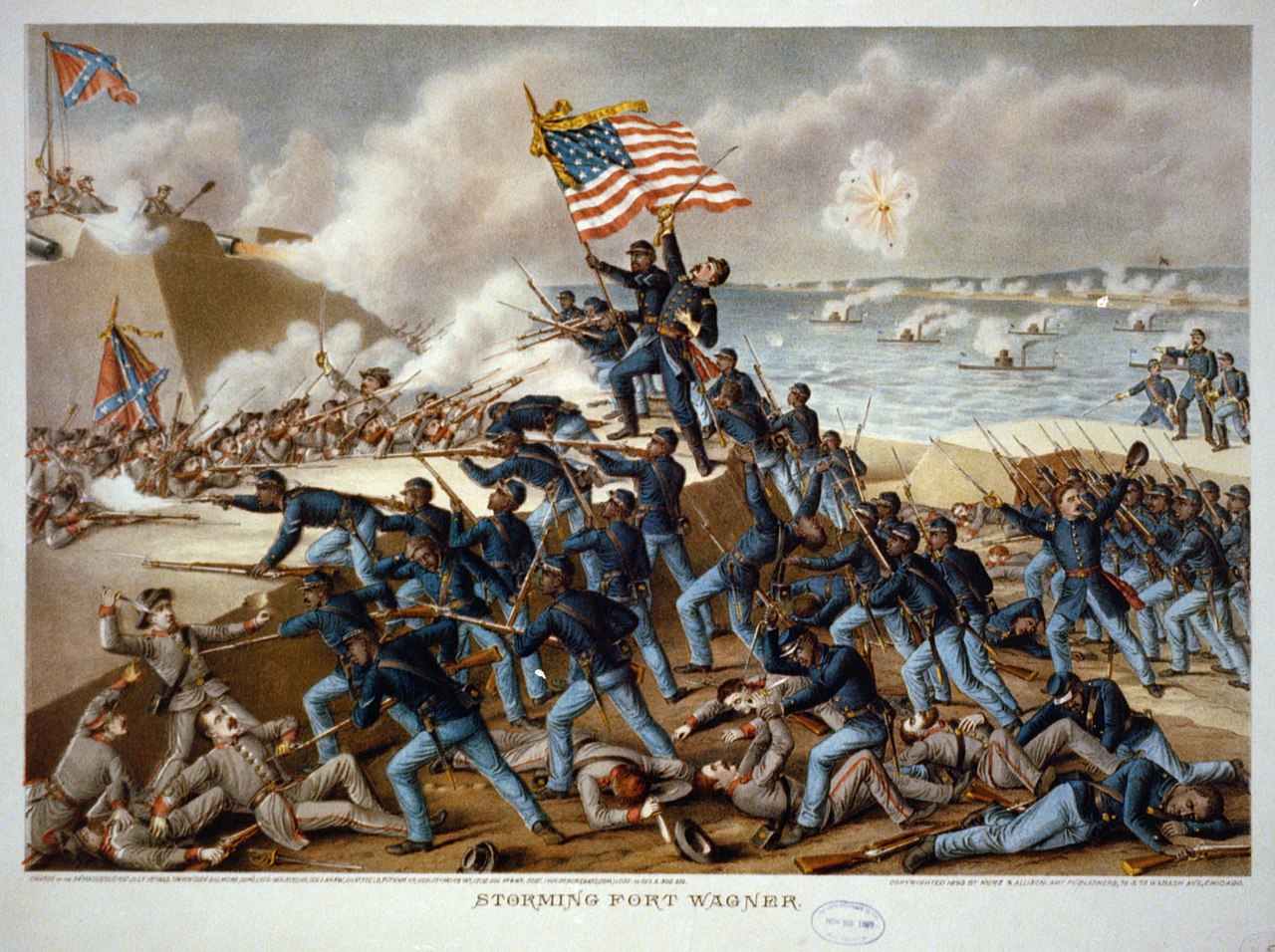
In July 1863 Union forces under General Quincy Gillmore landed on Morris Island at the mouth of Charleston Harbor to get within range of Fort Sumter. Two assaults on Battery Wagner failed; the second, on 18 July, was led by the 54th Massachusetts, one of the first Black regiments in the Union army, whose courage — and the death of Colonel Robert Gould Shaw — made it famous, later told in the film Glory. After a two-month siege the Confederates abandoned Wagner and Battery Gregg in September, but Fort Sumter held out until 1865. In December 1864 a Confederate marksman in Sumter made one of the longest recorded rifle kills of the war at Battery Gregg.
Open the interactive map6 stages on modern satellite imagery and terrain, with 3D elevation
This battle is part of the full atlas, open to Patreon members. Free battles include Yorktown, Waterloo, The Alamo, Antietam, Little Bighorn, Belleau Wood, Omaha Beach, Ia Drang.
The battle, stage by stage
- 10 July 1863
Landing on Morris Island
Charleston, where the war began, is guarded by a ring of forts. To reach Fort Sumter with siege guns, General Quincy Gillmore must first take Morris Island, a low strip of sand at the harbour mouth. Covered by 47 guns hidden on Folly Island, General George Strong's brigade crosses Lighthouse Inlet in boats and overruns the Confederate batteries at the south end, driving the defenders three miles up the beach to Battery Wagner.
- 11 July, dawn
First assault
At daybreak the 7th Connecticut, followed by the 76th Pennsylvania and 9th Maine, charges Wagner across the narrow neck. The Connecticut men reach the ditch and parapet, but the regiments behind them stall under canister and the attack collapses with over 300 Union casualties to about 12 Confederate.
- 18 July, 7:45 PM
The 54th Massachusetts leads
After an eleven-hour bombardment by Gillmore's batteries and the fleet — the heaviest yet of the war — the garrison of about 1,700 under General William Taliaferro has sheltered in the fort's bombproof and is barely hurt. At dusk the 54th Massachusetts, one of the first Black regiments raised in the North, forms on the beach at the head of Strong's brigade. Colonel Shaw tells his men, 'I want you to prove yourselves men.' The narrow strip between the marsh and the surf forces the column into a funnel only a few companies wide.
- 18 July, 8–11 PM
On the parapet
The 54th crosses the moat waist-deep under musketry and canister and gains the parapet; Shaw is killed on the wall and buried with his men in a common grave. Sergeant William Carney, wounded several times, carries the flag back — the act that later earns him the Medal of Honor. Strong is mortally wounded and Colonel Haldimand Putnam killed leading the second brigade. Men of the 6th Connecticut and 48th New York hold a corner of the south-east bastion for hours before falling back. Union losses are 1,515 killed, wounded and missing; the Confederates lose 174.
- 19 July – 7 September 1863
The siege
Gillmore turns to siege. Sappers dig parallels up the island under fire while rifled guns, firing over Wagner, batter Fort Sumter into rubble from more than two miles away; the 'Swamp Angel' in the marshes throws shells into Charleston itself. With the trenches at the moat, the Confederates quietly evacuate Wagner and Gregg on the night of 6–7 September. Fort Sumter, a heap of brick, holds out until 1865.
- 5 December 1864
The 1,390-yard shot
Over a year later the siege drags on. According to the Charleston Courier of 6 December 1864, a Confederate rifleman in the ruins of Fort Sumter spotted a Union soldier walking near Battery Gregg on Cummings Point, about 1,390 yards away across the harbour channel — and killed him with a single shot. The rifleman's name and weapon were not recorded; a British-made Whitworth, the Confederacy's long-range sharpshooter rifle, is the likeliest candidate. The shot is featured on DOPE HISTORY, on Ronnie Adkins's American Marksman channel.
On American Marksman
The 1,390-yard shot from Fort Sumter ≈1,390 yd
On 5 December 1864, according to the Charleston Courier, a Confederate rifleman in the ruins of Fort Sumter killed a Union soldier walking near Battery Gregg on Cummings Point, about 1,390 yards across the harbour channel. His name and rifle went unrecorded; a Whitworth is the likeliest candidate.
Paintings and photographs


