Battlefield Atlas
American Civil War · 1864 Locked

The Crater, 30 July 1864

Before dawn on 30 July 1864, Union troops of the IX Corps exploded four tons of powder in a tunnel dug by the 48th Pennsylvania under Elliott's Salient in the Confederate lines east of Petersburg, Virginia, blowing a crater about 170 feet long in the works. The assault that followed failed: Ledlie's division, which had replaced Ferrero's specially trained division of U.S. Colored Troops at the last minute, crowded into the crater, the other divisions followed, and the Confederates sealed the breach. Mahone's counterattacks retook the works by early afternoon, and Confederates killed many Black soldiers who were trying to surrender. The National Park Service estimates 3,798 Union and 1,491 Confederate casualties. Grant called it 'the saddest affair' of the war; a court of inquiry blamed Burnside, Ledlie, Ferrero, Willcox and Col. Zenas Bliss, and the siege went on until April 1865.

Open the interactive map8 stages on modern satellite imagery and terrain, with 3D elevation

This battle opens with Battlefield Explorer ($4.99 a month or $39 a year), which unlocks every battle in the atlas and every one added later. Lifetime access and war packs are one-time options. Free battles include Thermopylae, Actium, Viking raid on Lindisfarne, Hastings, Hattin, Agincourt, Vítkov Hill, Bosworth, Fort William Henry, Yorktown, Waterloo, The Alamo, Antietam, Little Bighorn, Belleau Wood, Omaha Beach, Inchon, Ia Drang, Goose Green, 73 Easting, Wanat, Baghdad Thunder Runs, Battle of Raqqa, Donetsk Airport, Battle of Kyiv, Battle of Hostomel Airport, Siege of Mariupol, Kharkiv counteroffensive, Kherson counteroffensive, Bakhmut, Vuhledar, Mala Tokmachka and Robotyne, Avdiivka.

The mine explodes (Waud)
The mine explodes (Waud) — A. R. Waud, 1864 — public domain

The battle, stage by stage

  1. 25 June – 27 July 1864

    The 48th Pennsylvania's mine

    After the failed assaults of mid-June, the IX Corps' advanced line at Petersburg lay only about 400 feet from Elliott's Salient, a bulge in the Confederate works on the Griffith farm held by Pegram's Petersburg battery and Brig. Gen. Stephen Elliott's South Carolina brigade. Lt. Col. Henry Pleasants of the 48th Pennsylvania, a regiment raised largely from coal miners, proposed tunneling under it. Burnside backed the plan; Meade and his engineers doubted it, but Grant let it go ahead. Digging began on 25 June from a hollow behind the Union picket line, with improvised tools and a fire-draft ventilation shaft. The main gallery, 511 feet long and about 20 feet under the Confederate works, was finished on 17 July, and two lateral galleries were run along under the line. Suspecting a mine, the Confederates dug listening galleries but missed the deeper tunnel. On 23–27 July about four tons of powder were placed and the gallery sandbagged.

  2. 28–29 July 1864

    The assault division is changed

    Burnside planned to lead with Brig. Gen. Edward Ferrero's Fourth Division, U.S. Colored Troops, the corps' largest and freshest, whose men had trained for weeks to go around the crater's flanks rather than into it. On 29 July Meade overruled him, fearing, according to the Army's official history, that if the Black division failed the army's leaders would be blamed for sacrificing it; Grant backed Meade. With about twelve hours to change the plan, Burnside had his white division commanders draw lots, and the choice fell on Brig. Gen. James H. Ledlie's First Division, worn down by the Overland Campaign, whose commander did not brief his men on the new task. Meade's orders also told the assault to push for Cemetery Hill, the crest behind the salient, rather than widen the breach. A II Corps expedition north of the James at Deep Bottom had meanwhile drawn part of Lee's army away from Petersburg.

  3. 30 July 1864, 3:15–4:45 AM

    The mine is sprung

    In the dark, about 15,000 men of the IX Corps filed into the ravine and trenches in front of Fort Morton, where Burnside took post, and more than 160 guns and mortars stood ready along the line. Pleasants lit the fuse at about 3:15 AM (some accounts say 3:00); when nothing happened, Lt. Jacob Douty and Sgt. Harry Reese crawled into the tunnel, found the fuse had burned out at a splice, and relit it. At about 4:45 the charge went off, throwing earth, guns and men into the air and leaving a crater roughly 170 feet long, 50 to 97 feet wide and 25 to 30 feet deep, by differing contemporary measurements. About 278 Confederates of Pegram's battery and two South Carolina regiments (the 18th and 22nd) were killed, wounded or buried (NPS). The Union guns then opened along the whole front.

  4. About 5:00–7:30 AM

    Into the crater

    Ledlie's division started late, clambering over its own parapet in the half-light, and instead of passing around the crater most of Marshall's and Bartlett's men poured down into it, stopping to dig out buried Confederates and gape at the wreck; Ledlie himself stayed in a bombproof behind the Union line. The 2nd Pennsylvania Provisional Heavy Artillery pushed a short way west of the rim. Potter's division followed on the right, Griffin's brigade lodging in the maze of traverses and bombproofs north of the crater, and Willcox's on the left, where Hartranft's men took the works to the south. The Federals held about 150 yards of the line on each side but got no farther. Elliott, wounded while rallying a counterattack, gave way to Col. Fitz McMaster, whose South Carolinians, with Ransom's North Carolinians and Wise's Virginians on the flanks, built barricades and formed a line west of the pit, while guns and mortars on both flanks swept the open ground. Lee ordered Maj. Gen. William Mahone to bring two brigades from the right of the line.

  5. About 7:30–8:30 AM

    Ferrero's division goes in

    With the attack stalled, Burnside sent in Ferrero's division, about 4,300 men by the park's count, through a crater and trenches already jammed with men; Ferrero, like Ledlie, stayed behind the lines. Col. Henry G. Thomas, finding 'the crater was already too full', led his brigade around its north side under heavy fire. In their first major battle the USCT regiments got farther than any other Union troops, taking part of the works north of the crater and a number of prisoners and forming to charge west toward Cemetery Hill. North of them, Turner's X Corps men crossed the Poor Creek bottom and fired from the brush below the Confederate works. Meanwhile Mahone's Virginians and Georgians, moving unseen up the Jerusalem Plank Road and east through a covered way, filed into a ravine about 200 yards west of the crater. Confederate accounts say the Black troops went in shouting 'No quarter' and 'Remember Fort Pillow', which Confederates later cited for what followed.

  6. About 8:30–10:00 AM

    Mahone's counterattack

    Before the USCT could form, Weisiger's Virginia brigade, about 800 men, many of them from Petersburg, charged out of the ravine with bayonets fixed (the time is given as anywhere from about 9 to 10 AM). In savage hand-to-hand fighting they drove Thomas's and Sigfried's regiments and Potter's men back over the trenches north of the crater, and the fleeing troops broke through Turner's line in the Poor Creek bottom, carrying it back to the picket line. A stone marks roughly the right of Mahone's brigade in the recaptured works. Part of Wright's Georgia brigade, attacking toward the south side of the crater, was stopped. Some Confederates killed Black soldiers who were trying to surrender in this phase too. At about 9:30 Meade ordered the attack halted and Burnside's men withdrawn, but crossing the open ground under fire was nearly impossible, and the order did not reach the men in the crater until about 12:30.

  7. About 11:00 AM – 2:00 PM

    The crater retaken; Black soldiers killed

    The rest of Wright's Georgians attacked at about 11 without success. In the early afternoon (about 1 to 1:30 PM by different accounts) Sanders's Alabama brigade, with Georgians and Virginians on its flanks, rushed the crater itself. Thousands of men were packed in the pit, and the fighting there was the most brutal of the siege. Many Federals ran back across the open ground; hundreds were captured, among them Brig. Gen. William F. Bartlett. Confederates killed many Black soldiers after they had surrendered, in the crater and as prisoners were taken to the rear (National Park Service; A. Wilson Greene for the American Battlefield Trust). Historian Bryce Suderow found an unusually high ratio of killed among the USCT, and Kevin Levin estimates upwards of 200 were killed during and especially after the battle; Union accounts say some white Union soldiers joined in. Captured Black soldiers who survived were sent to prisons or claimed by local slaveholders (Levin). By about 2 PM every Union unit was back in its own lines.

  8. 31 July – September 1864

    Aftermath and inquiry

    By the next morning the Confederates had taken the crater into a new line of works. Under a truce on 1 August burial parties cleared the dead between the lines. The Union lost about 3,800 men killed, wounded and captured and the Confederates about 1,500, by the National Park Service estimate (5,289 in all). Grant called it 'the saddest affair I have witnessed in the war'. A court of inquiry blamed Burnside, Ledlie, Ferrero, Willcox and Col. Zenas Bliss and cleared Meade; the Joint Committee on the Conduct of the War later put more of the blame on Meade. Burnside went on leave in mid-August and was never recalled, and Ledlie was given no further meaningful command; Mahone was promoted to major general. The siege went on for eight more months.

Forces

Burnside massed about 15,000 men of the IX Corps for the assault, but only part of them, and part of the defenders, actually fought: the American Battlefield Trust counts about 8,500 Union and 6,100 Confederate troops engaged. Unit figures exist only for a few units.

Confederate (Army of Northern Virginia)

EngagedAmerican Battlefield Trust estimate: Johnson's division in the line, Mahone's three brigades and the artillery. American Battlefield Trust, The Craterabout 6,100

Union (Army of the Potomac, IX Corps)

Massed for the assaultIX Corps, including about 4,300 U.S. Colored Troops (NPS waysides; the Army's official history also gives about 15,000), with more than 160 guns and mortars; supports from the II, V, XVIII and X Corps. HMdb: A Stupendous Failure (NPS wayside); HMdb: Prelude to the Crater (NPS wayside); U.S. Army CMH, The Petersburg and Appomattox Campaigns (Maass, 2015)about 15,000
EngagedAmerican Battlefield Trust estimate of the Union troops actually engaged. American Battlefield Trust, The Craterabout 8,500
Artillery HMdb: Prelude to the Crater (NPS wayside)more than 160 guns and mortars

Casualties

About 5,300 men became casualties in roughly ten hours (National Park Service: 3,798 Union and 1,491 Confederate; the NPS park page says nearly 5,500), and Confederates killed upwards of 200 Black soldiers, many after they surrendered (Levin). The totals are well attested for the Union; Confederate figures and the number of USCT killed after surrender are estimates. Certainty: fair.

Confederate (Army of Northern Virginia)

Total casualtiesThe National Park Service battle summary and the American Battlefield Trust give 1,491; A. Wilson Greene, writing for the Trust, puts Confederate losses at fewer than 1,200 including the men lost in the explosion, and Stone Sentinels at about 1,500. National Park Service, Crater battle summary; American Battlefield Trust, The Crater; A. Wilson Greene, 'No Quarter' (American Battlefield Trust); Stone Sentinels, Battle of the Crater: Collapse1,491 (under 1,200–about 1,500)
Killed, wounded or buried by the mineThe NPS wayside at the crater says 278 Confederates died; the NPS 'Dash into the Crater' wayside says roughly 260 were killed or buried, and Cullen's NPS report counts 278 killed, wounded or buried. Most were of Pegram's battery and the 18th and 22nd South Carolina. HMdb: The Crater (NPS wayside); HMdb: Dash into the Crater (NPS wayside); J. P. Cullen, Physical History of the Crater (NPS, 1975)about 278 (about 260–278)
Elliott's brigadeStone Sentinels' figure for the South Carolina brigade at the salient, including the explosion. Stone Sentinels, Battle of the Crater: Collapseover 700
Mahone's counterattacking brigadesStone Sentinels' estimate for the losses in Mahone's counterattacks. Stone Sentinels, Battle of the Crater: Collapseabout 600

Union (Army of the Potomac, IX Corps)

Total casualties (killed, wounded, captured)The National Park Service battle summary and the American Battlefield Trust give 3,798; the Army's official history (Maass, CMH) about 3,800; Stone Sentinels about 3,500 for Burnside's IX Corps alone, more than a quarter of its strength. National Park Service, Crater battle summary; U.S. Army CMH, The Petersburg and Appomattox Campaigns (Maass, 2015); Stone Sentinels, Battle of the Crater: Collapse3,798 (about 3,500–3,800)
Black soldiers killed after surrenderingKevin M. Levin's estimate of USCT soldiers killed by Confederates during and especially after the battle; the NPS and A. Wilson Greene state that Black soldiers were shot after surrendering, and Bryce Suderow (Civil War History) found an unusually high ratio of killed among the USCT. No official count exists. Kevin M. Levin, What You Didn't Learn About the Battle of the Crater; National Park Service, Battle of the Crater; Siege of Petersburg Online, Crater summaryupwards of 200
2nd Pennsylvania Provisional Heavy ArtilleryOf 780 men who went into action, by the regiment's monument at the crater; 286 answered roll call afterward. HMdb: 2nd Pennsylvania Veteran Heavy Artillery monument494 killed and wounded
Generals and brigade commanders capturedBrig. Gen. William F. Bartlett and Col. Elisha Marshall, commanding Ledlie's two brigades, were captured in the crater. Stone Sentinels, Armies at the Crater2

Equipment and ships

Confederate guns destroyed by the mineTwo of Pegram's guns (about 1,700 pounds each) were thrown out of the works, one about 40 yards. HMdb: The Crater (NPS wayside); W. H. Whitner's report, Official Records (Siege of Petersburg Online)2

Then and now: how the ground has changed

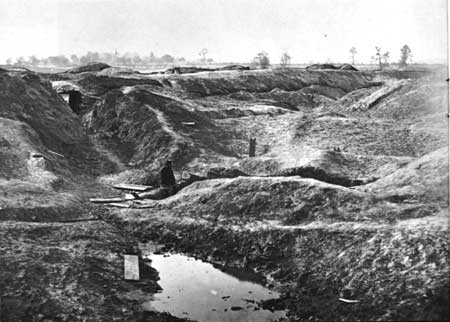
The crater itself survives inside Petersburg National Battlefield, shallower and grassed over, with the mine entrance and tunnel depressions still traceable; the Union works behind it were plowed away after the war, a golf course once surrounded it, and the Jerusalem Plank Road behind the Confederate line is now the commercial Crater Road (US 301).

The interactive map can show the period landscape (1 shape: Crater Road (US 301), on the old Jerusalem Plank Road) under the units. Open the map.

Weapons

Confederate (Army of Northern Virginia)

Pattern 1853 Enfield rifle-musket

Pattern 1853 Enfield rifle-musket

Rifled percussion musket · 1853–1867

At The Crater: Common Confederate rifle-musket.

Britain's standard infantry rifle of the 1850s and, after the Springfield, the most common long arm of the Civil War. Both sides imported it by the hundreds of thousands; it fired the same family of hollow-based Minié bullets as the Springfield.

Caliber
.577
Effective range
about 300–500 yd (sighted to 900+)
Rate of fire
2–3 rounds a minute
Photo: Smithsonian Institution (NMAH) · Public domain
Socket bayonet

Socket bayonet

Edged weapon (musket attachment) · c. 1690s-1860s

At The Crater: Mahone's brigades charged with bayonets fixed; the fight in the crater was hand to hand.

The socket bayonet slipped over the outside of the musket barrel and locked in place, turning every musket into a short pike without blocking the muzzle. It made the pike obsolete and let infantry defend themselves against cavalry and finish an assault at close quarters. For a century and a half, a determined bayonet charge often decided fights that musketry could not.

Length
Triangular blade, about 17 in on the Brown Bess
Use
Fitted over the muzzle so the musket could still be fired
Photo: Rama · CC BY-SA 2.0 fr
M1857 12-pounder "Napoleon"

M1857 12-pounder "Napoleon"

Smoothbore field gun (bronze) · 1857-1865 (U.S. service into the 1870s)

At The Crater: Field guns on the flanks swept the open ground.

A U.S. copy of a French gun-howitzer named for Emperor Napoleon III, the Napoleon fired a 12-pound ball but was light enough for field batteries. Rifled guns outranged it, but at the short ranges of most Civil War fighting its heavy canister made it the most trusted gun on both sides. It became the most common field piece of the war.

Caliber
4.62 in
Range
About 1,600-1,700 yd (solid shot at 5°)
Shot
Solid shot, shell, case shot, canister
Crew
9
Photo: Hal Jespersen · Public domain

Union (Army of the Potomac, IX Corps)

Springfield Model 1861 rifle-musket

Springfield Model 1861 rifle-musket

Rifled percussion musket · 1861–1865

At The Crater: Standard Union rifle-musket.

The Union's standard infantry weapon, made in the hundreds of thousands at Springfield Armory and by contractors. Its Minié bullet expanded into the rifling, giving rifle accuracy at musket loading speed, one reason Civil War assaults on prepared works were so costly.

Caliber
.58
Effective range
about 200–400 yd (sighted to 500)
Rate of fire
2–3 rounds a minute
Photo: Smithsonian Institution (NMAH) · Public domain
M1857 12-pounder "Napoleon"

M1857 12-pounder "Napoleon"

Smoothbore field gun (bronze) · 1857-1865 (U.S. service into the 1870s)

At The Crater: IX Corps field batteries.

A U.S. copy of a French gun-howitzer named for Emperor Napoleon III, the Napoleon fired a 12-pound ball but was light enough for field batteries. Rifled guns outranged it, but at the short ranges of most Civil War fighting its heavy canister made it the most trusted gun on both sides. It became the most common field piece of the war.

Caliber
4.62 in
Range
About 1,600-1,700 yd (solid shot at 5°)
Shot
Solid shot, shell, case shot, canister
Crew
9
Photo: Hal Jespersen · Public domain
3-inch Ordnance Rifle

3-inch Ordnance Rifle

Rifled field gun (wrought iron) · 1861-1865 (later as saluting guns)

At The Crater: Union rifled guns among the more than 160 pieces along the front.

Built by wrapping wrought-iron strips into a single tough tube, the 3-inch Ordnance Rifle was light, accurate and almost never burst. Phoenix Iron Works made about 1,100 during the war; the Confederacy made only a few dozen copies and relied heavily on captured guns. Gunners prized it for long-range accuracy, though its small shell was weak as canister.

Caliber
3.0 in
Shot
About 9.5 lb shell or bolt
Range
About 1,830 yd at 5° (4,000+ yd max)
Photo: Tim Evanson · CC BY-SA 2.0

Paintings and photographs

The mine explodes (Waud)
The mine explodes (Waud) Alfred Waud's 1864 sketch of the explosion under Elliott's Salient, reproduced in Battles and Leaders of the Civil War. A. R. Waud, 1864 — public domain · source
The Battle of the Crater (Elder)
The Battle of the Crater (Elder) John Adams Elder's postwar painting of the fight in the crater. John Adams Elder — public domain · source
The crater in 1865
The crater in 1865 The crater after the war, 1865. Public domain · source

★ Medal of Honor 10 recipients

Links go to the official records: the Congressional Medal of Honor Society and, where they exist, the service's own pages.

Free for everyone every year on its anniversary: July 30.

Accuracy score: 74/100 (good)

How the accuracy score works

Sources and method

The Crater, 30 July 1864. No U.S. Army staff ride handbook covers the Crater (the Combat Studies Institute's Overland Campaign staff ride handbook ends on 15 June 1864); the Army's official narrative is John R. Maass, The Petersburg and Appomattox Campaigns, 1864–1865 (U.S. Army Center of Military History, CMH Pub 75-16, 2015), used for the mine, the change of division, the timings and Union losses. Positions are anchored on the National Park Service waysides and monuments at Petersburg National Battlefield as recorded by the Historical Marker Database: The Crater, A Stupendous Failure, Confederate Counterattack, Digging the Mine, Confederate Countermine, Crater of Mine, 2nd Pennsylvania Heavy Artillery, Mahone's Brigade, The Union Picket Line, Dash into the Crater, Up and Over, Prelude to the Crater, The Struggle Across Poor Creek, Battle of the Crater – Covered Way (Jerusalem Plank Road), and Gracie's and Colquitt's salients for the bearing of the Confederate line. Narrative and figures: National Park Service, Battle of the Crater and Crater battle summary (3,798 Union and 1,491 Confederate casualties); Joseph P. Cullen, A Report on the Physical History of the Crater (NPS, 1975: the salient, the 130-yard gap, the crater's measurements); American Battlefield Trust, The Crater and A. Wilson Greene, 'No Quarter'; Brett Schulte's Siege of Petersburg Online, Crater summary (Mahone's brigades and times, Suderow's findings, the court of inquiry) and W. H. Whitner's report (Official Records, Vol. XL, Part 1); Kevin M. Levin, What You Didn't Learn About the Battle of the Crater; order of battle from Stone Sentinels. Period map: J. E. Weyss and N. Michler, Map of the siege of Petersburg, 1864-5 (Library of Congress). The crater, the mine entrance, the markers and the recaptured works are well fixed; the lines between markers, the Union assault formations, the Confederate gun positions, the ravine and the march route south of the covered way are reconstructed or approximate, and the times of Mahone's attacks differ by up to an hour between sources. Medal of Honor citations: Congressional Medal of Honor Society (cmohs.org).

Where the positions come from

Further reading