Battlefield Atlas
Napoleonic Wars · 5–6 July 1809

Wagram, 5–6 July 1809

Also known as Schlacht bei Wagram, Bataille de Wagram

Accuracy65 /100 · moderate
Stages8 · over 2 days
On the map68 photos pinned
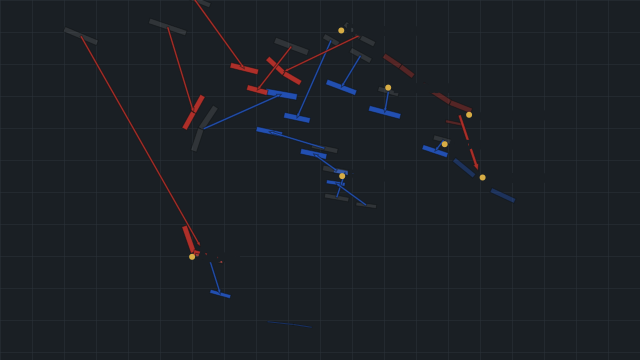
Drawing of the units and movements at WagramStages 1–3 freeOpen the interactive map

The first 3 stages are free. No account needed to start.

On 5–6 July 1809, six weeks after his first defeat in the field at Aspern-Essling, Napoleon crossed the Danube from the Lobau island at night and fought Archduke Charles's Austrian army on the Marchfeld plain north-east of Vienna, around the village of Deutsch-Wagram. It was the largest battle in Europe to that date: by Ian Castle's figures about 180,000 French and allied troops with nearly 500 guns on the field against about 138,000 Austrians. A French evening attack on the Austrian line behind the Russbach stream failed on 5 July. On 6 July Charles attacked the French left, occupying Aderklaa, which Bernadotte had abandoned without orders in the night, and pushing Klenau's corps to Aspern and Essling, but Napoleon shifted Masséna south, massed a grand battery of about 112 guns in the center and sent Davout round the Austrian left at Markgrafneusiedl; Macdonald's huge column then pinned the Austrian center at heavy cost. Charles withdrew in good order in the afternoon, before his brother John's army could arrive; after a further battle at Znaim on 10–11 July, an armistice was agreed on 12 July. Losses on both sides were very heavy, roughly 70,000–80,000 men together, by most estimates.

Battlefield Explorer opens stages 4–8 and every other battle. See the free battles.

Napoleon at Wagram (Horace Vernet, 1836)
Napoleon at Wagram (Horace Vernet, 1836) — Horace Vernet · public domain

The battle, stage by stage

  1. 4–5 July 1809, about 9 PM to 2 AM

    Out of the Lobau

    Six weeks after his repulse at Aspern-Essling, Napoleon has turned the Lobau, the large wooded island in the Danube, into a fortress and depot, with bridges back to the right bank and heavy batteries along its shore. This time he crosses from the island's eastern end over the narrow Stadler Arm, away from the Aspern-Essling ground the Austrians have fortified. Around 9 PM on 4 July, in a storm of cold, heavy rain, the first men of Oudinot's corps (1,500 by Rickard's account, about 4,500 by a Vienna account of 1809) are ferried across and drive Austrian Jäger out of the Hanselgrund woods toward Mühlleuten; a floating bridge is in place before midnight and three more prefabricated bridges follow, while more than a hundred guns on the Lobau bombard Gross-Enzersdorf, which burns through the night. Oudinot's and Masséna's corps cross first, then Davout's. Archduke Charles, expecting the crossing but unsure where, has left only Nordmann's Advance Guard and Klenau's VI Korps on the Danube front; his main army waits on the low heights behind the Russbach, about 10 km to the north.

  2. 5 July, morning to about 5 PM

    The fan across the Marchfeld

    By the morning of 5 July the French are across in strength, and Gross-Enzersdorf falls to Masséna. The army pivots on its left at Aspern-Essling and wheels north like an opening fan across the flat, open Marchfeld. Nordmann and Klenau fall back: Nordmann to Markgrafneusiedl, Klenau north-west toward Stammersdorf. By late afternoon Davout faces Markgrafneusiedl from Glinzendorf and Grosshofen, Oudinot faces Baumersdorf (today Parbasdorf), Eugène's Army of Italy and Bernadotte's Saxons face Deutsch-Wagram, and Masséna holds the left from Süssenbrunn and Breitenlee back to the Danube. The Austrians stand on the Russbach heights: Bellegarde's I Korps east of Wagram, Hohenzollern's II at Baumersdorf, Rosenberg's IV and Nordmann at Markgrafneusiedl, with Kollowrat's III Korps and the grenadiers farther west.

  3. 5 July, about 7 PM to 11 PM

    Evening attack on the Russbach heights

    Seeing the Austrians apparently thin on the heights, Napoleon orders an attack before dark. At Baumersdorf, burning under the fire of some forty guns, Hardegg's brigade beats off Oudinot. West of the village Dupas, Macdonald and Lamarque of the Army of Italy wade the Russbach, climb the escarpment and rout the first line of I Korps, but Charles himself leads a counterattack and Hohenzollern's cavalry helps throw them back; in the dark, Saxons of Dupas's division are fired on by their own side. From about 9 PM Bernadotte's Saxons attack Deutsch-Wagram itself and are broken in confused night fighting, again firing on each other; around 11 PM they fall back toward Aderklaa. Davout's push on Markgrafneusiedl through Grosshofen comes to little. Every attack has failed. Overnight Marmont's corps and Wrede's Bavarians reach the field.

  4. 6 July, about 4 AM to 11 AM

    Charles strikes the French left

    Charles plans a general attack at 4 AM, aiming his right wing, Klenau's VI and Kollowrat's III Korps, down toward the Danube to cut Napoleon off from the Lobau bridges, while waiting for his brother Archduke John's army from Pressburg. The orders reach the right wing late. Rosenberg, attacking on time toward Glinzendorf, is stopped by Davout's fire and called back. In the center Bernadotte has abandoned Aderklaa without orders; Bellegarde's I Korps occupies it just after 3 AM. Masséna's divisions under Carra Saint-Cyr and then Molitor counterattack, and the Saxons are driven back in disorder. Accounts differ: Castle has both French assaults fail and the Austrians hold the village; Rickard, following Gill, has Carra Saint-Cyr briefly take it and Molitor hold it until about 11 AM. On the far right Klenau comes down the road from Kagran, overruns Boudet's division and takes the ruins of Aspern; by about 10 AM his outposts are at Essling, behind the French left.

  5. 6 July, about 11 AM to 1 PM

    Masséna turns south; the grand battery

    Napoleon answers the threat to his left by ordering Masséna to march his corps south, across the front of the grenadiers and III Korps, toward Essling. To cover the move, Bessières sends about 4,000 of Nansouty's cuirassiers against the junction of III Korps and the grenadiers; heavy fire stops them and Bessières is wounded. Into the gap Masséna leaves, General Lauriston brings a grand battery of about 112 guns, from the Guard, the Army of Italy and Wrede's Bavarians, and places it in an arc south of Aderklaa toward Breitenlee; its fire tears into the packed Austrian center. Klenau, his outposts at Essling, halts to wait for III Korps, which cannot advance under the guns and the batteries on the Lobau.

  6. 6 July, about 10 AM to 1 PM

    Davout at the tower of Markgrafneusiedl

    Meanwhile the decisive blow falls on the Austrian left. With about 40,000 men against Rosenberg's 27,000 (by Rickard's figures), Davout sets Markgrafneusiedl on fire with his artillery. Montbrun, Grouchy and Pully's cavalry drive the Austrian hussars from Obersiebenbrunn and swing round Rosenberg's flank; Gudin and Puthod storm the village from the south, while Morand and Friant cross the Russbach to the east and climb the heights to the ruined church tower identified locally as the 'tower of Markgrafneusiedl', at the end of the Austrian line. Nordmann is mortally wounded. Charles sends reserve cavalry and infantry from the center, and around noon about 30 Austrian squadrons strike Davout's horsemen north-east of the village, but by about 1 PM Grouchy's dragoons tip the balance. Rosenberg's line is bent back toward the north.

  7. 6 July, about 12:30 PM to 2 PM

    Macdonald's column

    Watching Davout's guns move past the tower, Napoleon commits the center. Macdonald forms the Army of Italy's divisions of Broussier and Lamarque into a huge hollow square or column, by one account eight battalions across, and marches it north from the grand battery toward Süssenbrunn, into the gap between the grenadiers and III Korps, with Guard cavalry on its right and Nansouty on its left. Caught by musketry and canister from three sides, it is shredded: by the usual figures about 8,000 men start and some 1,500 are left within the hour. It does not break the Austrian line, but it pins and wears down the center, and Pacthod, Durutte, Wrede's Bavarians, the Young Guard and Marmont move up behind it. To the east Oudinot finally crosses the Russbach at Baumersdorf as Davout's divisions roll up the heights from Markgrafneusiedl.

  8. 6 July, from about 2:30 PM to nightfall

    Charles withdraws

    About 2 PM Charles learns that John cannot arrive before about 5 PM. With his left turned and his center pinned, he orders a phased withdrawal at about 2:30 PM, each corps retiring along its own road: Klenau to Stammersdorf, Kollowrat to Gerasdorf, Rosenberg north through Bockfliess. Masséna retakes Essling, relieves Boudet's isolated division and presses north-west along the Danube. Austrian rearguards hold off the exhausted French; the cavalry general Lasalle is killed in one of these actions. Fighting in the center dies down by about 3:30 PM. After 5 PM John's leading cavalry appear near Obersiebenbrunn, causing a panic among French stragglers, and then turn back. Losses are enormous on both sides: Ian Castle gives about 23,750 Austrian killed and wounded, 7,500 prisoners and some 10,000 missing, and about 27,500 French killed and wounded plus about 10,000 prisoners and missing; per Britannica, more than 40,000 Austrian and about 34,000 French. After a further battle at Znaim on 10–11 July, an armistice is agreed on 12 July.

At a glance

When
5–6 July 1809
Where
The Marchfeld plain around Deutsch-Wagram in Lower Austria, just north-east of Vienna, Austria (Aspern and Essling are now part of Vienna).
Forces
By Ian Castle's figures Napoleon had about 182,000 men and 488 guns on the Marchfeld, with 8,500 more men and 129 guns on the Lobau, against about 137,700 Austrians; Britannica instead gives about 154,000 French and allies…
Casualties
Wagram was one of the costliest battles of the era: by Ian Castle's figures about 23,750 Austrians and 27,500 French were killed or wounded, with thousands more taken prisoner or missing on each side; Britannica puts the totals…
On the map
8 stages, 68 photos pinned where they were taken

Who fought

  • Austrian army (Archduke Charles)
  • French army and allies (Napoleon)

Accuracy score

65/100 · moderate

Moderate confidence in where units stood and moved, scored on the quality of the source map, how well independent fixed points agree, the level of detail and corroboration. How scores work

Places on the map

  • Markgrafneusiedl: ruined church tower (St Martin; identified locally as the 1809 tower)
  • Markgrafneusiedl
  • Deutsch-Wagram
  • Baumersdorf (Parbasdorf)
  • Aderklaa
  • Raasdorf (Napoleon's command post)
  • Glinzendorf
  • Grosshofen
  • Aspern: St Martin's church and the Lion of Aspern
  • Essling
  • Gross-Enzersdorf
  • Süssenbrunn
  • Breitenlee
  • Gerasdorf
  • Stammersdorf
  • Obersiebenbrunn
  • Napoleon's headquarters stone, Lobau
  • Crossing of the Stadler Arm (Hanselgrund, approximate)

Forces

By Ian Castle's figures Napoleon had about 182,000 men and 488 guns on the Marchfeld, with 8,500 more men and 129 guns on the Lobau, against about 137,700 Austrians; Britannica instead gives about 154,000 French and allies against about 158,000 Austrians. Totals differ by tens of thousands depending on the date counted and whether late arrivals are included, though most modern accounts give the French a clear numerical edge.

Austrian army (Archduke Charles)

Present (night of 5–6 July)about 137,700

Castle: 113,500 infantry, 14,600 cavalry and 9,600 artillery, engineers and others. Ian Castle, 'The Battle of Wagram' (Fondation Napoléon)

Infantry and cavalry (other counts)about 128,000–136,000 (128,400–135,766)

Rickard, following Gill, gives 120,197 infantry and 15,569 cavalry on the morning of 5 July; the World History Encyclopedia gives 113,800 infantry and 14,600 cavalry. J. Rickard, 'Battle of Wagram, 5–6 July 1809', historyofwar.org; H. W. Mark, 'Battle of Wagram', World History Encyclopedia

Total (Britannica)about 158,000

Britannica's figure, larger than the corps returns used by Castle and Rickard. Encyclopaedia Britannica, 'Battle of Wagram'

French army and allies (Napoleon)

On the Marchfeld (night of 5–6 July)about 182,000 with 488 guns

Castle: 140,500 infantry, 28,000 cavalry and 13,500 artillery, engineers and others, plus 8,500 men and 129 guns in reserve on the Lobau. Ian Castle, 'The Battle of Wagram' (Fondation Napoléon)

Infantry, cavalry and guns (other counts)about 154,000–172,000

Rickard, following Gill: 122,911 infantry, 24,941 cavalry and 404 guns at the start, plus 22,838 infantry, 1,246 cavalry and 71 guns arriving by the morning of 6 July. The World History Encyclopedia gives 130,800 infantry, 23,300 cavalry and 544 guns. J. Rickard, 'Battle of Wagram, 5–6 July 1809', historyofwar.org; H. W. Mark, 'Battle of Wagram', World History Encyclopedia

Davout's attack on the Austrian left (6 July)about 40,000

Rickard, following Gill, gives Davout 40,000 men against Rosenberg's 27,000; the figure covers the whole right wing and is not split between the III Corps blocks on the map. J. Rickard, 'Battle of Wagram, 5–6 July 1809', historyofwar.org

Total (Britannica)about 154,000

Britannica's figure for French and allied troops. Encyclopaedia Britannica, 'Battle of Wagram'

Casualties

Wagram was one of the costliest battles of the era: by Ian Castle's figures about 23,750 Austrians and 27,500 French were killed or wounded, with thousands more taken prisoner or missing on each side; Britannica puts the totals at more than 40,000 Austrian and about 34,000 French. The killed-and-wounded figures agree well between sources, but the prisoner and missing counts are rough. Certainty: fair.

Austrian army (Archduke Charles)

Killed and woundedabout 23,750

Ian Castle's figure; Rickard, following Gill, gives the same. Ian Castle, 'The Battle of Wagram' (Fondation Napoléon); J. Rickard, 'Battle of Wagram, 5–6 July 1809', historyofwar.org

Missingabout 10,000

Castle and Rickard; a round figure, the least precise of the Austrian categories. Ian Castle, 'The Battle of Wagram' (Fondation Napoléon); J. Rickard, 'Battle of Wagram, 5–6 July 1809', historyofwar.org

Casualties (all categories)about 37,000–41,000 (37,156 to more than 40,000)

Britannica gives more than 40,000 Austrian casualties; the World History Encyclopedia gives 37,156. Castle's categories together come to about 41,250, but he does not add them up himself. Encyclopaedia Britannica, 'Battle of Wagram'; H. W. Mark, 'Battle of Wagram', World History Encyclopedia

Generals4 killed, 13 senior officers wounded

World History Encyclopedia; among the mortally wounded were FML Nordmann, commanding the Advance Guard, and a brigade commander, Meyer (Rickard). H. W. Mark, 'Battle of Wagram', World History Encyclopedia; J. Rickard, 'Battle of Wagram, 5–6 July 1809', historyofwar.org

French army and allies (Napoleon)

Killed and woundedabout 27,500–32,500 (27,500–32,500)

Castle and Rickard give 27,500 killed and wounded; the World History Encyclopedia gives 32,500, about 24 percent of the army. Ian Castle, 'The Battle of Wagram' (Fondation Napoléon); J. Rickard, 'Battle of Wagram, 5–6 July 1809', historyofwar.org; H. W. Mark, 'Battle of Wagram', World History Encyclopedia

Prisoners and missingabout 10,000

Castle and Rickard give a single combined figure for prisoners and missing. Ian Castle, 'The Battle of Wagram' (Fondation Napoléon); J. Rickard, 'Battle of Wagram, 5–6 July 1809', historyofwar.org

Casualties (all categories)about 34,000

Britannica's figure. Encyclopaedia Britannica, 'Battle of Wagram'

Officers40 generals and 1,822 junior officers

World History Encyclopedia; the cavalry general Lasalle was killed in a rearguard action on 6 July, and Bessières was wounded in the cuirassier charge (Castle). H. W. Mark, 'Battle of Wagram', World History Encyclopedia; Ian Castle, 'The Battle of Wagram' (Fondation Napoléon)

Equipment and ships

Then and now: how the ground has changed

The Marchfeld north of the Russbach is still open farmland around the surviving village cores, but the Danube has been straightened and dammed off from the Lobau, which is now a protected floodplain forest inside a national park, and the southern and western parts of the field around Aspern, Essling, Breitenlee and Süssenbrunn have been absorbed into Vienna's 22nd district, with the former Aspern airfield now the Seestadt Aspern development.

  • In 1809 the Lobau was an island between arms of the Danube, which meandered across a wide floodplain. The Danube regulation completed in 1875 confined the river to a single channel, and the Hubertusdamm now separates the Lobau from the main stream; most of the old arms on the city side were filled in. Source: Austria-Forum, 'Lobau'
  • The Lobau became a protected area in 1905 and a nature reserve in 1978 (a UNESCO biosphere reserve from 1977), and since 1996 it has been part of the Donau-Auen National Park. Falling groundwater led the city to feed Danube water into its old side-arm system from 1992. Source: Austria-Forum, 'Lobau'; ganz-wien.at, 'Die Geschichte der Lobau'
  • From 1938–39 the Lobau was cut by works for the unfinished Danube–Oder Canal (about 4.2 km of navigable canal were dug before work stopped), the Lobau oil port at its junction with the Danube, a refinery, a large tank farm, a pipeline and a rail line; wartime bombing added to the damage. Source: Austria-Forum, 'Lobau'; ganz-wien.at, 'Die Geschichte der Lobau'
  • Six 'Napoleon stones' in the Lobau mark the French bridgehead, the French cemetery, Napoleon's headquarters, the powder magazine, the crossing into the Marchfeld and the Napoleon road. They were set up by the Ebersdorf economic commission, in 1859 or 1879 depending on the source, and are later memorials, not period features. Source: Wien Geschichte Wiki, 'Napoleonsteine'
  • Aspern joined Vienna in 1904–05, and Essling, Breitenlee and Süssenbrunn followed in 1938; since 1954 they have formed part of the 22nd district, Donaustadt, which had about 220,800 inhabitants in 2024. Much of the ground over which Masséna and Klenau fought on 6 July is now suburban Vienna. Source: Austria-Forum, 'Donaustadt'; Austria-Forum, 'Aspern'
  • Between Aspern and Essling, the Aspern airfield opened in 1912 and closed in 1977; an engine plant was built on its southern part in 1983, and the rest has been built over since 2014 as the Seestadt Aspern, a new quarter of about 240 hectares around an artificial lake, due for completion in 2028. Source: Austria-Forum, 'Aspern'; Wien Geschichte Wiki, 'Seestadt'
  • The Lion of Aspern, in front of St Martin's church in Aspern, has commemorated the 1809 battles since 1858. Source: Austria-Forum, 'Aspern'
  • The first section of the Northern Railway, between Floridsdorf and Deutsch-Wagram, opened in November 1837; Deutsch-Wagram has since grown as a commuter town, with a rapid-transit link to Vienna since 1962. Its Erzherzog Carl Haus holds a museum of the battle. Source: Wien Geschichte Wiki, 'Deutsch-Wagram'; Weinviertel tourism, 'Erzherzog Carl Haus – Napoleonmuseum'
  • The Russbach, the stream in front of the Austrian line, now also carries Danube water: the Marchfeld Canal, begun in 1983 after the plain's groundwater had been falling by about 50 cm a year, feeds the Russbach and other streams near Deutsch-Wagram. Source: Austria-Forum (AEIOU), 'Marchfeld Canal'
  • The 13th-century fortified church of St Martin above Markgrafneusiedl, at the highest point of the Marchfeld, survives as a ruin with its tower and was given a general restoration in 1988. Source: Weinviertel tourism, 'Ruine Markgrafneusiedl'

Weapons

Austrian army (Archduke Charles)

Canister Shot

Canister Shot

Close-range artillery ammunition · Used throughout the Civil War

At Wagram: Austrian guns and infantry caught Macdonald's column with canister and musketry from three sides; by the usual figures about 8,000 men went in and some 1,500 were left within the hour.

Canister turned a cannon into a giant shotgun: the tin can split open at the muzzle and sprayed iron balls across the front. In emergencies gunners loaded double or even triple canister. It was the deadliest round in a battery's limber chest whenever infantry charged the guns.

Contents
A tin can packed with iron balls (27 in a 12-pounder round)
Range
Most effective inside about 400 yd
Use
Against infantry and cavalry at close range
Photo: Minnesota Historical Society · CC BY-SA 3.0

French army and allies (Napoleon)

French Model 1777 musket (An IX)

French Model 1777 musket (An IX)

Flintlock smoothbore musket · 1777-1840s

At Wagram: French line and light infantry carried the Model 1777 (An IX) musket.

The Model 1777 was the last major Charleville-family musket of the old French royal army, adding a cheek rest cut into the butt, a slanted brass pan and other refinements. Lightly revised in Year IX of the Republic (1800-1801), it became the standard infantry musket of the Revolutionary and Napoleonic Wars. Millions of soldiers across Europe carried it or copies of it.

Caliber
.69 in (17.5 mm)
Effective range
About 100 yards
Rate of fire
2-3 rounds per minute
Photo: Rama · CC BY-SA 3.0 fr
French 12-pounder field gun (Gribeauval)

French 12-pounder field gun (Gribeauval)

Field artillery · 1765-1820s

At Wagram: Lauriston's grand battery of about 112 guns, drawn from the Guard, the Army of Italy and Wrede's Bavarians, tore into the packed Austrian center.

The 12-pounder was the heavy hitter of the Gribeauval artillery system, which standardized French guns, carriages and ammunition from 1765. Napoleon, a former artillery officer, massed these guns into grand batteries and fondly called them his 'belles filles' (beautiful daughters). They stayed in French service until the Valee system replaced them around 1829.

Bore
121 mm (4.8 in)
Range
About 900 m round shot, 600 m canister
Crew
15 men and 6 horses
Photo: PHGCOM · CC BY-SA 3.0
French heavy cavalry sword (An XI)

French heavy cavalry sword (An XI)

Edged weapon (cavalry) · 1803-1830s

At Wagram: About 4,000 of Nansouty's cuirassiers charged the junction of III Korps and the grenadiers to cover Masséna's march south; heavy fire stopped them.

France's armored heavy cavalry carried a long, straight, thrusting sword designed to strike first with the point at full gallop. Paired with a steel breastplate and helmet, it made the cuirassier the shock trooper of Napoleon's battlefields. A cuirassier charge could ride down infantry caught out of square or overwhelm lighter horsemen.

Length
Long straight blade, roughly 97 cm (38 in)
Use
Thrusting from the saddle
Carried by
Cuirassiers and carabiniers
Photo: Ludo29 and Rama · CC BY-SA 3.0

Paintings and photographs

Napoleon at Wagram (Horace Vernet, 1836)
Napoleon at Wagram (Horace Vernet, 1836) Horace Vernet's 1836 painting of Napoleon at the Battle of Wagram. Place not recorded; pinned at Napoleon's command post at Raasdorf, approximate. Horace Vernet · public domain · source
Napoleon arriving on the Lobau (Raffet)
Napoleon arriving on the Lobau (Raffet) Auguste Raffet's lithograph of Napoleon arriving on the Lobau, the island in the Danube that he turned into his base for the crossing. Pinned at the stone marking his headquarters on the Lobau, approximate. Auguste Raffet · public domain · source
Crossing the Danube (Swebach)
Crossing the Danube (Swebach) Jacques Swebach's painting of Napoleon leading his troops across the Danube before the Battle of Wagram, July 1809. Pinned at the crossing of the Stadler Arm, approximate. Jacques Swebach · public domain · source
First clashes, 8 AM on 5 July (Siméon Fort)
First clashes, 8 AM on 5 July (Siméon Fort) Siméon Fort's view of the battle at 8 AM on 5 July: having crossed from the Lobau (center left) early that morning, the French deploy and push back Nordmann's Advance Guard. Pinned with Nordmann's Advance Guard near the crossing, approximate. Siméon Fort · public domain · source
Attaque du 5 Juillet 1809 (Seyffer)
Attaque du 5 Juillet 1809 (Seyffer) 'Attaque du 5 Juillet 1809 (Schlacht bey Essling/Wien)', a contemporary sheet by Seyffer of about 1809 showing the French attack of 5 July (Hauptstaatsarchiv Stuttgart, N 100 Nr. 464). Pinned at the center of the 5 July field, approximate. Seyffer (Landesarchiv Baden-Württemberg, Hauptstaatsarchiv Stuttgart) · CC BY 4.0 · source
Colbert's chasseurs march past the Emperor (Dupray)
Colbert's chasseurs march past the Emperor (Dupray) Henri Louis Dupray's painting of the 7th and 20th Chasseurs (Colbert's brigade, II Corps) marching past the Emperor. Place not recorded; pinned with Oudinot's II Corps, approximate. Henri Louis Dupray · public domain · source
Napoleon's bivouac, night of 5–6 July (Roehn, 1810)
Napoleon's bivouac, night of 5–6 July (Roehn, 1810) Adolphe Roehn's 1810 painting of Napoleon's bivouac on the field of Wagram during the night of 5 to 6 July 1809 (oil on canvas, Versailles, Musée de l'Histoire de France). Pinned at Napoleon's command post at Raasdorf, approximate. Adolphe Roehn · public domain · source
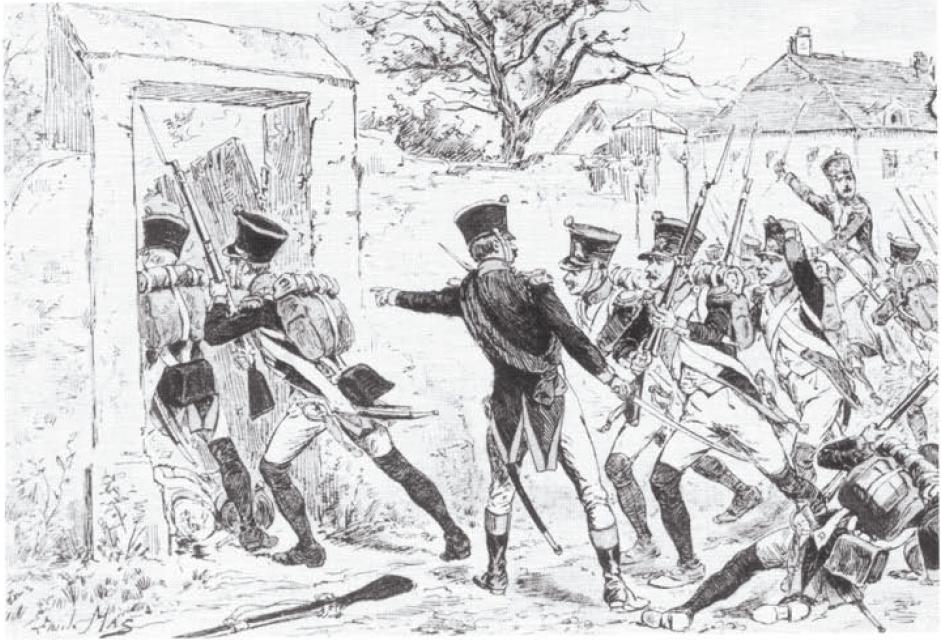
The 4th Line storms Aderklaa
The 4th Line storms Aderklaa The 4th Line Regiment of Carra Saint-Cyr's division, Masséna's IV Corps, storms the village of Aderklaa in the Austrian center on the second day of the battle. Engraving by L. Mas, Musée de l'Armée, Paris. Pinned at Aderklaa. L. Mas · public domain · source
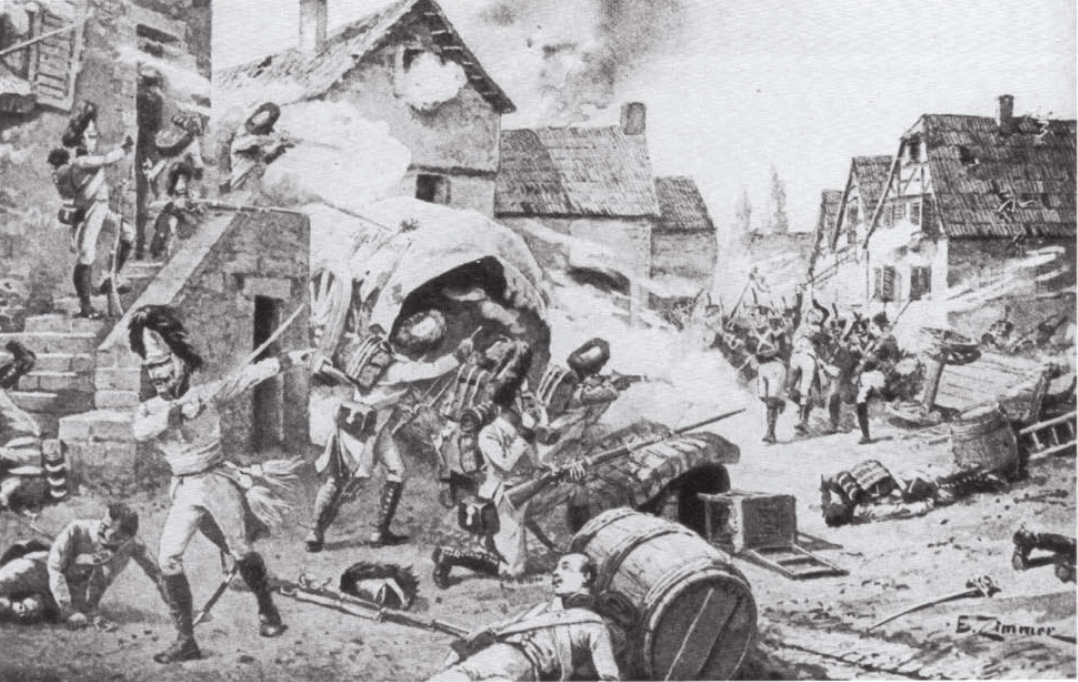
Molitor's division at Aderklaa
Molitor's division at Aderklaa French infantry of Molitor's division (IV Corps) take Aderklaa from the Austrian grenadiers (left) on 6 July; by the file's account the grenadiers and their supports needed two full hours to retake it. 19th-century engraving. Pinned at Aderklaa. Unknown artist · public domain · source
Masséna at Wagram (Charron after Martinet)
Masséna at Wagram (Charron after Martinet) Marshal Masséna at the Battle of Wagram, engraved by Charron after Martinet. Place not recorded; pinned with Masséna's IV Corps near Aderklaa on the morning of 6 July, approximate. Charron after Martinet · public domain · source
Masséna directs the battle from a carriage
Masséna directs the battle from a carriage Marshal Masséna at Wagram, 6 July 1809: hurt in a fall from his horse a few days before, he gives his orders from a carriage (illustration dated 1904). Place not recorded; pinned with IV Corps near Aderklaa, approximate. Unknown artist · public domain · source
Austrian hussars take Boudet's guns
Austrian hussars take Boudet's guns Austrian hussars capture the guns of Boudet's division not far from the village of Aspern. Engraving in the Heeresgeschichtliches Museum, Vienna. Pinned with Boudet's division south of Aspern on the morning of 6 July. Unknown artist · public domain · source
General Jean Boudet
General Jean Boudet Engraved portrait of General Jean Boudet (1769–1809), whose division held the French left near Aspern on 6 July. Date and place of the portrait not recorded; pinned with his division. Jean (engraver) · public domain · source
Cuirassiers cheer Napoleon (Sigriste, 1912)
Cuirassiers cheer Napoleon (Sigriste, 1912) Guido Sigriste's 1912 painting 'Napoléon pendant la bataille de Wagram': cuirassiers cheer Napoleon as they ride past during a cavalry charge. Place not recorded; pinned with Bessières' heavy cavalry in its charge of 6 July, approximate. Guido Sigriste · public domain · source
Horse artillery of the Guard at Wagram (Bréville)
Horse artillery of the Guard at Wagram (Bréville) Jacques Onfroy de Bréville's painting of the horse artillery of the Imperial Guard at Wagram. Place not recorded; pinned at Lauriston's grand battery, which included Guard guns, approximate. Jacques Onfroy de Bréville · public domain · source
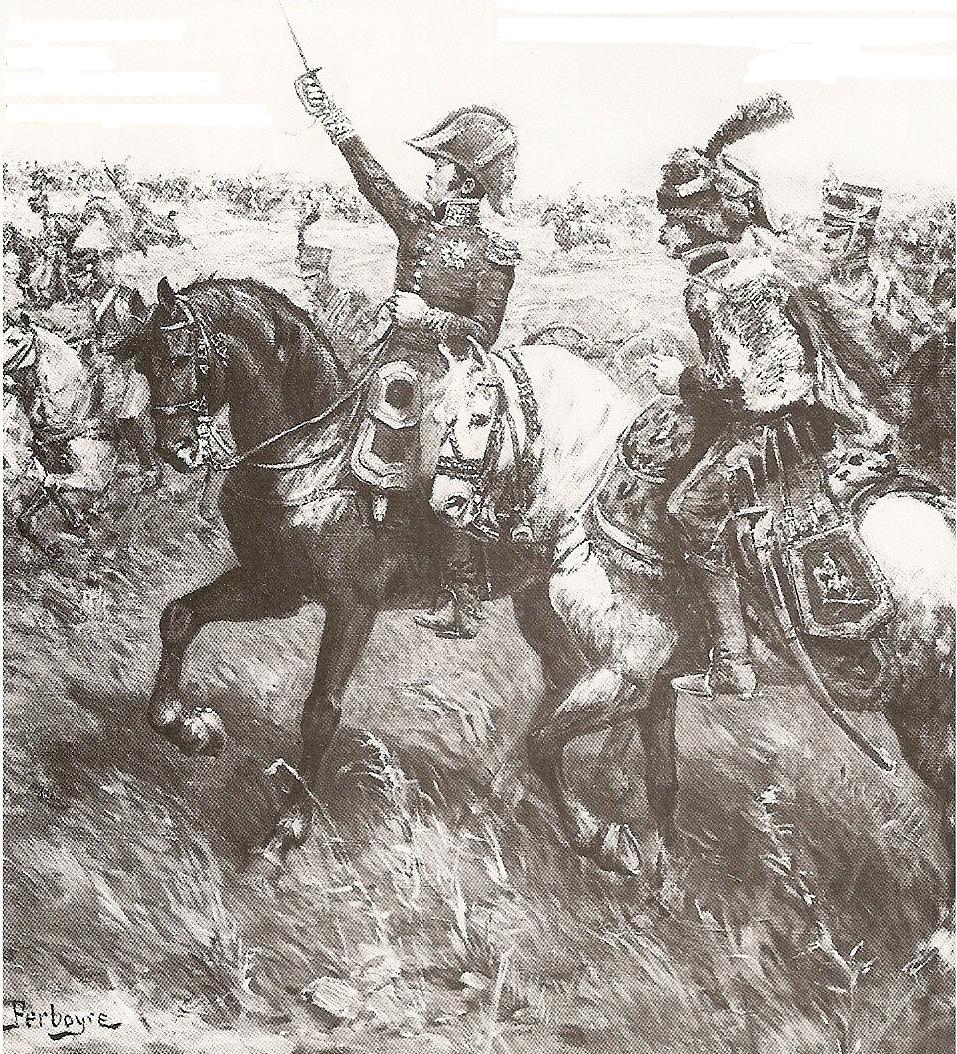
General Drouot at Wagram (Perboyre, 1913)
General Drouot at Wagram (Perboyre, 1913) Paul-Émile-Léon Perboyre's 1913 painting of General Antoine Drouot at the Battle of Wagram. Place not recorded; pinned at the grand battery, approximate. Paul-Émile-Léon Perboyre · public domain · source
Davout orders the assault on Markgrafneusiedl
Davout orders the assault on Markgrafneusiedl Leading his III Corps from the front, Davout has his horse shot under him and orders his men on against Markgrafneusiedl, its tower visible in the background. 19th-century print, Anne S. K. Brown Collection. Pinned at Markgrafneusiedl. Unknown artist (Anne S. K. Brown Collection) · public domain · source
The decisive attack, about 1 PM on 6 July (Siméon Fort)
The decisive attack, about 1 PM on 6 July (Siméon Fort) Siméon Fort's view of the decisive French attack at Wagram at about 1 PM on 6 July, with Macdonald's square attack column in the center. Pinned with Macdonald's column. Siméon Fort · public domain · source
General Macdonald at Wagram
General Macdonald at Wagram General Macdonald at the Battle of Wagram, 6 July 1809 (19th-century painting, signed lower left). Pinned with his column. Unknown artist · public domain · source
Broussier's division at Wagram (Lapeyre)
Broussier's division at Wagram (Lapeyre) Lucien Lapeyre's painting (about 1914) of General Broussier making his men swear to 'die for the eagles' at Wagram on 6 July 1809. Broussier's division formed part of Macdonald's column, sent to break the Austrian center. Pinned with the column. Lucien Lapeyre · public domain · source
Liechtenstein's cavalry charge the 10th Line
Liechtenstein's cavalry charge the 10th Line Prince Liechtenstein's Austrian cavalry charge the French 10th Line Regiment (Seras's division) at Wagram; the regiment took part in the advance of Macdonald's column toward Aderklaa. 19th-century print. Pinned with Macdonald's column, approximate. Unknown artist · public domain · source
Guard chasseurs charge Austrian dragoons (Chartier, 1897)
Guard chasseurs charge Austrian dragoons (Chartier, 1897) Henri-Georges Chartier's 1897 painting of chasseurs à cheval of the Imperial Guard charging Austrian dragoons at Wagram. Place not recorded; pinned with the Guard on the right of Macdonald's column, approximate. Henri-Georges Chartier · public domain · source
Polish light horse of the Guard (W. Kossak, 1893)
Polish light horse of the Guard (W. Kossak, 1893) Wojciech Kossak's 1893 painting of the Polish light horse of the Imperial Guard at Wagram. The regiment made several charges against the Austrian cavalry and routed Schwarzenberg's uhlans. Place not recorded; pinned with the Imperial Guard, approximate. Wojciech Kossak · public domain · source
Tomasz Łubieński at Wagram (J. Kossak, 1867)
Tomasz Łubieński at Wagram (J. Kossak, 1867) Juliusz Kossak's 1867 watercolor of Tomasz Łubieński at Wagram in 1809. Place not recorded; pinned with the Imperial Guard, approximate. Juliusz Kossak · public domain · source
Lasalle charges at Wagram (Sigriste, 1906)
Lasalle charges at Wagram (Sigriste, 1906) Guido Sigriste's 1906 painting of General Lasalle and his cavalrymen charging at Wagram. Lasalle was killed in one of the rearguard actions late on 6 July; the place is not recorded, so it is pinned with Masséna's IV Corps on the French left, approximate. Guido Sigriste · public domain · source
Lasalle's last charge (Detaille, 1912)
Lasalle's last charge (Detaille, 1912) Édouard Detaille's painting of General Lasalle charging at Wagram in the afternoon of 6 July, just before he was killed (the file says 'June 6th' in error). Place not recorded; pinned with Masséna's IV Corps on the French left, approximate. Édouard Detaille · public domain · source
The end of the battle (after Swebach)
The end of the battle (after Swebach) 'The ending of the Battle of Wagram, July 6, 1809', engraved by Mariage after Jacques Swebach. Scene not identified; pinned at the center of the battlefield, approximate. Mariage after Jacques Swebach · public domain · source
Schlacht bei Wagram (Kobell, about 1811)
Schlacht bei Wagram (Kobell, about 1811) Wilhelm von Kobell's 'Schlacht bei Wagram (6. Juli 1809)', painted about 1811, oil on canvas, 204 × 323 cm (Residenzmuseum, Munich). Scene not identified; pinned at the center of the battlefield, approximate. Wilhelm von Kobell · public domain · source
Napoleon on the field of Wagram (Chabord, 1810)
Napoleon on the field of Wagram (Chabord, 1810) Joseph Chabord's 1810 painting of Napoleon on horseback on the field of Wagram, pointing from the top of a hill (Museo Napoleonico, Rome). Place not recorded; pinned at Napoleon's command post at Raasdorf, approximate. Joseph Chabord · public domain · source
Bataille de Wagram, 6 juillet 1809 (Couché print)
Bataille de Wagram, 6 juillet 1809 (Couché print) 'Bataille de Wagram, 6 Juillet 1809', a book illustration engraved by François Louis Couché and Pigeot and published by Ternisien d'Haudricourt between 1809 and 1820, with a long French text below the plate (Rijksmuseum, RP-P-2018-590). Scene not identified; pinned at the center of the battlefield, approximate. François Louis Couché and Pigeot (Rijksmuseum) · CC0 · source
Bataille de Wagram (after Carle Vernet and Swebach)
Bataille de Wagram (after Carle Vernet and Swebach) A colored lithograph after Carle Vernet and Jacques François Swebach, captioned 'Bataille de Wagram, livrée le 7 juillet 1809' (the battle ended on 6 July). Scene not identified; pinned at the center of the battlefield, approximate. Carle Vernet and Jacques François Swebach (photo: JoJan) · public domain · source
Wagram, 6 juillet 1809 (Raffet etching)
Wagram, 6 juillet 1809 (Raffet etching) 'Wagram (6 Juillet 1809)', an etching by Morinet after Auguste Raffet from the series 'Année 1809: De la prise de Saragosse à la bataille de Wagram' (Musée Carnavalet, G.37786). Scene not identified; pinned at the center of the battlefield, approximate. Morinet after Auguste Raffet (Musée Carnavalet, Paris Musées) · CC0 · source
Wagram (lithograph after Gros)
Wagram (lithograph after Gros) 'Wagram', a 19th-century lithograph printed by Charles Motte after a model by Antoine-Jean Gros (Paris Musées, G.34426). Scene not identified; pinned at the center of the battlefield, approximate. Charles Motte after Antoine-Jean Gros (Paris Musées) · CC0 · source
French and Austrians at close quarters (Beck, 1860)
French and Austrians at close quarters (Beck, 1860) August Beck's 1860 wood engraving of French and Austrian troops fighting at Wagram. Scene not identified; pinned at the center of the battlefield, approximate. August Beck · public domain · source
The Battle of Wagram (engraving)
The Battle of Wagram (engraving) An anonymous engraving of the Battle of Wagram. Scene not identified; pinned at the center of the battlefield, approximate. Unknown artist · public domain · source
The Battle of Wagram (Emil Adam)
The Battle of Wagram (Emil Adam) Emil Adam's painting of the Battle of Wagram. Scene not identified; pinned at the center of the battlefield, approximate. Emil Adam · public domain · source
Napoleon and Colonel Gambin (Fastes de la gloire, 1820)
Napoleon and Colonel Gambin (Fastes de la gloire, 1820) An engraving from 'Fastes de la gloire' (1820) showing Napoleon and Colonel Jean Hugues Gambin at Wagram. Place not recorded; pinned at Napoleon's command post at Raasdorf, approximate. Duparc and Chasselat · public domain · source
Napoleon, with Wagram behind (d'Orsay, 1843)
Napoleon, with Wagram behind (d'Orsay, 1843) Alfred d'Orsay's 1843 portrait of Napoleon, with the Battle of Wagram in the background; painted long after the battle. Place not recorded; pinned at Napoleon's command post at Raasdorf, approximate. Alfred d'Orsay · public domain · source
Timlich's map of the battle (Vienna, July 1809)
Timlich's map of the battle (Vienna, July 1809) Karl Timlich's map of the battle of 6 July, published in Vienna by P. Rehm's widow on 31 July 1809 (National Széchényi Library, Budapest). Pinned at the center of the battlefield. Karl Timlich (National Széchényi Library) · public domain · source
Plan from Alison's atlas (1850), sheet 1
Plan from Alison's atlas (1850), sheet 1 A lithographed plate by Alexander Keith Johnston from the atlas to Archibald Alison's History of Europe (Edinburgh and London, about 1850), filed among maps of the Battle of Wagram. Pinned at the center of the battlefield. Alexander Keith Johnston · public domain · source
Plan from Alison's atlas (1850), sheet 2
Plan from Alison's atlas (1850), sheet 2 A second lithographed plate by Alexander Keith Johnston from the atlas to Archibald Alison's History of Europe (about 1850), filed among maps of the Battle of Wagram. Pinned at the center of the battlefield. Alexander Keith Johnston · public domain · source
Woerl's battle atlas (1857)
Woerl's battle atlas (1857) A sheet from Joseph Edmund Woerl's Atlas der Schlachten, Treffen und Belagerungen (Freiburg im Breisgau, 1857), filed among maps of the Battle of Wagram. Pinned at the center of the battlefield. Joseph Edmund Woerl · public domain · source
Map of the battle (Meyers, 1890)
Map of the battle (Meyers, 1890) Historical map of the Battle of Wagram, 5–6 July 1809, from Meyers Konversations-Lexikon, volume 16 (1890). Pinned at the center of the battlefield. Meyers Konversations-Lexikon · public domain · source
Positions late on 6 July (Sloane)
Positions late on 6 July (Sloane) William Milligan Sloane's map of the positions at Wagram toward the end of the day on 6 July 1809. Pinned at the center of the battlefield. William Milligan Sloane · public domain · source
The final day (Colbeck, 1905)
The final day (Colbeck, 1905) Charles Colbeck's 1905 map of the final day of the Battle of Wagram. Pinned at the center of the battlefield. Charles Colbeck · public domain · source
Wagram battlefield (Britannica, 1911)
Wagram battlefield (Britannica, 1911) Map of the Wagram battlefield drawn by Emery Walker for the 1911 Encyclopædia Britannica article on Wagram. Pinned at the center of the battlefield. Emery Walker · public domain · source
Sytin Military Encyclopedia, map 1 (1911)
Sytin Military Encyclopedia, map 1 (1911) Map No. 1 for the article 'Wagram' in volume 5 of Sytin's Military Encyclopedia (St. Petersburg, 1911). Pinned at the center of the battlefield. Sytin Military Encyclopedia · public domain · source
Sytin Military Encyclopedia, map 2 (1911)
Sytin Military Encyclopedia, map 2 (1911) Map No. 2 for the article 'Wagram' in volume 5 of Sytin's Military Encyclopedia (St. Petersburg, 1911). Pinned at the center of the battlefield. Sytin Military Encyclopedia · public domain · source
The French counterattack on 6 July (Holt, 1920)
The French counterattack on 6 July (Holt, 1920) Lucius Hudson Holt's 1920 plan of the French counterattack at Wagram on 6 July 1809. Pinned at the center of the battlefield. Lucius Hudson Holt · public domain · source
Wagram and vicinity, 5 July 1809 (West Point)
Wagram and vicinity, 5 July 1809 (West Point) United States Military Academy map of the strategic situation and the Battle of Wagram in early July 1809. Pinned at the center of the area it covers. United States Military Academy · public domain · source
Map: operations on 5 July
Map: operations on 5 July Modern map of operations on the first day of the battle, 5 July 1809, based on David Chandler's work. Pinned at the center of the area it covers. Alexandru.demian · CC BY-SA 3.0 · source
Map: the evening attacks of 5 July
Map: the evening attacks of 5 July Modern map of the French attacks on the Russbach line on the evening of 5 July 1809. Pinned at the center of the area it covers. Alexandru.demian · CC BY-SA 3.0 · source
The Marchfeld north of Vienna (map, 1875)
The Marchfeld north of Vienna (map, 1875) Map of the region north of Vienna where the battles of Aspern-Essling (21–22 May) and Wagram (5–6 July) were fought in 1809, printed in Vienna in 1875. Pinned at the center of the area it covers. Mechitharisten-Buchdruckerei, Vienna · public domain · source
Aspern-Essling and Wagram (Thiers atlas, 1859)
Aspern-Essling and Wagram (Thiers atlas, 1859) Map of the region north of Vienna, site of the battles of Aspern-Essling and Wagram in 1809, from the atlas to Adolphe Thiers' Histoire du Consulat et de l'Empire (1859). Pinned at the center of the area it covers. Atlas to Adolphe Thiers' Consulat et Empire · public domain · source
Church ruin at Markgrafneusiedl
Church ruin at Markgrafneusiedl The ruined church of St Martin at Markgrafneusiedl, on the highest point of the Marchfeld, 2021. Its tower marked the end of the Austrian line, and Davout's Morand and Friant divisions climbed the heights to it on 6 July. CMatula · CC BY-SA 4.0 · source
Markgrafneusiedl church ruin from the northeast
Markgrafneusiedl church ruin from the northeast Northeast view of the ruined church of St Martin at Markgrafneusiedl, 2014. C.Stadler/Bwag · CC BY-SA 4.0 · source
Markgrafneusiedl church ruin from the southeast
Markgrafneusiedl church ruin from the southeast Southeast view of the ruined church of St Martin at Markgrafneusiedl, 2014. C.Stadler/Bwag · CC BY-SA 3.0 AT · source
Archduke Charles's quarters, Deutsch-Wagram
Archduke Charles's quarters, Deutsch-Wagram The town house in Deutsch-Wagram where Archduke Charles had his quarters during the battle, today a local museum, 2011. The house is not in the atlas data; pinned at Deutsch-Wagram, approximate. Peter Lauppert · CC BY-SA 3.0 · source
Erzherzog-Carl-Haus, Deutsch-Wagram
Erzherzog-Carl-Haus, Deutsch-Wagram The Erzherzog-Carl-Haus in Deutsch-Wagram, Archduke Charles's quarters during the battle. The house is not in the atlas data; pinned at Deutsch-Wagram, approximate. Peter Lauppert · CC BY-SA 4.0 · source
Battlefield archaeology display, Napoleon Museum
Battlefield archaeology display, Napoleon Museum A display at the Napoleon Museum in Deutsch-Wagram, 2023, on the 2017 excavations for the planned S8 Marchfeld expressway, which found skeletons, musket balls and remains of positions and shelters from the Napoleonic period. Pinned at Deutsch-Wagram, approximate. CMatula · CC BY-SA 4.0 · source
Wagram memorial, Deutsch-Wagram
Wagram memorial, Deutsch-Wagram The memorial to the Battle of Wagram in Deutsch-Wagram, by the Viennese sculptor Franz Seifert, unveiled on 4 July 1909 for the centenary: an Austrian grenadier of the 42nd Infantry Regiment holding up a flag, 2020. Exact spot not in the atlas data; pinned at Deutsch-Wagram, approximate. CMatula · CC BY-SA 4.0 · source
Wagram memorial, 2023
Wagram memorial, 2023 The Battle of Wagram memorial in Deutsch-Wagram, 2023. Exact spot not in the atlas data; pinned at Deutsch-Wagram, approximate. CMatula · CC BY-SA 4.0 · source
Wagram memorial (postcard)
Wagram memorial (postcard) A postcard of the memorial in Deutsch-Wagram to the soldiers who died in the Battle of Wagram, 5–6 July 1809. Exact spot not in the atlas data; pinned at Deutsch-Wagram, approximate. Unknown photographer (uploaded by Andronicus92) · CC BY-SA 3.0 · source
Memorial stone at Aderklaa
Memorial stone at Aderklaa Memorial stone at Aderklaa for 5 and 6 July 1809, 2016. Pinned at Aderklaa; exact spot approximate. Earnest B · CC BY-SA 3.0 · source
Napoleon's headquarters stone, Lobau
Napoleon's headquarters stone, Lobau The stone marking the place of Napoleon's headquarters on the Lobau in 1809, the island from which he launched the crossing of 4–5 July, 2009. Erich Schmid · CC BY-SA 3.0 · source
Napoleon's headquarters stone, 2007
Napoleon's headquarters stone, 2007 Napoleon's headquarters stone on the Lobau, 2007. Bluefox at · CC BY-SA 3.0 AT · source
St Martin's church, Aspern
St Martin's church, Aspern The parish church of St Martin in Aspern, 2006. Klenau's VI Korps took the ruins of Aspern on the morning of 6 July, and Masséna retook the village that afternoon. Invisigoth67 · CC BY-SA 3.0 · source
The Lion of Aspern
The Lion of Aspern The Lion of Aspern beside St Martin's church, a monument to the Battle of Aspern-Essling of May 1809, 2011. The village was fought over again on 6 July. Invisigoth67 · CC BY-SA 3.0 · source

Free for everyone every year on its anniversary: July 5–6.

Accuracy score: 65/100 (moderate)

  • Sources24/40

    Ian Castle's study (Fondation Napoléon), Rickard following Gill's Thunder on the Danube, a contemporary 1809 Vienna account and reference works; Gill, Petre and Arnold not read directly and no georeferenced period map.

  • Fixed points22/30

    The villages, the Markgrafneusiedl church tower, Aspern church and Schloss Essling are fixed from heritage and gazetteer sources; the crossing point and the corps frontages are drawn from descriptions.

  • Movement detail12/20

    Corps blocks are schematic frontages; arrows show direction and sequence, not traced routes.

  • Corroboration7/10

    Castle and Rickard (after Gill) agree on most movements and figures; they differ on how long the French held Aderklaa, and both readings are given.

How the accuracy score works

Sources and method

Wagram, 5–6 July 1809. Corps are placed by the villages the sources name — Deutsch-Wagram, Aderklaa, Baumersdorf (today Parbasdorf), Markgrafneusiedl and its ruined church tower (the 13th-century fortified church of St Martin on the edge of the Wagram escarpment, identified locally as the 'tower of Markgrafneusiedl' of the 1809 accounts), Raasdorf, Glinzendorf, Grosshofen, Süssenbrunn, Breitenlee, Aspern, Essling, Gross-Enzersdorf and the Lobau — at surviving village cores; blocks are corps frontages, drawn schematically, and their exact traces are interpretive. No U.S. Army staff ride handbook covers the battle. Sources differ on details: how long the French held Aderklaa on the morning of 6 July, and all casualty totals. Macdonald's column aimed at Süssenbrunn (Castle: 'the church spire of Süssenbrunn'; Rickard: 'Aiming at Süssenbrunn'). The arrows are straight lines between positions, not routes traced from a period map.

Where the positions come from

  • Heritage sites Markgrafneusiedl church ruin (TracesOfWar, Weinviertel tourism), Aspern church and the Lion of Aspern (Wien Geschichte Wiki, Austria-Forum), Schloss Essling plaque (TracesOfWar), Napoleon's headquarters stone on the Lobau (Wien Geschichte Wiki, Napoleonsteine)
  • Gazetteer Village cores checked against GeoNames and Lower Austria and Weinviertel municipality pages; Komoot points for the Breitenlee and Stammersdorf churches and Schloss Süssenbrunn
  • Contemporary account Schlacht bei Wagram / Bataille de Wagram (Vienna: Ghelen, c. 1809–10) for the crossing by the Hanselgrund and Mühlleuten; crossing point approximate

Further reading