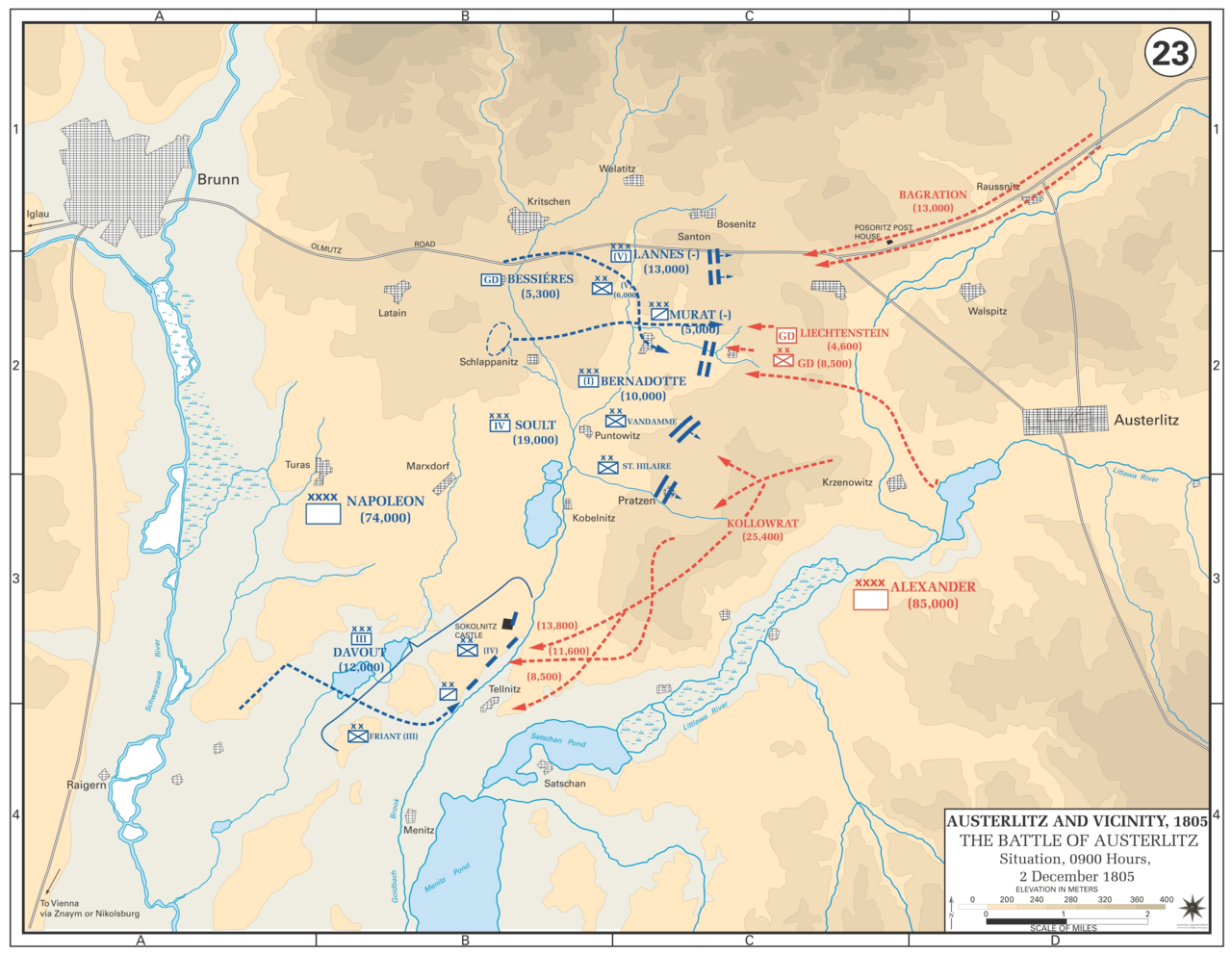
Austerlitz, 2 December 1805. Fixed points come from the battlefield's memorial landscape, with published coordinates: the Cairn of Peace (Mohyla míru) on the Pratzeberg (
TracesOfWar, corroborated by Komoot), Žuráň hill, the Santon and its chapel, the Old Post (Stará pošta), Sokolnice castle and pheasantry, Telnice church, Slavkov castle, Rajhrad abbey and the Guard-clash monument near Holubice, from the South Moravian Region's
Napoleonic Moravia locality pages; Žuráň also from the
Archeologický atlas, the Santon from
South Moravia, and the Staré Vinohrady (approximate) from Komoot. Events at each site follow the
History Trail of the Austerlitz Battlefield and
Communes of the battlefield (austerlitz.org, the Slavkov battlefield association) — including the draining of the Satschan pond (8–12 December 1805), which found many dead horses but only two or three bodies — and the Žatčany teacher Gabriel Richter's chronicle (
austerlitz.org). Village centers are from Wikipedia (coordinates only). The course of the battle, column objectives and strengths follow J. Rickard,
'Battle of Austerlitz, 2 December 1805' (History of War, 2012); Neil Faulkner,
'The Battle of Austerlitz: Napoleon's masterpiece' (Military History Matters); Jack Sigler,
'The Battle of Austerlitz and the Principles of War' (Napoleonic Scholarship, 2011); the Fondation Napoléon
timeline and
bibliography;
Encyclopaedia Britannica (about 68,000 French against almost 90,000); and the standard modern histories — Christopher Duffy,
Austerlitz 1805 (1977); Scott Bowden,
Napoleon and Austerlitz (1997), who argues the Allies' paper strength of about 85,000 overstates the men present; Robert Goetz,
1805: Austerlitz (2005), who stresses the Allies' tactical competence and their high command's failures; David Chandler,
The Campaigns of Napoleon (1966) and
Austerlitz 1805 (1990); Ian Castle,
Austerlitz 1805 (2003) — and the Austerlitz plates of the West Point atlas (Esposito and Elting,
A Military History and Atlas of the Napoleonic Wars). A period German plan, 'Plan der Schlacht von Austerlitz' (c. 1805,
Bodleian Libraries), shows the same weakened French right and Pratzen attack. Napoleon's
30th Bulletin (3 December 1805) is quoted as propaganda: its 20,000 drowned and 800 French dead are not credible. Strengths and losses are given as ranges; clock times differ by an hour or more between accounts; the ponds have been drained and their outlines here are conjectural; unit blocks are interpretive placements of corps, divisions and brigades. Images from Wikimedia Commons.