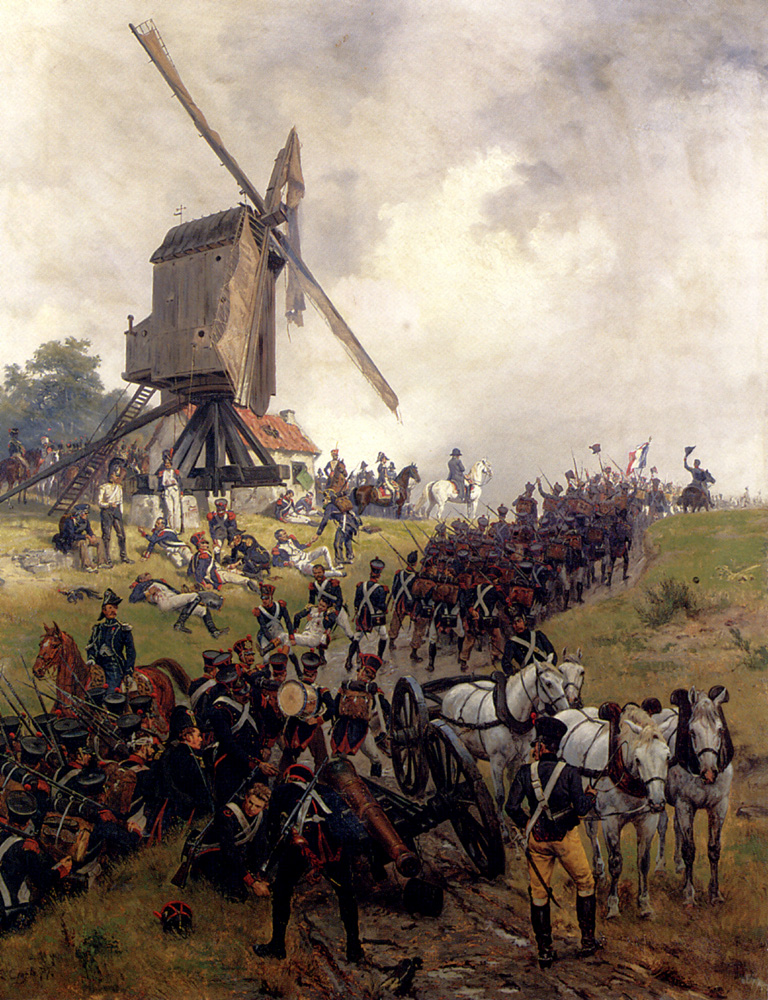
Quatre Bras and Ligny, 16 June 1815
On 16 June 1815, two days before Waterloo, Napoleon fought two battles at once. At Ligny he attacked Blücher's Prussian army and, after six hours of savage village fighting, broke its centre with the Imperial Guard — his last victory. Ten kilometres west, Marshal Ney failed to take the crossroads at Quatre Bras from Wellington's arriving troops. Because the Prussians retreated north to Wavre rather than east, they were able to march to Wellington's aid at Waterloo.
Open the interactive map9 stages on modern satellite imagery and terrain, with 3D elevation
This battle opens with Battlefield Explorer ($5 a month on Patreon), which unlocks every battle in the atlas. Free battles include Yorktown, Waterloo, The Alamo, Antietam, Little Bighorn, Belleau Wood, Omaha Beach, Ia Drang.

The battle, stage by stage
- 16 June 1815, midday
Two battles, one day
Napoleon has crossed the Sambre at Charleroi and driven a wedge between Wellington's Anglo-allied army and Blücher's Prussians. Marshal Ney, with the French left wing, is to take the crossroads at Quatre Bras on the Brussels road; Napoleon himself turns on the Prussians, concentrated behind the Ligny brook ten kilometres to the east. At Quatre Bras only Perponcher's Dutch-Belgian division stands in the way. About 1 PM Wellington rides over to meet Blücher at the Bussy windmill and promises help — if he is not attacked himself.
- About 2–3 PM
Ney attacks at Quatre Bras
Ney finally opens with a battery of 22 guns. Reille's II Corps — Bachelu, Foy and Jérôme Bonaparte — drives Perponcher's men back: the Nassauers from Grand-Pierrepont into the Bois de Bossu, the Dutch militia from Gemioncourt farm after a costly fight. By 3 PM the French line runs Pierrepont–Gemioncourt–Piraumont. Then Picton's 5th Division arrives from Brussels and lines the Namur road, and Wellington returns to take command.
- About 2:30–3 PM
Ligny: the villages
Napoleon waits for the sound of Ney's guns, then attacks. Vandamme's III Corps storms Saint-Amand; Lefol's division drives out Jagow's brigade and Girard's division takes Saint-Amand-la-Haye. Zieten's Prussians counter-attack again and again. The fighting in the walled farms and orchards along the brook is savage, with little quarter given.
- About 3–5 PM
Ligny burns
At 3 PM Gérard's IV Corps attacks Ligny. Pécheux's division reaches the church but is driven out by fire from three sides; the village catches fire and changes hands repeatedly in house-to-house fighting as Jagow's and Henckel's brigades counter-attack. Girard is mortally wounded at La Haye, which the Prussians retake.
- About 5 PM
D'Erlon's wasted march
Blücher prepares to throw Pirch I's II Corps round the French left at Wagnelée. Then a column of 20,000 men is seen approaching from the west — d'Erlon's I Corps, diverted from Quatre Bras toward Ligny by a garbled order. Vandamme takes it for the enemy and halts; before Napoleon can use it, Ney recalls it. D'Erlon marches back and fights in neither battle.
- About 3:30–6 PM
Quatre Bras: crisis at the crossroads
The Duke of Brunswick is shot dead leading his men near the Charleroi road. Piré's lancers catch Pack's Highlanders, and the 42nd and 44th fight back-to-back. At 5 PM Alten's 3rd Division arrives from Nivelles; Ney, told that d'Erlon has gone, sends Kellermann's cuirassiers at the British line. They ride down the 69th, take its colour and reach the crossroads before artillery and musketry drive them back.
- About 7:30–8:30 PM
The Guard breaks the Prussian centre
In a thunderstorm, 60 guns signal the final blow: Gérard and the Imperial Guard, with Milhaud's cuirassiers, storm through Ligny and up the slope behind it. Blücher, 72 years old, leads a last cavalry charge in person; his horse is shot and falls on him, and he is carried from the field half-conscious. The Prussian centre gives way and a new line forms between Brye and Sombreffe.
- About 6:30–9 PM
Wellington holds Quatre Bras
Cooke's Guards division arrives and clears Jérôme's men from the Bois de Bossu, though the Guards are cut up by lancers when they emerge. With superior numbers, Wellington pushes forward and by dark has retaken all the ground lost during the day. Each side has lost about 4,500 killed and wounded.
- Night, 16–17 June
The Prussians fall back on Wavre
Napoleon has won his last victory, but not a decisive one. The Prussians lose about 16,000 killed and wounded and many more stragglers; the French perhaps 11,000. With Blücher missing, Gneisenau orders the retreat north toward Tilly and Wavre rather than east toward Prussia — keeping the armies in reach of each other. Next day Wellington falls back to Mont-Saint-Jean, and on 18 June Blücher marches to join him at Waterloo.
Paintings and photographs