Battlefield Atlas
The Crusades · 1097 First 3 stages free

Dorylaeum, 1 July 1097

On 1 July 1097, a few days after the fall of Nicaea, the Seljuk sultan Kilij Arslan I and his Danishmend allies ambushed the vanguard of the First Crusade, Bohemond's column, which had marched a few kilometers ahead of the main army. All morning the Turkish horse archers pressed the vanguard back onto its camp, where the foot soldiers and pilgrims held out and the women carried water to the fighters. Around midday the knights of the main army arrived under Godfrey of Bouillon and Hugh of Vermandois, and a force under Bishop Adhemar of Le Puy came over the hills onto the Turkish rear. The Turks fled, leaving their camp and treasure, and the crusaders had an open road across Anatolia. The battle is named after Dorylaeum (modern Eskişehir), but its exact site is unknown: this map follows John France's reconstruction, which places it at a valley junction near Bozüyük, and every position is approximate.

Play the first 3 stages free6 stages on modern satellite imagery and terrain, with 3D elevation

The first 3 of its 6 stages are free to play. The rest opens with Battlefield Explorer ($4.99 a month or $39 a year), which unlocks every battle in the atlas and every one added later. Lifetime access and war packs are one-time options. Free battles include Thermopylae, Plataea, Actium, Viking raid on Lindisfarne, Hastings, Hattin, Agincourt, Vítkov Hill, Kutná Hora, Fall of Constantinople, First St Albans, Lützen, Siege of Buda, Culloden, Fort William Henry, Yorktown, Lake Erie, Waterloo, The Alamo, Monterrey, Antietam, Little Bighorn, Manila Bay, Belleau Wood, Saint-Mihiel, Omaha Beach, Inchon, Ia Drang, Goose Green, 73 Easting, Wanat, Baghdad Thunder Runs, Manbij, Battle of Raqqa, Donetsk Airport, Ilovaisk, Debaltseve, Battle of Kyiv, Battle of Hostomel Airport, Siege of Mariupol, Bilohorivka (Siverskyi Donets crossing), Kharkiv counteroffensive, Kherson counteroffensive, Bakhmut, Vuhledar, Mala Tokmachka and Robotyne, Avdiivka, Kursk incursion.

Battle of Dorylaeum (manuscript, c. 1330–40)
Battle of Dorylaeum (manuscript, c. 1330–40) — Unknown illuminator, Bibliothèque nationale de France · public domain

The battle, stage by stage

  1. 26–30 June 1097

    Two columns from Nicaea

    After Nicaea surrenders to the Byzantines, the crusade army begins leaving Nicaea on 26 June (the Provençals last, on 28 June) and gathers at the bridge at Leukai (Lefke, modern Osmaneli) on the Göksu. It sets out from the bridge on 29 June for Dorylaeum, and on the march it splits in two. The Gesta Francorum says they lost the single road in the dark; Raymond of Aguilers blamed Bohemond's rashness, and Albert of Aachen calls the split deliberate, for foraging; France points to sheer size and the lack of an overall commander. In front go Bohemond with Tancred and the Italo-Normans, Robert of Normandy and Stephen of Blois: by John France's estimate under 20,000 people, many of them noncombatants. Behind, by Raymond of Aguilers about five kilometers back, come Godfrey of Bouillon, Hugh of Vermandois, Robert of Flanders, Raymond of Toulouse and Bishop Adhemar of Le Puy, over 30,000 (France). Kilij Arslan, the Seljuk sultan who lost Nicaea and his family in it, has allied with the Danishmend emir and waits ahead with an all-mounted army that France puts at roughly the size of the crusaders' knights (France elsewhere suggests 6,000–7,000; the Gesta and Fulcher of Chartres say 360,000). The route shown is schematic, and the whole site is a reconstruction (see sources).

  2. 1 July 1097, dawn

    Bohemond's camp surprised

    Turkish horsemen are seen on the evening of 30 June; at first light the vanguard finds itself facing the whole Turkish army, which comes up out of the valley on its right. In John France's reconstruction this is a basin where two valleys meet, about three to five kilometers north of modern Bozüyük, where the crusaders' road came down the western valley. Bohemond orders the knights to dismount and the camp to be pitched, then sends the knights forward while the foot soldiers make camp (Gesta), and sends riders back to hurry the other column. Pilgrims are strung out along the road behind. Camp, marsh and Turkish positions are conjectural.

  3. 1 July 1097, morning

    Defending the camp

    The Turkish horse archers ride in, shoot and wheel away, then close in on every side. The vanguard knights cannot catch them, are driven back on the tents and rally in front of them; some Turks reportedly get into the camp among the tents and baggage. A marsh on one side, probably the left, keeps them from closing the ring (Fulcher; its place is not known). Fulcher writes that they were 'huddled together like sheep in a fold, trembling and frightened'. The Gesta's author, who was there, remembers that 'our women were a great blessing to us that day', carrying drinking water up to the fighting men and encouraging them. Stragglers caught on the road are cut down. The Gesta has the fighting from the third to the ninth hour; Fulcher has the vanguard fighting alone from the first to the sixth.

  4. 1 July 1097, about noon

    Godfrey and Hugh arrive

    By about midday the main body's knights come up from the west. The Gesta has Duke Godfrey and Hugh the Great arrive first with their men, then the bishop, then the Count of Saint-Gilles with a great force. In France's reading they form up to the right of Bohemond's battered line, and the Turks have to turn to face a new threat on their left. Godfrey, with about 50 companions (France), charges what they take to be Kilij Arslan's own household on a low hill. The Gesta puts Bohemond, Robert of Normandy and Tancred on the left of the line, Godfrey, the Count of Flanders and Hugh on the right. The hill's position is conjectural.

  5. 1 July 1097, early afternoon

    Adhemar on the Turkish rear

    The decisive stroke comes from an unexpected direction. 'The Bishop of Le Puy approached by way of another mountain', the Gesta says, 'and thus the unbelieving Turks were surrounded on all sides'. In France's reconstruction Raymond of Toulouse enters the main valley through the glacial drumlins on its western shoulder, while Adhemar's part of the relief force comes round behind a small hill far to the right and onto the Turks' rear. Ralph of Caen sums up the day: the enemy were helped by numbers, we by our armor. Routes are drawn after France and are conjectural.

  6. 1 July 1097, afternoon

    Rout and the Turkish camp

    Caught between the two forces, the Turks break. By the Gesta they 'fled to their tents' but could not stay there long, and the crusaders followed, 'killing them as we went, for a whole day', and took 'many spoils: gold, silver, horses, donkeys, camels, sheep, cattle'. Albert of Aachen gives the dead as 4,000 Christians and 3,000 Turks; France comments that 'how far we can regard Albert's 4,000 Christians and 3,000 Turks as precise figures is a different matter'. Kilij Arslan withdraws and does not risk another battle, and the army marches on across Anatolia toward Antioch, passing dead Turks and horses by the road for days. The Turkish camp's site is not known.

Forces

John France puts the crusader vanguard at under 20,000 people, many of them noncombatants, and the main body at over 30,000; the all-mounted Turkish army was roughly equal to the crusaders' knights, perhaps 6,000–7,000. The chroniclers' 360,000 Turks is not credible, and every figure is an estimate.

Seljuk Turks and allies (Kilij Arslan I)

Present (all mounted)about 6,000–7,000 (France, modern estimate) (roughly equal to the crusader knights)

In Victory in the East France says the Turkish force was all mounted and 'probably roughly equal to the knights in the whole crusader host'; elsewhere (The Crusades and the Expansion of Catholic Christendom, 2005, p. 71) he suggests 6,000–7,000. The Society of Ancients' pack likewise reasons to about 7,000, at most 10,000 with the Danishmend allies. John France, Victory in the East (Cambridge UP, 1994), ch. 'The crusader army crosses into Asia Minor' (text); Wikipedia, 'Battle of Dorylaeum (1097)' (lead only, for France 2005, p. 71); Society of Ancients, 'Dorylaeum 1097 AD - the Battle Pack' (2006)

Contemporary claim360,000 (Gesta Francorum; Fulcher of Chartres)

The Gesta counts 360,000 'Turks, Persians, Paulicians, Saracens, Angulans, and other pagans', not counting the Arabs; France calls Fulcher's 360,000 'sheer fantasy'. Internet Medieval Sourcebook, Gesta Francorum (tr. Brundage); John France, Victory in the East (Cambridge UP, 1994), ch. 'The crusader army crosses into Asia Minor' (text)

First Crusade (Bohemond; Godfrey, Raymond of Toulouse and Adhemar)

Vanguard (Bohemond, Robert of Normandy, Stephen of Blois)under 20,000, including noncombatants (France)

France: 'probably fewer than 20,000 in all'; the Society of Ancients' pack suggests it may have been smaller still. John France, Victory in the East (Cambridge UP, 1994), ch. 'The crusader army crosses into Asia Minor' (text); Society of Ancients, 'Dorylaeum 1097 AD - the Battle Pack' (2006)

Main body (Godfrey, Hugh, Robert of Flanders, Raymond, Adhemar)over 30,000 (France)

France: 'rather more than 30,000 strong'. John France, Victory in the East (Cambridge UP, 1994), ch. 'The crusader army crosses into Asia Minor' (text)

Whole army leaving Nicaeaabout 7,000 knights and 43,000 foot (France, as summarized)

France's figures for the army after Nicaea as summarized in the Society of Ancients' battle pack ('7,000 knights and 43,000 assorted foot'). Society of Ancients, 'Dorylaeum 1097 AD - the Battle Pack' (2006)

Casualties

Albert of Aachen's 4,000 Christian and 3,000 Turkish dead are the only figures; John France thinks them plausible in scale but doubts their precision, and many of the crusader dead were stragglers and noncombatants. No reliable count exists for either side. Certainty: poor.

Seljuk Turks and allies (Kilij Arslan I)

Killedabout 3,000 (Albert of Aachen)

Albert of Aachen gives 3,000 Turkish dead; John France writes that 'how far we can regard Albert's 4,000 Christians and 3,000 Turks as precise figures is a different matter', though he finds them small enough to be credible. The Gesta Francorum gives no count, saying only that the crusaders killed the fleeing Turks 'for a whole day'. John France, Victory in the East (Cambridge UP, 1994), ch. 'The crusader army crosses into Asia Minor' (text); Internet Medieval Sourcebook, Gesta Francorum (tr. Brundage)

Camp and baggagecaptured

The Gesta says the crusaders took 'many spoils: gold, silver, horses, donkeys, camels, sheep, cattle'; no count is given. Internet Medieval Sourcebook, Gesta Francorum (tr. Brundage)

First Crusade (Bohemond; Godfrey, Raymond of Toulouse and Adhemar)

Killedabout 4,000 (Albert of Aachen)

Albert of Aachen's figure for Christian dead; France doubts that it is precise. Fulcher of Chartres, supported by Raymond of Aguilers, says most of the dead were stragglers caught on the road between the two crusader columns. John France, Victory in the East (Cambridge UP, 1994), ch. 'The crusader army crosses into Asia Minor' (text)

Named knights killed2 named (Gesta)

The Gesta names Godfrey of Monte-Scaglioso and William, Tancred's brother, and adds that 'some other knights and infantrymen whose names I do not know were also killed'. Internet Medieval Sourcebook, Gesta Francorum (tr. Brundage)

Civilians

Pilgrims and stragglers killedunknown

The vanguard included many noncombatants, and Fulcher says most of the dead were stragglers caught on the road; no separate figure survives, and it is not known how many of Albert's 4,000 were noncombatants. John France, Victory in the East (Cambridge UP, 1994), ch. 'The crusader army crosses into Asia Minor' (text)

Then and now: how the ground has changed

Nobody knows exactly where the battle was fought, so changes to the field cannot be pinned down. The valley junction near Bozüyük that John France proposed is now a highway crossroads and railway corridor beside an industrial town, and the alternative site near Eskişehir lies under or beside a large modern city.

Weapons

Seljuk Turks and allies (Kilij Arslan I)

Turkish composite bow

Turkish composite bow

Recurved composite bow · in use for many centuries

At Dorylaeum: The Turks were all mounted; their horse archers shot into the crusader camp.

Small, very strong recurved bows built up from horn, wood and sinew. Mounted archers could shoot them at the gallop and wheel away before a charge reached them, the tactic that wore down Crusader columns on the march.

Build
horn, wood and sinew, glued and bound
Use
shot from horseback at the gallop
Range
effective to about 100–150 yd; farther for volleys
Photo: Daderot (a later Ottoman example, Higgins Armory Museum) · Public domain

First Crusade (Bohemond; Godfrey, Raymond of Toulouse and Adhemar)

Mailed knight and couched lance

Mailed knight and couched lance

Heavy cavalry · 11th–13th centuries

At Dorylaeum: Godfrey's and Adhemar's knights broke the Turks when they arrived.

With the lance couched under the arm, a knight put the weight of man and horse behind the point. A massed charge could break almost any enemy that stood to receive it, so Muslim commanders tried to avoid it, scattering and shooting at the horses instead.

Armor
mail hauberk, helmet, kite or heater shield
Weapon
lance held under the arm, then sword or mace
Weakness
unarmoured horses; heat and thirst
Photo: Morgan Picture Bible, Paris, c. 1250 · Public domain

Paintings and photographs

Battle of Dorylaeum (manuscript, c. 1330–40)
Battle of Dorylaeum (manuscript, c. 1330–40) A 14th-century illumination of the Battle of Dorylaeum, 1097, from a French copy of William of Tyre's history of the Crusades (BnF MS Fr. 352, f. 49), made in Paris about 1330–1340. Unknown illuminator, Bibliothèque nationale de France · public domain · source
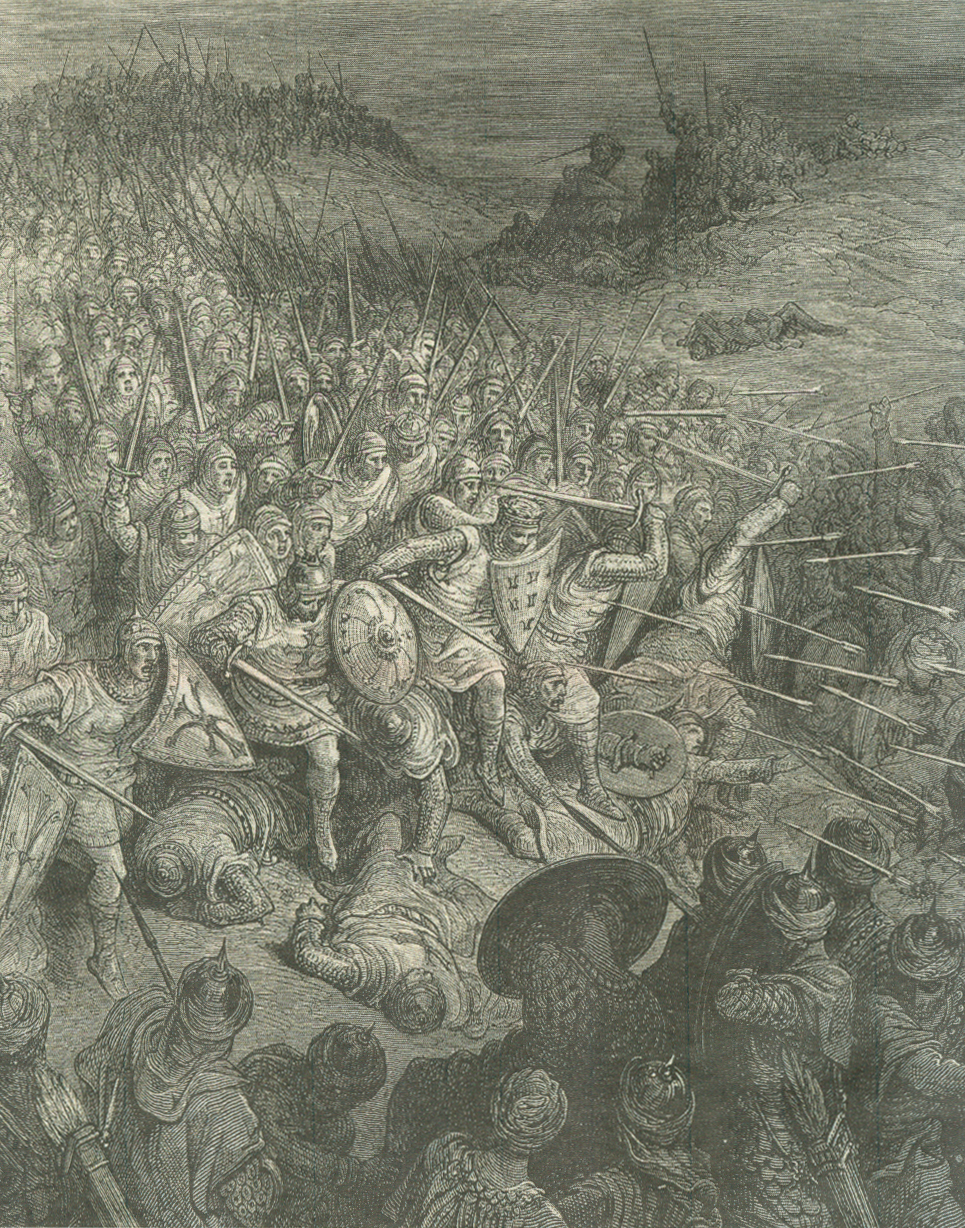
The Battle of Dorylaeum (19th century)
The Battle of Dorylaeum (19th century) A 19th-century depiction of the Battle of Dorylaeum, 1097, dated about 1850. The artist is not identified. Unknown artist · public domain · source

Medieval reconstruction. No troop maps survive for this battle. Positions follow the chronicles of both sides and modern studies, numbers are disputed, and the map shows the shape of the battle rather than exact spots.

Free for everyone every year on its anniversary: July 1.

Accuracy score: 45/100 (limited)

How the accuracy score works

Sources and method

Battle of Dorylaeum, 1 July 1097. This is a reconstruction. The medieval sources say only that the battle was fought near Dorylaeum, and no marker, survey or archaeology fixes the field. Events follow the eyewitness Gesta Francorum (Internet Medieval Sourcebook; Latin text with notes, Dickinson College Commentaries 3.9.1–2 and 3.9.3–4), with Fulcher of Chartres, Raymond of Aguilers, Ralph of Caen and Albert of Aachen as quoted and weighed by John France, Victory in the East: A Military History of the First Crusade (Cambridge University Press, 1994), ch. 'The crusader army crosses into Asia Minor' (text). The site and the movements follow France: a junction of two valleys some three to five kilometers north of Bozüyük, 'roughly where the modern road from Bursa meets route 650 from Bilecik', just south of the Kara Su gorges, with glacial drumlins, the camp against the northern rim and a marsh (placed conjecturally). The map's center point is a general-area point, good to a kilometer or two. Kahraman and Arıkan (Vakanüvis 2, 2017) argue that the site cannot be fixed without archaeology. The Turkish strength of 6,000–7,000 is from France, The Crusades and the Expansion of Catholic Christendom, 1000–1714 (2005), p. 71; Victory in the East says only that the Turks were all mounted and roughly equal to the crusader knights. Accounts differ on Robert of Flanders (France's figure caption has him with Bohemond); the map follows the Gesta, which puts him with Godfrey. France's strength estimates are also summarized in the Society of Ancients' Battle Day 2006 pack. Other readings put the battle in the plain near Eskişehir itself: Runciman (a valley near Dorylaeum, as reported second-hand and not verified here) and a thesis on Dorylaion's historical topography at Anadolu University, which places it in the Sarısu plain west of the city (Anadolu Üniversitesi). Fixed points: Bozüyük and Osmaneli (Lefke) town centers (terralocate), and Şarhöyük, the Dorylaion mound (Kültür Envanteri). Numbers are disputed: the Gesta and Fulcher give the Turks 360,000; France's estimates are under 20,000 for the vanguard (noncombatants included), over 30,000 for the main body and a Turkish army roughly equal to the crusaders' knights. Images from Wikimedia Commons.

Where the positions come from

Further reading