Battlefield Atlas
The Crusades · 1098 Locked

Antioch, 1097–1098

From October 1097 to June 1098 the First Crusade besieged Antioch, one of the great walled cities of the eastern Mediterranean, held for the Seljuks by Yaghi-Siyan. The crusaders blockaded the gates on the plain, starved through the winter and beat off two relief armies, but could not storm walls that climbed over two mountains. On the night of 2–3 June 1098 an officer named Firuz let Bohemond's men into his towers and the city fell, except the citadel. Two days later Kerbogha of Mosul's army arrived and besieged the crusaders inside. Encouraged by the reported finding of the Holy Lance, they marched out through the Bridge Gate and over the bridge on 28 June and routed Kerbogha's divided coalition. Antioch became a crusader principality, and the road to Jerusalem lay open.

Open the interactive map8 stages on modern satellite imagery and terrain, with 3D elevation

This battle opens with Battlefield Explorer ($4.99 a month or $39 a year), which unlocks every battle in the atlas and every one added later. Lifetime access and war packs are one-time options. Free battles include Thermopylae, Actium, Viking raid on Lindisfarne, Hastings, Hattin, Agincourt, Vítkov Hill, Bosworth, Fort William Henry, Yorktown, Waterloo, The Alamo, Antietam, Little Bighorn, Belleau Wood, Omaha Beach, Inchon, Ia Drang, Goose Green, 73 Easting, Wanat, Baghdad Thunder Runs, Battle of Raqqa, Donetsk Airport, Battle of Kyiv, Battle of Hostomel Airport, Siege of Mariupol, Kharkiv counteroffensive, Kherson counteroffensive, Bakhmut, Vuhledar, Mala Tokmachka and Robotyne, Avdiivka.
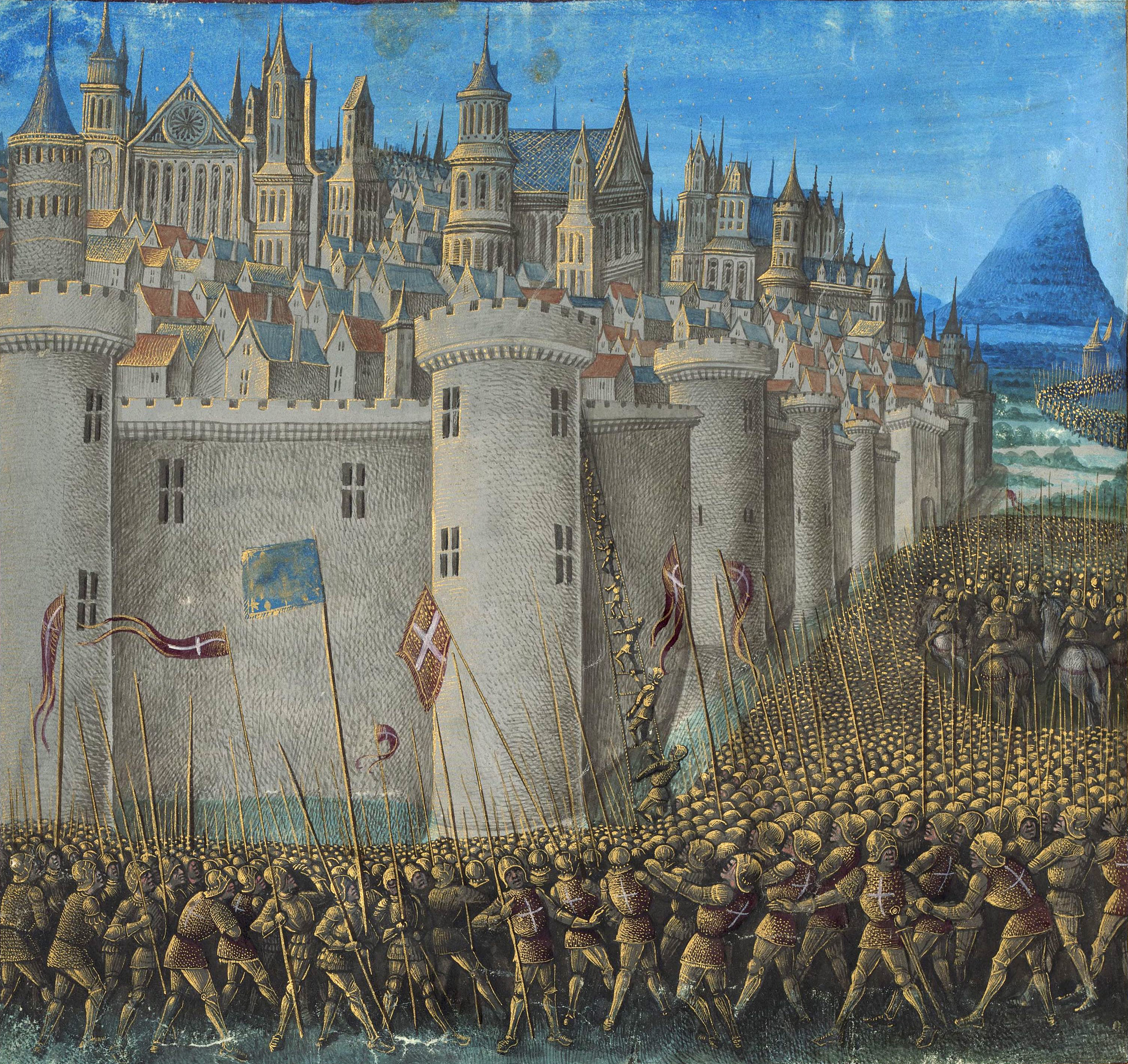
The Siege of Antioch (Colombe)
The Siege of Antioch (Colombe) — Jean Colombe — public domain

The battle, stage by stage

  1. 20 October – November 1097

    Before the walls

    After crossing Anatolia, the armies of the First Crusade force the Iron Bridge over the Orontes and reach Antioch on 20–21 October 1097 — by modern estimates perhaps 40,000 people, non-combatants included. The city's Justinianic walls run from the river up over Mount Silpius and Mount Staurin, with the citadel on the summit about 450 meters above sea level, and the Seljuk governor Yaghi-Siyan holds them with a garrison put at about 5,000 by some modern estimates (Raymond of Aguilers gives far more). The crusaders camp on the plain along the north side: Bohemond opposite St Paul's Gate, the northern French on his right, Raymond of Toulouse and Bishop Adhemar opposite the Dog Gate, Godfrey opposite the Duke's Gate, squeezed between wall and river. The Bridge Gate, the mountain walls, the Iron Gate and St George's Gate in the south stay open. By late November a siege fort, Malregard, rises on the hill outside St Paul's Gate. Gate sites are approximate.

  2. December 1097 – 9 February 1098

    Famine and the battle of the Lake

    Winter brings rain and famine; by Runciman's reading about one man in seven dies of hunger, and the horses die too. On 29 December Yaghi-Siyan sorties over the bridge against Raymond's camp; on 31 December Bohemond and Robert of Flanders, foraging far to the south, beat off a Damascene relief army under Duqaq. In February Ridwan of Aleppo comes on from Harim with an army of about 12,000 by the letters of Stephen of Blois and Anselm of Ribemont, a figure modern historians generally accept (Albert of Aachen says 30,000). On the night of 8–9 February the crusaders' last 700 or so mounted knights ride out and meet him where the Orontes and the Lake of Antioch close in near the Iron Bridge, so that his horse archers cannot spread round them; their charges break his army, while the foot soldiers left behind hold the camps against a sortie. The exact battlefield is not known; it is drawn here schematically.

  3. March – April 1098

    Closing the ring

    Early in March ships put into the port of St Symeon with supplies and building materials. On 6 March Turks from the Bridge Gate ambush a convoy on the road up from the coast; the crusaders recover and cut down many of the garrison at the bridge. With the stone the army then builds La Mahomerie, a fort at a mosque by the Muslim cemetery facing the Bridge Gate, held by Raymond's men; in April Tancred, paid by the princes, fortifies a monastery outside St George's Gate. Tatikios and the Byzantines have left the army in February. The city is now closed except over the mountain. Inside, an officer the Gesta calls Pirus (Firuz; Ibn al-Athir calls him Ruzbah, an armorer), who holds three towers (placed by Runciman on the southern wall, opposite Tancred's fort), is in secret contact with Bohemond.

  4. Night of 2–3 June 1098

    The Tower of the Two Sisters

    With Kerbogha's great relief army days away, the princes agree that whoever takes Antioch may keep it. At dusk on 2 June Bohemond's force marches off east, as if to meet Kerbogha (Runciman) or to raid (Gesta), then doubles back in the dark to the wall below Firuz's towers. A leather ladder goes up; by the Gesta about 60 men climb before it breaks, and Ibn al-Athir says more than 500 came up on ropes to a tower 'with a window overlooking the valley'. They seize the towers, open a postern and then the gates, and the army pours in. Joined by many of the Christian townspeople, the crusaders massacre the Muslim inhabitants they find, garrison and civilians alike, taking no prisoners (Raymond of Aguilers); by the Gesta, the squares were full of corpses. Only those who reach the citadel survive. Yaghi-Siyan rides out with about 30 men and is killed outside by Armenian peasants, who bring his head to Bohemond. Bohemond's banner is raised on a hill facing the citadel (Gesta). Neither the tower's exact place nor Bohemond's route to it is known; the tower is drawn on the southern wall, opposite Tancred's fort.

  5. 4–12 June 1098

    The besiegers besieged

    Kerbogha, atabeg of Mosul, with contingents from much of Syria and Mesopotamia — by modern estimates about 40,000 or more (HistoryNet; Britannica 75,000), chroniclers' figures far higher — reaches the Iron Bridge on 5 June and sets his camp, by Raymond of Aguilers, about two miles from the city. The citadel never fell: Yaghi-Siyan's son Shams ad-Daulah still holds it, and Kerbogha puts his own officer, Ahmad ibn Marwan, in command. From the mountain his troops attack down into the city; the crusaders throw up a wall and ditch facing the citadel and beat back the assaults of 9–12 June. They are now the ones besieged, starving in the city they have stripped bare; some, the Gesta's 'rope-dancers', let themselves down from the walls at night and flee.

  6. 14–27 June 1098

    The Holy Lance

    A poor Provençal pilgrim, Peter Bartholomew, says Saint Andrew has shown him in visions where the lance that pierced Christ lies buried. On 14 June, after a day's digging in the Cathedral of St Peter, a piece of iron is found; Raymond of Aguilers, who was there, says he kissed it while it still lay in the earth. Bishop Adhemar is reportedly doubtful, and later chroniclers question it, but the find and further reported visions lift the army's spirits. The princes put Bohemond in overall command, and on 27 June Peter the Hermit and Herluin go to Kerbogha (the Gesta), and are told he will accept only surrender (Runciman); by Ibn al-Athir the Franks asked for terms and were refused. The cathedral's site is not known; it is marked here schematically.

  7. 28 June 1098, morning

    Out by the Bridge Gate

    After three days of fasting the army goes out 'by the gate before the mosque' — the Bridge Gate — in six lines (the Gesta): Hugh of Vermandois and Robert of Flanders, Godfrey, Robert of Normandy, Adhemar with Raymond's Provençals and the Lance, Tancred, and Bohemond in the rear. Raymond, ill, stays behind with about 200 men to watch the citadel. Across the bridge the lines wheel right, the right on the river, and extend 'from the river to the mountain, about two miles'. Most of the knights fight on foot; only a few hundred horses are left. Kerbogha, by Ibn al-Athir, lets them come out unhindered so as to destroy them all at once. When a Turkish force swings round from the west, a seventh line under Rainald of Toul, formed from Godfrey's and Robert of Normandy's men (Gesta), faces it. The positions on the plain are schematic.

  8. 28 June 1098, midday

    Kerbogha's rout

    The crusaders press on, and Kerbogha's coalition comes apart: Duqaq of Damascus and other emirs, already at odds with him, leave the field, and the rest follow. Ibn al-Athir writes that the Muslims fled 'without any of them striking a single blow'; Raymond of Aguilers that few of their horsemen fell but scarcely any of their foot escaped. The crusaders take the camp and pursue toward the Iron Bridge. The citadel garrison surrenders that day to Bohemond, who will hold Antioch as his principality; disease follows, and Adhemar dies on 1 August. The army does not march on for Jerusalem until January 1099.

Forces

The crusaders arrived with perhaps 40,000 people, non-combatants included, and were down to roughly 20,000 fighting men and a few hundred horses by June 1098; the Antioch garrison is put at about 5,000, and Kerbogha's relief army by modern estimates at about 40,000 or more (HistoryNet; Britannica gives 75,000). Chroniclers' figures are much higher and every total is uncertain.

Seljuk and allied Muslim forces (Yaghi-Siyan, then Kerbogha)

Antioch garrison (Yaghi-Siyan)Raymond of Aguilers claims about 2,000 elite and 4,000-5,000 ordinary horsemen plus 10,000 foot, which modern historians treat as inflated; Runciman calls the garrison 'not very large'. Steven Runciman, 'The First Crusade: Antioch to Ascalon', in Setton (ed.), A History of the Crusades I; Wikipedia, 'Siege of Antioch' (lead only, for the modern estimate and Raymond's figures)about 5,000 (modern estimate) (5,000 to over 15,000)
Kerbogha's relief army (June 1098)HistoryNet (B. English) gives 'upward of 40,000'; Britannica gives 75,000; Raymond of Aguilers counts 'not less than twenty-eight thousand horsemen' at the battle; chroniclers' larger totals are not credited. Internet Medieval Sourcebook, The Siege and Capture of Antioch (Gesta Francorum; Raymond of Aguilers; tr. A. C. Krey); Encyclopaedia Britannica, 'Siege of Antioch'; Brian M. English, 'The Crucible of Antioch', HistoryNet (2019)about 40,000 or more (modern estimate) (28,000 horsemen (Raymond of Aguilers) to 75,000 (Britannica))
Ridwan of Aleppo's army (February 1098)The letters of Stephen of Blois and Anselm of Ribemont give about 12,000, a figure modern historians generally accept; Albert of Aachen says 30,000. Wikipedia, 'Battle of the Lake of Antioch' (citing the crusader letters and Albert of Aachen)about 12,000 (Stephen of Blois; Anselm of Ribemont) (12,000–30,000 (Albert of Aachen))

First Crusade (Bohemond, Raymond of Toulouse, Godfrey and others)

At the start of the siege (October 1097)HistoryNet estimates about 30,000 foot and 4,500 mounted knights plus some 8,500 non-combatants; Riley-Smith (via Wikipedia) about 43,000 at Nicaea earlier in 1097. Brian M. English, 'The Crucible of Antioch', HistoryNet (2019); Wikipedia, 'Siege of Antioch' (lead only)about 40,000 people, including non-combatants (about 34,500 fighting men in HistoryNet's estimate)
At the battle of 28 June 1098HistoryNet puts the army at no more than about 20,000 by the final battle; Britannica gives 30,000. Brian M. English, 'The Crucible of Antioch', HistoryNet (2019); Encyclopaedia Britannica, 'Siege of Antioch'about 20,000 fighting men (estimate) (up to 30,000 (Britannica))
HorsesAbout 700 mounted knights rode out against Ridwan; estimates for the horses left on 28 June range from 200 to 600, so most knights fought on foot. HistoryofWar, 'Battle of Harenc, 9 February 1098'; Brian M. English, 'The Crucible of Antioch', HistoryNet (2019)about 700 (February); a few hundred (June) (200-600 in June)

Casualties

The eight-month siege cost the crusaders far more to hunger and disease than to battle, and the garrison and many Muslim townspeople were killed when the city fell; Kerbogha's army lost thousands in the rout. No reliable totals exist for any side. Certainty: poor.

Seljuk and allied Muslim forces (Yaghi-Siyan, then Kerbogha)

Antioch garrison killed when the city fell (3 June)The Latin eyewitnesses describe the defenders killed in the streets; no count survives. Yaghi-Siyan fled with about 30 men (Ibn al-Athir) and was killed outside; the citadel garrison survived. Internet Medieval Sourcebook, The Siege and Capture of Antioch (Gesta Francorum; Raymond of Aguilers; tr. A. C. Krey); Ibn al-Athir, tr. D. S. Richards (2006), extractmost of the garrison; number unknown
Killed, battle of the Lake (9 February)Figure for Ridwan's losses as given by HistoryNet; the contemporary accounts give no reliable count. Brian M. English, 'The Crucible of Antioch', HistoryNet (2019)upward of 2,000 (estimate)
Killed, battle of 28 June (Kerbogha's army)Ibn al-Athir says the Franks killed thousands of the Muslims who stood; Raymond of Aguilers says few horsemen fell but scarcely any foot soldiers escaped; Britannica gives about 10,000. No reliable count exists. Ibn al-Athir, tr. D. S. Richards (2006), extract; Internet Medieval Sourcebook, The Siege and Capture of Antioch (tr. A. C. Krey); Encyclopaedia Britannica, 'Siege of Antioch'thousands; about 10,000 by Britannica

First Crusade (Bohemond, Raymond of Toulouse, Godfrey and others)

Deaths from famine and disease during the siegeRunciman estimates about one man in seven died of hunger in the winter; the Armenian chronicler Matthew of Edessa says one in five; Ibn al-Athir says most of the Franks perished during the siege. Disease after the victory killed many more, including Bishop Adhemar (1 August 1098). Steven Runciman, 'The First Crusade: Antioch to Ascalon', in Setton (ed.), A History of the Crusades I; Ibn al-Athir, tr. D. S. Richards (2006), extract; Wikipedia, 'Siege of Antioch' (lead only, for Matthew of Edessa)unknown; very heavy (about one in seven (Runciman) to one in five (Matthew of Edessa) starved)
Killed, sortie of 29 December 1097Raymond of Aguilers' figure for the losses at the bridge. Internet Medieval Sourcebook, The Siege and Capture of Antioch (Raymond of Aguilers; tr. A. C. Krey)about 15 knights and 20 foot
Casualties over the siege and battleBritannica's figure; it plainly does not include the many who died of hunger and disease, and the chronicles give no total. Encyclopaedia Britannica, 'Siege of Antioch'about 2,000 (Britannica)

Civilians

Townspeople killed when the city fell (3 June)The Latin accounts describe a general slaughter of the Muslim inhabitants, with local Christians joining the crusaders; no figure is recorded. Encyclopaedia Britannica, 'Siege of Antioch'; Internet Medieval Sourcebook, The Siege and Capture of Antioch (tr. A. C. Krey)unknown

Equipment and ships

Crusader horsesFamine and fighting killed most of the horses, so most knights fought the battle of 28 June on foot. HistoryofWar, 'Battle of Harenc, 9 February 1098'; Brian M. English, 'The Crucible of Antioch', HistoryNet (2019)most lost (about 700 left in February; 200-600 in June)

Then and now: how the ground has changed

The walls that climb Mount Silpius and Staurin, the citadel and the Iron Gate dam still stand in ruins, but the plain where the crusaders camped and the riverside gates are buried under modern Antakya, the Lake of Antioch has been drained, and the 2023 earthquake destroyed much of the old town.

The interactive map can show the period landscape (2 shapes: Lake of Antioch (Amik Lake), drained 1940s-1987 (approximate), Walled city in the plain, now under modern Antakya (approximate)) under the units. Open the map.

Weapons

Seljuk and allied Muslim forces (Yaghi-Siyan, then Kerbogha)

Turkish composite bow

Turkish composite bow

Recurved composite bow · in use for many centuries

At Siege of Antioch: Turkish horse archers were the core of the relief armies; at the Lake and on 28 June the crusaders sought narrow ground where they could not encircle them.

Small, very strong recurved bows built up from horn, wood and sinew. Mounted archers could shoot them at the gallop and wheel away before a charge reached them, the tactic that wore down Crusader columns on the march.

Build
horn, wood and sinew, glued and bound
Use
shot from horseback at the gallop
Range
effective to about 100–150 yd; farther for volleys
Photo: Daderot (a later Ottoman example, Higgins Armory Museum) · Public domain
Straight Islamic sword (sayf)

Straight Islamic sword (sayf)

Straight, mostly double-edged sword · in use for centuries; curved sabers spread later

At Siege of Antioch: The straight sword was the standard sidearm of Seljuk and Syrian horsemen and of the Antioch garrison.

Saladin's horsemen fought with straight swords much like the Franks', alongside lance, mace and bow. The curved saber popularly linked with the Crusades became widespread in the Middle East mainly after the 13th century. This sword is a 13th-century Mamluk example.

Blade
straight, about 80–90 cm
Use
cavalry and infantry sidearm
Note
the curved scimitar of legend became common only after this period
Photo: Dosseman, Istanbul Military Museum (13th-century Mamluk sword) · CC BY-SA 4.0
Trebuchet and mangonel

Trebuchet and mangonel

Stone-throwing siege engine · traction type from the 6th c.; counterweight type from the 12th c.

At Siege of Antioch: Traction mangonels were used by both sides around Antioch, from the walls and against them.

A long throwing arm on a pivot hurled stones from a sling. Crews hauling on ropes powered the older traction engines; the counterweight trebuchet, spreading in the late 12th century, threw much heavier stones and could bring down walls.

Power
crew hauling ropes (traction) or a heavy counterweight
Missile
stones of several kilograms up to over 100 kg
Use
battering walls and towers
Photo: Reconstruction at Château de Castelnaud · CC BY-SA 3.0

First Crusade (Bohemond, Raymond of Toulouse, Godfrey and others)

Mailed knight and couched lance

Mailed knight and couched lance

Heavy cavalry · 11th–13th centuries

At Siege of Antioch: By February only about 700 crusader horses were left, and their charges broke Ridwan's army; on 28 June most knights fought on foot.

With the lance couched under the arm, a knight put the weight of man and horse behind the point. A massed charge could break almost any enemy that stood to receive it, so Muslim commanders tried to avoid it, scattering and shooting at the horses instead.

Armor
mail hauberk, helmet, kite or heater shield
Weapon
lance held under the arm, then sword or mace
Weakness
unarmoured horses; heat and thirst
Photo: Morgan Picture Bible, Paris, c. 1250 · Public domain
Mail hauberk and kite shield

Mail hauberk and kite shield

Body armor and shield · 11th–13th centuries

At Siege of Antioch: Mail hauberks and kite shields were the protection of the knights and the better-equipped foot.

A knee-length shirt of riveted iron rings over a padded coat, with a long shield covering the left side. It stopped most cuts and many arrows; chroniclers describe Crusader foot soldiers marching on with arrows stuck in their mail. Heat and thirst were its cost.

Mail
thousands of riveted iron rings, about 10–15 kg
Shield
tall, kite- or flat-topped, wood faced with leather
Under
a padded gambeson
Photo: Walters Art Museum · Public domain
Knightly sword (arming sword)

Knightly sword (arming sword)

Straight, double-edged sword · 10th–14th centuries

At Siege of Antioch: Sword and spear decided the street fighting of 3 June and the close fighting of 28 June.

The knight's sidearm once the lance had broken: a broad, double-edged cutting blade with a simple cross guard and a disc or brazil-nut pommel. Swords were costly, prized and often blessed, and the cross shape of the hilt was not lost on men who had taken the cross.

Blade
about 75–90 cm, broad and fullered
Weight
about 1–1.4 kg
Use
one-handed, with a shield, on foot or horseback
Photo: A 12th–13th-century sword, Kostroma museum-reserve · CC0

Paintings and photographs

The Siege of Antioch (Colombe)
The Siege of Antioch (Colombe) Jean Colombe's miniature of the siege from Sébastien Mamerot's Passages d'Outremer, about 1474, painted almost four centuries after the event. Jean Colombe — public domain · source
The walls on Mount Silpius
The walls on Mount Silpius The city wall climbing Mount Silpius, photographed by the Matson Collection in the early twentieth century; the mountain walls survive while the walls on the plain are gone. Matson Photograph Collection (Library of Congress) — public domain · source
Church of St Peter
Church of St Peter The cave church of St Peter outside Antakya; its facade was built by the crusaders and restored in 1863. Dosseman — CC BY-SA 4.0 · source

Medieval reconstruction. No troop maps survive for this battle. Positions follow the chronicles of both sides and modern studies, numbers are disputed, and the map shows the shape of the battle rather than exact spots.

Free for everyone every year on its anniversary: October 21 and June 3 and June 28.

Accuracy score: 51/100 (limited)

How the accuracy score works

Sources and method

Siege of Antioch, 20 October 1097 – 28 June 1098. This is a reconstruction: no plan of the siege survives, the medieval gates of the plain are gone, and every position here is approximate or conjectural. Events follow the eyewitness Latin narratives — the Gesta Francorum (Dickinson College Commentaries, ed. W. Turpin) and Raymond of Aguilers, with Fulcher of Chartres (Internet Medieval Sourcebook, tr. A. C. Krey) — and the Arabic account of Ibn al-Athir (tr. D. S. Richards, 2006, extract; Carole Hillenbrand, The Crusades: Islamic Perspectives, 1999, extract), as read by Steven Runciman, 'The First Crusade: Antioch to Ascalon', in K. M. Setton (ed.), A History of the Crusades I (text), Encyclopaedia Britannica, Brian English, 'The Crucible of Antioch' (HistoryNet, 2019) and HistoryofWar (also on the battle of 9 February). Gate sites against modern Antakya follow the Antioch-on-the-Orontes site notes (Bridge Gate by the Ulu Cami, Dog Gate at Küçükdalyan) and the camp-by-gate order in Runciman and the kobayat.org summary of the siege. Fixed points: the citadel (Burgenwelt), St Peter's Cave Church and the Habib-i Neccar Mosque (Kültür Envanteri), the old Hatay Archaeology Museum and the Iron Bridge (Vici.org); the Iron Gate from Wikipedia. The walls are an approximate trace; the modern wall studies — the Brands/Brasse survey (BTU Cottbus; Brasse, 'The City Walls of Antioch', 2024), the DFG fortification project and A. U. De Giorgi and A. A. Eger, Antioch: A History (2021) — were consulted for the circuit but no georeferenced plan of the gates was available. The Tower of the Two Sisters is placed on the southern wall, after Runciman ('opposite Tancred's tower') and Raymond of Aguilers (banners on 'the southern hill'); some modern accounts put it on the south-east. Ridwan's strength follows the letters of Stephen of Blois and Anselm of Ribemont (about 12,000; Albert of Aachen 30,000), as summarized in Wikipedia's 'Battle of the Lake of Antioch'. Numbers are disputed: chroniclers' figures for Kerbogha run to hundreds of thousands, modern estimates to about 40,000 or more (HistoryNet; Britannica gives 75,000); the crusaders had perhaps 20,000 fighting men by June. Images from Wikimedia Commons.

Where the positions come from

Further reading