Battlefield Atlas
The Crusades · 1099 Members · from $3

Jerusalem, 1099

In June 1099 the First Crusade, reduced to perhaps 13,000 fighting men, reached Jerusalem, held for Fatimid Egypt by Iftikhar al-Dawla. After a failed assault on 13 June, the Crusaders built siege towers from Genoese ship timber and wood carried from Samaria, and on 14–15 July attacked from the north and from Mount Zion. Godfrey of Bouillon's tower, moved by night to the north-east, put the first men on the wall near today's Herod's Gate around noon on 15 July. The city fell the same day, followed by a massacre of Muslim and Jewish inhabitants described in both Latin and Arabic sources; Iftikhar surrendered the Tower of David and was allowed to leave. The capture founded the Latin Kingdom of Jerusalem.

Open the interactive map8 stages on modern satellite imagery and terrain, with 3D elevation

This battle opens with Battlefield Enjoyer ($3 a month on Patreon), which unlocks every battle in the atlas and every one added later. Free battles include Hattin, Yorktown, Waterloo, The Alamo, Antietam, Little Bighorn, Belleau Wood, Omaha Beach, Ia Drang.

Taking of Jerusalem by the Crusaders (Signol, 1847)
Taking of Jerusalem by the Crusaders (Signol, 1847) — Émile Signol, 1847 — public domain

The battle, stage by stage

  1. 7 June 1099

    Before the walls

    Three years after leaving Europe, the First Crusade reaches Jerusalem — by modern estimates about 1,300 knights and 12,000 foot, plus non-combatants (chroniclers' figures are higher and disputed). The city is held for the Fatimid caliph of Egypt by its governor, Iftikhar al-Dawla, with a garrison of perhaps a few thousand men, reportedly including about 400 elite Egyptian cavalry. He has expelled the city's Christians, filled or poisoned the wells outside and stripped the countryside of timber. Deep valleys guard the east, south and west, so the Crusaders camp where the ground is level: Robert of Normandy and Robert of Flanders on the north near the church of St Stephen, Godfrey of Bouillon and Tancred round the north-west corner, Raymond of Toulouse on the west by the Tower of David.

  2. 13 June 1099

    The first assault

    Urged on by a hermit on the Mount of Olives to attack at once, the Crusaders storm the northern walls with almost no equipment — reportedly a single ladder. They break through the outer wall, but the few men who climb the main wall (one, Raimbold of Chartres, loses a hand, by one account) cannot hold it, and the attack is abandoned. The exact point of the assault is not recorded; it is drawn here schematically.

  3. 17 June – 7 July 1099

    Timber and towers

    Genoese ships put into Jaffa on 17 June; their crews strip them for timber, ropes and nails and come up under escort. More wood is hauled from the hills near Nablus. Under Guglielmo Embriaco and Gaston of Béarn the army builds two great wheeled siege towers, a ram, ladders and screens, while suffering badly from thirst in the summer heat — water comes from the Siloam pool under fire or from springs miles away. Raymond moves his camp to Mount Zion, outside the Fatimid wall, beside the church of Hagia Sion. Inside, the garrison raises the walls opposite the towers and sets up its own mangonels. News arrives that an Egyptian relief army is coming.

  4. 8 July 1099

    Procession round the walls

    On the advice of a priest who reported a vision of the late papal legate Adhemar, the army fasts and walks barefoot in procession round the city behind the clergy and their relics, out of bow range. From the walls, by the Latin accounts, the defenders jeer and mock crosses. On the Mount of Olives, which looks down on the city across the Kidron, Peter the Hermit and Arnulf of Chocques preach, urging the quarrelling princes to reconcile; the procession returns by way of Mount Zion.

  5. About 10 July 1099 (night)

    Godfrey's tower moves east

    The defenders have strengthened the wall opposite Godfrey's tower. In a single night — usually dated to about 10 July, though accounts differ — Godfrey has the tower taken to pieces and re-erected about a kilometre to the east, facing the weakly held stretch of the north wall between the Flowers Gate (today's Herod's Gate) and the north-east corner. At dawn the garrison finds it in a new place; the northern contingents shift east to support it, while Raymond's men keep filling the ditch on Mount Zion — the count reportedly paid a penny for every stone thrown in.

  6. 14 July 1099

    Ram and towers

    The general assault opens on both fronts. In the north the ram batters through the outer wall; it is then set on fire so that Godfrey's tower can be pushed up to the inner wall. On Mount Zion Raymond's tower reaches the wall, but here Iftikhar has concentrated his best men and most of his mangonels — reportedly about fifteen — and the Provençals make little progress. Both sides throw incendiaries: the defenders burning naphtha ('Greek fire') against the towers, the attackers burning bales and wooden screens.

  7. 15 July 1099, about noon

    Over the wall

    By midday Godfrey's tower is against the wall. Fire set to stuffed sacks hung over the wall to cushion it drives the defenders back in smoke, and a bridge is let down from the tower. The brothers Letold and Engelbert of Tournai are named as the first across; Godfrey and Eustace follow, with ladders going up alongside. The defenders of the northern walls give way, a gate is opened from inside, and Tancred, the two Roberts and their men pour into the city. The breach lay close to today's Herod's Gate; its exact point is not known.

  8. 15–16 July 1099

    The fall of the city

    The garrison on Mount Zion holds briefly, then flees. Iftikhar al-Dawla shuts himself in the Tower of David and surrenders it to Raymond, who has him and his men escorted out to Ascalon — almost the only defenders to leave alive. In the city the Crusaders kill indiscriminately: the eyewitness Latin accounts describe bloodshed on the Temple Mount, and refugees on the roof of al-Aqsa who had been given Tancred's banner are killed the next morning. Ibn al-Qalanisi reports Jews burnt in their synagogue. Ibn al-Athir's figure of 70,000 dead is generally rejected; the contemporary Abu Bakr ibn al-Arabi gives about 3,000, and modern estimates vary widely. Godfrey becomes ruler on 22 July; on 12 August the Crusaders defeat the Egyptian relief army at Ascalon.

Weapons

Fatimid garrison

Trebuchet and mangonel

Trebuchet and mangonel

Stone-throwing siege engine · traction type from the 6th c.; counterweight type from the 12th c.

At Siege of Jerusalem: The garrison's mangonels, reportedly about fifteen, were concentrated against Raymond's tower on Mount Zion.

A long throwing arm on a pivot hurled stones from a sling. Crews hauling on ropes powered the older traction engines; the counterweight trebuchet, spreading in the late 12th century, threw much heavier stones and could bring down walls.

Power
crew hauling ropes (traction) or a heavy counterweight
Missile
stones of several kilograms up to over 100 kg
Use
battering walls and towers
Photo: Reconstruction at Château de Castelnaud · CC BY-SA 3.0
Greek fire and naphtha

Greek fire and naphtha

Incendiary weapon · 7th century onward

At Siege of Jerusalem: Defenders threw naphtha at the towers; the Crusaders covered them with hides to resist it.

Petroleum-based fire that clung and was hard to put out. The Byzantines' siphon-fired Greek fire was a state secret, but Muslim armies used naphtha widely, throwing it in pots at siege engines and towers.

Base
petroleum (naphtha) mixtures
Delivery
pots thrown by hand or engine, or siphons
Counter
hides soaked in vinegar or urine
Photo: Madrid Skylitzes, 12th century · Public domain
Turkish composite bow

Turkish composite bow

Recurved composite bow · in use for many centuries

At Siege of Jerusalem: Archers on the walls and towers shot down on the attackers.

Small, very strong recurved bows built up from horn, wood and sinew. Mounted archers could shoot them at the gallop and wheel away before a charge reached them, the tactic that wore down Crusader columns on the march.

Build
horn, wood and sinew, glued and bound
Use
shot from horseback at the gallop
Range
effective to about 100–150 yd; farther for volleys
Photo: Daderot (a later Ottoman example, Higgins Armory Museum) · Public domain

First Crusade

Siege tower

Siege tower

Wheeled assault tower · ancient times to the 15th century

At Siege of Jerusalem: Godfrey's tower, dismantled and rebuilt east of Herod's Gate by night, gave the first foothold on the wall on 15 July.

A movable timber tower pushed up to a wall after the ditch was filled, letting attackers fight from above the defenders and drop a bridge onto the parapet. Defenders answered with stones and fire.

Build
timber frame, covered with hides against fire
Height
level with or above the wall
Use
a bridge dropped onto the wall top
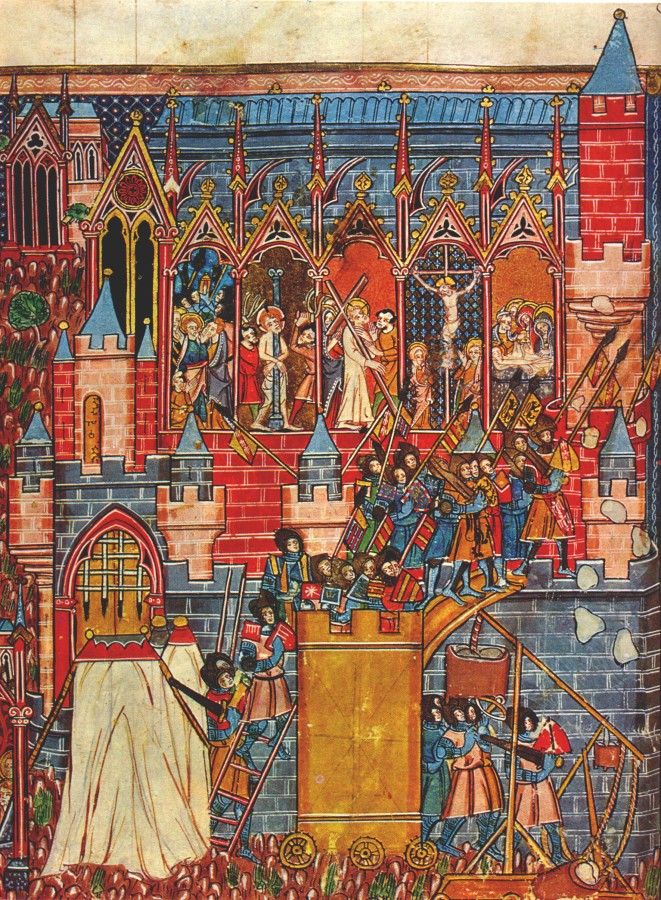
Photo: Medieval manuscript illumination of the taking of Jerusalem · Public domain
Mailed knight and couched lance

Mailed knight and couched lance

Heavy cavalry · 11th–13th centuries

At Siege of Jerusalem: Few horses survived the march, so most knights fought on foot at Jerusalem, in mail with sword and shield.

With the lance couched under the arm, a knight put the weight of man and horse behind the point. A massed charge could break almost any enemy that stood to receive it, so Muslim commanders tried to avoid it, scattering and shooting at the horses instead.

Armour
mail hauberk, helmet, kite or heater shield
Weapon
lance held under the arm, then sword or mace
Weakness
unarmoured horses; heat and thirst
Photo: Morgan Picture Bible, Paris, c. 1250 · Public domain
Knightly sword (arming sword)

Knightly sword (arming sword)

Straight, double-edged sword · 10th–14th centuries

At Siege of Jerusalem: Once over the wall the fighting in the streets was at close quarters, with sword and spear.

The knight's sidearm once the lance had broken: a broad, double-edged cutting blade with a simple cross guard and a disc or brazil-nut pommel. Swords were costly, prized and often blessed, and the cross shape of the hilt was not lost on men who had taken the cross.

Blade
about 75–90 cm, broad and fullered
Weight
about 1–1.4 kg
Use
one-handed, with a shield, on foot or horseback
Photo: A 12th–13th-century sword, Kostroma museum-reserve · CC0
Mail hauberk and kite shield

Mail hauberk and kite shield

Body armour and shield · 11th–13th centuries

At Siege of Jerusalem: After three years on the march, mail and shields were often worn and patched; many men fought without horses.

A knee-length shirt of riveted iron rings over a padded coat, with a long shield covering the left side. It stopped most cuts and many arrows; chroniclers describe Crusader foot soldiers marching on with arrows stuck in their mail. Heat and thirst were its cost.

Mail
thousands of riveted iron rings, about 10–15 kg
Shield
tall, kite- or flat-topped, wood faced with leather
Under
a padded gambeson
Photo: Walters Art Museum · Public domain

Paintings and photographs

Taking of Jerusalem by the Crusaders (Signol, 1847)
Taking of Jerusalem by the Crusaders (Signol, 1847) Émile Signol's 1847 painting of the Crusaders entering Jerusalem on 15 July 1099 (Versailles). Émile Signol, 1847 — public domain · source
The siege in a manuscript of William of Tyre
The siege in a manuscript of William of Tyre The siege of Jerusalem in a 13th-century manuscript of William of Tyre's history (BnF fr. 352). Unknown illuminator — public domain · source
Siege of Jerusalem (Histoire d'Outremer)
Siege of Jerusalem (Histoire d'Outremer) Siege towers against the walls, from a 13th-century Histoire d'Outremer (British Library, Yates Thompson 12). Unknown illuminator (British Library, Yates Thompson 12) — CC BY-SA 4.0 · source

Medieval reconstruction. No troop maps survive for this battle. Positions follow the chronicles of both sides and modern studies, numbers are disputed, and the map shows the shape of the battle rather than exact spots.

Free for everyone every year on its anniversary: July 15.

Accuracy score: 54/100 (limited)

How the accuracy score works

Sources and method

Siege of Jerusalem, 7 June – 15 July 1099. This is a reconstruction: no medieval plan of the siege survives, and the positions of contingents and engines are interpretive. Events and camp positions follow the eyewitness Latin narratives — the Gesta Francorum, Raymond of Aguilers' Historia Francorum — with Fulcher of Chartres, Albert of Aachen and William of Tyre, and the Arabic accounts of Ibn al-Qalanisi and Ibn al-Athir, as read by John France (Victory in the East, 1994), Thomas Asbridge (The First Crusade, 2004), Conor Kostick (The Siege of Jerusalem, 2009) and B. Z. Kedar ('The Jerusalem Massacre of July 1099', 2004). The wall line follows the Ottoman walls, which largely stand on the medieval line, except on Mount Zion where the 1099 wall is drawn slightly further south (with the Hagia Sion/Cenacle outside it, as the sources require) and at the north-west corner, the excavated Qasr Jalud (Tancred's Tower; Adrian Boas, Jerusalem in the Time of the Crusades, 2001; Israel Antiquities Authority). Gate and monument coordinates from Wikipedia. Numbers are disputed: modern estimates of about 1,300 knights and 12,000 foot for the Crusaders, a garrison of a few thousand; casualty figures for the massacre range from about 3,000 (Abu Bakr ibn al-Arabi) to 70,000 (Ibn al-Athir). Images from Wikimedia Commons.

Where the positions come from

Approximate locations