Battlefield Atlas
Iraq War · 2003 First 3 stages free

Operation Viking Hammer, 21–30 March 2003

Operation Viking Hammer (21–30 March 2003) was Task Force Viking's operation to clear Ansar al-Islam from behind the Kurdish lines before the Green Line offensive. The 3rd Battalion, 10th Special Forces Group, CIA officers of the Northern Iraq Liaison Element and about 6,500 PUK Peshmerga attacked Ansar al-Islam, an Islamist group with reported al-Qaeda ties entrenched in the mountains above Halabja on the Iranian border. After 64 Tomahawks struck the enclave on 21 March, six Peshmerga columns, each led by a Special Forces detachment, attacked at dawn on 28 March, took the suspected chemical site at Sargat and the village of Biyara, and in two days of fighting drove Ansar from the valley and the high ground. MEI estimates about half of the survivors escaped into Iran. Hill and village positions are partly approximate; routes are schematic.

Play the first 3 stages free6 stages on modern satellite imagery and terrain, with 3D elevation

The first 3 of its 6 stages are free to play. The rest opens with Battlefield Explorer ($4.99 a month or $39 a year), which unlocks every battle in the atlas and every one added later. Lifetime access and war packs are one-time options. Free battles include Thermopylae, Plataea, Actium, Viking raid on Lindisfarne, Hastings, Hattin, Agincourt, Vítkov Hill, Kutná Hora, Fall of Constantinople, First St Albans, Lützen, Siege of Buda, Culloden, Fort William Henry, Yorktown, Lake Erie, Waterloo, The Alamo, Monterrey, Antietam, Little Bighorn, Manila Bay, Belleau Wood, Saint-Mihiel, Omaha Beach, Inchon, Ia Drang, Goose Green, 73 Easting, Wanat, Baghdad Thunder Runs, Manbij, Battle of Raqqa, Donetsk Airport, Ilovaisk, Debaltseve, Battle of Kyiv, Battle of Hostomel Airport, Siege of Mariupol, Bilohorivka (Siverskyi Donets crossing), Kharkiv counteroffensive, Kherson counteroffensive, Bakhmut, Vuhledar, Mala Tokmachka and Robotyne, Avdiivka, Kursk incursion.
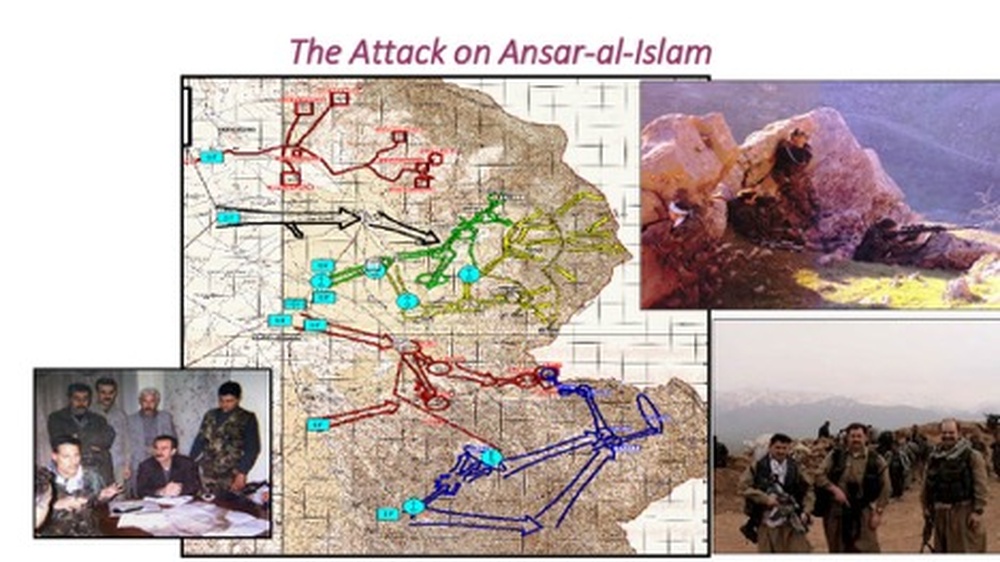
The attack on Ansar al-Islam (briefing slide)
The attack on Ansar al-Islam (briefing slide) — Courtesy Mark Grdovic / Sgt. Isaih Vega, 10th SFG (DVIDS), public domain

The battle, stage by stage

  1. 21 March 2003, evening

    Tomahawks on the enclave

    Ansar al-Islam, an Islamist group with reported al-Qaeda ties, held an enclave in the mountains above Halabja along the Iranian border, about 700 fighters by the USASOC history (locals quoted by TIME estimated about 800). The Islamic Group of Kurdistan held a sector to the north. At Sargat, at the foot of the Shandahari Ridge, lay a suspected chemical and poison site. On the evening of 21 March, Lt. Col. Ken Tovo of the 3rd Battalion, 10th Special Forces Group, and the PUK commander Kak Mustafa watched from the roof of a house in Halabja held by ODA 081 as the first Tomahawk hit, about 25 minutes late. NILE officers, Special Forces advance elements and Peshmerga leaders watched from the roof of a Peshmerga battalion headquarters near Halabja (MEI). Over about three hours 64 missiles struck the Ansar area. The fighters sheltered in caves and their defenses were little hurt, but the strike drove the Islamic Group of Kurdistan from its positions and out of the fight.

  2. 22–27 March

    Six routes

    Turkey refused basing and overflight, so the main Special Forces body flew in from Jordan by MC-130 on 22 March (MEI). That day Australian ABC cameraman Paul Moran was killed near Gerdigo by a likely suicide car bomb; according to the Committee to Protect Journalists, "The PUK has blamed Ansar al-Islam." The ground force was the PUK's, about 6,500 Peshmerga under Kak Mustafa; a 2021 MEI study names Sheik Jafar as commander of the assault force. Tovo's reinforced C Company split it into six routes, north to south Orange, Black, Green, Yellow, Red and Blue, each of 900 to 1,500 Peshmerga with a Special Forces detachment at its head. AOB 090, with FOB 103 co-located, set up on Hill 654, with a view of nearly the whole valley, and manned 81mm mortars for the Green and Red routes, with supplemental fires on Blue. Start lines here are schematic.

  3. 28 March, 06:00–about 10:00

    Sargat falls

    The attack began at 6 AM on 28 March (MEI also gives 28 March). The Yellow route, with a three-gun 81mm mortar section, took the Ansar checkpoint, cleared caves and was in Sargat by about 10 AM, while one element turned against Bakhakon (Bahka Kon). Green took Hill 868, overwatching Yellow's advance. AI fighters fled higher toward the slopes of Shram Mountain. Planned close air support was thinner than hoped, MEI notes, because the area was far from bases and carriers and other fights drew sorties away. A DVIDS retrospective with 3/10's operations officer, Mark Grdovic, credits Sargat to the Yellow and Green prongs together and gives 25 March as the start; the USASOC history's dates are used here.

  4. 28 March, afternoon and night

    Biyara and Hill 1351

    Red and Blue took several villages, and Blue halted for the night at Biyara. TIME's Michael Ware (spelling it "Biarra") called the village Ansar's base, and reported that U.S. bombing flattened a mosque used as its headquarters at 2 p.m. on Friday, 28 March, and that the PUK captured it an hour later. Black stayed in reserve. In the north, Orange attacked east from Shilamar toward Hill 1351, where about 20 Ansar fighters in a bunker survived three air strikes and held the Peshmerga about 200 meters off. Grdovic recalled that the detachment with the Black prong was nearly overrun in a counterattack, with an attempted suicide bomber, and that the northernmost detachment called a danger-close air strike to break an attack (dates not given; DVIDS describes five ODAs plus a late, uncolored northernmost prong, which Veritas names Orange). Four AC-130 gunships maintained pressure on the scattered AI fighters through the night and prevented them from regrouping. PUK politburo member Mahmood Sangarwi told TIME that 60 Ansar dead were left behind after Friday's fighting.

  5. 29 March

    Up the Zalm Valley

    On 29 March Green pushed northeast and took Hill 1365, Yellow widened its hold around Sargat to the villages of Hanidind and Daramar, and Red consolidated near Biyara. Black and Orange attacked together up the Zalm Valley and secured Hill 1351 and its communications tower. TIME described Ansar holding three or four isolated pockets on very high ground, with U.S. snipers firing on Ansar on Shram Mountain. Ware watched U.S. mortars work over three Ansar positions for four hours, and on Saturday, 29 March, saw eight more Ansar dead. Positions of Hills 1351 and 1365 are approximate.

  6. 29–30 March

    To the Iranian border

    The Peshmerga pursued toward the Iranian border. Many Ansar fighters crossed without difficulty, the USASOC history says; others were fired on by Iranian forces and pushed back toward the Peshmerga. MEI estimates about half of the survivors escaped into Iran. By 30 March the PUK held the valley and the high ground, Ansar was no longer an effective force, and 3/10 turned to the Green Line. Grdovic put losses at about 40 Peshmerga killed and two or three times as many wounded, and 150 to 200 enemy killed. No U.S. deaths are reported in the published accounts. At Sargat, Grdovic told DVIDS, searchers found positive tests for hydrogen cyanide, dozens of forged passports and documents describing how to make VX nerve agent; an MEI endnote cites evidence that Ansar was "experimenting with chemical/biological weapons at Sargat".

Forces

About 6,500 PUK Peshmerga with roughly 100 U.S. Special Forces soldiers and CIA officers attacked an Ansar al-Islam enclave of about 700 to 800 fighters; the Peshmerga figure is from the USASOC history, while Ansar's strength is a U.S. and local estimate.

Ansar al-Islam

Fightersabout 700 (700–800 or more)

The USASOC history calls Ansar 'seven hundred-man-strong'; TIME reported a local guess of 800 fighters, which a U.S. commando called an underestimate. Kenneth Finlayson, 'Operation VIKING HAMMER: 3/10 Special Forces Group against the Ansar Al-Islam', Veritas 1:1 (USASOC History Office); Michael Ware, 'Battling Terrorists in the Hills', TIME (30 March 2003, author's archive)

PUK Peshmerga, U.S. Special Forces and CIA

PUK Peshmerga (ground force)about 6,500 (6,500–9,000)

USASOC history: 6,500 Peshmerga under Kak Mustafa. Grdovic (DVIDS) describes a plan of five ODAs each with about 1,000 Peshmerga plus 4,000 in reserve, and says 9,000 Peshmerga moved west afterward; Tactical Life gives some 7,000. Kenneth Finlayson, 'Operation VIKING HAMMER: 3/10 Special Forces Group against the Ansar Al-Islam', Veritas 1:1 (USASOC History Office); Sgt. Isaih Vega, 'TF Viking Hammer 20th anniversary', DVIDS (2023; interview with Mark Grdovic); Tactical Life Staff, 'Operation Viking Hammer: Targeting Militant Islamic Groups in Iraq' (2015)

U.S. Special Forcesabout 100

The Middle East Institute study gives approximately 100 Special Forces soldiers plus CIA NILE officers (no CIA headcount); TIME also reported about 100 American commandos. The USASOC figure of 300 SF soldiers is for Col. Cleveland's whole force in the north. Mick Mulroy et al., 'Irregular Warfare: A Case Study in CIA and US Army Special Forces Operations in Northern Iraq, 2002–03', Middle East Institute (2021); Michael Ware, 'Battling Terrorists in the Hills', TIME (30 March 2003, author's archive)

Air support64 Tomahawks; four AC-130 gunships

USASOC history: 64 TLAMs struck the enclave on 21 March, and four AC-130s worked over Ansar positions on the night of 28 March. Kenneth Finlayson, 'Operation VIKING HAMMER: 3/10 Special Forces Group against the Ansar Al-Islam', Veritas 1:1 (USASOC History Office)

Casualties

No Americans were killed or wounded; the PUK lost about 40 Peshmerga killed by its operations officer's account (popular accounts say 3), and Ansar al-Islam lost roughly 150 to 250 killed, with about half its survivors escaping into Iran. The official USASOC history gives no casualty figures, so all numbers rest on participants' and journalists' estimates. Certainty: fair.

Ansar al-Islam

Killedabout 150–200 (150–250)

Mark Grdovic, 3/10 SFG's operations officer, put enemy dead at about 150 to 200 (DVIDS, 2023); IWPR reported about 200 Islamists killed, and a 2015 Tactical Life article gives some 250. The USASOC history gives no figure. Sgt. Isaih Vega, 'TF Viking Hammer 20th anniversary', DVIDS (2023; interview with Mark Grdovic); IWPR, 'Bayarans Enjoy New Lease of Life' (2004); Tactical Life Staff, 'Operation Viking Hammer: Targeting Militant Islamic Groups in Iraq' (2015)

Dead left on the field after the first day60

PUK politburo member Mahmood Sangarwi told TIME's Michael Ware that 60 Ansar dead were left behind after the fighting of Friday 28 March; a PUK claim, made during the battle. Michael Ware, 'Battling Terrorists in the Hills', TIME (30 March 2003, author's archive)

Escaped to Iranabout half of the survivors

The 2021 Middle East Institute study says about half of the members who survived escaped across the border into Iran; IWPR reported about 600 fled there. The USASOC history says some crossed and others were fired on by Iranian forces and driven back. Mick Mulroy et al., 'Irregular Warfare: A Case Study in CIA and US Army Special Forces Operations in Northern Iraq, 2002–03', Middle East Institute (2021); IWPR, 'Bayarans Enjoy New Lease of Life' (2004); Kenneth Finlayson, 'Operation VIKING HAMMER: 3/10 Special Forces Group against the Ansar Al-Islam', Veritas 1:1 (USASOC History Office)

PUK Peshmerga, U.S. Special Forces and CIA

Killed (Peshmerga)about 40 (3–40)

Grdovic says the PUK lost about 40 fighters (DVIDS, 2023); popular accounts (Tactical Life, SOFREP) give only 3 Kurdish killed and 23 wounded. The USASOC history gives no figure; Grdovic's is the closest to the operation. Sgt. Isaih Vega, 'TF Viking Hammer 20th anniversary', DVIDS (2023; interview with Mark Grdovic); Tactical Life Staff, 'Operation Viking Hammer: Targeting Militant Islamic Groups in Iraq' (2015); SOFREP News Team, 'The Green Berets' Stealth Victory: An Analysis of Operation Viking Hammer'

Wounded (Peshmerga)at least two to three times the number killed (23 (popular accounts) to more)

Grdovic says at least two to three times as many were wounded as killed, without giving a number; Tactical Life and SOFREP give 23 wounded. Sgt. Isaih Vega, 'TF Viking Hammer 20th anniversary', DVIDS (2023; interview with Mark Grdovic); Tactical Life Staff, 'Operation Viking Hammer: Targeting Militant Islamic Groups in Iraq' (2015)

U.S. casualtiesnone

Tactical Life and SOFREP both state that American Special Forces suffered no casualties; the DVIDS and USASOC accounts report no U.S. losses. Tactical Life Staff, 'Operation Viking Hammer: Targeting Militant Islamic Groups in Iraq' (2015); SOFREP News Team, 'The Green Berets' Stealth Victory: An Analysis of Operation Viking Hammer'

Then and now: how the ground has changed

The mountains, ridges and valley floor fought over in 2003 are unchanged in shape, but Byara and the Hawraman villages have been rebuilt and opened to tourism, with roads widened and new ones built, while mines still lie near the Iranian border.

Weapons

Ansar al-Islam

AK-47 / Type 56

AK-47 / Type 56

Assault rifle · 1949–present

At Operation Viking Hammer: Ansar al-Islam held caves, bunkers and the high ground above Sargat and Biyara with Kalashnikov-pattern rifles and machine guns.

Mikhail Kalashnikov's AK-47 became the world's most widespread military rifle thanks to its simplicity and reliability in mud, heat and rain. North Vietnamese and Viet Cong troops carried both Soviet AKs and the Chinese-made copy, the Type 56.

Caliber
7.62×39mm
Rate of fire
about 600 rounds/min
Magazine
30-round box
Effective range
about 350 m
Photo: U.S. Department of Defense · Public domain

PUK Peshmerga, U.S. Special Forces and CIA

M4 / M4A1 carbine

M4 / M4A1 carbine

5.56 mm assault carbine · 1994–present

At Operation Viking Hammer: The Special Forces soldiers with each Peshmerga prong carried M4 carbines and called in mortars and air strikes.

A shortened, lighter M16 that became the standard weapon of U.S. Army infantry and special operations forces in Iraq and Afghanistan; Marine infantry in 2003–04 still mostly carried the full-length M16A4.

Caliber
5.56×45 mm NATO
Barrel
14.5 in
Magazine
30 rounds
Photo: U.S. Marine Corps photo · public domain
AC-130H Spectre

AC-130H Spectre

Gunship · 1972–2015

At Operation Viking Hammer: Four AC-130 gunships kept pressure on the scattered Ansar fighters on the night of 28 March and kept them from regrouping.

A converted C-130 transport that circles a target firing side-mounted guns, a night killer of vehicles in the open. At Khafji the gunship Spirit 03 stayed on station past dawn to support the Marines and was shot down with all 14 crew on 31 January 1991.

Armament
105 mm howitzer, 40 mm Bofors, 20 mm cannon
Crew
14
Role
night close air support
Photo: U.S. Air Force photo · public domain

Paintings and photographs

The attack on Ansar al-Islam (briefing slide)
The attack on Ansar al-Islam (briefing slide) "The Attack on Ansar-al-Islam": a briefing slide showing the prongs that advanced on the Ansar enclave in Operation Viking Hammer, with photos of the fighting. Courtesy Mark Grdovic, posted by 10th Special Forces Group in 2023. Courtesy Mark Grdovic / Sgt. Isaih Vega, 10th SFG (DVIDS), public domain · source

Free for everyone every year on its anniversary: March 21–30.

Accuracy score: 60/100 (moderate)

How the accuracy score works

Sources and method

Operation Viking Hammer, 21–30 March 2003. No U.S. Army staff ride handbook covering this action was found. The key source is the USASOC history: Kenneth Finlayson, 'Operation VIKING HAMMER: 3/10 Special Forces Group against the Ansar Al-Islam', Veritas 1:1 (2005) (PDF), for the routes, hills, villages and timings. Further: Andrew L., Mick Mulroy and Kenneth Tovo, 'Irregular Warfare: A Case Study in CIA and US Army Special Forces Operations in Northern Iraq, 2002–03' (Middle East Institute, 12 August 2021); Sgt. Isaih Vega, 'TF Viking Hammer 20th anniversary' (DVIDS, 2023; interview with Lt. Col. (ret.) Mark Grdovic, author of Those Who Face Death); Michael Ware, 'Battling Terrorists in the Hills', TIME, 30 March 2003; 'To Baghdad and Beyond: ARSOF in Operation Iraqi Freedom' (army.mil); Eugene G. Piasecki, 'Task Force Viking', Veritas 12:1 (2016); Committee to Protect Journalists, 'Journalist killed in northern Iraq' (March 2003). Village positions from OpenStreetMap (via Mapbox); hill positions matched to Mapbox terrain heights and approximate (Hill 1365 by description only); Shilamar, Hanidind and Daramar are schematic.

Where the positions come from

Further reading