Battlefield Atlas
Iraq War · 2004 Members · from $3

Second Fallujah, 2004

In November 2004 the 1st Marine Division, with two Army mechanized task forces, Iraqi battalions and British support, retook Fallujah, which insurgents had held since the First Battle of Fallujah ended in May. After weeks of shaping and feints toward the south and east, Task Force Wolfpack and the Iraqi 36th Commando Battalion seized the peninsula hospital and the bridges on 7 November, and on the night of 8 November six battalions — RCT-1 in the west (3/5, 3/1, Task Force 2-7 Cavalry) and RCT-7 in the east (1/8, 1/3, Task Force 2-2 Infantry) — broke through the northern railway berm. They reached Highway 10 (Phase Line Fran) within about two days, turned south, and by 16 November had reached the southern edge; clearing continued until 23 December, when residents began to return. It is often called the heaviest urban battle for U.S. forces since Hue in 1968: roughly 80 to 95 Americans were killed in the operation, with estimates of 1,200 to 2,000 insurgents and several hundred civilians dead.

Open the interactive map8 stages on modern satellite imagery and terrain, with 3D elevation

This battle opens with Battlefield Enjoyer ($3 a month on Patreon), which unlocks every battle in the atlas and every one added later. Free battles include Hattin, Agincourt, Yorktown, Waterloo, The Alamo, Antietam, Little Bighorn, Belleau Wood, Omaha Beach, Ia Drang, 73 Easting, Wanat, Najaf.

An air strike in Fallujah, November 2004
An air strike in Fallujah, November 2004 — Cpl. Joel A. Chaverri, USMC — public domain

The battle, stage by stage

  1. 1–7 November 2004

    The cordon and the feint

    Fallujah has been the insurgency's stronghold in al-Anbar since the Marines handed it to the 'Fallujah Brigade' in May. Most of its people have fled by late October; the Marines estimate fewer than 500 civilians remain (other estimates run to tens of thousands) alongside some 3,000 to 4,500 fighters, whose defences face south and east. Weeks of raids, air strikes, loudspeaker 'tank noises', probing attacks and feints on the southern and south-eastern outskirts encourage that belief. From 5 November the Army's 2d Brigade, 1st Cavalry Division ('Blackjack') closes a ring of about 270 degrees: Task Force 1-5 Infantry to the south, 1-5 Cavalry to the north-east and the 2d Reconnaissance Battalion with Iraqi special forces to the south-east, while Britain's Black Watch battle group helps isolate the area. Meanwhile the two assault regiments, RCT-1 and RCT-7, gather unseen in the desert north of the railway.

  2. 7 November 2004, 19:00 – 8 November, 01:40

    The peninsula, the hospital and the bridges

    With Iraq under a state of emergency, Lt. Col. Stephen Dinauer's Task Force Wolfpack — built on the 3d Light Armored Reconnaissance Battalion, with Company B of 1/23 Marines, Company C of 1-9 Infantry and the Iraqi 36th Commando Battalion — attacks up the western peninsula. The western ends of the two bridges are held by 21:00, and by 23:00 the Iraqi commandos have taken Fallujah General Hospital, judged an insurgent command node, without resistance. By 01:40 on 8 November all bridge objectives are secured, closing the city's western exits; the Small Craft Company on the river takes fire from the Jolan.

  3. 8 November 2004, evening

    Through the railway berm

    Seabees and civil affairs Marines cut the city's power at dusk. After a heavy air and artillery preparation the assault battalions breach the railway embankment along the northern edge. In RCT-1's sector Company L, 3/1, with Iraqi soldiers, takes the train station and Company K, 3/5, the apartment complex in the north-west; 3/5 attacks into the Jolan at 19:26, Company I taking the Ma'ahidy Mosque and the Jolan cemetery. Army Task Force 2-7 Cavalry breaches the tracks just after midnight and drives south down Phase Line Henry. In RCT-7's sector 1/8 attacks south astride Phase Line Ethan; 1/3's bulldozers bog down and its Company C wins only a small foothold; Task Force 2-2 Infantry breaches in the east at about 19:40, where its Command Sergeant Major, Steven Faulkenburg, is killed.

  4. 9 November 2004

    To Highway 10

    Company A, 2-7 Cavalry, reaches Jolan Park before dawn while 3/5 grinds through the Jolan house by house and 3/1 fights south to guard its flank, reaching Phase Line Donna by about 12:30 with Company I near the Old Bridge. That night Company C, 3-8 Cavalry, seizes the Martyrs' Cemetery on Highway 10 — Phase Line Fran. In the east Task Force 2-2's armour reaches Highway 10 by about 09:00, so fast that a seam opens with 1/3 and it must later turn back to clear bypassed blocks. 1/8's Company B takes the Islamic Cultural Center, full of weapons and bomb-making material, and Company C, with Iraqi troops, the al-Hadrah al-Muhammadiyah Mosque; Company A then crosses the wide road under fire to seize the Government Center, where Iraqi soldiers raise their flag. By nightfall 1/3 too is on Phase Line Fran: RCT-7 has crossed the city's northern half in about 43 hours rather than the 72 to 96 planned.

  5. 10–12 November 2004

    The turn south

    North of Highway 10 the battalions clear what they bypassed. On 10 November Staff Sgt. David Bellavia of Task Force 2-2 fights through a house of insurgents during block-clearing in the north-east, for which he later receives the Medal of Honor. Iraqi battalions with RCT-7 take the al-Tawfiq and Hadrah mosques, and on 11 November Iraqi forces take over the Jolan. On 11 November the division orders both regiments to keep going south. Task Force 2-7 moves south-east from Highway 10 into Resala, Nazal and Jebail, and Task Force 2-2 south and west across the industrial district; on 12 November coalition officials claim about 80 percent of the city, with the insurgents pushed into its southern districts. Task Force 2-2's Company A loses 1st Lt. Edward Iwan on 12 November and its commander, Capt. Sean Sims, the next day.

  6. 13 November 2004

    The 'Hell House'

    In 3/1's sector Marines of Company K's 3d Platoon are pinned down inside a house held by insurgents firing from an upper floor. First Sgt. Bradley Kasal of Weapons Company, with the Combined Anti-Armor Platoon, goes in with a squad to reach them; he and Pfc. Alex Nicoll are badly wounded in the legs, and when grenades are thrown at the wounded Kasal rolls onto his fellow Marine to shield him. Cpl. Robert J. Mitchell is also decorated; Sgt. Byron Norwood is killed. Kasal and Mitchell receive the Navy Cross. (The official citations do not locate the house; it is placed here schematically in 3/1's zone.) Elsewhere the regiments press on toward the southern edge. The same day an incident of unlawful use of force against an enemy combatant takes place, later investigated by the 1st Marine Division.

  7. 14–16 November 2004

    The southern edge

    The attacking battalions reach the southern edge of the city; Task Force 2-7 swings west toward the river to isolate the south-western districts. On 15 November officials say most of the city is taken, with isolated pockets — some linked by tunnels — still fighting in the south, and clearing is slowed by booby-trapped houses. That morning Sgt. Rafael Peralta of Company A, 1/3, clearing his seventh house of the day, is mortally wounded; the Navy Cross citation states that he pulled an insurgent grenade to his body to shield his fellow Marines. On 16 November the command describes the fighting as mopping up. By one count 38 Americans have been killed and about 275 wounded so far.

  8. 17 November – 23 December 2004

    Search and attack; the return

    The battalions turn back north, searching every block for caches, bomb factories and holdouts; the Army task forces leave within about two weeks, and sporadic fighting goes on until the operation is declared over on 23 December. The searches turn up some 350 arms caches, 26 bomb factories and eight hostage or torture houses (military figures). Thousands of the city's roughly 50,000 buildings and some 60 mosques are destroyed or damaged. On 23 December, after biometric screening is set up, residents of the al-Andalus district are allowed back through three entry control points under 3/5, Iraqi forces and police — more than 900 on the first day — with other districts reopening in phases. Estimates of civilian deaths range from about 600 to 800 or more.

Weapons

Insurgents

RPG-7

RPG-7

Shoulder-fired rocket-propelled grenade launcher · 1961–present

At Second Fallujah: Insurgents fought from fortified houses, firing RPGs and machine guns from rooftops and stairwells.

The most widespread anti-armour weapon in the world: cheap, simple and effective against light vehicles and buildings. Iraqi soldiers, Fedayeen and later insurgents and militias fired it in volleys from rooftops and alleys in every battle here.

Calibre
40 mm tube, 85 mm warhead (PG-7V)
Effective range
about 200–300 m
Crew
1–2
Photo: U.S. military photo · public domain
AK-47 / Type 56

AK-47 / Type 56

Assault rifle · 1949–present

At Second Fallujah: Many held out room by room, as at the 'Hell House' on 13 November.

Mikhail Kalashnikov's AK-47 became the world's most widespread military rifle thanks to its simplicity and reliability in mud, heat and rain. North Vietnamese and Viet Cong troops carried both Soviet AKs and the Chinese-made copy, the Type 56.

Calibre
7.62×39mm
Rate of fire
about 600 rounds/min
Magazine
30-round box
Effective range
about 350 m
Photo: U.S. Department of Defense · Public domain

U.S., Coalition and Iraqi forces

M1A1 Abrams

M1A1 Abrams

Main battle tank · 1985–present

At Second Fallujah: Marine and Army tanks led the breach and blasted strongpoints at point-blank range for the infantry.

The U.S. Army and Marine Corps main battle tank. In 2003 its armour proved almost impervious to the RPGs and older Iraqi guns it met, which made armoured raids like the Thunder Runs possible; in the cities it fought at point-blank range alongside infantry.

Gun
120 mm smoothbore
Crew
4
Weight
about 57–63 t
Photo: U.S. Air Force photo · public domain
AAV-7A1 amphibious assault vehicle

AAV-7A1 amphibious assault vehicle

Amphibious armoured personnel carrier · 1972–present

At Second Fallujah: Amtracs carried Marines up to the breach on the night of 8 November.

The Marine Corps' 'amtrac', built to carry Marines ashore from ships and used as a battle taxi inland. Its thin armour left it vulnerable to RPGs and heavier weapons, as Charlie Company of 1/2 Marines found at Nasiriyah.

Crew
3, plus about 21 Marines
Armament
.50 cal machine gun and 40 mm grenade launcher
Armour
aluminium hull, light protection
Photo: MSgt Edward D. Kniery, USMC · public domain
M4 / M4A1 carbine

M4 / M4A1 carbine

5.56 mm assault carbine · 1994–present

At Second Fallujah: Clearing went house by house for more than a week across the whole city.

A shortened, lighter M16 that became the standard weapon of U.S. Army infantry and special operations forces in Iraq and Afghanistan; Marine infantry in 2003–04 still mostly carried the full-length M16A4.

Calibre
5.56×45 mm NATO
Barrel
14.5 in
Magazine
30 rounds
Photo: U.S. Marine Corps photo · public domain

Paintings and photographs

An air strike in Fallujah, November 2004
An air strike in Fallujah, November 2004 An insurgent stronghold goes up in smoke after an air strike during the battle, November 2004. Cpl. Joel A. Chaverri, USMC — public domain · source
1/3 Marines in Fallujah
1/3 Marines in Fallujah A Marine of Bravo Company, 1st Battalion, 3rd Marines with an SMAW rocket launcher during Operation Phantom Fury. LCpl Jeremy W. Ferguson, USMC — public domain · source
Marine artillery firing on Fallujah
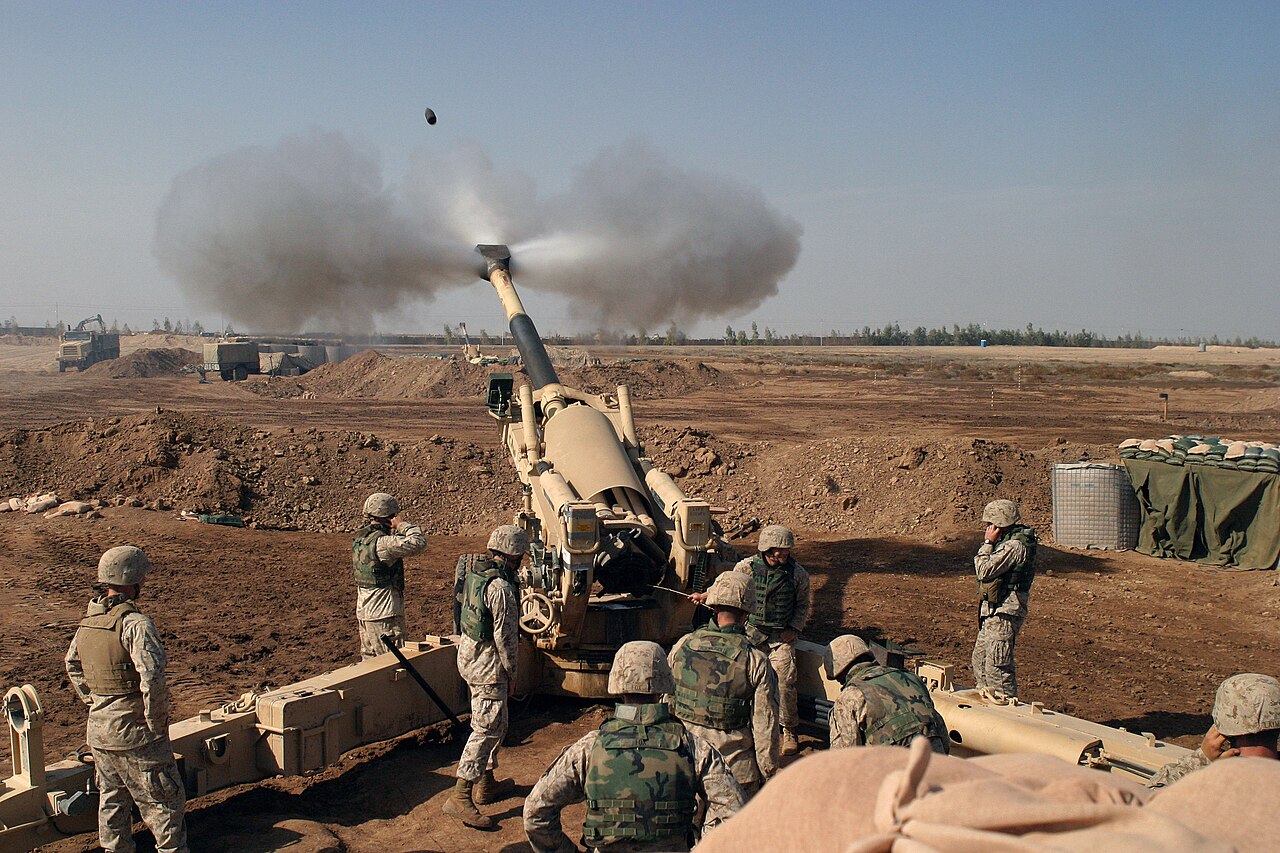
Marine artillery firing on Fallujah An M198 155 mm howitzer firing in support of the assault on Fallujah. LCpl Samantha L. Jones, USMC — public domain · source
1/8 Marines step off on patrol
1/8 Marines step off on patrol Marines of 1st Battalion, 8th Marines prepare to patrol through Fallujah during the battle. SSgt Jonathan C. Knauth, USMC — public domain · source

★ Medal of Honor 1 recipient

Links go to the official records: the Congressional Medal of Honor Society and, where they exist, the service's own pages.

Free for everyone every year on its anniversary: November 8–9.

Accuracy score: 61/100 (moderate)

How the accuracy score works

Sources and method

Second Battle of Fallujah (Operation Al-Fajr / Phantom Fury), 7 November – 23 December 2004. Main source: CWO-4 Timothy S. McWilliams with Nicholas J. Schlosser, U.S. Marines in Battle: Fallujah, November–December 2004 (USMC History Division, 2014) — usmcu.edu: the shaping and feints, the Blackjack Brigade cordon (TF 1-5 Infantry, TF 1-5 Cavalry, 2d Reconnaissance Battalion), Task Force Wolfpack and the 36th Commandos on the peninsula, the breaches and company objectives of 8–9 November (train station, apartment complex, Ma'ahidy Mosque, Jolan Park, Phase Lines Henry, Ethan, Cathy, Donna and Fran, the Islamic Cultural Center, the al-Hadrah Mosque, the Government Center, the Martyrs' Cemetery, the al-Tawfiq Mosque). Plan, phases and districts: 1st Marine Division, 'Operation Al Fajr: The Battle for Fallujah' (brief, USMC History Division). 3/1's tasks along Phase Line Henry and the al-Kabir Mosque: 3/1 unit history (from McWilliams & Schlosser), TogetherWeServed. Army task forces and the timeline: Combat Studies Institute, On Point II, ch. 8; Matt M. Matthews, Operation AL FAJR: A Study in Army and Marine Corps Joint Operations (CSI, 2006); army.mil on TF 2-7. Feint, breach and the push south: John Spencer, Jayson Geroux and Liam Collins, Urban Warfare Case Study #7: Second Battle of Fallujah (Modern War Institute, West Point, 2023). Daily progress, districts (Resala, Nazal, Jebail, the industrial area) and casualty counts to 16 November: GlobalSecurity, Operation al-Fajr; VFW Magazine (2019). Bellavia: army.mil. Kasal: Navy Cross citation as quoted in the Wikipedia article and by War History Online; Peralta: Naval History and Heritage Command. Return of residents: CENTCOM release, 24 Dec 2004; Marine Corps News, 28 Dec 2004. Further reading: Kenneth W. Estes, U.S. Marines in Iraq, 2004–2005: Into the Fray (2011); Richard S. Lowry, New Dawn; Dick Camp, Operation Phantom Fury (2009); Bing West, No True Glory (2005); William Knarr et al., The Battle for Fallujah: Al Fajr — the Myth-buster (IDA, 2009). Coordinates: the Old and New Bridges and the Highway 10 / Highway 1 cloverleaf from OpenStreetMap; the railway, objectives and districts are placed from the official descriptions (±300–500 m) and company traces are interpretive. Accounts differ on casualties, especially civilian deaths (about 600 to 800 or more).

Where the positions come from

Further reading