Battlefield Atlas
Iraq War · 2006 First 3 stages free

Ramadi, 2006

From June 2006 to February 2007 the U.S. Army's 1st Brigade, 1st Armored Division ('Ready First', Col. Sean MacFarland), with Marine battalions, Navy SEALs of Task Unit Bruiser and Iraqi troops, took back Ramadi, the capital of al-Anbar province, from al-Qaeda in Iraq and its allies. Instead of a Fallujah-style assault the brigade seized the city piece by piece, building combat outposts in insurgent neighborhoods and holding them through repeated attacks over the summer. From September the Anbar Awakening led by Sheikh Abdul Sattar Abu Risha turned the tribes against al-Qaeda and filled the police with local recruits. On 29 September 2006, during Operation Kentucky Jumper in the Ma'laab near Camp Corregidor, Petty Officer Michael A. Monsoor threw himself on a grenade to save his teammates and was awarded the Medal of Honor. By February 2007 police numbers had risen from under 100 to about 4,000, at a cost of 85 U.S. dead by the brigade's count, and Ramadi became an example often cited for the counterinsurgency approach of the 2007 'surge'.

Play the first 3 stages free7 stages on modern satellite imagery and terrain, with 3D elevation

The first 3 of its 7 stages are free to play. The rest opens with Battlefield Explorer ($4.99 a month or $39 a year), which unlocks every battle in the atlas and every one added later. Lifetime access and war packs are one-time options. Free battles include Thermopylae, Plataea, Actium, Viking raid on Lindisfarne, Hastings, Hattin, Agincourt, Vítkov Hill, Kutná Hora, Fall of Constantinople, First St Albans, Lützen, Siege of Buda, Culloden, Fort William Henry, Yorktown, Lake Erie, Waterloo, The Alamo, Monterrey, Antietam, Little Bighorn, Manila Bay, Belleau Wood, Saint-Mihiel, Omaha Beach, Inchon, Ia Drang, Goose Green, 73 Easting, Wanat, Baghdad Thunder Runs, Manbij, Battle of Raqqa, Donetsk Airport, Ilovaisk, Debaltseve, Battle of Kyiv, Battle of Hostomel Airport, Siege of Mariupol, Bilohorivka (Siverskyi Donets crossing), Kharkiv counteroffensive, Kherson counteroffensive, Bakhmut, Vuhledar, Mala Tokmachka and Robotyne, Avdiivka, Kursk incursion.

1st Armored Division soldiers in Tameem, August 2006
1st Armored Division soldiers in Tameem, August 2006 — U.S. Air Force photo by Tech. Sgt. Jeremy T. Lock — public domain

The battle, stage by stage

  1. 7–13 June 2006

    A city held by the insurgents

    When the 1st Brigade, 1st Armored Division — the 'Ready First', under Col. Sean MacFarland — took over greater Ramadi from the 2d Brigade, 28th Infantry Division in early June 2006, the provincial capital of about 400,000 people was the most violent city in Iraq. By the brigade's own account it saw more than three times the attacks per head of any other area; al-Qaeda in Iraq and its allies moved freely, held the city hospital, laid belts of buried bombs and had named Ramadi the capital of their future 'caliphate'. Fewer than 100 police reported for duty. U.S. forces held only their camps at the edges — Camp Ramadi in the west and Camp Corregidor in the east, the 'bookends' — the Marines' Camp Hurricane Point, and the embattled Government Center downtown, held by a company of Marines. Zarqawi was killed north of Baqubah on 7 June. Outpost positions on this map are approximate.

  2. 14–30 June 2006

    Seize: the first combat outposts

    MacFarland chose not to storm the city as Fallujah had been stormed, but to take it piece by piece with the 'clear, hold, build' method the 3d Armored Cavalry Regiment had pioneered in Tal Afar, where the brigade had begun its tour: seize ground, build a combat outpost in it, and stay. On 14 June brigade elements attacked into Ramadi from the south across the old railroad bridge in Tameem. In the week of 18–25 June Task Force 1-37 Armor seized Combat Outposts Iron and Spear to cut the southern infiltration route and won a foothold across the canal, and in the second half of June its Bulldog Company (B/1-37) began COP Falcon downtown. By the end of June, according to the IDA's study of the campaign, four COPs (Iron, Spear, Eagle's Nest and Falcon) stood in the south and south-east of the city.

  3. July–August 2006

    Clear: the summer battles

    As the first outposts were finished in July, the enemy answered with multiple-platoon assaults on them. On 4 July Company I, 3/8 Marines, followed Iraqi soldiers into Ramadi General Hospital, which insurgents had used as a base for about a year; an outpost beside it let the hospital treat patients properly again within days. On 24 July, the brigade's commander later wrote, insurgents were badly beaten in a citywide battle. On 2 August the brigade fought its largest battle in the city; that day Petty Officer Marc Lee became the first Navy SEAL killed in Iraq, in South-Central Ramadi (Silver Star). The next day insurgents assaulted COP Falcon for two hours. TF 1-37 opened Central Street and cleared the area called Baseline, and built COP Grant from 1 August. By Michael Rubin's account in Proceedings, 33 Marines and soldiers were killed in action around Ramadi in August. By 1 September Army and Marine engineers were demolishing an eight-block area opposite the Government Center.

  4. 21 August – mid-September 2006

    The Anbar Awakening

    On 21 August a car bomb struck the new Jazeera police station north of the river, near Sattar's house; the police, mostly Albu Ali Jassim tribesmen, stayed at their posts. Al-Qaeda then murdered Sheikh Khaled Ali Albu-Jassim and held his body for four days, denying him a Muslim burial, which many local people later named as a turning point. Sheikh Abdul Sattar Abu Risha hosted an emergency council at his compound on 2 September; the council of more than 50 sheikhs on 9 September, with MacFarland present, declared the Awakening (Military Review), and Sattar announced it publicly on 14 September (IDA). Tribes that joined sent their young men into the police, and attacks on U.S. forces stopped in their areas. Inside the city TF 1-37 closed COP Spear, built OP Sword and pushed into the 2d Officers district; in September 1/6 Marines began relieving 3/8. Sattar's compound is placed schematically north of the river.

  5. 29 September 2006

    Kentucky Jumper: Monsoor's rooftop

    On the feast of St. Michael, 1-506 Infantry and Iraqi troops launched Operation Kentucky Jumper, a battalion clearance and isolation operation in southern Ramadi. Petty Officer Michael A. Monsoor of SEAL Team 3's Delta Platoon, a Mk 48 machine gunner based at Camp Corregidor, was one of four SEALs and eight Iraqi soldiers in a sniper overwatch on a residential rooftop in the Ma'laab, guarding the operation's western flank. From the morning the snipers engaged insurgents scouting the position; later, in the early afternoon by one account, fighters attacked it with automatic weapons and a rocket-propelled grenade. Then a grenade thrown onto the roof struck Monsoor's chest. He was beside the only exit and could have escaped; instead he threw himself on it. He died about 30 minutes later. The Medal of Honor citation credits him with saving two teammates; the Navy's biography says three SEALs and the Iraqi soldiers. The building has not been publicly located; its position is schematic.

  6. October–December 2006

    Hold and build

    Task Force 1-9 Infantry took over east Ramadi and the Ma'laab in October. On 21 October insurgents set off the first documented chlorine car bomb, 12 mortar shells and two 100-pound chlorine tanks, wounding three Iraqi policemen and a civilian. On 27 October, in Operation Belleau Wood (IDA; 'mid-October' in Proceedings), 1/6 Marines seized a three-story building on 17th Street, the street al-Qaeda had used to celebrate its new 'caliphate', as the first joint Marine and Iraqi security station in the city. On 25 November 30 to 40 gunmen attacked the Albu Soda tribe in Sufia; tanks, aircraft and the tribesmen drove them off, and within two months every tribe in Sufia and Julaybah had joined the Awakening and four new COPs stood there. From 1 December Operation Squeeze Play, a month-long brigade operation by the Iraqi Army, police, U.S. soldiers and Marines in central Ramadi and to the north and east (Sufia, Hamdiyah), set up four police sub-stations; the command reported 44 insurgents killed and 172 detained. On 6 December Capt. Travis Patriquin, Maj. Megan McClung and Spc. Vincent Pomante were killed by a roadside bomb in Ramadi. Civilians were also killed in the fighting; on 28 November, by an Associated Press report, a man and five women and girls, the youngest an infant, were found dead in a house hit by U.S. machine-gun and tank fire after insurgents fired on troops clearing a roadside bomb.

  7. January – 18 February 2007

    The city turns

    By early 2007 Ramadi had some 4,000 to 5,000 police, more than nine in ten of them from tribes that had joined the Awakening, and 24 outposts where Americans and Iraqis lived together, by an NPR report quoted in Military Review; insurgent contacts were almost 70 percent below their June level. A first reconstruction conference met at Sattar's home in January and a new mayor began work. Hard fighting remained in the Ma'laab and the center, where TF 1-9's Operation Murfreesboro began in February. The brigade handed Ramadi to the 1st Brigade, 3d Infantry Division on 18 February 2007. In nine months the brigade lost, by its commander's count, 85 soldiers, sailors and Marines killed and more than 500 wounded. Sattar was assassinated in September 2007.

Forces

The Ready First brigade fought with five Army and Marine maneuver task forces (about 3,900 of its soldiers had their tours extended in September) and a growing Iraqi Army and police force. Insurgent strength was never reliably counted.

Insurgents (al-Qaeda in Iraq and allied fighters)

Fightersunknown

The sources used give no overall estimate. Military Review notes that Ramadi saw more than three times the attacks per head of any other area in June 2006; on 25 November 30 to 40 gunmen attacked the Albu Soda tribe. Smith and MacFarland, 'Anbar Awakens', Military Review 2008

U.S. forces (1st Brigade, 1st Armored Division; Marines; SEAL Task Unit Bruiser), Iraqi Army and the Anbar Awakening

Maneuver task forces5

Five Army and Marine maneuver task forces under the brigade (Military Review). Smith and MacFarland, 'Anbar Awakens', Military Review 2008

Brigade soldiers extended (September 2006)about 3,900

The Army extended about 3,900 of the brigade's soldiers by 46 days; this counts only those extended, not every U.S. service member in Ramadi. Stars and Stripes, brigade timeline

Iraqi policeabout 100 → 4,000–5,000

Fewer than 100 police present daily in June 2006 (about 140 reporting); about 4,000 joined from June to December, and 4,000 to 5,000 were serving by early 2007 (Military Review; IDA). Smith and MacFarland, 'Anbar Awakens', Military Review 2008; Knarr et al., IDA P-5052

Outposts4 → 24

Combat outposts and joint security stations grew from 4 to 24 by early 2007, by an NPR report quoted in Military Review. Smith and MacFarland, 'Anbar Awakens', Military Review 2008

Casualties

The Ready First brigade lost 85 killed and more than 500 wounded in nine months, by its commander's count. Insurgent losses are known only from partial U.S. claims (over 400 killed in one task force's sector), and no reliable campaign-wide civilian toll was found. Certainty: fair.

Insurgents (al-Qaeda in Iraq and allied fighters)

Killed, TF 1-37 Armor's sector (South-Central Ramadi)over 400

Lt. Col. Tedesco's command brief claims more than 400 AQIZ fighters killed and more than 175 detained by his task force over its tour; U.S. claim, not independently checked. Tedesco, TF 1-37 Armor command brief

Killed and detained, Operation Squeeze Play (December 2006)44 killed, 172 detained

Figures from the Multi-National Force–Iraq release closing the month-long operation; U.S. claim. MNF-I release, 14 Jan 2007 (GlobalSecurity)

Killed, whole campaignunknown

No campaign-wide insurgent count was found in the official sources used; Military Review says only that AQIZ forces were 'severely beaten' on 24 July and that contacts fell almost 70 percent by February 2007. Smith and MacFarland, 'Anbar Awakens', Military Review 2008

U.S. forces (1st Brigade, 1st Armored Division; Marines; SEAL Task Unit Bruiser), Iraqi Army and the Anbar Awakening

U.S. killed (brigade's nine months)85

Col. MacFarland and Maj. Smith give 85 soldiers, sailors and Marines killed in the Ready First's nine months in Ramadi. Smith and MacFarland, 'Anbar Awakens', Military Review 2008

U.S. wounded (brigade's nine months)more than 500

Smith and MacFarland, 'Anbar Awakens', Military Review 2008

U.S. killed in action, August 200633

Marines and soldiers killed around Ramadi in August 2006, by Michael Rubin's account. Rubin, Proceedings, April 2008

TF 1-37 Armor losses12 killed, about 100 wounded

10 task-force soldiers, 1 Marine and 1 SEAL killed in action and about 100 wounded over its 13 months in combat (Tedesco). Tedesco, TF 1-37 Armor command brief

Iraqi Army, police and tribal lossesnot counted here

The sources used give no totals; they record attacks such as the 21 August car bomb at the Jazeera police station and the 25 November attack on the Albu Soda tribe. Smith and MacFarland, 'Anbar Awakens', Military Review 2008

Civilians

Killed by U.S. fire, 28 November 20066

The Associated Press reported a man and five women and girls found dead in a house hit by machine-gun and tank fire after insurgents fired on troops; the Marines said they would offer help to the survivors. Associated Press via The Vindicator, 29 Nov 2006

Wounded by the chlorine car bomb, 21 October 20063 police and 1 civilian

American Forces Press Service, 6 Jun 2007

Civilian deaths, whole campaignunknown

No reliable campaign-wide count was found in the sources used.

Equipment and ships

U.S. vehicles destroyed, TF 1-37 sectorabout 25

Tanks, Bradleys and trucks destroyed, mostly by IEDs (113 detonated in the sector), by Tedesco's count. Tedesco, TF 1-37 Armor command brief

Then and now: how the ground has changed

The river, canal and street plan of 2006 are still there, but the U.S. outposts were dismantled from 2008 and much of the city was wrecked again in the 2015–16 fight against the Islamic State, so many buildings of 2006, the main hospital among them, are gone or rebuilt.

Weapons

Insurgents (al-Qaeda in Iraq and allied fighters)

AK-47 / Type 56

AK-47 / Type 56

Assault rifle · 1949–present

At Ramadi: Al-Qaeda in Iraq and allied fighters attacked the new outposts with small arms; TF 1-37 logged 252 small-arms attacks between June 2006 and January 2007 (Tedesco).

Mikhail Kalashnikov's AK-47 became the world's most widespread military rifle thanks to its simplicity and reliability in mud, heat and rain. North Vietnamese and Viet Cong troops carried both Soviet AKs and the Chinese-made copy, the Type 56.

Caliber
7.62×39mm
Rate of fire
about 600 rounds/min
Magazine
30-round box
Effective range
about 350 m
Photo: U.S. Department of Defense · Public domain
RPG-7

RPG-7

Shoulder-fired rocket-propelled grenade launcher · 1961–present

At Ramadi: RPGs struck the outposts and, on 29 September, the building held by Monsoor's overwatch team.

The most widespread anti-armor weapon in the world: cheap, simple and effective against light vehicles and buildings. Iraqi soldiers, Fedayeen and later insurgents and militias fired it in volleys from rooftops and alleys in every battle here.

Caliber
40 mm tube, 85 mm warhead (PG-7V)
Effective range
about 200–300 m
Crew
1–2
Photo: U.S. military photo · public domain

U.S. forces (1st Brigade, 1st Armored Division; Marines; SEAL Task Unit Bruiser), Iraqi Army and the Anbar Awakening

Mk 48 machine gun

Mk 48 machine gun

7.62 mm light machine gun · 2003–present

At Ramadi: Monsoor's weapon as Delta Platoon's automatic-weapons gunner on rooftop overwatches in the Ma'laab.

A lightweight 7.62 mm belt-fed machine gun built for U.S. special operations forces. Michael Monsoor carried one as Delta Platoon's heavy-weapons gunner in Ramadi, with a double load of ammunition on many missions (Defense Media Network).

Caliber
7.62×51 mm NATO
Feed
belt
Photo: U.S. Army PEO Soldier, public domain
M1A1 Abrams

M1A1 Abrams

Main battle tank · 1985–present

At Ramadi: Tanks backed the outposts and helped the Albu Soda tribe beat off the 25 November attack in Sufia (Military Review).

The U.S. Army and Marine Corps main battle tank. In 1991 its thermal sights and 120 mm gun let crews kill Iraqi tanks at ranges the enemy could not answer, often through rain, smoke and sandstorms; in 2003 its armor proved almost impervious to the RPGs and older Iraqi guns it met, which made armored raids like the Thunder Runs possible.

Gun
120 mm smoothbore
Crew
4
Weight
about 57–63 t
Photo: U.S. Air Force photo · public domain
M2/M3 Bradley

M2/M3 Bradley

Infantry / cavalry fighting vehicle · 1981–present

At Ramadi: Bradleys carried the wounded from Monsoor's overwatch to the aid station, a trip of 20 to 25 minutes (All Hands).

The Army's tracked fighting vehicle, carrying infantry (M2) or cavalry scouts (M3). In 1991 its 25 mm gun shredded Iraqi personnel carriers and its TOW missiles killed tanks; in Iraq after 2003 it fought alongside the Abrams in Baghdad, Baqubah and Sadr City.

Armament
25 mm Bushmaster chain gun, TOW missile launcher
Crew
3 + 6 infantry (M3: 2 scouts)
Weight
about 25–30 t
Photo: Matt Zalewski · CC BY-SA 4.0
M4 / M4A1 carbine

M4 / M4A1 carbine

5.56 mm assault carbine · 1994–present

At Ramadi: Soldiers, Marines and SEALs fought from outposts and rooftops across the city.

A shortened, lighter M16 that became the standard weapon of U.S. Army infantry and special operations forces in Iraq and Afghanistan; Marine infantry in 2003–04 still mostly carried the full-length M16A4.

Caliber
5.56×45 mm NATO
Barrel
14.5 in
Magazine
30 rounds
Photo: U.S. Marine Corps photo · public domain

Paintings and photographs

1st Armored Division soldiers in Tameem, August 2006
1st Armored Division soldiers in Tameem, August 2006 Soldiers of the 1st Armored Division take cover from small-arms fire while investigating a suicide car bombing in Tameem, Ramadi, 10 August 2006. U.S. Air Force photo by Tech. Sgt. Jeremy T. Lock — public domain · source
Attack on the Government Center, March 2006
Attack on the Government Center, March 2006 Smoke rises from an insurgent attack on the Government Center in downtown Ramadi, 13 March 2006 (published in Military Review, 2008). U.S. Army photo by SFC David Isakson — public domain · source
Downtown Ramadi, April 2006
Downtown Ramadi, April 2006 Downtown Ramadi, April 2006. Exact viewpoint not recorded; pinned downtown by the Government Center, approximate. Joey Buccino · CC BY-SA 3.0 · source
House search, Operation Iron Eagle
House search, Operation Iron Eagle A Navy corpsman with India Company, 3rd Battalion, 8th Marines, stands security while Marines search a house in Ramadi during Operation Iron Eagle, 25 April 2006. Place not recorded; pinned at 3/8 Marines' base at Camp Hurricane Point, approximate. LCpl. William L. Dubose, U.S. Marine Corps · public domain · source
Rooftop gun battle, April 2006
Rooftop gun battle, April 2006 Marines attached to the 2nd Brigade, 28th Infantry Division plan how to flush insurgents from their fighting positions during a rooftop gun battle in Ramadi, 28 April 2006. Place not recorded; pinned at the insurgent-held center of the city, approximate. PH2 Samuel Peterson, U.S. Navy · public domain · source
Patrol in Ramadi, May 2006
Patrol in Ramadi, May 2006 A Marine of the 2nd Air Naval Gunfire Liaison Company scans the area on patrol in Ramadi, 13 May 2006. Place not recorded; pinned at the center of the city, approximate. PO2 Samuel C. Peterson, U.S. Navy · public domain · source
Snap vehicle checkpoint, 3/8 Marines
Snap vehicle checkpoint, 3/8 Marines A Navy corpsman with 3rd Platoon, Lima Company, 3rd Battalion, 8th Marines, searches a car for insurgent propaganda at a snap vehicle checkpoint in Ramadi, 20 June 2006. Place not recorded; pinned at 3/8 Marines' base at Camp Hurricane Point, approximate. Cpl. Joseph DiGirolamo, U.S. Marine Corps · public domain · source
Waiting to leave Camp Ramadi
Waiting to leave Camp Ramadi A Marine military policeman of Combat Logistics Detachment 15 waits to depart Camp Ramadi on convoy security in heat of about 116 degrees Fahrenheit, 22 June 2006. Cpl. Daniel Redding, U.S. Marine Corps (DVIDS) · public domain · source
Charlie Medical trauma team
Charlie Medical trauma team Army and Navy medical personnel of Charlie Medical, the joint trauma center at Camp Ramadi, treat a wounded Iraqi Army soldier, 3 July 2006. Stephen Holt, U.S. Marine Corps (DVIDS) · public domain · source
Iraqi police at Ramadi General Hospital
Iraqi police at Ramadi General Hospital Iraqi police prepare to enter Ramadi General Hospital to secure it from insurgents, 5 July 2006; Combat Logistics Detachment 115 carried them in. Stephen Holt, U.S. Marine Corps (DVIDS) · public domain · source
Fortifying Combat Outpost Hawk
Fortifying Combat Outpost Hawk A Marine front-end loader fills HESCO barriers with dirt to fortify Combat Outpost Hawk, 6 July 2006. Stephen Holt, U.S. Marine Corps (DVIDS) · public domain · source
Patrol outside COP Hawk
Patrol outside COP Hawk A soldier of the 2nd Battalion, 1st Brigade, 7th Iraqi Army Division hands water to residents near Ramadi General Hospital on a patrol outside Combat Outpost Hawk with Company I, 3/8 Marines, 14 July 2006. Cpl. Joseph DiGirolamo, U.S. Marine Corps · public domain · source
Street-corner security in Tameem
Street-corner security in Tameem Soldiers of Company B, 2nd Battalion, 6th Infantry, attached to Task Force 1-35 Armor, provide security from a street corner on a foot patrol in Tameem, 16 August 2006. TSgt. Jeremy T. Lock, U.S. Air Force · public domain · source
Detainee escort, Task Force 1/6
Detainee escort, Task Force 1/6 Marines with Task Force 1/6 escort a detainee for transport during combat operations in Ramadi, 5 September 2006. Place not recorded; pinned at 1/6 Marines' base at Camp Hurricane Point, approximate. Sgt. Francisco Olmeda, U.S. Marine Corps · public domain · source
1/6 Marines set up a command post
1/6 Marines set up a command post A lance corporal of the 1st Battalion, 6th Marines, cleans his weapon as his fellow Marines establish a command post in Ramadi, 29 October 2006. Place not recorded; pinned at 1/6 Marines' new 17th Street position, approximate. Sgt. Timothy Stephens, U.S. Army · public domain · source
Food for a mosque in central Ramadi
Food for a mosque in central Ramadi Soldiers of the Iraqi Army's 2nd Battalion, 1st Brigade, 7th Division unload food supplies for a mosque in central Ramadi to relieve a food shortage, 4 November 2006. Exact spot not recorded; pinned with the Iraqi Army battalions in the city, approximate. U.S. Department of Defense · public domain · source
Seabees at Camp Ramadi (1)
Seabees at Camp Ramadi (1) Seabees of Naval Mobile Construction Battalion 74 cut frames for steps at Camp Ramadi, 25 November 2006. The battalion was building combat outposts and upgrading posts across the city. MC2 Gregory N. Juday, U.S. Navy · public domain · source
Seabees at Camp Ramadi (2)
Seabees at Camp Ramadi (2) Seabees of Naval Mobile Construction Battalion 74 set a wall at Camp Ramadi, 25 November 2006. MC2 Gregory N. Juday, U.S. Navy · public domain · source
Seabees at Camp Ramadi (3)
Seabees at Camp Ramadi (3) A Seabee of Naval Mobile Construction Battalion 74 secures the frame of a wall at Camp Ramadi, 25 November 2006. MC2 Gregory N. Juday, U.S. Navy · public domain · source
Seabees wire an Iraqi police station
Seabees wire an Iraqi police station Seabees of Naval Mobile Construction Battalion 74 connect a breaker box at an Iraqi police station in Ramadi, 30 November 2006, part of upgrading posts and building new outposts. Place not recorded; pinned at the joint security stations and police posts, approximate. MC2 Gregory N. Juday, U.S. Navy · public domain · source
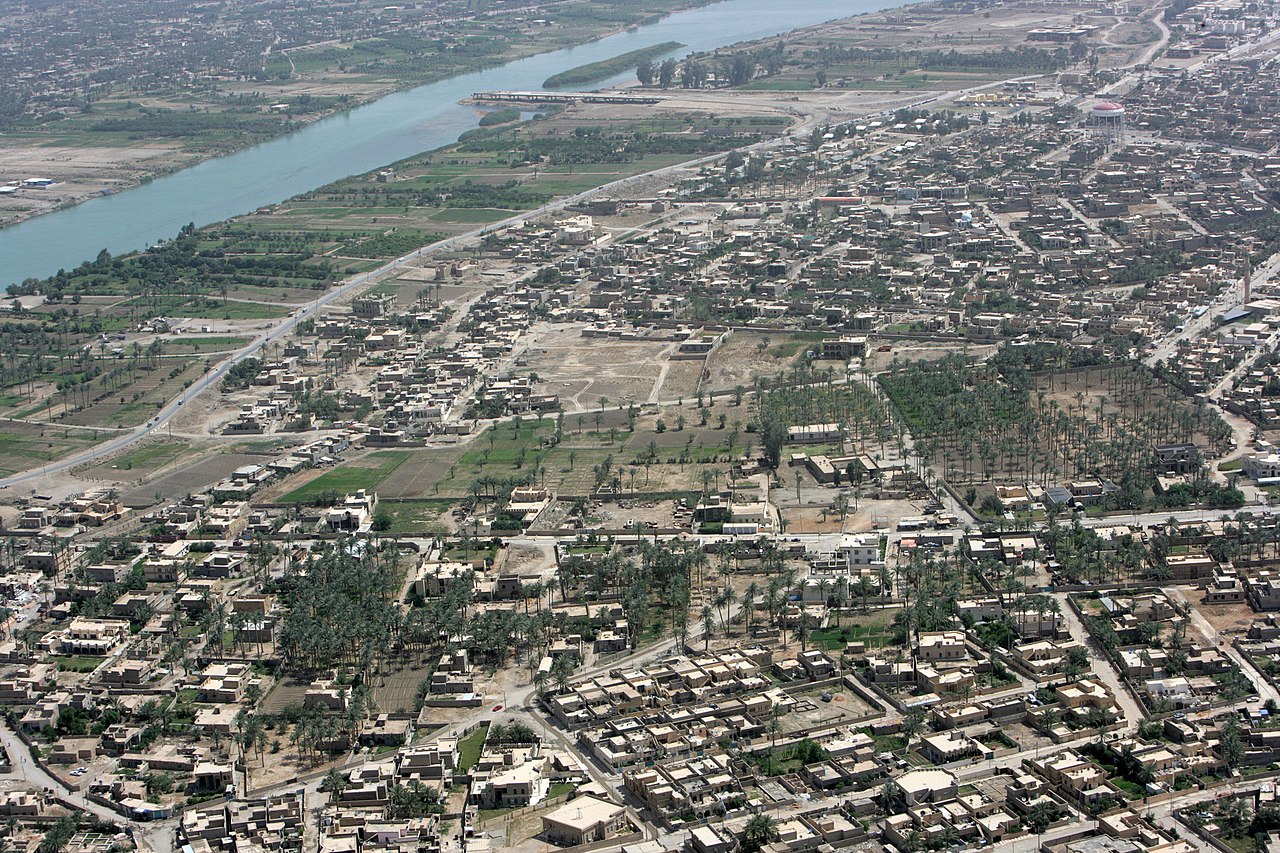
Ramadi and the Euphrates from the air, 2008
Ramadi and the Euphrates from the air, 2008 The Euphrates at Ramadi from a Marine UH-1N Huey of HMLA-169, 23 April 2008, a year after the battle. Exact view not recorded; pinned at the Euphrates bridge, approximate. Cpl. Jeremy M. Giacomino, U.S. Marine Corps · public domain · source
Monsoor's Medal of Honor presented to his parents
Monsoor's Medal of Honor presented to his parents President George W. Bush presents Michael Monsoor's Medal of Honor to his parents, George and Sally Monsoor, at the White House, 8 April 2008. U.S. Navy photo — public domain · source

★ Medal of Honor 1 recipient

Links go to the official records: the Congressional Medal of Honor Society and, where they exist, the service's own pages.

Free for everyone every year on its anniversary: September 29.

Accuracy score: 55/100 (limited)

How the accuracy score works

Changelog

Corrections and updates to this map since 9 November 2026, newest first. All changes

Sources and method

Battle of Ramadi, June 2006 – February 2007. Main sources: Maj. Niel Smith and Col. Sean MacFarland, 'Anbar Awakens: The Tipping Point', Military Review, March–April 2008 (the plan, the first COPs, 24 July, 21 August, 9 September, 25 November, police and contact figures, losses); William Knarr et al., Al Sahawa — The Awakening, Vol. IV: Al Anbar Province, Area of Operations Topeka, Ramadi (IDA P-5052, 2016) (battalion sectors, the 14 June attack, the four COPs, 2 and 14 September, 17th Street, TF 1-9); LTC V.J. Tedesco, TF 1-37 Armor command brief (COP dates, box score). Medal of Honor: navy.mil, MA2 Michael A. Monsoor (citation and biography); All Hands, 'I Will Defend'; Defense Media Network. Marc Lee: Silver Star citation. Marines: Michael Rubin, 'Ramadi: From the Caliphate to Capitalism', Proceedings, April 2008; I MEF on the hospital, 7 Jul 2006. Stars and Stripes: brigade timeline, 'Awakening in Ramadi', COP Falcon (13 Aug 2006). Camp Corregidor: Washington Examiner; DVIDS, 'Life at Corregidor'. Camp Ramadi grid: GlobalSecurity. Operation Squeeze Play: MNF-I release, 14 Jan 2007. Chlorine car bomb: American Forces Press Service, 6 Jun 2007. Civilians killed on 28 November: Associated Press via The Vindicator, 29 Nov 2006. Further reading: Dick Couch, The Sheriff of Ramadi (2008); Jim Michaels, A Chance in Hell (2010); Jocko Willink and Leif Babin, Extreme Ownership (2015). No staff ride handbook covers this battle. Coordinates: the Government Center, the Ma'laab, Tameem and Sufia follow OpenStreetMap; Camp Ramadi is the police academy inside the Camp Junction City wall, from a published grid; Camp Corregidor is placed approximately at the east edge of the Ma'laab, which the Washington Examiner describes as just outside its gate; the COPs, the hospital, Sattar's compound and Monsoor's overwatch building are schematic, since none has a published location.

Where the positions come from

Further reading