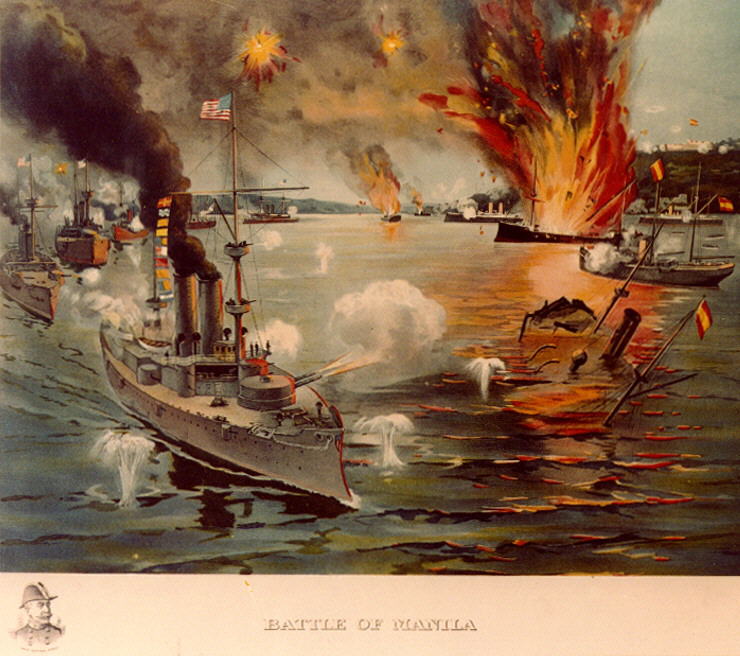
30 April - 1 May 1898, about 11:30 PM to 12:30 AM
Through the Boca Grande
Commodore George Dewey's Asiatic Squadron, out of Mirs Bay near Hong Kong since 27 April, finds no Spanish ships at Subic Bay and runs into Manila Bay by night, in column at about 8 knots with lights screened: the cruisers Olympia (flagship), Baltimore, Raleigh and Boston, the gunboats Petrel and Concord, the revenue cutter Hugh McCulloch and the supply ships Nanshan and Zafiro. They take the broad south channel, the Boca Grande, between Caballo Island and El Fraile Rock, leaving Corregidor to the north. Soot in McCulloch's funnel catches fire and flares as she passes El Fraile; the rock's battery fires a few shots (Britannica says two) after about half the column is past, and Boston, Concord and McCulloch reply. McCulloch's chief engineer, Frank Randall, collapses fighting the fire and dies, by one account of a heart attack. Across the bay, Rear Admiral Patricio Montojo's squadron lies at anchor off Sangley Point, Cavite.
1 May 1898, about 5:00-5:15 AM
Daybreak off Manila
The squadron crosses the bay at slow speed and arrives off Manila at daybreak. Finding only merchant shipping there, it turns south for Cavite, leaving the supply ships and McCulloch out of range. Montojo's report has his lookouts in Don Juan de Austria signaling the enemy squadron at 4:45; the Sangley Point battery opens at about 5:00 (5:15 by the U.S. logs), its shells falling short, and the Spanish ships slip their cables. Three batteries at Manila, on the Pasig River mole, the south bastion of the walled city and at Malate, also fire, without effect; Dewey does not answer them. At 5:06, by Captain Gridley's report, two mines explode well ahead of the flagship, too far off to do harm.
About 5:41-6:20 AM
"You may fire when you are ready, Gridley"
At 5:40, with the range at about 5,000 to 5,500 yards, Dewey tells Captain Charles Gridley of Olympia, "You may fire when you are ready, Gridley," and the squadron opens fire at 5:41. Olympia, Baltimore, Raleigh, Petrel, Concord and Boston steam past roughly parallel to the Spanish line, which lies roughly east-west from Cañacao Bay, behind Sangley Point, across the mouth of Bacoor Bay. Castilla, whose engines no longer work, is moored as a floating battery behind sand-filled lighters, and Ulloa, also under repair, is moored in Cañacao Bay; the rest are under way. Two Spanish launches that run at Olympia are driven off, one sunk and one beached. At about 6:20 Olympia turns to starboard and leads back across the line, the first of five passes in all, three to the west and two to the east (Gridley's report).
About 7:00 AM
Reina Cristina's sortie
On each pass Dewey closes the range, down to about 2,000 yards. At about 7:00 Montojo's flagship, the cruiser Reina Cristina, moves out of the line to close with Olympia; concentrated fire drives her back under the point, burning. By Montojo's account a shell destroys her steering gear at about 7:30 and she is steered by hand. Castilla and Don Juan de Austria are also on fire. Spanish accounts stress how outmatched the squadron was: Montojo puts his five effective ships at 10,111 tons, 76 guns and 1,875 men against the Americans' 21,410 tons, 163 guns and about 1,750 men.
About 7:35-11:16 AM
The breakfast pause
At 7:35 Dewey breaks off the action and stands out into the bay after a report, later found to be wrong, that only about fifteen rounds per gun are left for the 5-inch battery. The crews go to breakfast and the captains are called aboard the flagship; Baltimore is sent to check a steamer flying, as it turns out, British colors. In the smoke the Spanish squadron looks intact, but it is wrecked. Reina Cristina, with some 130 to 150 killed by U.S. accounts, among them Captain Luis Cadarso, is scuttled and abandoned in shoal water under the north wall of Cavite; Montojo shifts his flag to Isla de Cuba. Castilla burns at her moorings. At about 8:00 Montojo orders the surviving ships behind the arsenal into Bacoor Bay, to fight on and to be sunk rather than surrendered.
About 11:16 AM-12:30 PM
The second attack
Learning that ammunition is plentiful, Dewey returns to the attack at 11:16. Baltimore leads in, slows to dead slow at about 2,800 to 2,200 yards and silences the batteries at Sangley Point and Cañacao and the moored Ulloa, which sinks, still firing; by Gridley's report she and the shore guns are the last to reply. Petrel, the shallowest-draft ship, rounds Sangley Point about 500 yards outside the burning Castilla and fires on the sunken Ulloa and then on the ships behind the arsenal's inner breakwater. Concord is sent into Bacoor Bay against the transport Isla de Mindanao, whose crew abandon her in about ten boats after the first rounds, and keeps firing until she burns. Spanish losses in the day, by Montojo's report, reach 381 killed and wounded, including the arsenal's people.
1-3 May 1898, from 12:30 PM
White flag over Cavite
At 12:30, after Petrel's first shots into the arsenal's public buildings, a white flag goes up and the Spanish flag is hauled down from the arsenal's sheers; Petrel signals the surrender to the squadron, which anchors off Manila at 12:40. Lieutenant Edward Hughes and seven men in Petrel's only whaleboat then burn the scuttled and grounded Don Juan de Austria, Isla de Cuba, Isla de Luzon, General Lezo and Marqués del Duero; by Commander Wood's report Velasco and El Correo (actually the gunboat Elcano) are burned later, and the unarmed Manila is spared. Dewey reports no Americans killed and seven slightly wounded; Baltimore's own report lists eight wounded aboard her. Landing parties destroy the Sangley Point batteries on 2 May, the garrison evacuates the Cavite arsenal and a U.S. party takes possession on 3 May, and the Corregidor batteries surrender to Raleigh and Baltimore the same day.