Battlefield Atlas
Spanish–American War · 1898 Members · from $3

San Juan Hill, 1 July 1898

On 1 July 1898, outside Santiago de Cuba, about 8,400 American regulars and volunteers of General William Shafter's Fifth Army Corps attacked the San Juan Heights, held by a few hundred Spanish infantry under General Arsenio Linares armed with smokeless 7 mm Mausers. Pinned for hours in the open valley below the ridge, the attackers broke through after Lieutenant John Parker's Gatling guns swept the crest: the dismounted cavalry, including Theodore Roosevelt's Rough Riders and the Black regulars of the 9th and 10th Cavalry, took Kettle Hill, and the regular infantry of Kent's division carried San Juan Hill and its blockhouse. The black-powder smoke of the volunteers' old Springfields, and the Gatlings' smokeless fire, became the battle's lasting lesson; Santiago surrendered on 17 July.

Open the interactive map8 stages on modern satellite imagery and terrain, with 3D elevation

This battle opens with Battlefield Enjoyer ($3 a month on Patreon), which unlocks every battle in the atlas and every one added later. Free battles include Yorktown, Waterloo, The Alamo, Antietam, Little Bighorn, Belleau Wood, Omaha Beach, Ia Drang.

Charge of the Rough Riders at San Juan Hill (Remington)
Charge of the Rough Riders at San Juan Hill (Remington) — Frederic Remington, 1898 — public domain

The battle, stage by stage

  1. 1 July 1898, about 8 AM

    Smoke over El Pozo

    General William Shafter's Fifth Army Corps, landed at Daiquirí and Siboney in late June, moves on Santiago de Cuba. While Lawton's division attacks El Caney to the north-east (not shown), Captain George Grimes's four guns on El Pozo hill open on the San Juan blockhouse at about 2,600 yards. Their black powder raises a cloud of white smoke, Spanish shrapnel answers almost at once, and men near the battery — among them some of the Rough Riders — are hit. The cavalry division and Kent's infantry wait in column on the narrow road behind. On the heights ahead, General Arsenio Linares has only a few hundred men — about 520 by one count, 760 or more by others — with some 10,000 more in the city.

  2. About 9 AM to noon

    Down the jungle trail

    The army squeezes down a single trail through thick jungle under fire it can barely see. Above the column, a Signal Corps balloon towed by soldiers marks its position for every Spanish gunner until it is shot full of holes. Before it comes down, Lt. Col. George Derby spots a second trail branching left toward a lower ford, which eases the jam. The dismounted cavalry wades the San Juan River and files right; Kent sends the 71st New York, carrying single-shot black-powder .45-70 Springfields, down the new trail, where under fire it stalls and breaks apart.

  3. About 12:30 PM

    Hell's Pocket

    The regulars deploy along the far bank, in tall grass about 600 yards below the trenches. Spanish Mausers — smokeless 7 mm — reach them while the shooters stay almost invisible; every volley from the volunteers' trapdoors puts up a puff of smoke that draws fire back. The crossing becomes the 'Bloody Ford'. Colonel Charles Wikoff, bringing his brigade past the 71st to form on Hawkins's left, is killed; his two successors are hit within minutes. With no new orders from Shafter, the line waits and bleeds. Many of the 71st attach themselves to whatever unit is nearest.

  4. About 1 PM

    Up Kettle Hill

    On the right the cavalry starts forward without waiting longer. Lieutenant Colonel Theodore Roosevelt, mounted on Little Texas, pushes the Rough Riders through the 9th Cavalry, and the Rough Riders, the 9th and 10th, the 3rd, 6th and 1st Cavalry go up the low hill the troopers name for a sugar-refining kettle found on top. Black regulars of the 9th and 10th are in the charge from the start; Sergeant George Berry of the 10th is said to carry two regiments' colours to the crest. The small Spanish outpost falls back across the valley.

  5. 1:15–1:23 PM

    'It's the Gatlings, men!'

    Lieutenant John H. Parker runs his mule-hauled Gatling guns into the open beyond the ford, one on the road itself, about 600 yards from the blockhouse; of his four, three are in action. Firing the same smokeless .30 Army round as the Krag, they rake the crest for about eight minutes — roughly 18,000 rounds by one count — throwing up yellow dust along the Spanish trenches. On Kettle Hill, Roosevelt's men take the drumming for Spanish machine guns until he shouts that they are 'our Gatlings'. The infantry rushes forward across the open valley to the foot of the hill. At 1:23, an officer waves a white handkerchief and the guns cease fire.

  6. 1:23–1:50 PM

    The blockhouse

    Hawkins's and Wikoff's brigades go up the steep face, with men of the 10th Cavalry and the scattered 71st among them, through wire to the crest. Lieutenant Jules Ord, who had asked to lead the charge, is among the first to the top and is killed there (accounts place the wound in the throat or face). Because Linares dug his trenches on the very top rather than the forward slope, the attackers were partly hidden from fire on the last stretch. Private Arthur Agnew of the 13th Infantry pulls down the flag on the blockhouse at about 1:50; on the left, Pearson's 10th and 2nd Infantry take a green knoll. The Spanish fall back toward the city.

  7. About 2–4 PM

    Holding the heights

    From Kettle Hill, Roosevelt leads a mixed force across the narrow valley, past a small lagoon, onto the northern part of the heights; the fuller picture is that the cavalry took Kettle Hill and the regular infantry carried San Juan Hill itself. Two Gatlings come up onto the ridge, and two of them silence a Spanish 16-cm gun about 2,000 yards away — Parker's men later bring home its range table and rear sight. A Spanish counterattack later in the afternoon is beaten back with the Gatlings' help. In the 71st New York, men who have picked up Krags from the fallen regulars are ordered to hand them back.

  8. Night of 1 July — 17 July 1898

    The cost

    Shafter considers pulling back; Wheeler persuades Kent and Sumner to hold, and the line is entrenched overnight. Parker takes the wheels off his guns and sets them into the trenches beside the Rough Riders, a spot that becomes 'Fort Roosevelt'. Including El Caney, American losses on 1 July are about 205 killed and 1,200 wounded (26 of the dead from the 10th Cavalry, by one count); Spanish losses roughly 215 killed and 376 wounded. The 71st New York loses 15 dead to wounds and 79 to disease. Santiago surrenders on 17 July, after talks under a ceiba tree just west of the heights — the Surrender Tree.

Weapons

Gatling gun

Gatling gun

Hand-cranked rotary machine gun · 1862–1911

DOPE HISTORY — "It's our Gatlings!": Lieutenant John Parker ran three Gatlings forward into the open about 600 yards from the blockhouse and swept the Spanish trenches for about eight minutes, by his count some 18,000 rounds. Roosevelt, on Kettle Hill, heard the drumming and thought it was Spanish machine guns until he shouted that it was "our Gatlings". The fire drove the defenders down as the infantry climbed.

Richard Gatling's crank-driven gun fired each barrel in turn as the cluster rotated, feeding from a gravity hopper. Most armies treated it as a kind of artillery; at Santiago Lieutenant John Parker pushed his battery forward with the infantry and used it as an assault weapon.

Barrels
6–10, turned by a crank
Rate of fire
several hundred rounds a minute
Calibre (1898 US)
.30-40 Krag
Photo: Max Smith (an 1865 British Gatling, Royal Artillery Museum) · Public domain

Spanish

Mauser Model 1893 ("Spanish Mauser")

Mauser Model 1893 ("Spanish Mauser")

Bolt-action magazine rifle · 1893–1940s

At San Juan Hill: The Spanish infantry on the heights fired smokeless Mausers from trenches dug along the crest, invisible while the Americans' black-powder smoke marked every position below.

Spain adopted Mauser's 1893 design, with a flush internal box magazine loaded by five-round stripper clips. Its smokeless powder gave the defenders a nearly invisible firing position and a flat, fast bullet, while American black-powder guns and the National Guard's old trapdoor rifles gave themselves away with every shot.

Calibre
7×57 mm, smokeless powder
Magazine
5-round charger-loaded box
Effective range
about 600–800 yd; sighted to 2,000 m
Photo: Auckland Museum (a Turkish-contract Model 1893) · CC BY 4.0

U.S. Fifth Army Corps

Krag–Jørgensen M1896 rifle and carbine

Krag–Jørgensen M1896 rifle and carbine

Bolt-action magazine rifle · 1894–1904 (US service)

At San Juan Hill: The Regulars, the Rough Riders and the 9th and 10th Cavalry carried smokeless Krags.

The U.S. Army's first smokeless-powder rifle, a Norwegian design with a distinctive side gate magazine that could be topped up a round at a time. In 1898 the Regulars and the Rough Riders carried Krags, but most volunteer regiments still had black-powder Springfield trapdoors.

Calibre
.30-40 Krag, smokeless powder
Magazine
5-round side-loading box
Effective range
about 500–600 yd
Photo: Tenacious Trilobite · CC0
Springfield Model 1873 carbine ("Trapdoor")

Springfield Model 1873 carbine ("Trapdoor")

Single-shot breech-loading carbine · 1873–1892

At San Juan Hill: The 71st New York and other volunteers carried black-powder .45-70 Springfield trapdoor rifles (this is the carbine version); each shot left a cloud of smoke for the Spanish to aim at. Men who picked up Krags from fallen Regulars were reportedly ordered to hand them back.

The U.S. Army's standard carbine after 1873: a hinged breechblock (the "trapdoor") flipped up to load one copper-cased cartridge at a time. Rugged and hard-hitting, but slower than a repeater, and the soft copper cases could stick in a fouled chamber.

Calibre
.45-55 (carbine load)
Effective range
about 300 yd; sighted to 1,200
Rate of fire
about 8–12 rounds a minute
Photo: Trapdoor carbine later owned by Geronimo · Smithsonian (NMAH) · Public domain
Gatling gun

Gatling gun

Hand-cranked rotary machine gun · 1862–1911

At San Juan Hill: Parker's detachment of four Gatlings, three in action, kept up the fire that covered the final assault and later helped beat off the Spanish counterattack.

Richard Gatling's crank-driven gun fired each barrel in turn as the cluster rotated, feeding from a gravity hopper. Most armies treated it as a kind of artillery; at Santiago Lieutenant John Parker pushed his battery forward with the infantry and used it as an assault weapon.

Barrels
6–10, turned by a crank
Rate of fire
several hundred rounds a minute
Calibre (1898 US)
.30-40 Krag
Photo: Max Smith (an 1865 British Gatling, Royal Artillery Museum) · Public domain

Paintings and photographs

Charge of the Rough Riders at San Juan Hill (Remington)
Charge of the Rough Riders at San Juan Hill (Remington) Frederic Remington's 1898 painting of the Rough Riders' charge — in fact largely up Kettle Hill. Frederic Remington, 1898 — public domain · source
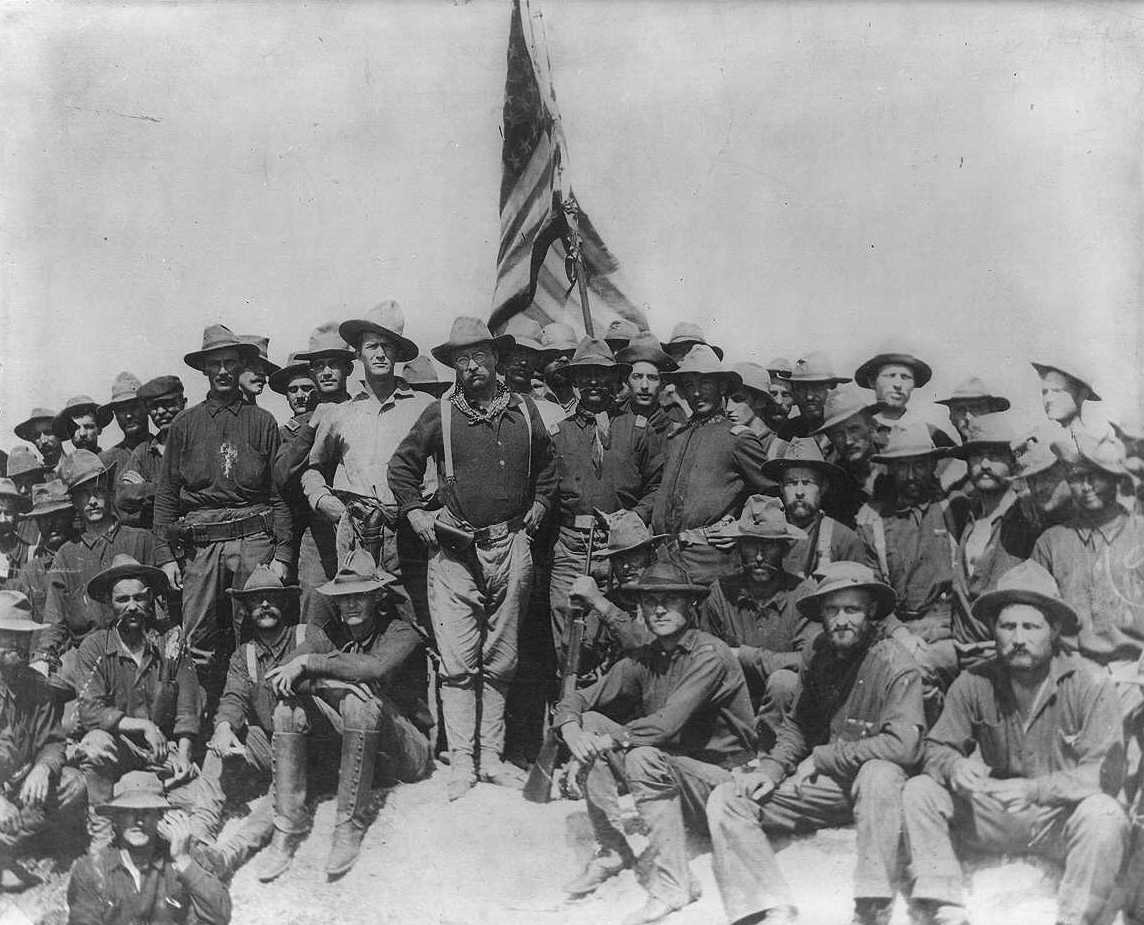
Roosevelt and the Rough Riders on the hill
Roosevelt and the Rough Riders on the hill Colonel Roosevelt with men of the Rough Riders on the captured heights, July 1898. William Dinwiddie, 1898 — public domain · source
The Advance on San Juan Hill
The Advance on San Juan Hill Period print of the infantry advance on San Juan Hill. C. D. Graves — public domain · source
San Juan Hill (Library of Congress)
San Juan Hill (Library of Congress) San Juan Hill, early 20th century (Library of Congress, National Photo Company collection). National Photo Company — public domain · source
Trenches in San Juan park today
Trenches in San Juan park today Re-dug Spanish trenches in the Parque Histórico de San Juan. Wikimedia Commons (check licence) · source

Sources and method

San Juan Heights, 1 July 1898. Placed from the Parque Histórico de San Juan on San Juan Hill (blockhouse site and monuments; OpenStreetMap 'Loma de San Juan' and Centenario monument), the Santiago Surrender Tree memorial (Wikipedia coordinates) and the old Santiago–Siboney road, now the Carretera de Siboney; other points are set by period distances: El Pozo about 2,600 yards from the blockhouse (Grimes's battery), the open valley about 600 yards wide, the Gatlings about 600 yards from the blockhouse and the Spanish 16-cm gun about 2,000 yards from them. Kettle Hill, the fords and the green knoll are interpretive. Sources: Cuban Battlefields of the Spanish-Cuban-American War (University of Nebraska–Lincoln, cubanbattlefields.unl.edu); John H. Parker, History of the Gatling Gun Detachment, Fifth Army Corps, at Santiago (1898, with a preface by Theodore Roosevelt); Theodore Roosevelt, The Rough Riders (1899); the Spanish-American War Centennial Website (spanamwar.com: Battery A 2nd Artillery, the Gatling detachment, the 71st New York, the Talavera Battalion); HistoryNet, 'Battle of San Juan Hill'; Wikipedia, 'Battle of San Juan Hill' and its order of battle; Lt Col G. McC. Derby, Map of Santiago de Cuba and vicinity showing entrenchments and positions of the Fifth Corps... evening of July 1st, 1898 (Military Information Division, 1898); U.S. Army Corps of Engineers, map of positions at the beginning of the truce, 3 July 1898. Strengths and losses differ between sources (Spanish defenders 521 to about 800; U.S. losses at San Juan alone about 144 killed and 1,024 wounded; combined with El Caney about 205 killed). Unit positions are schematic. Images from Wikimedia Commons.

Where the positions come from

Approximate locations