Battlefield Atlas
Seven Years' War · 1758 First 3 stages free

Siege of Louisbourg, 1758

In June and July 1758, an amphibious British force under Major-General Jeffery Amherst and Admiral Edward Boscawen besieged Louisbourg, France's fortified harbor town on Île Royale (Cape Breton Island). The army numbered roughly 11,600 to 13,200 regulars and rangers. The French governor, Augustin de Boschenry de Drucour, had about 3,500 regulars with militia, and the squadron of Jean-Antoine Charry Des Gouttes lay in the harbor. On 8 June Brigadier James Wolfe's boats landed at the Anse de la Cormorandière (Kennington Cove), where a few boatloads of light infantry found an unguarded rocky landing and turned the French entrenchments. Wolfe's batteries at Lighthouse Point silenced the Island Battery. Fire and boarding parties destroyed or captured the French ships. Louisbourg surrendered on 26 July, and the garrison became prisoners of war. The fall of Louisbourg opened the way to Quebec in 1759.

Play the first 3 stages free8 stages on modern satellite imagery and terrain, with 3D elevation

The first 3 of its 8 stages are free to play. The rest opens with Battlefield Explorer ($4.99 a month or $39 a year), which unlocks every battle in the atlas and every one added later. Lifetime access and war packs are one-time options. Free battles include Thermopylae, Actium, Viking raid on Lindisfarne, Hastings, Hattin, Agincourt, Vítkov Hill, Bosworth, Culloden, Fort William Henry, Yorktown, Fort McHenry and North Point, Waterloo, The Alamo, Palo Alto, Antietam, Little Bighorn, Belleau Wood, Omaha Beach, Inchon, Ia Drang, Goose Green, 73 Easting, Wanat, Baghdad Thunder Runs, Battle of Raqqa, Donetsk Airport, Battle of Kyiv, Battle of Hostomel Airport, Siege of Mariupol, Kharkiv counteroffensive, Kherson counteroffensive, Bakhmut, Vuhledar, Mala Tokmachka and Robotyne, Avdiivka.
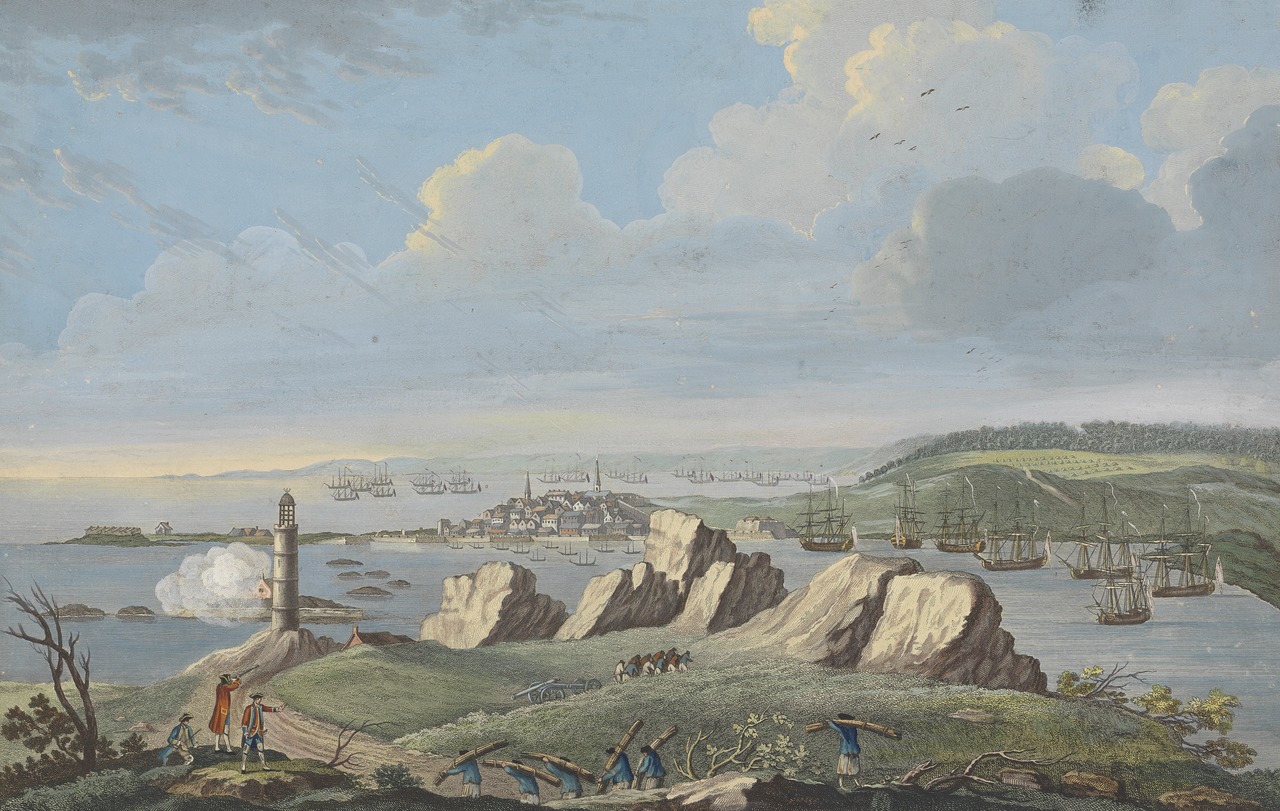
A View of Louisburg … taken near the Light House, 1758
A View of Louisburg … taken near the Light House, 1758 — Pierre-Charles Canot — public domain

The battle, stage by stage

  1. 2–7 June 1758

    The fleet in Gabarus Bay

    Admiral Edward Boscawen's fleet, carrying Major-General Jeffery Amherst's army from Halifax, anchors in Gabarus Bay on 2 June. The Dictionary of Canadian Biography counts 157 vessels in all, warships, transports and smaller craft. The army is usually given as about 11,600 to 13,200 men, nearly all regulars (Parkman counts 500 provincial rangers). Surf keeps the boats off the beaches for days. Governor Augustin de Boschenry de Drucour has about 3,500 regulars plus militia. Des Gouttes's squadron of 11 vessels, five of them ships of the line, lies in the harbor with about 3,800 seamen. Remembering 1745, the French have entrenched every likely beach. Parkman counts 2,000 regulars and about 1,000 militia and Indigenous warriors behind breastworks screened with felled spruce and fir.

  2. 8 June 1758, about 4–6 a.m.

    Into the Cormorandière

    Before dawn the frigates open fire on the shore. The boats pull in three divisions. Whitmore's on the right rows toward White Point as if to land, and Lawrence's in the center, in Amherst's words, 'made a show of landing at the Fresh Water Cove' (its position on the map is interpretive, and accounts disagree on which cove the British called by that name). The real attack is Brigadier James Wolfe's on the left, aimed at the Anse de la Cormorandière, now Kennington Cove. Lieutenant-Colonel Jean Mascle de Saint-Julhien's roughly 1,000 men hold their fire until the boats are close, then sweep the beach with cannon, swivels and musketry. Parkman counts eight guns. Wolfe signals the boats to turn back. Three light infantry boats under Lieutenants Hopkins and Brown and Ensign Grant pull instead for a craggy spot a few rods east of the beach (to the right, by Parkman's account), sheltered by a small point, which the French had thought too steep to need a guard.

  3. 8 June, morning

    The rock and the retreat

    The light infantry scramble ashore on the rocks. Major George Scott's boat is smashed in the surf, and by Thomas Pichon's account he reaches the top with only about ten men. Wolfe, carrying a cane by tradition, sends the rest of his division in after them, and men wade through the breakers. Several boats overturn and some soldiers drown. Saint-Julhien moves his grenadier companies too late. Outflanked, and with more boats landing at the far end of the beach, the French abandon their guns and fall back through the woods toward the town, and the other shore posts are given up. About 70 are taken prisoner. Parkman gives British losses at the landing as 109 killed, wounded and drowned. Light troops follow to within cannon shot of the walls.

  4. 12–25 June

    Lighthouse Point and the Island Battery

    Heavy surf slows the landing of guns and stores for about a week, and Amherst builds a road and an epaulement across the boggy ground west of the town. The French have already destroyed the Royal (Grand) Battery and abandoned their battery at Lighthouse Point. On 12 June Wolfe takes about 1,200 picked men round the North-East Harbor and occupies the point. Guns landed at Gunlanding Cove go into batteries there and open on the Island Battery from 19–20 June (the Dictionary of Canadian Biography gives the 19th for Drucour, the 20th for Amherst), and on the ships beyond it. Amherst reports the Island Battery silenced on the evening of 25 June. The approaches toward Green Hill begin, and Des Gouttes's ships draw in close under the town.

  5. 29 June – mid-July

    Blocking the channel

    With the harbor mouth now under British guns, Drucour decides to sink ships across the entrance. On 29 June the Apollon, Fidèle, Chèvre and Biche are scuttled in the channel (Amherst's dispatch; more hulks were sunk later). The frigate Aréthuse under Jean Vauquelin has harassed the British works from the harbor, and on the night of 14–15 July she is warped through the obstructions and escapes to France. Wolfe's men come back round to the west side. On the evening of 16 July they seize the Hauteur-de-la-Potence, Gallows Hill, and entrench 'scarcely three hundred yards from the Dauphin's Bastion' (Parkman). The heavy 24- and 32-pounders come forward and the approaches close on the land front.

  6. 21–22 July

    The squadron burns

    British batteries have been firing on the walls for weeks; Amherst's dispatch has them opening on the Citadel bastion by 12 July and on the Dauphin by 19 July. On 21 July a British shell lands on the Célèbre and fires her powder. By Parkman's account the wind carries the flames into the rigging of the Entreprenant and then the Capricieux, and all three burn to the waterline. Amherst's dispatch names the Superbe in place of the Célèbre. On 22 July new batteries on the right open with thirteen 24-pounders and mortars, and a shell sets fire to the barracks of the King's Bastion. The Queen's Bastion barracks burn the next night (Parkman). By the surrender the walls are reportedly breached in about a dozen places.

  7. Night of 25–26 July

    Cutting out the Prudent and Bienfaisant

    Only the Prudent (74) and Bienfaisant (64) are left. In darkness and fog, boats from the fleet carrying about 600 sailors and marines, in two divisions under Captains John Laforey and George Balfour, row into the harbor past the Island Battery while the siege batteries keep the defenders busy. The sentries hail and open fire, but both ships are boarded with little resistance. The Prudent is aground, so the boarders set her on fire. The Bienfaisant is towed to the North-East Harbor under Wolfe's guns. Boscawen gives the British loss as 7 killed and 9 wounded.

  8. 26–27 July 1758

    Surrender

    With no ships left and a breach that looks practicable, Drucour asks for terms on 26 July. Amherst and Boscawen require the garrison to surrender as prisoners of war without the honors of war. The French officers first resolve to fight on, but Drucour accepts to spare the town. On 27 July Major Farquhar's grenadiers take possession of the West (Dauphin) Gate, and Brigadier Whitmore receives the garrison's arms. Eleven colors are sent to England. About 5,600 to 5,700 soldiers and seamen become prisoners (Parkman: 5,637), and 221 cannon and 18 mortars are taken. The capitulation also gives up Île Saint-Jean. British engineers demolish the fortifications in 1760. The road up the St. Lawrence to Quebec is now open.

Forces

Roughly 11,600 to 13,200 British soldiers, carried by a fleet of 157 vessels, besieged about 3,500 French regulars with militia and some 3,800 seamen. The army totals are fairly secure; unit figures are few.

British army and Royal Navy (Amherst, Boscawen, Wolfe)

Army (present)Parkman: 11,600 soldiers, all regulars except 500 provincial rangers; History of War gives 13,200. Francis Parkman, Montcalm and Wolfe, ch. 19 (part 1); History of War, Siege of Louisbourgabout 11,600-13,200
FleetWarships, transports and smaller vessels together (DCB Amherst and Drucour); History of War gives 21 ships of the line and 14 frigates among them. The DCB's 27,000 men includes the seamen. Dictionary of Canadian Biography, Amherst; Dictionary of Canadian Biography, Drucour; History of War, Siege of Louisbourg157 vessels
In the 8 June assaultParks Canada's 'Siege Landing' marker. Parks Canada marker, HMdb 142966about 3,300

French garrison and squadron (Drucour, Des Gouttes)

GarrisonDCB Drucour and The Canadian Encyclopedia; British Battles and History of War give 6,000 to 7,000 including militia and seamen ashore. Dictionary of Canadian Biography, Drucour; The Canadian Encyclopedia, Louisbourg; History of War, Siege of Louisbourgabout 3,500 regulars, plus militia
SquadronFive ships of the line plus frigates and smaller ships (DCB Drucour; Massachusetts Historical Society). Dictionary of Canadian Biography, Drucour; Massachusetts Historical Society11 vessels, about 3,800 seamen
Guarding the landing placesParkman: 2,000 regulars with about 1,000 militia and Indigenous warriors. Francis Parkman, Montcalm and Wolfe, ch. 19 (part 1)about 3,000

Casualties

British losses were light for a seven-week siege: 109 at the landing and 16 in the boat attack, perhaps 500 killed and wounded in all. The French garrison of about 5,600 to 5,700 soldiers and seamen was made prisoner and the whole squadron was lost. French killed are not reliably known. Certainty: fair.

British army and Royal Navy (Amherst, Boscawen, Wolfe)

Losses at the landing, 8 June (killed, wounded and drowned)Parkman's figure. Amherst's first return in the London Gazette lists 38 men killed besides officers and about 51 men wounded, with several officers among the casualties. Francis Parkman, Montcalm and Wolfe, ch. 19 (part 1); London Gazette no. 9818 (Amherst's dispatch)109
Boat attack on the Prudent and Bienfaisant, 25-26 JulyBoscawen's figure in the London Gazette; the Massachusetts Historical Society gives the same 16 casualties. London Gazette no. 9818 (Boscawen's letter); Massachusetts Historical Society7 killed, 9 wounded
Killed and wounded, whole siegeA round figure from a popular secondary history; the full return was printed in an Extraordinary Gazette that was not consulted, so treat this as approximate. British Battles, Siege of Louisburg 1758about 500

French garrison and squadron (Drucour, Des Gouttes)

Prisoners at the landing, 8 JuneAmherst's dispatch; three captains of grenadiers and two lieutenants were among those taken. London Gazette no. 9818 (Amherst's dispatch)about 70
Captured at the surrender (soldiers and seamen)Parkman gives 5,637, as reported in the project's fact-check; British Battles gives 5,600 soldiers. The garrison surrendered as prisoners of war without the honors of war (DCB). Francis Parkman, Montcalm and Wolfe, ch. 19 (part 2); British Battles, Siege of Louisburg 1758; Dictionary of Canadian Biography, Drucourabout 5,600-5,700
Sick and wounded at the end of the siegeParkman: nearly a fourth of the garrison was in the hospitals by late July. No reliable total of French killed was found. Francis Parkman, Montcalm and Wolfe, ch. 19 (part 2)nearly a fourth of the garrison

Civilians

TownspeopleShells fell on the hospitals and on casemates where women and children sheltered (Parkman); Drucour asked for protection for the wounded and was refused (CBC). Civilians were later shipped to France. Francis Parkman, Montcalm and Wolfe, ch. 19 (part 2); CBC, Canada: A People's History; The Canadian Encyclopedia, Louisbourgunknown

Equipment and ships

French ships of the line lostThree burned on 21 July (Célèbre, Entreprenant, Capricieux by Parkman; Amherst names the Superbe for one), the Prudent burned and the Bienfaisant taken on 25-26 July. London Gazette no. 9818; Francis Parkman, Montcalm and Wolfe, ch. 19 (part 2)5
French ships scuttled in the harbor mouthApollon, Fidèle, Chèvre and Biche on 29 June (Amherst); Parkman says two more were sunk afterward. London Gazette no. 9818; Francis Parkman, Montcalm and Wolfe, ch. 19 (part 2)4, then 2 more
French frigate capturedTaken off the coast trying to reach Quebec for help (Gazette; Parkman). The Aréthuse escaped to France on 14-15 July. London Gazette no. 9818; Dictionary of Canadian Biography, Amherst1 (Écho)
Guns taken in the fortressFigures supplied by the project's fact-check (Parkman); Amherst's dispatch lists the captured guns and stores, including 36-pounders, without a single total in the pages consulted. Francis Parkman, Montcalm and Wolfe, ch. 19 (part 2); London Gazette no. 9818221 cannon, 18 mortars

Then and now: how the ground has changed

The fortress was demolished by British engineers in 1760-68 and the town abandoned by the 1780s; about a quarter of the walled town, including the King's Bastion and the Dauphin gate, was rebuilt by Parks Canada in 1961-81. The coves, points and harbor are little built over, but the modern town of Louisbourg stands on the north side of the harbor and the 1758 wrecks lie on its floor.

Weapons

British army and Royal Navy (Amherst, Boscawen, Wolfe)

Short Land Pattern musket ("Brown Bess")

Short Land Pattern musket ("Brown Bess")

Smoothbore flintlock musket · 1768–1790s pattern

At Louisbourg: The British regulars' musket; Wolfe's grenadiers and light infantry carried it up the rocks at the Cormorandière on 8 June.

The British infantryman's musket for most of the 18th century. Accuracy beyond about 100 yards was poor, so the tactics were volleys at close range followed by the bayonet, which the Brown Bess was built to carry.

Caliber
.75 (ball about .69)
Effective range
about 50–100 yd against a formed line
Rate of fire
3 rounds a minute, drilled
Photo: Tower (British Ordnance) · Public domain
Heavy siege guns (18- and 24-pounders)

Heavy siege guns (18- and 24-pounders)

Siege artillery · 1600s-1860s

At Louisbourg: Amherst's siege train and the 24- and 32-pounders brought forward to batter the land front; thirteen new 24-pounders opened on 22 July.

Siege guns were long, heavy cannon built to smash fortifications from close-range batteries dug behind trenches. They were too heavy for ordinary field maneuver, so they were brought up by road or water and fired for days on end. Paired with mortars and howitzers, they turned a siege into a slow but methodical demolition.

Shot
18 lb or 24 lb iron ball
Use
Battering earthworks from dug-in batteries
Mobility
Very heavy; hauled by large teams
Photo: DrStew82 · CC BY-SA 4.0
Siege and sea-service mortar (10- and 13-inch)

Siege and sea-service mortar (10- and 13-inch)

Siege artillery · 1600s-1860s

At Louisbourg: British mortars at Lighthouse Point and before the town; a shell set the Célèbre on fire on 21 July and others burned the bastion barracks.

Mortars threw explosive shells in a high arc over walls and parapets. At Louisbourg in 1758 British shells set French warships and the bastion barracks on fire and fell on the hospitals and casemates.

Shell
Hollow iron shell with a fuse, up to about 200 lb for a 13-inch
Fire
High-angle, over walls into the works and the harbor
Crew
Several men per piece
Photo: Royal Museums Greenwich (an 1825 example), public domain
Royal Navy ship's gun

Royal Navy ship's gun

Naval artillery · 1700s-1850s

At Louisbourg: Boscawen's ships covered the landing and the squadron landed 32- and 24-pounders for the siege batteries.

Smoothbore cast-iron guns mounted in rows along a warship's decks were the backbone of British sea power. Besides solid shot, crews could fire heated shot and incendiary carcasses to set targets on fire. In coastal campaigns, guns were often landed from ships to arm shore batteries.

Shot
Iron balls, commonly 6 to 32 lb by ship size
Mounting
Wooden truck carriage on a gun deck
Crew
Several men per gun
Photo: Moshi Anahory · CC BY-SA 2.0

French garrison and squadron (Drucour, Des Gouttes)

French Model 1766 musket ("Charleville")

French Model 1766 musket ("Charleville")

Smoothbore flintlock musket · 1766–1777 pattern

At Louisbourg: French regulars carried earlier patterns of the French infantry musket (the 1728 and its successors), forerunners of the 1766 'Charleville' shown here.

France shipped tens of thousands of these muskets to the Continental Army from 1777, quietly, before it entered the war. Lighter and slightly smaller-bored than the Brown Bess, it became the pattern for America's first national musket, the Springfield Model 1795.

Caliber
.69
Effective range
about 100 yd
Rate of fire
2–3 rounds a minute
Photo: Charleville Arsenal · Public domain
Heavy siege guns (18- and 24-pounders)

Heavy siege guns (18- and 24-pounders)

Siege artillery · 1600s-1860s

At Louisbourg: The fortress mounted heavy guns, 24-pounders on the Dauphin demi-bastion and 36-pounders among the guns taken at the surrender.

Siege guns were long, heavy cannon built to smash fortifications from close-range batteries dug behind trenches. They were too heavy for ordinary field maneuver, so they were brought up by road or water and fired for days on end. Paired with mortars and howitzers, they turned a siege into a slow but methodical demolition.

Shot
18 lb or 24 lb iron ball
Use
Battering earthworks from dug-in batteries
Mobility
Very heavy; hauled by large teams
Photo: DrStew82 · CC BY-SA 4.0
Siege and sea-service mortar (10- and 13-inch)

Siege and sea-service mortar (10- and 13-inch)

Siege artillery · 1600s-1860s

At Louisbourg: The garrison also had mortars; 18 were among the guns surrendered.

Mortars threw explosive shells in a high arc over walls and parapets. At Louisbourg in 1758 British shells set French warships and the bastion barracks on fire and fell on the hospitals and casemates.

Shell
Hollow iron shell with a fuse, up to about 200 lb for a 13-inch
Fire
High-angle, over walls into the works and the harbor
Crew
Several men per piece
Photo: Royal Museums Greenwich (an 1825 example), public domain

Paintings and photographs

A View of Louisburg … taken near the Light House, 1758
A View of Louisburg … taken near the Light House, 1758 Pierre-Charles Canot's engraving of the siege seen from near the lighthouse in 1758 (Yale Center for British Art). Pierre-Charles Canot — public domain · source
King's Bastion barracks (reconstructed)
King's Bastion barracks (reconstructed) The reconstructed King's Bastion barracks at the Fortress of Louisbourg National Historic Site. The barracks of 1758 burned on 22 July. Dennis G. Jarvis — CC BY-SA 2.0 · source
Fortress of Louisbourg
Fortress of Louisbourg An early photograph of the ruins of Louisbourg. M. O. Hammond — public domain · source

Free for everyone every year on its anniversary: June 8 – July 27.

Accuracy score: 67/100 (moderate)

How the accuracy score works

Sources and method

Siege of Louisbourg, 1758. No U.S. Army staff ride handbook covers this siege. Primary: Amherst's and Boscawen's dispatches, London Gazette no. 9818 (August 1758). These give the three landing divisions and their regiments, the covering frigates, Lighthouse Point, the Island Battery silenced on 25 June, the ships sunk on 29 June, the batteries' progress, the 21 July fire, the cutting-out of the Prudent and Bienfaisant (7 killed, 9 wounded), Farquhar at the West Gate and the 11 colors. Reference: Dictionary of Canadian Biography: Drucour (garrison about 3,500, about 3,800 seamen on 11 vessels, 157 British vessels), Amherst, Boscawen and Mascle de Saint-Julhien; Christopher Moore, 'Louisbourg', The Canadian Encyclopedia. Francis Parkman, Montcalm and Wolfe (1884), ch. 19 (part 1, part 2). George A. Bray III, 'Major Scott's Provisional Light Infantry Battalion', Early America Review (Pichon's account). Massachusetts Historical Society, 'The Daring Capture of the Prudent and Bienfaisant'. Places: Parks Canada, Wolfe's Landing, Dauphin Demi-Bastion and Gate, Royal Battery; E. McM. Larrabee, Archaeological Research at the Fortress of Louisbourg, 1961–1965 (Parks Canada). Canadian Register of Historic Places: Wolfe's Landing, Royal Battery, Fortress of Louisbourg. Parks Canada markers via HMdb: The Siege Landing, Lighthouse Point, French Garrison at Louisbourg. Period plans: Royal Collection Trust, C. G. Kennedy, plan of the coast of Gabarus Bay (RCIN 732059) and plan of the British encampments and works (RCIN 732060). The King's Bastion, the Dauphin demi-bastion, Battery Island, Kennington Cove, Lighthouse Point and the Royal Battery are placed from published or mapped coordinates. The Queen's and Princess bastions, Flat Point, White Point, Gallows Hill, the British lines and every ship's mooring are approximate and interpretive, as are the sectors given to the French garrison. Accounts differ on which cove the British called 'Fresh Water Cove', and on whether the third ship burned on 21 July was the Célèbre (Parkman) or the Superbe (Amherst's dispatch). Images from Wikimedia Commons.

Where the positions come from

Further reading