Battlefield Atlas
Seven Years' War · 1757 Locked

Leuthen, 5 December 1757

On 5 December 1757, near the village of Leuthen (now Lutynia, Poland) west of Breslau, Frederick the Great's Prussian army attacked an Austrian army roughly twice its size under Prince Charles of Lorraine and Field Marshal Daun. Making a show against the Austrian right, Frederick marched his main body south behind low hills, deployed off the open Austrian left at Sagschütz and rolled the line up from the end in his 'oblique order', the battalions advancing in echelon. The Austrians tried to make a new front at Leuthen, lost the village and its walled churchyard, and broke when Driesen's cavalry routed Lucchesi's counterattack at dusk. About 22,000 Austrians were lost, around half of them captured, for about 6,300 Prussians. Silesia was saved for Prussia, and Leuthen became Frederick's most celebrated victory.

Open the interactive map7 stages on modern satellite imagery and terrain, with 3D elevation

This battle opens with Battlefield Explorer ($4.99 a month or $39 a year), which unlocks every battle in the atlas and every one added later. Lifetime access and war packs are one-time options. Free battles include Thermopylae, Actium, Hattin, Agincourt, Vítkov Hill, Bosworth, Fort William Henry, Yorktown, Waterloo, The Alamo, Antietam, Little Bighorn, Belleau Wood, Omaha Beach, Inchon, Ia Drang, 73 Easting, Wanat, Baghdad Thunder Runs, Battle of Raqqa, Battle of Kyiv, Battle of Hostomel Airport, Siege of Mariupol, Kharkiv counteroffensive, Kherson counteroffensive, Bakhmut, Mala Tokmachka and Robotyne, Avdiivka.

The Leuthen chorale (Camphausen)
The Leuthen chorale (Camphausen) — Wilhelm Camphausen — public domain

The battle, stage by stage

  1. 5 December 1757, about 5–7 AM

    The march from Neumarkt

    Before dawn Frederick's army, roughly 33,000–36,000 men by most modern counts, marches east from Neumarkt along the high road to Breslau in four columns, the infantry in the two inner columns and the cavalry outside them. The Austrians under Prince Charles of Lorraine, with Field Marshal Daun, are about twice as strong: around 65,000 by most modern counts (older accounts say 72,000–82,000), including Württemberg and Bavarian contingents. In the morning mist the Prussian advance guard runs into the Saxon light horse of General Nostitz, posted at Borne in front of the Austrian line, and rides it down; one account gives about 600 prisoners.

  2. About 9–11 AM

    The feint and the march behind the hills

    From the knolls by Borne (the Schönberg) Frederick can see the whole Austrian line, about 5 miles long, from Nippern behind its peat bogs in the north, through Frobelwitz and Leuthen, to Sagschütz in the south. He sends cavalry and part of the advance guard toward the Austrian right as if to attack there; Lucchesi, commanding that wing, calls for help and Prince Charles sends his reserve north. Meanwhile the main columns turn south and march behind a chain of low rises, out of sight of the Austrian line. Tempelhof, who marched with them, remembered the heads of the columns staying level all the way; by Carlyle's account the first line sang a hymn as it went.

  3. About noon to 1 PM

    Off the Austrian left at Sagschütz

    Around noon the columns pass Lobetinz and wheel left, forming two lines south-west of Sagschütz, at an angle to the end of the Austrian line. Zieten's cavalry takes post on the right beyond Sagschütz, and the heavy 12-pounders brought from the Glogau fortress, the 'Brummer', go into battery on a rise. Facing them is the Austrian left under General Nádasdy: the Württembergers in hasty works on the pine-covered Kiefernberg, Bavarians around Sagschütz, and Nádasdy's cavalry toward Gohlau. Nádasdy sends warning after warning to Prince Charles, who by some accounts is watching from the church tower of Leuthen and still believes the blow will fall on his right. Positions of the hills here are approximate.

  4. About 1–2:30 PM

    The oblique attack

    Little daylight is left, and Frederick attacks at once. Wedel's vanguard of grenadiers and battalions of the Meyerinck and Itzenplitz regiments leads, and the battalions follow in echelon, each about 50 paces behind and to the left of the last, so the right strikes first while the left is held back. The Württembergers break after a short, hard fight, and the Bavarians are carried away with them. Nádasdy throws his cavalry at the Prussian right, but Zieten's squadrons beat it back toward Gohlau, by one account taking 15 guns. Battalion after battalion of the Austrian left is rolled up northward toward Leuthen.

  5. About 3:30–4 PM

    Leuthen village and churchyard

    Prince Charles swings his army round to face south, with Leuthen as the anchor of a new line, but the troops coming down from the north arrive in no order and crowd into and around the village, by one account in places as much as 100 ranks deep. Prussian guns on the Butterberg overlooking the village (position approximate) fire into the mass. The Prussians storm Leuthen after about half an hour's street fighting. Austrian infantry holds out in the walled churchyard until a battalion of the Guard under Captain Wichard von Möllendorff breaks in; a cannonball lodged in the church wall during the attack is still shown today.

  6. About 4–4:30 PM, at dusk

    Lucchesi's charge, Driesen's answer

    Lucchesi now leads the Austrian right-wing cavalry south to strike the open left flank of the Prussian infantry west of Leuthen. He does not see that General Driesen's cavalry, the Prussian left wing, is waiting out of sight behind Radaxdorf. Driesen takes Lucchesi in the flank; the Bayreuth Dragoons begin the fight and are being worsted until the cuirassiers of the second line come in, while the Puttkamer Hussars ride round into the Austrian rear. Lucchesi's horsemen are routed, Lucchesi himself is mortally wounded, and the Austrian infantry beside Leuthen, its flank now bare, breaks and runs.

  7. Evening of 5 December

    The pursuit to Lissa

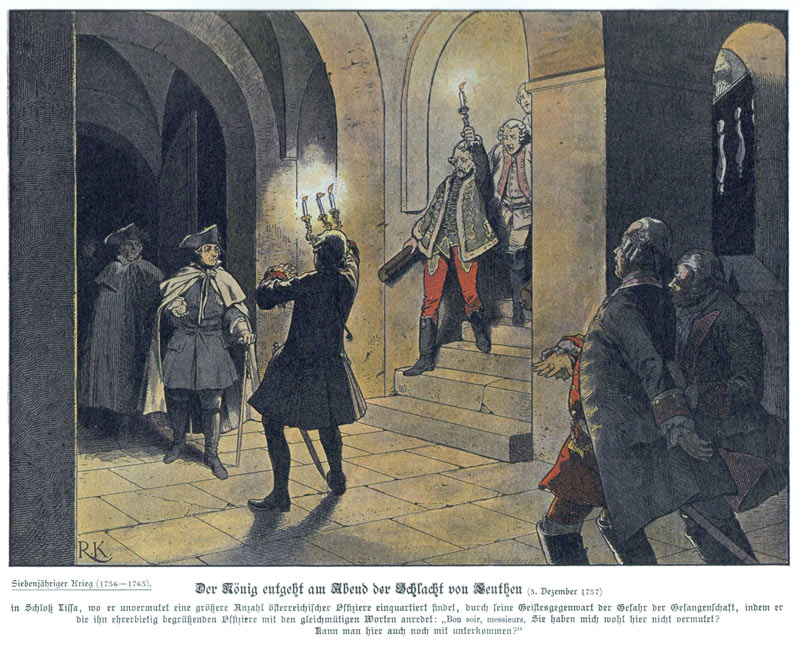
    The Austrian army streams east toward the bridges over the Weistritz (Schweidnitzer Wasser) at Lissa and on toward Breslau. With darkness and snow coming on, Frederick gathers grenadiers and cuirassiers and pushes on to Lissa to block the crossing, and there is fighting in the town. He spends the night in the manor house, where Prince Charles and Daun had been quartered before the battle; the story of his greeting to the Austrian officers he found there ('Bonsoir, messieurs') is a popular anecdote with no confirmed basis. By tradition the army on the field sang the hymn 'Nun danket alle Gott' that night. Austrian losses come to about 22,000, around half of them prisoners, with over 100 guns; the Prussians lose about 6,300. Breslau capitulates on about 20 December (sources give 19–21 December).

Forces

Frederick attacked with roughly 33,000 men against an Austrian army of about 65,000 by most modern counts; older and popular accounts give the Austrians 72,000–90,000. Totals are fair, unit figures rare.

Austrian army (Charles of Lorraine, Daun)

PresentBritish Battles gives 65,000; Britannica 72,000; the 1911 Britannica 82,000; History of War about 90,000. British Battles, Battle of Leuthen; Encyclopaedia Britannica, Battle of Leuthen; Encyclopaedia Britannica (1911), 'Leuthen'; History of War, Battle of Leuthenabout 65,000 (65,000–90,000)
Infantry British Battles, Battle of Leuthenabout 41,000
Cavalry British Battles, Battle of Leuthenabout 22,000
Guns British Battles, Battle of Leuthen210

Prussian army (Frederick II)

PresentBritish Battles and the 1911 Britannica give about 33,000; Britannica gives 43,000. British Battles, Battle of Leuthen; Encyclopaedia Britannica (1911), 'Leuthen'; Encyclopaedia Britannica, Battle of Leuthenabout 33,000 (33,000–43,000)
Infantry British Battles, Battle of Leuthenabout 21,000
Cavalry British Battles, Battle of Leuthenabout 11,000
Guns British Battles, Battle of Leuthen167

Casualties

Leuthen cost the Austrians about 22,000 men, around half of them prisoners, and over 100 guns, against about 6,300 Prussian casualties; older accounts give higher Austrian losses, and exact figures vary between sources. Certainty: fair.

Austrian army (Charles of Lorraine, Daun)

Total lossesBritish Battles gives about 22,000 including about 11,000 prisoners; the 1911 Britannica gives a much higher 10,000 left on the field and 21,000 captured, probably counting men taken in the pursuit. British Battles, Battle of Leuthen; Encyclopaedia Britannica (1911), 'Leuthen'about 22,000 (22,000–31,000)
CapturedAbout 11,000 per British Battles; the 1911 Britannica says 21,000, and History of War also gives 21,000. A further 17,000 surrendered at Breslau later in December (1911 Britannica). British Battles, Battle of Leuthen; Encyclopaedia Britannica (1911), 'Leuthen'; History of War, Battle of Leuthenabout 11,000–12,000 (11,000–21,000)
Killed and woundedThe 1911 Britannica's figure of about 10,000 left on the field; British Battles' total less its prisoners gives a similar number. No breakdown is attested in the sources consulted here. Encyclopaedia Britannica (1911), 'Leuthen'; British Battles, Battle of Leuthenabout 10,000

Prussian army (Frederick II)

Total casualties (killed, wounded, missing)British Battles gives 6,382; Britannica about 6,000; the 1911 Britannica 'under 5,500'. British Battles, Battle of Leuthen; Encyclopaedia Britannica, Battle of Leuthen; Encyclopaedia Britannica (1911), 'Leuthen'about 6,300 (5,500–6,400)
KilledHistory of War gives 1,140 Prussians killed. History of War, Battle of Leuthenabout 1,140

Equipment and ships

Austrian guns and colors lostFigures from the 1911 Britannica. Encyclopaedia Britannica (1911), 'Leuthen'116 guns, 51 colors

Then and now: how the ground has changed

The rolling farmland between Lutynia and Leśnica is still largely open fields, and the villages of the battle survive under Polish names, but the villages have grown, Lissa (Leśnica) is now a district of Wrocław, and the 1854 victory column survives only as a damaged base.

Weapons

Austrian army (Charles of Lorraine, Daun)

Socket bayonet

Socket bayonet

Edged weapon (musket attachment) · c. 1690s-1860s

At Leuthen: Socket bayonet on the Austrian infantry musket

The socket bayonet slipped over the outside of the musket barrel and locked in place, turning every musket into a short pike without blocking the muzzle. It made the pike obsolete and let infantry defend themselves against cavalry and finish an assault at close quarters. For a century and a half, a determined bayonet charge often decided fights that musketry could not.

Length
Triangular blade, about 17 in on the Brown Bess
Use
Fitted over the muzzle so the musket could still be fired
Photo: Rama · CC BY-SA 2.0 fr
Light 6-pounder field gun

Light 6-pounder field gun

Smoothbore muzzle-loading cannon · 18th century

At Leuthen: Light field guns

The workhorse of 18th-century field artillery: light enough to move with infantry, heavy enough to break up an attack. At close range the gunners switched to canister, a tin can of musket balls that turned the gun into a giant shotgun.

Shot
6 lb iron round shot, or canister
Range
round shot to about 1,200 yd; canister about 300 yd
Crew
about 6–8 men
Photo: Photojunkie · Public domain

Prussian army (Frederick II)

Socket bayonet

Socket bayonet

Edged weapon (musket attachment) · c. 1690s-1860s

At Leuthen: Socket bayonet on the Prussian infantry musket

The socket bayonet slipped over the outside of the musket barrel and locked in place, turning every musket into a short pike without blocking the muzzle. It made the pike obsolete and let infantry defend themselves against cavalry and finish an assault at close quarters. For a century and a half, a determined bayonet charge often decided fights that musketry could not.

Length
Triangular blade, about 17 in on the Brown Bess
Use
Fitted over the muzzle so the musket could still be fired
Photo: Rama · CC BY-SA 2.0 fr
Light 6-pounder field gun

Light 6-pounder field gun

Smoothbore muzzle-loading cannon · 18th century

At Leuthen: Battalion and field guns

The workhorse of 18th-century field artillery: light enough to move with infantry, heavy enough to break up an attack. At close range the gunners switched to canister, a tin can of musket balls that turned the gun into a giant shotgun.

Shot
6 lb iron round shot, or canister
Range
round shot to about 1,200 yd; canister about 300 yd
Crew
about 6–8 men
Photo: Photojunkie · Public domain

Paintings and photographs

The Leuthen chorale (Camphausen)
The Leuthen chorale (Camphausen) Wilhelm Camphausen's painting of Prussian troops singing 'Nun danket alle Gott' after the battle (a tradition). Wilhelm Camphausen — public domain · source
Battle of Leuthen (Röchling)
Battle of Leuthen (Röchling) Carl Röchling's painting of the fight at Leuthen. Carl Röchling — public domain · source
Frederick at Lissa (Menzel)
Frederick at Lissa (Menzel) Adolph Menzel's 'Bonsoir, messieurs': Frederick surprises Austrian officers at Lissa (an anecdote). Adolph von Menzel — public domain · source
Frederick arriving at Lissa (Knötel)
Frederick arriving at Lissa (Knötel) Richard Knötel's view of Frederick reaching the manor at Lissa that evening. Richard Knötel — public domain · source

Free for everyone every year on its anniversary: December 5.

Accuracy score: 56/100 (limited)

How the accuracy score works

Sources and method

Leuthen, 5 December 1757. No U.S. Army staff ride handbook covers this battle. The course of the battle, the times of day and the units follow British Battles: the Battle of Leuthen (strengths, the 50-pace echelon, Wedel's vanguard, the Butterberg battery, the half-hour village fight, Lucchesi and Driesen, the Bayreuth Dragoons and Puttkamer Hussars, Lissa), the 1911 Encyclopaedia Britannica article 'Leuthen' (the Saxon outpost at Borne, the échelon on Sagschütz, the ranks in Leuthen, Driesen's held-back cavalry), Encyclopaedia Britannica, and Thomas Carlyle's History of Friedrich II of Prussia (volume 18, Project Gutenberg; the Great Road, Nypern and Leuthen either side of it, the 'Brummer' guns, Tempelhof on the march). The Prussian General Staff history Die Kriege Friedrichs des Großen, volume 'Leuthen' (Berlin, 1904), is digitized by Digitales Brandenburg (UB Potsdam) but its text and plans could not be read for this build. Period plans: Oebschelwitz's 'Plan de la Bataille' (The Hague, 1758; Royal Collection RCIN 732044) and the view of the battle published by Parker and Bakewell (RCIN 732045). Lissa: Wojciech Brzezowski, 'Dzieje rezydencji w Leśnicy', Architectus 1998. The churchyard and its cannonball: TVN24 Wrocław. The battlefield today: Roger Moorhouse, 'The forgotten battlefield at Leuthen'. Modern scholarship: T. G. Otte, Leuthen (Oxford, Great Battles, 2024); Christopher Duffy, Prussia's Glory: Rossbach and Leuthen 1757 (2003). Villages are placed at their modern Polish successors (Lutynia, Wróblowice, Zakrzyce, Radakowice, Łowęcice, Gałów, Źródła, Mrozów, Leśnica) from published coordinates and distances; Sagschütz is identified as Zakrzyce by ehemalige-ostgebiete.de. The hills named in the accounts (Schönberg, Kiefernberg, Butterberg) and the line of the flank march are placed approximately, and the unit blocks are schematic at wing and contingent level. Strengths and losses vary widely between accounts and are given as ranges. Images from Wikimedia Commons.

Where the positions come from

Further reading