Battlefield Atlas
Texas Revolution · 1835 Locked

Battle of Gonzales, 2 October 1835

At dawn on 2 October 1835, on Ezekiel Williams' farm on the Guadalupe River above Gonzales, about 140–150 Texian militia under John Henry Moore attacked roughly 100 Mexican dragoons under Lieutenant Francisco de Castañeda. Castañeda had been sent from San Antonio de Béxar to take back a small cannon lent to the settlement in 1831. Since 29 September, 18 townsmen, the 'Old Eighteen', had kept him from crossing while volunteers gathered. After a failed parley the Texians fired the gun under a homemade flag reading 'Come and Take It', and Castañeda withdrew. One or two Mexican soldiers were killed; no Texians died. The skirmish was small, but it is counted as the first battle of the Texas Revolution.

Open the interactive map6 stages on modern satellite imagery and terrain, with 3D elevation

This battle opens with Battlefield Explorer ($4.99 a month or $39 a year), which unlocks every battle in the atlas and every one added later. Lifetime access and war packs are one-time options. Free battles include Thermopylae, Actium, Viking raid on Lindisfarne, Hastings, Hattin, Agincourt, Vítkov Hill, Bosworth, Fort William Henry, Yorktown, Waterloo, The Alamo, Antietam, Little Bighorn, Belleau Wood, Omaha Beach, Inchon, Ia Drang, Goose Green, 73 Easting, Wanat, Baghdad Thunder Runs, Battle of Raqqa, Donetsk Airport, Battle of Kyiv, Battle of Hostomel Airport, Siege of Mariupol, Kharkiv counteroffensive, Kherson counteroffensive, Bakhmut, Mala Tokmachka and Robotyne, Avdiivka.

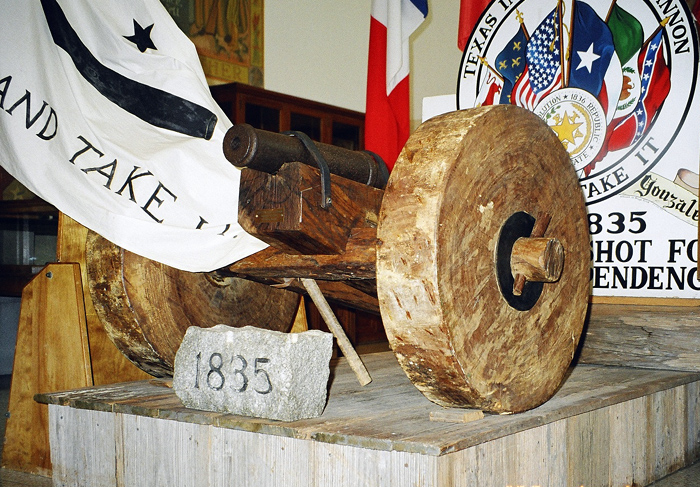
The Gonzales cannon
The Gonzales cannon — Larry D. Moore — CC BY 4.0

The battle, stage by stage

  1. 1831 – 25 September 1835

    A cannon for Gonzales

    In March 1831 the authorities at San Antonio de Béxar lent the DeWitt colony at Gonzales, the westernmost Anglo-American settlement in Texas, a bronze six-pounder cannon for defense against Indian raids, on condition that it be returned when asked for. By 1835 Santa Anna's centralists were dissolving state governments and disarming civilians, and Texian anger was rising. In September, Colonel Domingo de Ugartechea, the military commander at Béxar, sent a corporal and a handful of soldiers (four or five, by different accounts) with a cart to bring the gun back. Alcalde Andrew Ponton stalled, and the soldiers were detained. Ugartechea took the refusal as a challenge.

  2. 29 September 1835

    The Old Eighteen hold the crossing

    Lieutenant Francisco de Castañeda arrived with about 100 dragoons (the 1936 markers say 150) and an order to recover the gun, by force if necessary but without open conflict if he could avoid it. He found the Guadalupe running high and the boats and ferry taken to the far bank. Eighteen Gonzales men, the 'Old Eighteen', stood on the east bank and told him the alcalde was away and he must wait. Castañeda camped on high ground nearby (Hardin says 300 yards from the ford; the 1936 marker names De Witt's, later Santa Anna, Mound). That day the townsmen buried the cannon in George W. Davis's peach orchard and sent riders to the other settlements for help. The crossing's exact site is not known; it is drawn near today's US 183 bridge.

  3. 30 September – 1 October

    Volunteers and a flag

    Volunteers rode in from the Colorado and Guadalupe settlements. By the evening of 30 September there were more than 150 by one marker's count, and a Coushatta man told Castañeda that at least 140 had gathered with more on the way. The men elected John Henry Moore to command. The cannon was dug up and mounted on the fore-wheels of Albert Martin's cotton wagon, and loaded with scrap iron. The flag is credited to Evaline DeWitt and Cynthia Burns (the marker for Evaline's mother, Sarah Seely DeWitt, credits her too). They painted a black cannon, a single star and the words 'Come and Take It' on a length of white cotton about six feet long. On 1 October a war council voted to fight.

  4. Night of 1 October – morning of 2 October

    Fog at Williams' farm

    At sundown on 1 October Castañeda moved about seven miles upriver to Ezekiel Williams' land, looking for a better place to cross. About 7 PM the Texians crossed at Gonzales, some 50 of them mounted, and followed him up the west bank. A thick fog came in around midnight. About 3 AM a barking dog gave them away near the camp and the pickets fired; a Texian thrown by his startled horse got a bloody nose (one account adds a slight gunshot wound). At dawn, from Williams' corn and watermelon fields, they opened fire; Lieutenant Gregorio Pérez charged with about 40 horsemen but the timber stopped him, and Castañeda pulled his men back to a low rise behind the camp. When the fog lifted the two commanders met between the lines. Moore said they were fighting for their gun and the Constitution of 1824; Castañeda, by his own account a federalist himself, said he had his orders. The talks failed. Where the camp and rise lay is traditional, not surveyed.

  5. Morning of 2 October 1835

    "Come and Take It"

    Back in their lines, the Texians fired the cannon at the dragoons, by tradition the first shot of the Texas Revolution, and advanced under the flag, firing their rifles. Castañeda reported about 200 attackers with two guns. Mexican documents mention a small iron esmeril as well as the bronze piece, and some historians now think two guns were fired. Castañeda was outnumbered and had orders to withdraw 'without compromising the honor of Mexican arms', so he took his dragoons back toward Béxar. Mexican losses were one or two killed; Castañeda's Handbook of Texas biography says two. No Texian was killed. Hardin calls it 'really only a brief skirmish.'

  6. October 1835

    The march on Béxar

    The skirmish turned a quarrel over a cannon into a war. Volunteers kept arriving at Gonzales. On 11 October they elected Stephen F. Austin to command what they called the Army of the People, and within days it marched for San Antonio de Béxar, where it besieged General Martín Perfecto de Cos until his surrender in December. The fate of the Gonzales gun is disputed. The Handbook of Texas says the bronze piece went on to the Alamo and was buried there after the siege in 1836. A small iron gun, abandoned at Sandies Creek on the march and uncovered by a flood in 1936, is the one shown today in the Gonzales Memorial Museum; whether it was fired on 2 October is still argued.

Forces

About 100 Mexican dragoons faced Texian militia that grew from 18 men on 29 September to about 140–160 by 2 October. The Texians outnumbered Castañeda, but every figure on both sides varies by source.

Mexican detachment (Castañeda)

Dragoons sent from BéxarHardin's Handbook of Texas entry gives 100 dragoons. The 1936 Old Eighteen and Cannon Burial markers say 150, and Captain Albert Martin's message at the time put the force at about 150. Stephen L. Hardin, 'Gonzales, Battle of', Handbook of Texas Online (TSHA); Texas Historical Commission marker 13, Old Eighteen (THC Atlas); Sons of DeWitt Colony Texas (W. L. McKeehan), Battle of Gonzalesabout 100 (100–150)

Texian militia (Moore)

Militia at Gonzales, 30 Sept – 2 OctHardin cites a Coushatta informant's report to Castañeda of at least 140, with more expected. The Gonzales County Historical Commission says more than 150 volunteers had camped in Gonzales by 30 September, and THC marker 2221 says the force grew to about 160. Castañeda reported being attacked by about 200. Stephen L. Hardin, 'Gonzales, Battle of', Handbook of Texas Online (TSHA); Gonzales County Historical Commission, 'Texians at the Battle' marker (HMdb); Texas Historical Commission marker 2221, Battle of Gonzales (THC Atlas); Gonzales Inquirer, 'Mexican documents refer to 2 cannons at Battle of Gonzales'about 140–160 (140–200)
ArtilleryTexian tradition records one small bronze cannon. Castañeda's report and the Handbook of Texas cannon entry also mention a small iron esmeril, so some historians think two guns were present. Lindley and Woodrick, 'Gonzales Come and Take It Cannon', Handbook of Texas Online (TSHA); Gonzales Inquirer, 'Mexican documents refer to 2 cannons at Battle of Gonzales'1–2 guns

Casualties

A nearly bloodless skirmish: one or two Mexican dragoons killed and no Texian dead. The exact Mexican loss differs between accounts. Certainty: fair.

Mexican detachment (Castañeda)

KilledAccounts differ. The Sons of DeWitt Colony history says Castañeda withdrew with one casualty, while de la Teja's Handbook of Texas biography of Castañeda says he lost two men. Hardin's Handbook entry on the battle gives no figure. Jesús F. de la Teja, 'Castañeda, Francisco de', Handbook of Texas Online (TSHA); Sons of DeWitt Colony Texas (W. L. McKeehan), Battle of Gonzales1–2 (1–2)
WoundedAccounts drawing on Mexican reports mention a private wounded by a Texian volley; Hardin, Texian Iliad p. 11. Hardin, Texian Iliad (1994), p. 111 (by one account)

Texian militia (Moore)

KilledNo Texian was killed. The only injuries recorded are a slight gunshot wound from the Mexican pickets in the night and a bloody nose from a man thrown by his horse. Sons of DeWitt Colony Texas (W. L. McKeehan), Battle of Gonzalesnone
Wounded / injuredOne slight gunshot wound and one bloody nose (Sons of DeWitt Colony); other accounts mention only the bloody nose. Sons of DeWitt Colony Texas (W. L. McKeehan), Battle of Gonzales1–2 slightly

Then and now: how the ground has changed

The battleground near Cost is still open farm and ranch country marked by monuments. The Guadalupe is the most changed feature: since 1931 it has been dammed for hydropower above and at Gonzales, and the river crossing of 1835 is now a highway bridge on the edge of town.

Weapons

Mexican detachment (Castañeda)

Napoleonic cavalry lance

Napoleonic cavalry lance

Polearm (cavalry) · c. 1800-1910s

At Gonzales: Castañeda's command was cavalry. At dawn Lt Gregorio Pérez charged the Texians with about 40 horsemen, but the river timber broke up the charge. The lance is shown as typical Mexican cavalry equipment; the sources do not list the detachment's arms.

Polish lancers revived the lance in western Europe, and their success led France to convert several regiments into chevau-legers lanciers from 1811; Prussia, Austria and Russia fielded uhlans of their own. The long reach let a lancer strike swordsmen before they could reach him and stab infantry who had lost their formation. It was deadly in pursuit and fearsome against broken units.

Length
About 9 ft (2.7-2.9 m)
Use
Out-reaching swordsmen and spearing infantry or fallen men
Photo: Metropolitan Museum of Art · CC0

Texian militia (Moore)

Light 6-pounder field gun

Light 6-pounder field gun

Smoothbore muzzle-loading cannon · 18th century

At Gonzales: The Handbook of Texas describes the Gonzales gun as a small Spanish bronze piece of six-pound caliber. The Texians mounted it on ox-cart wheels, loaded it with chain and scrap iron and fired it on 2 October. It was not a regulation field gun.

The workhorse of 18th-century field artillery: light enough to move with infantry, heavy enough to break up an attack. At close range the gunners switched to canister, a tin can of musket balls that turned the gun into a giant shotgun.

Shot
6 lb iron round shot, or canister
Range
round shot to about 1,200 yd; canister about 300 yd
Crew
about 6–8 men
Photo: Photojunkie · Public domain
American long rifle

American long rifle

Rifled flintlock (Pennsylvania / "Kentucky" rifle) · about 1730–1840

At Gonzales: Most of the Texian volunteers were armed with their own rifles. After the cannon fired they advanced with a rifle volley.

Made by German-American gunsmiths in Pennsylvania for hunting on the frontier. The spiral rifling and a greased patch around the ball made it far more accurate than a musket, but slow to load and too delicate for a bayonet, so riflemen fought as skirmishers and sharpshooters rather than in the line.

Caliber
typically .45–.54
Effective range
200–300 yd in skilled hands
Rate of fire
about 1 round a minute
Photo: Long rifle of William Clark · Missouri Historical Society · Public domain

Paintings and photographs

The Gonzales cannon
The Gonzales cannon The small iron cannon displayed at the Gonzales Memorial Museum as the 'Come and Take It' gun; whether it is the gun fired in 1835 is disputed (the carriage is a reproduction). Larry D. Moore — CC BY 4.0 · source
The 'Come and Take It' flag
The 'Come and Take It' flag A modern version of the Gonzales flag, a cannon and lone star over 'COME AND TAKE IT', made for the Texians in 1835. DLS Texas — CC BY 3.0 · source
Gonzales Memorial Museum
Gonzales Memorial Museum The 1937 Gonzales Memorial Museum, built for the Texas Centennial. 25or6to4 — CC BY-SA 3.0 · source

Free for everyone every year on its anniversary: September 29 – October 2.

Accuracy score: 60/100 (moderate)

How the accuracy score works

Sources and method

Battle of Gonzales, 29 September – 2 October 1835. No U.S. Army staff ride handbook covers this battle. The narrative follows Stephen L. Hardin, 'Gonzales, Battle of', Handbook of Texas Online (Texas State Historical Association) and his Texian Iliad: A Military History of the Texas Revolution (1994); Thomas Ricks Lindley, revised by James Woodrick, 'Gonzales Come and Take It Cannon', Handbook of Texas; Jesús F. de la Teja, 'Castañeda, Francisco de', Handbook of Texas; and the Gonzales Inquirer report on Gregg Dimmick's and James Woodrick's reading of Castañeda's report (the two-cannon question). Places come from the Texas Historical Commission markers, with positions from the THC Atlas and the Historical Marker Database: Old Eighteen (no. 13) and Gonzales Cannon (2214) at the crossing, the Cannon Burial Site (2215), Santa Anna Mound (4571), Battle of Gonzales (2221), and near Cost the Site of the First Shot (1866), First Shot (1867) and the 1903 'first gun' monument (2459), together with the Gonzales County Historical Commission's waysides ('Texians at the Battle') and the Gonzales Flag marker. The day-by-day account is checked against the Sons of DeWitt Colony history (Battle of Gonzales). The site of the crossing, the Mexican camp, the low rise and the lines on Williams' farm are not fixed by survey or archaeology. They are drawn from the markers and the written accounts and are approximate. Strengths and losses vary between sources: Mexicans about 100 (150 on the 1936 markers), Texians 140 to about 160 (Castañeda said about 200), Mexican dead one or two.

Where the positions come from

Further reading