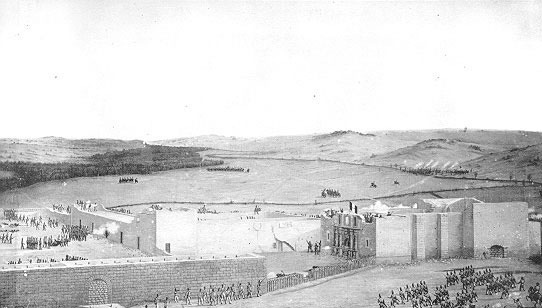
The Alamo, 23 February – 6 March 1836
From 23 February to 6 March 1836, during the Texas Revolution, General Antonio López de Santa Anna's Mexican army besieged the Alamo, a former Spanish mission in San Antonio de Béxar held by about 200 Texian and Tejano volunteers under William B. Travis, James Bowie and Davy Crockett. After thirteen days Santa Anna stormed the walls before dawn and killed almost every defender. The defeat, and the execution of prisoners at Goliad three weeks later, rallied support for Texas independence; 'Remember the Alamo!' was the battle cry when Sam Houston's army destroyed Santa Anna's at San Jacinto on 21 April.
Open the interactive map5 stages on modern satellite imagery and terrain, with 3D elevation
This battle is free to explore — no account needed.
The battle, stage by stage
- 23 February 1836
Santa Anna arrives
General Antonio López de Santa Anna's army marches into San Antonio de Béxar and raises a red flag — no quarter. About 150 Texians and Tejanos under William B. Travis and James Bowie retreat into the Alamo, the old mission across the river, whose walls enclose some three acres. The next day Travis writes his letter 'To the People of Texas & All Americans in the World': 'I shall never surrender or retreat… Victory or Death.'
- 24 February – 5 March
The siege
Mexican batteries bombard the walls and work their lines closer each night. On 1 March, 32 men from Gonzales slip through the lines — the only reinforcements that ever arrive — raising the garrison to about 200. Bowie, sick with fever, is confined to bed. On 5 March Santa Anna orders the assault for the next morning.
- 6 March, about 5:30 AM
The assault
About 1,800 Mexican soldiers advance in four columns in the pre-dawn darkness, carrying ladders, axes and crowbars — Cos against the north-west, Duque against the north wall, Romero from the east and Morales against the south-west corner — while Sesma's cavalry circles outside to catch anyone who tries to escape. A shout of 'Viva Santa Anna!' gives the alarm. Travis is shot dead on the north wall battery.
- About 6:00 AM
Over the walls
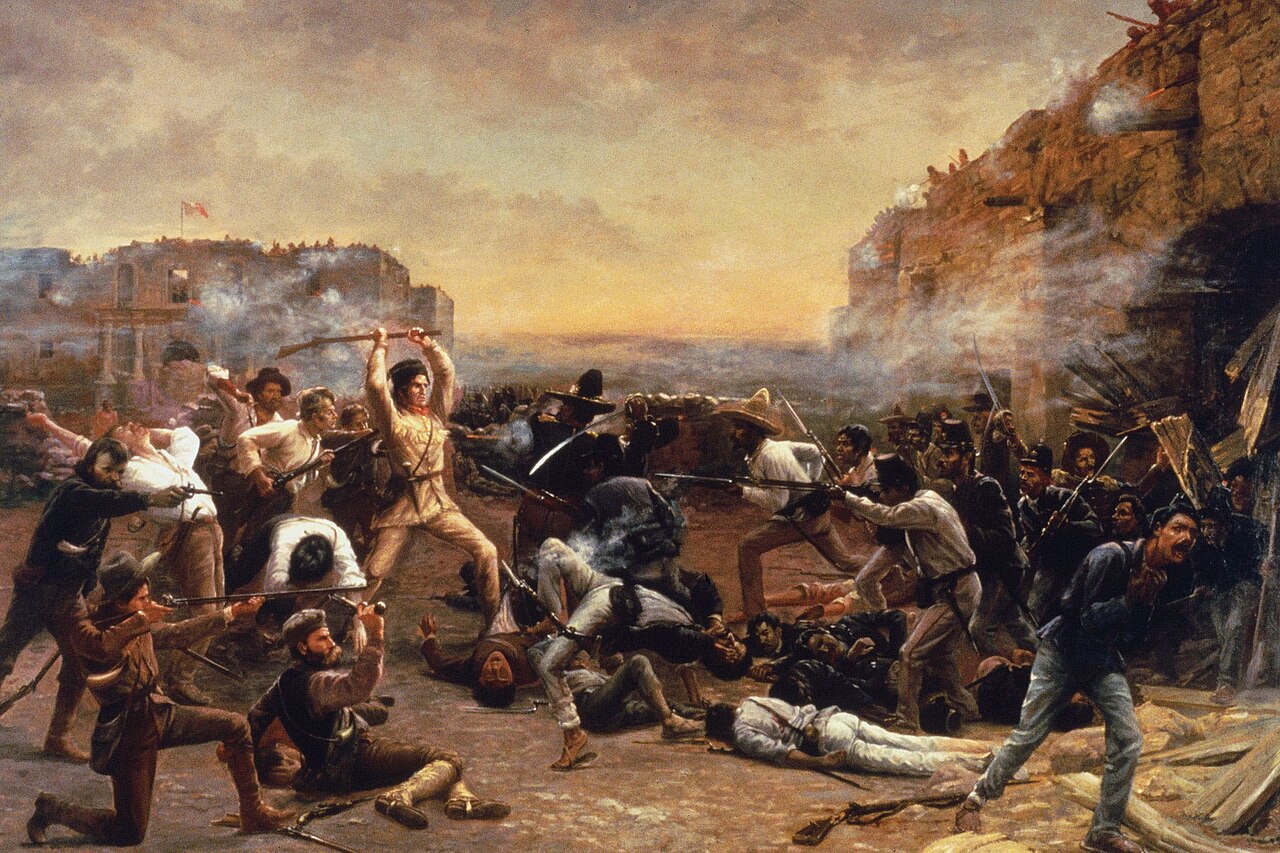
Twice thrown back by cannon and rifle fire, the columns crowd against the north wall, which is breached; Cos's men swing round and climb the west wall. The defenders fall back from the walls into the Long Barrack and the church. Some try to break out to the east and are cut down by the cavalry.
- About 6:30 AM
The end
The Mexicans turn the defenders' own cannon on the Long Barrack and clear it room by room; Bowie is killed in his bed. The church is the last to fall. Crockett and perhaps six others are captured and executed on Santa Anna's orders. About 180–250 defenders die; several women, children and Travis's slave Joe are spared. Mexican losses are perhaps 400–600 killed and wounded. Six weeks later, Texians shouting 'Remember the Alamo!' rout Santa Anna at San Jacinto.
Paintings and photographs