Battlefield Atlas
World War I · 1916 First 3 stages free

Verdun, 21 February – 18 December 1916

From 21 February to 18 December 1916 the German Fifth Army under Crown Prince Wilhelm, executing the plan of Chief of the General Staff Erich von Falkenhayn, attacked the French fortified region of Verdun on the Meuse. Falkenhayn later claimed his aim was to bleed the French army white at a place it would defend at any cost; historians still debate how far that was his purpose from the start. After the first rush took Fort Douaumont, Pétain's Second Army, fed by the Voie Sacrée and rotated division by division, held both banks: the Mort-Homme and Hill 304 on the left, Vaux, Fleury and Souville on the right. The German offensive died below Souville in July, and in October and December Nivelle and Mangin retook Douaumont, Vaux and most of the lost ground. It was the longest battle of the war; according to the French Ministry of the Armed Forces, about 162,000 French and 143,000 German soldiers died; estimates of total casualties run from about 700,000 to 750,000.

Play the first 3 stages free8 stages on modern satellite imagery and terrain, with 3D elevation

The first 3 of its 8 stages are free to play. The rest opens with Battlefield Explorer ($4.99 a month or $39 a year), which unlocks every battle in the atlas and every one added later. Lifetime access and war packs are one-time options. Free battles include Thermopylae, Plataea, Actium, Viking raid on Lindisfarne, Hastings, Hattin, Agincourt, Vítkov Hill, Kutná Hora, Fall of Constantinople, First St Albans, Lützen, Siege of Buda, Culloden, Fort William Henry, Yorktown, Lake Erie, Waterloo, The Alamo, Monterrey, Antietam, Little Bighorn, Manila Bay, Belleau Wood, Saint-Mihiel, Omaha Beach, Inchon, Ia Drang, Goose Green, 73 Easting, Wanat, Baghdad Thunder Runs, Manbij, Battle of Raqqa, Donetsk Airport, Ilovaisk, Debaltseve, Battle of Kyiv, Battle of Hostomel Airport, Siege of Mariupol, Bilohorivka (Siverskyi Donets crossing), Kharkiv counteroffensive, Kherson counteroffensive, Bakhmut, Vuhledar, Mala Tokmachka and Robotyne, Avdiivka, Kursk incursion.

Germans attack the Mort-Homme
Germans attack the Mort-Homme — Hermann Rex · public domain

The battle, stage by stage

  1. 21–22 February 1916

    The storm of steel and the Bois des Caures

    At 7:15 on the morning of 21 February more than 1,200 German guns massed on the front, including heavy 305 mm and 420 mm mortars, opened on the French positions north of Verdun. Falkenhayn's Fifth Army, under Crown Prince Wilhelm, struck on the right bank of the Meuse with three corps (VII Reserve, XVIII and III) against a thinly held salient stripped of much of its artillery in 1915. In the Bois des Caures, Lieutenant Colonel Émile Driant's two Chasseur battalions (about 1,200 men; the 59th in front, the 56th in reserve at Mormont Farm) were hit by what one account puts at 80,000 shells, then by assault parties with flamethrowers in the late afternoon. They held through the night and into the 22nd; Driant was killed while falling back, and only about 110 chasseurs and a dozen officers came out, but they cost the Germans a vital day.

  2. 23–25 February

    Fort Douaumont falls

    The French line cracked. Brabant, Samogneux, Haumont, Beaumont, the Fosses and Caurières woods and Ornes fell between 22 and 24 February, and the troops in the Woëvre plain were pulled back to the foot of the Meuse heights. On 25 February small parties of the Brandenburg Infantry Regiment 24 got into Fort Douaumont — the largest fort of the ring, held by a caretaker garrison of fewer than 60 territorials. By German accounts a pioneer NCO, Feldwebel Felix Kunze, got in first, then Lieutenant Eugen Radtke's platoon and Captain Haupt, with Oberleutnant von Brandis arriving later; Haupt and Brandis received the credit and the Pour le Mérite. Douaumont village held for the moment. The Germans were about 8 km from Verdun, and Balfourier's XX Corps was arriving to plug the line.

  3. 25 February – early March

    Pétain and the Voie Sacrée

    Joffre sent Castelnau to Verdun with full powers; on the night of 25–26 February General Philippe Pétain took over the Verdun front with his Second Army, headquartered at Souilly. He organized the defense around the forts and the artillery, rotated divisions through the fighting so none was destroyed outright, and turned the single road from Bar-le-Duc into a supply artery: the Voie Sacrée ('Sacred Way'), about 70 km long, carried some 2,900 trucks a day in each direction — by one count a vehicle every 14 seconds — kept open by territorials shoveling stone from quarries along the route. By early March the German drive on the right bank had stalled.

  4. 6 March – end of May

    The left bank: Mort-Homme and Hill 304

    Flanking fire from the left-bank ridges was killing the Germans on the right bank, so on 6 March the VI Reserve Corps attacked across the Meuse. Forges and the Bois des Corbeaux fell; Avocourt Wood and Malancourt Wood went on 20 March, Malancourt village on 31 March, Haucourt on 5 April and Béthincourt on 8 April. Hill 304 and the twin summits of the Mort-Homme ('Dead Man') were pounded for weeks; the Germans reached the crest of 304 in early May and the Mort-Homme and Cumières in the second half of the month. On the right bank, Nivelle replaced Pétain on 1 May, and on 22 May Mangin's 5th Division (129th and 36th Infantry among its regiments) got onto the top of Fort Douaumont before being driven off by 24 May.

  5. 1–7 June

    Fort Vaux

    On 1 June the Germans pushed from the Douaumont ridge toward Vaux, taking the Hardaumont salient and the Bois de la Caillette. The small Fort Vaux, commanded by Major Sylvain-Eugène Raynal and crammed with stragglers and wounded, was surrounded; on 2 June the Germans fought into its corridors with grenades and flamethrowers, and the garrison held them at sandbag barricades for days. With water gone, Raynal surrendered on 7 June. The Germans now stood on the ridge that ran through Thiaumont, Fleury and Souville — the last heights before Verdun.

  6. 23 June and 11–12 July

    High-water mark: Fleury and Souville

    After a 22 June bombardment with more than 116,000 diphosgene gas shells, German divisions — Bavarians and the Alpine Corps — attacked on 23 June on a front of about 5 km. They took the Thiaumont work and most of Fleury and reached the Froideterre ridge and the Quatre Cheminées shelter, but were stopped at the Sainte-Fine chapel below Fort Souville, where the Lion de Souville memorial to the 130th Division marks the farthest German advance. A last attack on 11–12 July reached Fort Souville itself: by Chemins de Mémoire's account only a few attackers got there and were captured (other accounts put about 30 men of Infantry Regiment 140 on top; the Michelin guide says they failed to reach the moats). The garrison, under Sub-Lieutenant Kléber Dupuy after Captain Soucarre was gassed, and counterattacks by the 7th Infantry and 25th Chasseurs held the fort. On 12 July Falkenhayn halted the offensive; the Somme and the Brusilov offensive now claimed his reserves. Fleury changed hands repeatedly until the Moroccan Colonial Regiment cleared it in August.

  7. 24 October – 2 November

    Douaumont and Vaux retaken

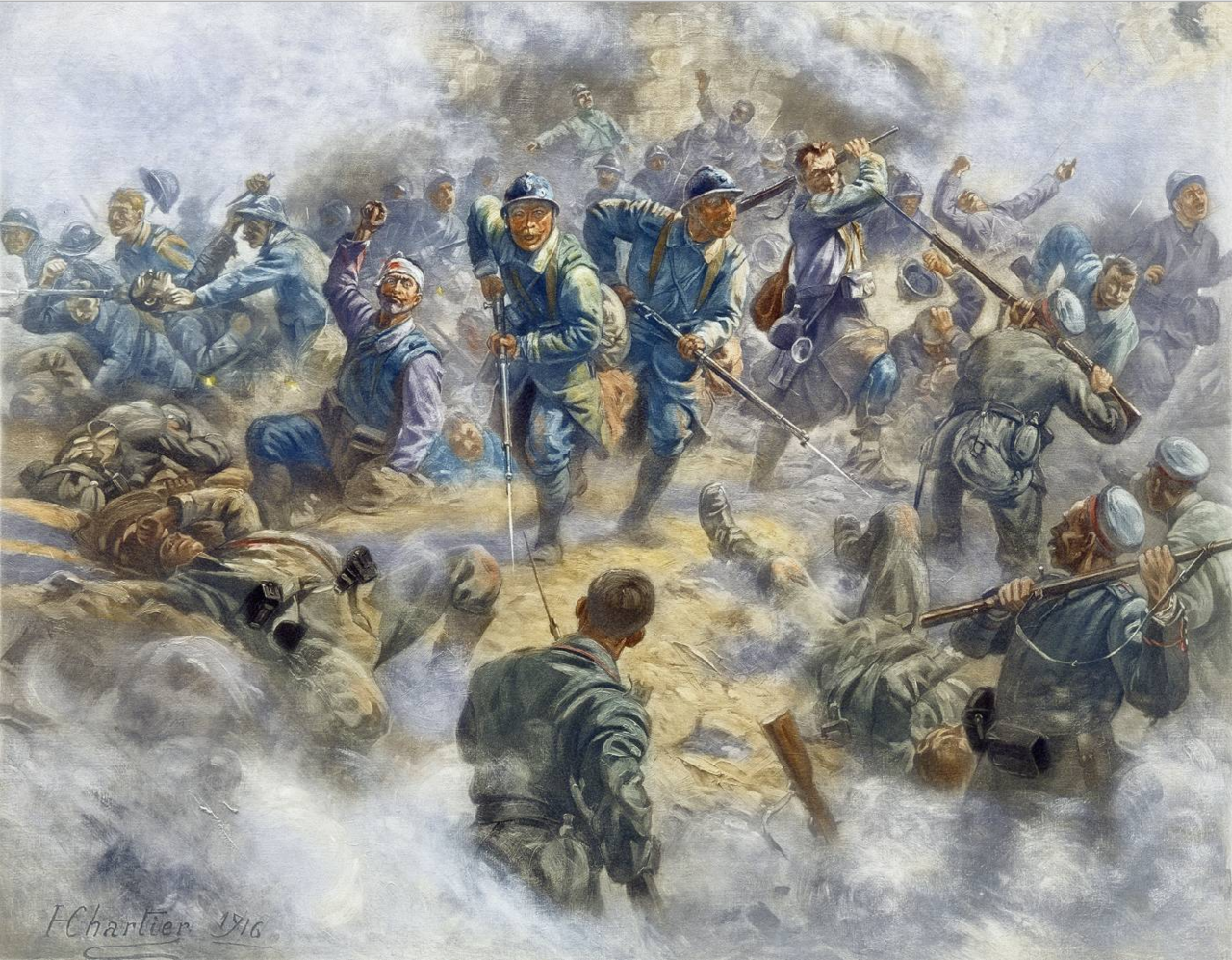
    After four days of shelling, in which French 400 mm railway howitzers smashed Douaumont's concrete, Mangin's group attacked at 11:40 on 24 October in thick fog behind a creeping barrage: the 38th Division (Guyot de Salins) on the left, the 133rd (Passaga) in the center and the 74th (de Lardemelle) on the right. The Moroccan Colonial Infantry Regiment (RICM) took Fort Douaumont that afternoon — Captain Dorey's advance guard first, the 1st Battalion organized there by about 15:30, and Captain Nicolay's 8th Battalion taking the rest of the garrison; the Haudromont quarries, Thiaumont, Douaumont village, the Caillette Wood, Vaux pond and the Damloup battery fell the same day. Vaux held out until the Germans evacuated it on the night of 1–2 November; French troops reoccupied it without a fight.

  8. 15–18 December

    Back to the February line

    In bitter cold Mangin attacked again on 15 December with four divisions — the 126th, 38th, 37th and 133rd — taking Vacherauville, the Côte du Poivre, Louvemont and Bezonvaux and more than 11,000 prisoners; Les Chambrettes farm fell on 18 December, the official end of the battle. The new line ran from the Meuse north of Vacherauville to Bezonvaux, roughly where the French had stood on 24 February. The left-bank heights of Hill 304 and the Mort-Homme stayed in German hands until August 1917. In ten months the two armies lost about 300,000 dead between them, by French Ministry figures.

Forces

The German Fifth Army opened with three corps and some 1,200 guns against a thinly held French sector; over ten months the French rotated about 70 divisions, roughly three quarters of their army, through Verdun, and the Germans about 56 divisions. Division counts are well documented; total men engaged are not given in the sources found, and the opening gun count differs between sources.

German Fifth Army

Guns, 21 Februaryabout 1,200 (1,200–3,000)

Chemins de Mémoire gives the Fifth Army 1,200 guns plus twenty-five 305 mm and 420 mm mortars and three 380 mm naval guns; the Michelin guide (1919) claims 'at least 3,000 guns of all calibers'. The lower, later figure is the one usually given. Chemins de Mémoire (French Ministry of the Armed Forces), 'La bataille de Verdun'; Michelin, The Battle of Verdun (1914–1918) (1919; Project Gutenberg)

Infantry in the first assault, 21 February (right bank)about 80,000

Chemins de Mémoire; the Michelin guide says nine fresh divisions joined the six already in the sector. Chemins de Mémoire (French Ministry of the Armed Forces), 'La bataille de Verdun'; Michelin, The Battle of Verdun (1914–1918) (1919; Project Gutenberg)

Divisions engaged over the battle56½ (567 battalions)

French count of German divisions identified at Verdun up to 1 February 1917 (Michelin guide). Michelin, The Battle of Verdun (1914–1918) (1919; Project Gutenberg)

Attackers, 23 June (Thiaumont–Fleury–Souville)about 50,000 (50,000–60,000)

Chemins de Mémoire gives 50,000; the battlefield marker at the Quatre Cheminées shelter about 60,000. The Michelin guide counts seventeen regiments. Chemins de Mémoire, 'Colonel Driant's Division'; Historical Marker Database, 'L'abri des Quatre Cheminées'

French Second Army

Divisions rotated through Verdunabout 70 (70–73)

Chemins de Mémoire: 70 divisions, three quarters of the French army, had fought or were fighting at Verdun by late June 1916; Antoine Prost: 73 of the army's 100 divisions passed through the 'noria'. Chemins de Mémoire (French Ministry of the Armed Forces), 'La bataille de Verdun'; Chemins de Mémoire, 'Verdun 1916–2016' (Antoine Prost)

Carried up the Voie Sacrée (daily average)about 13,000 men

With 6,400 metric tons of equipment and 1,500 metric tons of munitions a day, by about 2,900 trucks each way (Chemins de Mémoire). Chemins de Mémoire (French Ministry of the Armed Forces), 'La bataille de Verdun'

Attack of 24 October3 divisions, about 650 guns

The 38th, 133rd and 74th Divisions, with artillery preparation by 650 guns including new 400 mm howitzers, against seven German divisions in the line (Michelin guide). Michelin, The Battle of Verdun (1914–1918) (1919; Project Gutenberg)

Attack of 15 December4 divisions, 4 in reserve

The 126th, 38th, 37th and 133rd, with the 123rd, 128th, 21st and 6th in reserve, against five German divisions in the line and four in reserve (Michelin guide). Michelin, The Battle of Verdun (1914–1918) (1919; Project Gutenberg)

Casualties

About 300,000 soldiers died at Verdun in ten months: about 162,000 French and 143,000 German by French Ministry of the Armed Forces figures, out of total casualties on both sides estimated at about 700,000–750,000 (Mémorial de Verdun about 712,000; Britannica about 750,000). Death totals are well established; wounded and total casualty figures vary by source and by what they count. Certainty: good.

German Fifth Army

Dead (whole battle, February–December 1916)about 143,000

The French Ministry of the Armed Forces (Chemins de Mémoire) gives 143,000 German dead; the Mémorial de Verdun's summary table counts 143,000 'dead and missing'. Chemins de Mémoire (French Ministry of the Armed Forces), 'La bataille de Verdun'; Mémorial de Verdun, 'Le bilan des batailles de Verdun et de la Somme'

Woundedabout 190,000

Mémorial de Verdun summary table; it gives no breakdown of its source. Mémorial de Verdun, 'Le bilan des batailles de Verdun et de la Somme'

Casualties (killed, wounded, missing and captured)about 333,000–350,000 (328,000–350,000)

Encyclopaedia Britannica gives about 350,000; the Mémorial de Verdun table 333,000, and it cites the German High Command's acknowledged figure of 328,000 (Rémy Porte). Encyclopaedia Britannica, 'Battle of Verdun'; Mémorial de Verdun, 'Le bilan des batailles de Verdun et de la Somme'

Casualties to 31 August 1916about 281,000 (281,000–282,000)

Robert T. Foley's figure for the German losses to the end of August (as summarized); Alistair Horne's monthly table for February–August gives 282,323. Either way, by then German losses were close to French. Robert T. Foley, German Strategy and the Path to Verdun (Cambridge, 2005), via Wikipedia, 'Battle of Verdun' (leads only); Alistair Horne's monthly figures, reproduced by wereldoorlog1418.nl

Captured by the French (24–25 October and 15–18 December)more than 17,000

The Michelin guide (1919) gives more than 6,000 prisoners on 24–25 October and more than 11,000 (300 officers) on 15–18 December, with 115 guns; German prisoners taken earlier in the battle are not totaled in the sources found. Michelin, The Battle of Verdun (1914–1918) (1919; Project Gutenberg)

French Second Army

Dead (whole battle, February–December 1916)about 162,000 (162,000–163,000)

The French Ministry of the Armed Forces (Chemins de Mémoire) gives 162,000 French dead; the historian Antoine Prost, in the same ministry's centenary review, and the Mémorial de Verdun ("dead and missing") give 163,000. The French official history figure is quoted as 162,308 dead or missing. Chemins de Mémoire (French Ministry of the Armed Forces), 'La bataille de Verdun'; Chemins de Mémoire, 'Verdun 1916–2016' (Antoine Prost); Mémorial de Verdun, 'Le bilan des batailles de Verdun et de la Somme'; wereldoorlog1418.nl, 'Casualties' (French official history figure)

Woundedabout 216,000

Mémorial de Verdun summary table. Mémorial de Verdun, 'Le bilan des batailles de Verdun et de la Somme'

Casualties (killed, wounded, missing and captured)about 377,000–400,000 (377,000–400,000)

Encyclopaedia Britannica gives about 400,000; the Mémorial de Verdun table 379,000; the French official figure is usually quoted as 377,231. Encyclopaedia Britannica, 'Battle of Verdun'; Mémorial de Verdun, 'Le bilan des batailles de Verdun et de la Somme'; wereldoorlog1418.nl, 'Casualties' (French official history figure)

Casualties to 31 August 1916about 315,000

Foley's figure to the end of August (as summarized), matching Horne's monthly table for February–August. Robert T. Foley, German Strategy and the Path to Verdun (Cambridge, 2005), via Wikipedia, 'Battle of Verdun' (leads only); Alistair Horne's monthly figures, reproduced by wereldoorlog1418.nl

Then and now: how the ground has changed

The open, shell-churned plateau of 1916 is now largely a planted forest of about 10,000 hectares, with shell holes still under the trees, nine villages that were never rebuilt or only partly rebuilt, and the forts, ossuary and national cemetery standing in the woods.

The interactive map can show the period landscape (2 shapes: Verdun forest, right bank (planted since 1920s), Mort-Homme and Hill 304 woods (planted since 1920s)) under the units. Open the map.

Weapons

German Fifth Army

MG 08

MG 08

Heavy machine gun · 1908–1945

At Verdun: German machine guns held the captured forts and woods against French counterattacks.

Germany's licensed version of the Maxim gun, the water-cooled MG 08 was the backbone of German defensive firepower in World War I. Heavy but extremely reliable, it was usually fired from a sled mount by a trained crew and could sustain fire for long periods.

Caliber
7.92×57mm Mauser
Rate of fire
450–500 rounds/min
Weight
about 69 kg with sled mount
Photo: Burtonpe · CC BY-SA 3.0
Gewehr 98

Gewehr 98

Bolt-action rifle · 1898–1945

At Verdun: Standard German infantry rifle.

The Mauser-designed Gewehr 98 was the standard German infantry rifle of World War I. Its controlled-feed bolt action proved so sound that it became the basis for countless military and sporting rifles worldwide, including the later Karabiner 98k.

Caliber
7.92×57mm Mauser
Effective range
about 500 m (iron sights)
Magazine
5-round internal box
Photo: Armémuseum (Swedish Army Museum) · CC BY-SA 4.0

French Second Army

Lebel Model 1886

Lebel Model 1886

Bolt-action rifle · 1887–1940s

At Verdun: Standard French infantry rifle.

The Lebel was the first military rifle designed for smokeless-powder ammunition, a breakthrough that made every black-powder rifle obsolete. Though dated by 1914, it remained the main rifle of the French infantry throughout World War I.

Caliber
8×50mmR Lebel
Magazine
8-round tube under the barrel
Weight
about 4.4 kg
Photo: Armémuseum (Swedish Army Museum) · CC BY-SA 3.0
Canon de 75 modèle 1897 (French 75)

Canon de 75 modèle 1897 (French 75)

Field gun · 1898–1940s

At Verdun: Standard French field gun.

The French 75 was the first field gun with an effective hydro-pneumatic recoil system, letting it stay on target and fire very rapidly. The AEF received about 2,000 of them, and they became the main light gun of American artillery in France.

Caliber
75 mm
Max range
about 11,000 m
Rate of fire
15+ rounds/min in bursts
Weight
about 1,540 kg
Photo: Jean-Pol Grandmont · CC BY 4.0

Paintings and photographs

Germans attack the Mort-Homme
Germans attack the Mort-Homme German soldiers leave their trenches to attack the Mort-Homme (Dead Man's Hill), 14-15 March 1916, photographed by Hermann Rex. Exact spot not recorded; pinned at the summit, approximate. Hermann Rex · public domain · source
Driant's position in the Bois des Caures
Driant's position in the Bois des Caures A position of Lieutenant Colonel Émile Driant's chasseurs in the Bois des Caures, which they held against the German assault of 21-22 February 1916. The landmark position is approximate. Amis du Musée Émile Driant (via G. Garitan) · CC BY-SA 3.0 · source
Driant beside the light railway
Driant beside the light railway Driant, with his cane, at a position in the Bois des Caures in front of the Decauville light railway that brought up heavy loads, before the German attack. Amis du Musée Émile Driant (via G. Garitan) · CC BY-SA 3.0 · source
Anti-aircraft position in the Bois des Caures
Anti-aircraft position in the Bois des Caures Driant, with his cane, at an anti-aircraft position in the Bois des Caures, before the German attack. Amis du Musée Émile Driant (via G. Garitan) · public domain · source
Chasseurs fighting in the Bois des Caures
Chasseurs fighting in the Bois des Caures Driant's chasseurs in combat in the Bois des Caures. Date not recorded. Amis du Musée Émile Driant (via G. Garitan) · public domain · source
Aid post in the Bois des Caures
Aid post in the Bois des Caures The aid post and ambulance in the Bois des Caures, about 1915. Amis du Musée Émile Driant (via G. Garitan) · public domain · source
Chasseur Chaumont congratulated by Driant
Chasseur Chaumont congratulated by Driant Chasseur Chaumont is congratulated by Driant for burying a soldier, Bois des Caures, about 1915. Amis du Musée Émile Driant (via G. Garitan) · public domain · source
The Driant monument, 1922
The Driant monument, 1922 The monument to Lieutenant Colonel Driant and his chasseurs in the Bois des Caures, April 1922 (Rol 73774). Agence Rol (BnF) · public domain · source
The Driant monument in 1929
The Driant monument in 1929 Autochrome of the monument to Colonel Driant and his chasseurs in the Bois des Caures, taken by Stéphane Passet in 1929. Stéphane Passet (Musée Albert-Kahn) · CC0 · source
The Driant monument today
The Driant monument today The monument in the Bois des Caures where Driant and his men are buried, December 2023. Antoine Rex · CC0 · source
Stele where Driant fell
Stele where Driant fell The stele marking the place where Driant was killed in the Bois des Caures, December 2023. The landmark position is approximate. Antoine Rex · CC0 · source
Driant's first grave
Driant's first grave Driant's provisional grave in the Bois des Caures, December 2023. Antoine Rex · CC0 · source
Reserves and ammunition by motor convoy
Reserves and ammunition by motor convoy A 1916 French illustration of reserves and ammunition being brought to Verdun by motor convoy, the traffic of the Voie Sacrée. Pinned at Souilly on that road, approximate. Unknown French illustrator · public domain · source
The 87th Infantry on Hill 304
The 87th Infantry on Hill 304 French soldiers of the 87th Infantry Regiment shelter in their trenches on Hill 304, 1916. Exact spot not recorded; pinned at the summit, approximate. French official photographer · public domain · source
A 75 of the 33rd Artillery in the Bois d'Esnes
A 75 of the 33rd Artillery in the Bois d'Esnes A 75 mm gun of the 33rd Field Artillery Regiment in the Bois d'Esnes, May 1916. Exact spot in the wood not recorded; pinned at Esnes, approximate. Unknown photographer · public domain · source
Supply convoy in the Bois d'Esnes
Supply convoy in the Bois d'Esnes A supply convoy of the 33rd Field Artillery Regiment in the Bois d'Esnes, May 1916. Exact spot in the wood not recorded; pinned at Esnes, approximate. Unknown photographer · public domain · source
Esnes memorial to the 23rd Infantry
Esnes memorial to the 23rd Infantry The memorial to the 23rd Infantry Regiment and other units at Esnes-en-Argonne, 2015. Havang(nl) · CC0 · source
Esnes memorial to the 76th Division
Esnes memorial to the 76th Division The memorial to the 76th Infantry Division at Esnes-en-Argonne, 2015. Havang(nl) · CC0 · source
Esnes memorial to the 173rd Infantry
Esnes memorial to the 173rd Infantry The memorial to the 173rd Infantry Regiment at Esnes-en-Argonne, 2015. Havang(nl) · CC0 · source
Fort Souville and the eastern forts
Fort Souville and the eastern forts Verdun and its eastern forts photographed by Hermann Rex on 22 May 1916: Fort Souville in the center foreground, the Froideterre battery at right, and Forts Saint-Michel and Belleville in the distance. Pinned at Fort Souville. Hermann Rex · public domain · source
The retaking of Fort Douaumont
The retaking of Fort Douaumont Henri-Georges Chartier's painting of French infantry retaking Fort Douaumont on 24 October 1916 (Musée de l'Armée, Paris). Henri-Georges Chartier · public domain · source
The cistern in Fort Douaumont
The cistern in Fort Douaumont The cistern inside Fort Douaumont today. Bagradian · CC BY-SA 3.0 · source
Fort Vaux from the air, 10 October 1916
Fort Vaux from the air, 10 October 1916 Aerial photograph of Fort Vaux, 10 October 1916, two weeks before the French counteroffensive, reproduced in a 1933 history of the battle. Unknown photographer · CC BY-SA 4.0 · source
Fort Vaux from the air, 25 October 1916
Fort Vaux from the air, 25 October 1916 Aerial photograph of Fort Vaux, 25 October 1916, the day after the French attack, reproduced in a 1933 history of the battle. Unknown photographer · CC BY-SA 4.0 · source
Saint-Jean-Baptiste church, Verdun
Saint-Jean-Baptiste church, Verdun The church of Saint-Jean-Baptiste in the Faubourg Pavé of Verdun, photographed by Charles Sensier on 2 October 1916. The suburb is not a landmark on this map; pinned at the Verdun citadel, approximate. Charles Sensier · CC BY-SA 3.0 · source
Poincaré's speech plaque, Porte Saint-Paul
Poincaré's speech plaque, Porte Saint-Paul Plaque on the Porte Saint-Paul in Verdun recording President Raymond Poincaré's speech of 14 September 1916, photographed in 2013. Pinned at the Verdun citadel, approximate. Fab5669 · CC BY-SA 3.0 · source
Verdun Victory monument at night
Verdun Victory monument at night The monument to the victory and the dead of Verdun, lit at night in the French national colors, 2024. Pinned at the Verdun citadel, approximate. Lukas Lober · CC BY-SA 4.0 · source
Shell-cratered ground at Verdun
Shell-cratered ground at Verdun Ground near Verdun still marked by the craters of the 1916 shellfire, photographed in 2005. Place not recorded; pinned at the destroyed village of Fleury, approximate. 01.camille · public domain · source
Douaumont National Cemetery
Douaumont National Cemetery Crosses at the Douaumont cemetery beside the Ossuary, the largest French military cemetery of the First World War. Photographed in February 2008. Ketounette · CC BY-SA 3.0 · source
The fortress of Verdun, 1915
The fortress of Verdun, 1915 German map of the fortress of Verdun and its surroundings, 1915. Pinned at the center of the battle area. O. Heymer · CC BY-SA 3.0 · source
Map of Verdun, about 1915
Map of Verdun, about 1915 A French map of Verdun from about 1915, from the Émile Driant museum. Pinned at the center of the battle area. Amis du Musée Émile Driant (via G. Garitan) · public domain · source
Front map no. 5: Verdun
Front map no. 5: Verdun Blondel la Rougery's 1:200,000 front map no. 5, the Verdun front, 1914-1917. Pinned at the center of the battle area. Blondel la Rougery (BnF) · public domain · source
Ground features at Verdun
Ground features at Verdun Douglas W. Johnson's diagram of the ground features that shaped the Verdun campaign. Pinned at the center of the battle area. Douglas W. Johnson · public domain · source
Bird's-eye view of Verdun, 1916
Bird's-eye view of Verdun, 1916 A bird's-eye view of Verdun and its battlefield, 1916. Pinned at the center of the battle area. Unknown author · public domain · source
Verdun from above (German, 1916)
Verdun from above (German, 1916) A German bird's-eye view of Verdun, 1916. Pinned at the center of the battle area. Unknown author · CC BY-SA 3.0 · source
Bird's-eye view north of Verdun
Bird's-eye view north of Verdun A hand-drawn bird's-eye view of the front north of Verdun, about 1917. Pinned at the center of the battle area. H.M. · public domain · source
Verdun area 1914-1916
Verdun area 1914-1916 Map of the Verdun area, 1914-1916. Pinned at the center of the battle area. Unknown author · public domain · source
Verdun and vicinity
Verdun and vicinity Map of Verdun and its vicinity. Pinned at the center of the battle area. Unknown author · public domain · source
The front north of Verdun, February 1916
The front north of Verdun, February 1916 Map of the front north of Verdun in February 1916, before the German attack. Pinned at the center of the battle area. Unknown author · CC BY-SA 4.0 · source
The front at Verdun, 21-26 February 1916
The front at Verdun, 21-26 February 1916 Map of the front at Verdun, 21-26 February 1916. Pinned at the center of the battle area. Unknown author · CC BY-SA 4.0 · source
East bank, 21-26 February 1916
East bank, 21-26 February 1916 Map of the east bank of the Meuse at Verdun, 21-26 February 1916. Pinned at the center of the east-bank battle. Unknown author · public domain · source
Beaumont and Wavrille
Beaumont and Wavrille The Times map of Beaumont and the Bois de Wavrille, north of Verdun, 1916. Pinned near Beaumont. The Times · public domain · source
East bank, February-March 1916
East bank, February-March 1916 Map of the east bank at Verdun, February-March 1916. Pinned at the center of the east-bank battle. Unknown author · public domain · source
East bank, March 1916
East bank, March 1916 Map of the east bank at Verdun, March 1916. Pinned at the center of the east-bank battle. Unknown author · public domain · source
Operations around Fort Vaux, March 1916
Operations around Fort Vaux, March 1916 French official history map no. 21: operations in the Vaux area, Fort Vaux, March 1916. Pinned at Fort Vaux. Service géographique de l'armée (AFGG) · public domain · source
German dispositions, 31 March 1916
German dispositions, 31 March 1916 Map of the German dispositions at Verdun on 31 March 1916. Pinned at the center of the battle area. Unknown author · public domain · source
Verdun and vicinity, May 1916
Verdun and vicinity, May 1916 Diagram of Verdun and its vicinity in May 1916 (1921). Pinned at the center of the battle area. Unknown author · public domain · source
Ground taken by the German Fifth Army
Ground taken by the German Fifth Army Diagram of the ground captured by the German Fifth Army at Verdun, February to June 1916 (1921). Pinned at the center of the battle area. Unknown author · public domain · source
The front, 11-12 July 1916
The front, 11-12 July 1916 Detail of a map of the Verdun front on 11 and 12 July 1916, at the German attack on Souville. Pinned at Fort Souville. Unknown author · CC BY-SA 4.0 · source
Verdun, August 1916
Verdun, August 1916 Map of Verdun, August 1916. Pinned at the center of the battle area. Unknown author · public domain · source
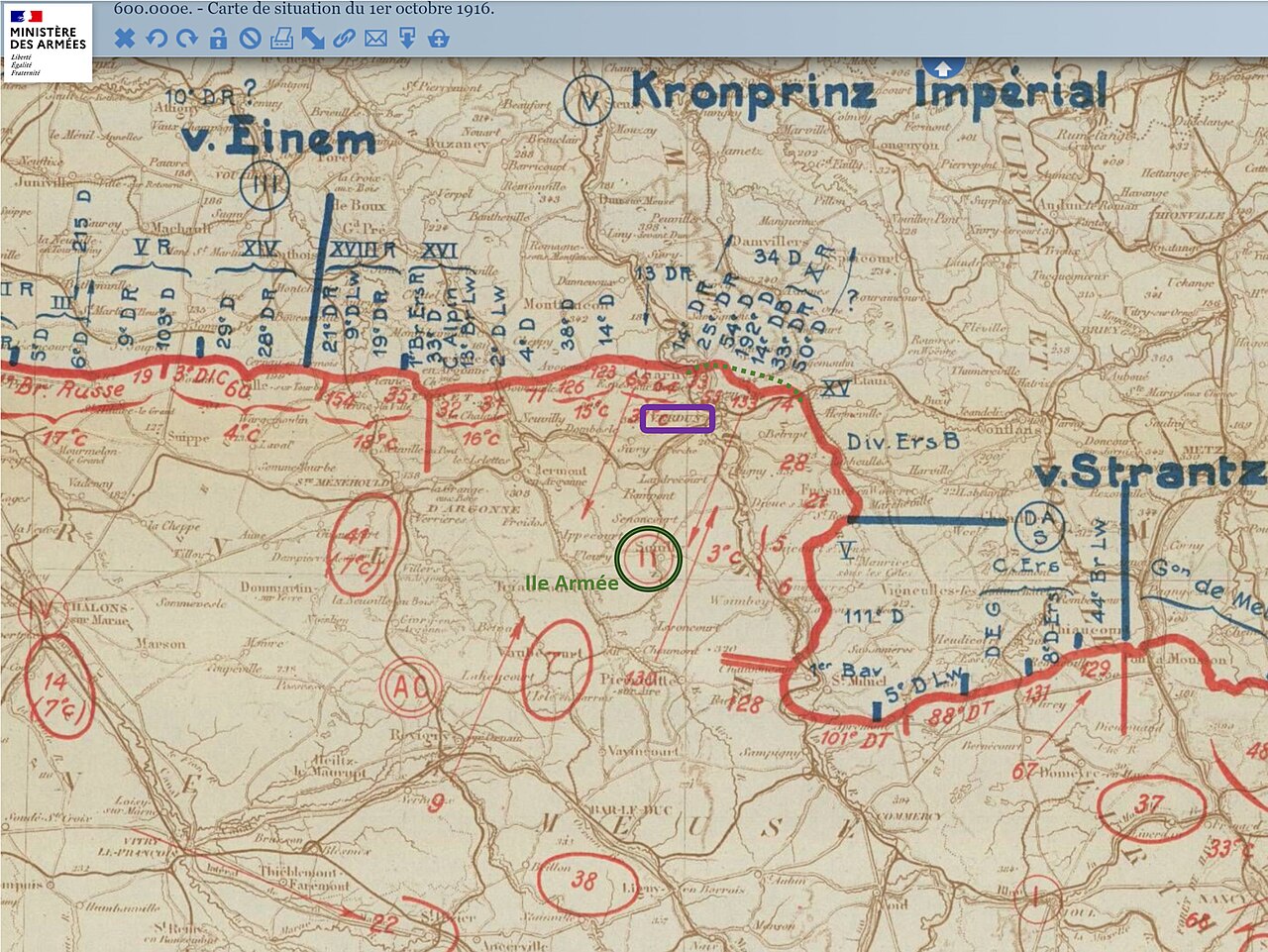
Second Army positions, 1 October 1916
Second Army positions, 1 October 1916 Map of the positions of the French Second Army in front of Verdun on 1 October 1916. Pinned at the center of the battle area. Mémoire des hommes (French Ministry of the Armed Forces) · CC BY-SA 4.0 · source
Attack proposal, 18 October 1916
Attack proposal, 18 October 1916 French attack proposal for Fort Vaux, 18 October 1916. Pinned at Fort Vaux. Unknown author · CC BY-SA 4.0 · source
Attack dispositions, 24 October 1916
Attack dispositions, 24 October 1916 French dispositions and objectives for the attack of 24 October 1916. Pinned between Douaumont and Vaux. Unknown author · CC BY-SA 4.0 · source
German order of battle, 24 October 1916
German order of battle, 24 October 1916 German positions in the Douaumont-Vaux area on 24 October 1916 (French army archives, SHD GR 26 N 70). Pinned between Douaumont and Vaux. Unknown author · CC BY-SA 4.0 · source
French counteroffensive, 24 October 1916
French counteroffensive, 24 October 1916 Map of the French counteroffensive at Verdun, 24 October 1916. Pinned between Douaumont and Vaux. Unknown author · public domain · source
50th Chasseurs attack plan for Fort Vaux
50th Chasseurs attack plan for Fort Vaux The 50th Chasseur Battalion's plan of attack on Fort Vaux, 24 October 1916. Pinned at Fort Vaux. Unknown author · CC BY-SA 4.0 · source
The front at Fort Vaux, 24 October 1916
The front at Fort Vaux, 24 October 1916 Map of the front at Fort Vaux on 24 October 1916. Pinned at Fort Vaux. Unknown author · CC BY-SA 4.0 · source
Fort Vaux, 24 October 1916, 8 p.m.
Fort Vaux, 24 October 1916, 8 p.m. Detail of the front at Fort Vaux at 8 p.m. on 24 October 1916. Pinned at Fort Vaux. Unknown author · CC BY-SA 4.0 · source
Around Fort Vaux, 3 November 1916
Around Fort Vaux, 3 November 1916 The approximate front around Fort Vaux at 6 p.m. on 3 November 1916. Pinned at Fort Vaux. Unknown author · CC BY-SA 4.0 · source
Victory at Douaumont and Vaux
Victory at Douaumont and Vaux Map of the French victory at Douaumont and Vaux, 24 October to 3 November 1916, from a 1933 history of the battle. Pinned between Douaumont and Vaux. Unknown author · CC BY-SA 4.0 · source
Mangin group front, 3 December 1916
Mangin group front, 3 December 1916 Front line of Mangin's group between Douaumont and Vaux on 3 December 1916. Pinned between Douaumont and Vaux. Unknown author · CC BY-SA 4.0 · source
French positions at Douaumont, 15 December 1916
French positions at Douaumont, 15 December 1916 French positions around Douaumont on 15 December 1916. Pinned north of Fort Douaumont. Unknown author · CC BY-SA 4.0 · source
French offensive, 15 December 1916
French offensive, 15 December 1916 Map of the French offensive at Verdun, 15 December 1916. Pinned at the center of the east-bank battle. Unknown author · public domain · source
Successive fronts (Michelin, 1933)
Successive fronts (Michelin, 1933) Michelin map of the successive front lines at Verdun, 1914-1918. Pinned at the center of the battle area. Michelin · public domain · source
The Verdun theater (1919)
The Verdun theater (1919) Map of the Verdun theater from Der Krieg 1914-19 in Wort und Bild (1919). Pinned at the center of the battle area. Thomas Quine (scan) · CC BY 2.0 · source

Free for everyone every year on its anniversary: February 21 and December 18.

Accuracy score: 66/100 (moderate)

How the accuracy score works

Sources and method

Verdun, 21 February – 18 December 1916. Front lines follow the day-by-day narrative of the Michelin illustrated battlefield guide The Battle of Verdun (1914–1918) (Michelin, 1919; Project Gutenberg), with corps, divisions and dates from the French Ministry of the Armed Forces' Chemins de Mémoire, 'La bataille de Verdun', 'Colonel Driant's Division' and 'Fort Souville'; the Université de Lorraine / Mémorial de Verdun MOOC Sur les pas des combattants de Verdun chronology; Encyclopaedia Britannica; the RICM veterans' association account of 24 October (anciens-du-ricm.org); Robert T. Foley, German Strategy and the Path to Verdun (Cambridge, 2005) and Alistair Horne, The Price of Glory (1962), via reviews and the Wikipedia article on the battle (used for German corps and French divisional commanders). Forts, memorials and shelters are placed from the battlefield's trilingual markers recorded on the Historical Marker Database (Fort Vaux, Sainte-Fine/Lion de Souville, Fleury, Froideterre, Tranchée des Baïonnettes); villages from published coordinates. Units are corps and divisions; lines between fixed points are schematic to within about a kilometer, the Bois des Caures position is estimated, and the order of the French divisions on 15 December is assumed west to east. No U.S. Army staff ride handbook covers Verdun. Photographs from Wikimedia Commons.

Where the positions come from

Further reading