Battlefield Atlas
World War I · 1918 First 3 stages free

Château-Thierry and the Marne, 1918

Château-Thierry, on the Marne where the Paris–Reims road crosses it, was the high-water mark of two German offensives in 1918. On 31 May–1 June, at the end of the German Seventh Army's drive from the Aisne, the motorized 7th Machine Gun Battalion of the newly arrived U.S. 3rd Division helped French colonial troops hold the south bank; the French blew the main bridge on the evening of 1 June and the German advance here was stopped by 4 June. Through June and early July French and American troops fought for Hill 204 west of the town, where the Château-Thierry American Monument stands today. On 15 July the Germans crossed the Marne in their last great offensive; the 3rd Division, and above all Col. Ulysses G. McAlexander's 38th Infantry at Mézy, held against attacks from the front and both flanks, earning the name 'Rock of the Marne'. Three days later the Allied counteroffensive began, and the French 39th Division reentered Château-Thierry on 21 July as the 3rd Division crossed the river in pursuit. Belleau Wood and Vaux, fought over by the U.S. 2nd Division a few kilometers to the west in June, have their own map.

Play the first 3 stages free8 stages on modern satellite imagery and terrain, with 3D elevation

The first 3 of its 8 stages are free to play. The rest opens with Battlefield Explorer ($4.99 a month or $39 a year), which unlocks every battle in the atlas and every one added later. Lifetime access and war packs are one-time options. Free battles include Thermopylae, Plataea, Actium, Viking raid on Lindisfarne, Hastings, Hattin, Agincourt, Vítkov Hill, Kutná Hora, Fall of Constantinople, First St Albans, Lützen, Siege of Buda, Culloden, Fort William Henry, Yorktown, Lake Erie, Waterloo, The Alamo, Monterrey, Antietam, Little Bighorn, Manila Bay, Belleau Wood, Saint-Mihiel, Omaha Beach, Inchon, Ia Drang, Goose Green, 73 Easting, Wanat, Baghdad Thunder Runs, Manbij, Battle of Raqqa, Donetsk Airport, Ilovaisk, Debaltseve, Battle of Kyiv, Battle of Hostomel Airport, Siege of Mariupol, Bilohorivka (Siverskyi Donets crossing), Kharkiv counteroffensive, Kherson counteroffensive, Bakhmut, Vuhledar, Mala Tokmachka and Robotyne, Avdiivka, Kursk incursion.

Machine gun in a railroad building
Machine gun in a railroad building — U.S. Army Signal Corps · public domain

The battle, stage by stage

  1. 27 – 31 May 1918

    The drive to the Marne

    On 27 May the German Seventh Army opens the Third Battle of the Aisne with a crushing bombardment on the Chemin des Dames. The French and British line breaks, Soissons falls on 29 May, and German divisions pour south across the Aisne toward the Marne. By 31 May they reach the river at Château-Thierry, an old market town where the main road from Paris to Reims crosses the Marne, about 80 km from Paris. The French 10th Colonial Division under Gen. Jean-Baptiste Marchand holds the town, which it judges the most threatened point in its line. The U.S. 3rd Division, still training and not yet complete, is rushed forward by the French command; its motorized 7th Machine Gun Battalion drives through the night of 30–31 May on bad, crowded roads and reaches Condé-en-Brie at midday on 31 May.

  2. 31 May – 1 June

    Machine guns at the bridges

    Ordered on to Château-Thierry, the battalion arrives late on 31 May, as German troops are entering the northern outskirts of the town; its first crews are firing by about 6 PM and all guns are in place by about 4 AM on 1 June (CMH). Company A puts eight guns in houses along the south bank covering the main stone bridge; Company B places nine guns in a sugar refinery and along a riverside road about 500 meters east, covering the railroad bridge. Two guns under 1st Lt. John T. B. Bissell cross to the north bank to support French colonial detachments fighting beyond the château. Through 1 June the Germans (the 231st Division, by the CMH history) press into the town, and the French are pushed back toward the river.

  3. 1 – 4 June

    The bridge blown

    In the evening a German patrol rushes the main bridge and is stopped at a barricade. At about 8 PM (CMH) French engineers blow up the bridge, dropping part of it into the river; machine-gun fire from the south bank stops the German attempt to cross, as the 231st Division's own war diary records. Bissell's section, cut off on the north bank, fights its way to the railroad bridge and, after hand-to-hand fighting with German infantry, crosses back with its French comrades; other men swim the Marne under covering fire from the alleys and gardens of the south bank. By the CMH account Bissell received the Croix de Guerre with Palm and, in 1920, the Silver Star. In the days that follow, the railroad bridge is destroyed on the night of 3–4 June, and the German advance here is stopped on 4 June, when the battalion goes into corps reserve. Sixty-five Americans were killed or wounded between 31 May and 4 June (CMH).

  4. June – early July

    Hill 204

    The Germans hold the north bank of the Marne through Château-Thierry and, west of the town, Hill 204 — a wooded ridge (the Bois de Courteau) with observation over the town and over Vaux — which they take on 1 June. On 6 June the French 10th Colonial Division, with the 30th Infantry, attacks twice from the direction of Monneaux; the 30th takes Monneaux at the western foot of the hill, but the attacks win only a foothold on the slopes. Later in June the 4th Infantry holds a front-line position in a wood behind the hill for a few days (ABMC). On 1 July, after a day-long bombardment, the U.S. 2nd Division's infantry and engineers take Vaux in about an hour behind a rolling barrage (see the Belleau Wood map). In early July the French 39th Division, with detachments of the U.S. 28th Division, takes much of the Bois de Courteau, but by one account the Germans retake the wood on 8–9 July. Accounts differ on when the hill finally fell: the ABMC says it was contested from 1 June to 9 July, and the CMH history records an unsuccessful French assault on the hill as late as 20 July (see the last stage).

  5. 15 July, 00:10 – 05:00

    The last German offensive

    On 15 July the Germans open their last great offensive of the war on both sides of Reims. The 3rd Division (Maj. Gen. Joseph T. Dickman) holds about 12 km of the Marne from the edge of Château-Thierry east to the slopes above the Surmelin valley, its regiments in line from west to east: the 4th, 7th, 30th and 38th Infantry; the French 125th Division, with two regiments of the U.S. 28th Division attached, is on its right. Warned by prisoners, Allied guns open fire on the German assembly areas at 11:45 PM on 14 July. The German bombardment begins at 12:10 AM, and at about 2 AM assault troops of the 10th and 36th Divisions cross in boats and on pontoon bridges. One regiment crossing in front of Mézy is cut up by American artillery and driven back to the north bank by about 5 AM. Col. Ulysses G. McAlexander has put about four companies of his 38th Infantry on the river bank, the rest of the regiment in lines about 2,700 and 5,400 meters back, and has dug trenches facing east in case the French to his right give way.

  6. 15 July, 05:00 – midnight

    The Rock of the Marne

    To the left of Mézy another German regiment crosses, overruns the Americans on the bank in the 30th Infantry's sector and pushes on until it stalls at the woods behind; a third crosses near Mont-Saint-Père about 8:45 AM and reaches the railroad. East of the Surmelin the French line gives way and the Germans advance about 6 km, so the 38th Infantry is attacked from the front and both flanks. It holds. Companies G and H of the 2nd Battalion counterattack the German landing east of Mézy at 4:15 AM, and Capt. Jesse W. Wooldridge's Company G stays near Mézy through the morning; Capt. Thomas C. Reid's Company F fires from east-facing trenches near Moulins, and Maj. Harry J. Keely's Companies B and D of the 1st Battalion assault the Moulin Ruiné signal station and take about 400 prisoners (CMH); 1st Lt. James H. Gay of the 30th leads about 100 men back with about 150 prisoners; two companies of the 4th Infantry clear Crézancy about noon.

  7. 16 July

    The line holds

    By midnight on 15 July the Germans in front of the 3rd Division and to its left are going back across the Marne, and the regiment at Mont-Saint-Père has withdrawn. East of the Surmelin they keep the far side of the valley for four days (ABMC). On 16 July the cut-off detachments on Moulins ridge withdraw about 1.5 km to the rear. From 15 to 17 July the 3rd Division lost 3,151 men, 606 of them killed; the 28th Division's 109th and 110th Infantry lost 670 (CMH). The stand gave the 3rd Division its name, the Rock of the Marne.

  8. 18 – 22 July

    Château-Thierry retaken

    On 18 July the French Tenth Army, led by the U.S. 1st and 2nd Divisions with French divisions, strikes the west face of the salient south of Soissons, and the whole Allied line goes over to the attack. With their front pierced to the north and east, the Germans pull back over the Marne on the night of 19–20 July and leave Château-Thierry during the night of 20–21 July. The French 39th Division enters the town at about 8 AM on 21 July (CMH), while the U.S. 26th Division attacks to the northwest. A regiment of the 3rd Division crosses near Château-Thierry and occupies Mont-Saint-Père to cover the rest of the division (ABMC); by the end of the day elements of the 4th and 7th Infantry are north of the river. The 38th Infantry crosses near Mézy at 4 AM on 22 July on a temporary bridge built by the division's engineers and is in Jaulgonne before noon. The pursuit to the Vesle has begun.

Forces

At the bridges in early June a single motorized machine-gun battalion of about 370 men backed the French 10th Colonial Division. On 15 July the 3rd Division held about 12 km of the Marne with four infantry regiments against two German divisions that, by the CMH history, could muster only about 5,000 effectives each; no sourced head count of the 3rd Division on that day was found.

German Seventh Army (231st, 10th and 36th Divisions)

10th and 36th Divisions (15 July), effectivesabout 5,000 each

The CMH history: the two divisions that attacked the 3rd Division could muster only about 5,000 effectives each, with companies averaging about sixty men. U.S. Army Center of Military History, McGeorge and Watson, The Marne, 15 July – 6 August 1918 (CMH Pub 77-5, 2018)

Whole offensive of 15 July (both sides of Reims)48 divisions, about 650,000 men; 6,353 guns

The CMH history's figures for the German army group's attack as a whole, of which the Marne crossing was one part; the Seventh Army received nearly half the guns. Not a figure for this sector. U.S. Army Center of Military History, McGeorge and Watson, The Marne, 15 July – 6 August 1918 (CMH Pub 77-5, 2018)

231st Division at the town (31 May – 4 June)unknown

The CMH history names the division from its war diary but gives no strength. U.S. Army Center of Military History, Grotelueschen, Into the Fight, April–June 1918 (CMH Pub 77-4, 2018)

U.S. 3rd Division (7th MG Bn; 4th, 7th, 30th, 38th Infantry) with French divisions

7th Machine Gun Battalion at the bridges (31 May – 4 June)about 370 men

The CMH history: around 370 men with a few dozen heavy machine guns and assorted cars, motorcycles and trucks; Company A had eight guns at the main bridge and Company B nine at the railroad bridge. U.S. Army Center of Military History, Grotelueschen, Into the Fight, April–June 1918 (CMH Pub 77-4, 2018)

3rd Division on 15 Julyfour infantry regiments in line on about 12 km

The CMH history gives the regiments (4th, 7th, 30th and 38th Infantry, west to east) but no head count for the division that day; it notes only that American divisions in general amounted to no less than 28,000 men, over twice the size of a full-strength French or German division. U.S. Army Center of Military History, McGeorge and Watson, The Marne, 15 July – 6 August 1918 (CMH Pub 77-5, 2018)

French divisionsunknown

No sourced strengths were found for the French 10th Colonial, 39th or 125th Divisions in this sector.

Casualties

The U.S. Army's official campaign histories count 65 men of the 7th Machine Gun Battalion killed or wounded at the bridges, and 3,151 casualties (606 dead) in the 3rd Division plus 670 in the 28th Division's two attached regiments during the German crossing of 15–17 July. German losses are known only in part: well over 1,000 prisoners from the two attacking divisions, and an estimate that about 60 percent of the attackers became casualties. Certainty: fair.

German Seventh Army (231st, 10th and 36th Divisions)

Captured, 10th and 36th Divisions (15 July)well over 1,000

The CMH history says prisoners taken from the two divisions that attacked the 3rd and 28th Division sectors on 15 July alone came to well over 1,000 men. Among local hauls it credits about 400 to Maj. Keely's companies of the 38th Infantry at the Moulin Ruiné and about 150 to 1st Lt. Gay's party of the 30th Infantry. U.S. Army Center of Military History, McGeorge and Watson, The Marne, 15 July – 6 August 1918 (CMH Pub 77-5, 2018)

Casualties, attack on the Marne (15 July)unknown; about 60% of the attackers by one estimate

The CMH history says German losses are harder to establish than American ones, but were heavy; it cites one German veteran's estimate that about 60 percent of the men who attacked the Americans on the Marne became casualties. Against divisions of about 5,000 effectives each, this is an estimate, not a count. U.S. Army Center of Military History, McGeorge and Watson, The Marne, 15 July – 6 August 1918 (CMH Pub 77-5, 2018)

Casualties at the town (31 May – 4 June)unknown

No figure was found for the German 231st Division's losses in the fighting for Château-Thierry; the CMH history quotes its war diary only on the machine-gun fire that stopped its crossing. U.S. Army Center of Military History, Grotelueschen, Into the Fight, April–June 1918 (CMH Pub 77-4, 2018)

U.S. 3rd Division (7th MG Bn; 4th, 7th, 30th, 38th Infantry) with French divisions

7th Machine Gun Battalion, killed or wounded (31 May – 4 June)65

The CMH history: sixty-five Americans were killed or wounded in a few days of fighting at the Château-Thierry bridges. It does not split killed from wounded. U.S. Army Center of Military History, Grotelueschen, Into the Fight, April–June 1918 (CMH Pub 77-4, 2018)

3rd Division casualties (15–17 July)3,151, including 606 dead

The CMH history's total for the German Marne crossing and its aftermath; the heaviest losses were in the 7th Infantry (730 casualties) and the 38th Infantry (632). U.S. Army Center of Military History, McGeorge and Watson, The Marne, 15 July – 6 August 1918 (CMH Pub 77-5, 2018)

28th Division's 109th and 110th Infantry casualties (15–18 July)670, including 223 dead

The two Pennsylvania regiments attached to the French 125th Division on the 3rd Division's right; note the CMH period runs to 18 July. U.S. Army Center of Military History, McGeorge and Watson, The Marne, 15 July – 6 August 1918 (CMH Pub 77-5, 2018)

French divisionsunknown

No sourced figures were found for the losses of the French 10th Colonial, 39th or 125th Divisions in this sector, or for the fighting on Hill 204 in June and July.

Then and now: how the ground has changed

The Marne, the hills on both banks and the river villages are where they were in 1918, but the town has been rebuilt since it was sacked and shelled, its bridges have been replaced more than once, and the battlefield is now marked by the ABMC's colonnade on Hill 204 (dedicated 1937), the 3rd Division monument by the river and a memorial to the 38th Infantry at Mézy-Moulins.

The interactive map can show the period landscape (1 shape: Château-Thierry American Monument, Hill 204 (dedicated 1937; approximate)) under the units. Open the map.

Weapons

German Seventh Army (231st, 10th and 36th Divisions)

Gewehr 98

Gewehr 98

Bolt-action rifle · 1898–1945

At Château-Thierry: Standard German infantry rifle.

The Mauser-designed Gewehr 98 was the standard German infantry rifle of World War I. Its controlled-feed bolt action proved so sound that it became the basis for countless military and sporting rifles worldwide, including the later Karabiner 98k.

Caliber
7.92×57mm Mauser
Effective range
about 500 m (iron sights)
Magazine
5-round internal box
Photo: Armémuseum (Swedish Army Museum) · CC BY-SA 4.0
MG 08

MG 08

Heavy machine gun · 1908–1945

At Château-Thierry: German machine guns covered the crossings and the river bank.

Germany's licensed version of the Maxim gun, the water-cooled MG 08 was the backbone of German defensive firepower in World War I. Heavy but extremely reliable, it was usually fired from a sled mount by a trained crew and could sustain fire for long periods.

Caliber
7.92×57mm Mauser
Rate of fire
450–500 rounds/min
Weight
about 69 kg with sled mount
Photo: Burtonpe · CC BY-SA 3.0

U.S. 3rd Division (7th MG Bn; 4th, 7th, 30th, 38th Infantry) with French divisions

Hotchkiss M1914

Hotchkiss M1914

Heavy machine gun · 1914–1940s

At Château-Thierry: The 7th Machine Gun Battalion's Hotchkiss guns held the Château-Thierry bridges.

The air-cooled, gas-operated Hotchkiss was France's standard heavy machine gun in World War I and was known for its ruggedness. The American Expeditionary Forces adopted it in large numbers while US production of its own machine guns caught up.

Caliber
8mm Lebel
Rate of fire
about 450 rounds/min
Feed
24- or 30-round strips, or 249-round articulated belt
Weight
about 50 kg with tripod
Photo: historicair · CC BY-SA 3.0
M1903 Springfield

M1903 Springfield

Bolt-action rifle · 1903–1936 as standard rifle (sniper use into the Vietnam era)

At Château-Thierry: Standard rifle of the 3rd Division's infantry.

Based closely on the Mauser action, the Springfield M1903 was the US service rifle from the early 1900s through the 1930s. Its fine adjustable rear sight made it well suited to the precise marksmanship the Marine Corps emphasized in training.

Caliber
.30-06 Springfield
Action
Bolt, 5-round internal magazine
Weight
about 3.9 kg (8.7 lb)
Photo: Curiosandrelics · CC BY-SA 3.0
Canon de 75 modèle 1897 (French 75)

Canon de 75 modèle 1897 (French 75)

Field gun · 1898–1940s

At Château-Thierry: French and American 75s broke up the 15 July crossings.

The French 75 was the first field gun with an effective hydro-pneumatic recoil system, letting it stay on target and fire very rapidly. The AEF received about 2,000 of them, and they became the main light gun of American artillery in France.

Caliber
75 mm
Max range
about 11,000 m
Rate of fire
15+ rounds/min in bursts
Weight
about 1,540 kg
Photo: Jean-Pol Grandmont · CC BY 4.0

Paintings and photographs

Machine gun in a railroad building
Machine gun in a railroad building American machine gunners man an emplacement in a railroad building at Château-Thierry, 7 June 1918 (Signal Corps 111-SC-14654). Exact building not recorded; pinned at the railroad station on the south bank, approximate. U.S. Army Signal Corps · public domain · source
The bridge at Château-Thierry, 1918
The bridge at Château-Thierry, 1918 The main bridge over the Marne at Château-Thierry, 1918; the original caption reads 'Bridge at Chateau-Thierry blown up by Americans'. Battle accounts credit French engineers with blowing it on the evening of 1 June. USMC Archives (William B. Croka collection) · CC BY 2.0 · source
Château-Thierry: the bridge cut
Château-Thierry: the bridge cut The cut bridge over the Marne at Château-Thierry, published by the Meurisse agency on 18 October 1918. Agence Meurisse · public domain · source
The blown bridge (Waller collection)
The blown bridge (Waller collection) The bridge at Château-Thierry, captioned 'blown up during German advance', 1918 (Littleton Waller Jr. collection). USMC Archives (Littleton Waller Jr. collection) · CC BY 2.0 · source
Ruins of the Marne bridge (1)
Ruins of the Marne bridge (1) Remains of the bridge over the Marne at Château-Thierry, photographed by Captain Moore (NARA 31484091). The original caption says the Germans dynamited it when forced back; battle accounts credit French engineers with blowing the main bridge on 1 June. Captain Moore (NARA) · public domain · source
Ruins of the Marne bridge (2)
Ruins of the Marne bridge (2) Remains of the bridge over the Marne at Château-Thierry, photographed by Captain Moore (NARA 31484093). The original caption says the Germans dynamited it when forced back; battle accounts credit French engineers with blowing the main bridge on 1 June. Captain Moore (NARA) · public domain · source
Ruins of the Marne bridge (3)
Ruins of the Marne bridge (3) Remains of the bridge over the Marne at Château-Thierry, photographed by Captain Moore (NARA 31484095). The original caption says the Germans dynamited it when forced back; battle accounts credit French engineers with blowing the main bridge on 1 June. Captain Moore (NARA) · public domain · source
Ruins of the Marne bridge (4)
Ruins of the Marne bridge (4) Remains of the bridge over the Marne at Château-Thierry, photographed by Captain Moore (NARA 31484135). The original caption says the Germans dynamited it when forced back; battle accounts credit French engineers with blowing the main bridge on 1 June. Captain Moore (NARA) · public domain · source
Ruins of the Marne bridge (5)
Ruins of the Marne bridge (5) Remains of the bridge over the Marne at Château-Thierry, photographed by Captain Moore (NARA 31484137). The original caption says the Germans dynamited it when forced back; battle accounts credit French engineers with blowing the main bridge on 1 June. Captain Moore (NARA) · public domain · source
Where the Americans stopped the drive
Where the Americans stopped the drive A destroyed concrete bridge over the Marne at Château-Thierry, 9 September 1918; the original caption, 'Where the Americans stopped the German drive on Paris', credits French airmen with its destruction. Which bridge is not stated; pinned at the main bridge, approximate. Underwood and Underwood (NARA) · public domain · source
Remains of the railroad bridge
Remains of the railroad bridge Remains of the railroad bridge over the Marne near Château-Thierry, 1918. USMC Archives (William B. Croka collection) · CC BY 2.0 · source
Château-Thierry railroad station, 1918
Château-Thierry railroad station, 1918 The Château-Thierry railroad station on the south bank of the Marne, 1918; the back of the postcard reads 'Chateau-Thierry station used as Hospital for our troops'. Éditions Bouvigny (USMC Archives) · CC BY 2.0 · source
Between shells at Château-Thierry (Harding)
Between shells at Château-Thierry (Harding) Official war drawing by Capt. George Harding, U.S. Army artist (NARA 55199963). George M. Harding, U.S. Army (NARA) · public domain · source
Temporary bridge over the Marne
Temporary bridge over the Marne A Keystone stereocard of the bridge American troops built over the Marne at Château-Thierry, about 1919. Exact spot not recorded; pinned at the main bridge, approximate. Keystone View Company · public domain · source
The Marne bank at Château-Thierry
The Marne bank at Château-Thierry The bank of the Marne at Château-Thierry during the 1918 counteroffensive, a Vest Pocket Kodak photograph by Marius Vasse. Exact spot not recorded; pinned at the main bridge, approximate. Marius Vasse (Vasse Nicolas-Antoine collection, Flickr) · CC BY 2.0 · source
Place de l'Hôtel de Ville, 1918
Place de l'Hôtel de Ville, 1918 The town hall square in Château-Thierry, published by the Meurisse agency on 18 October 1918. Pinned in the town center near the château ruins, approximate. Agence Meurisse · public domain · source
Château-Thierry town hall, 1918
Château-Thierry town hall, 1918 The town hall of Château-Thierry during the 1918 counteroffensive, a Vest Pocket Kodak photograph by Marius Vasse. Pinned in the town center near the château ruins, approximate. Marius Vasse (Vasse Nicolas-Antoine collection, Flickr) · CC BY 2.0 · source
Scene at Château-Thierry, 1918
Scene at Château-Thierry, 1918 Scene at Château-Thierry, 1918, from the Marine Recruiting Publicity Bureau, New York (NHHC NH 105). Place in the town not recorded; pinned in the town center, approximate. Marine Recruiting Publicity Bureau (NHHC) · public domain · source
Hill 204 from the air, 6 July 1918
Hill 204 from the air, 6 July 1918 German aerial photograph of Château-Thierry and Hill 204, 6 July 1918. Pinned on the crest of Hill 204, approximate. German 201st Division archives (Reinhardphilippi) · CC BY-SA 3.0 · source
Hill 204 from the air (201st Division)
Hill 204 from the air (201st Division) German aerial photograph of Château-Thierry, 6 July 1918, from the archives of the German 201st Division. Pinned on the crest of Hill 204, approximate. German 201st Division archives (Reinhardphilippi) · CC BY-SA 3.0 · source
The point of the salient, 1918
The point of the salient, 1918 The point of the Château-Thierry salient, 1918: looking up the Marne valley over Essômes, with Hill 204 on the left and Château-Thierry in the distance. Pinned at Essômes, approximate viewpoint. Unknown photographer (Library of Congress) · public domain · source
The Franco-American cemetery at Essômes
The Franco-American cemetery at Essômes The Franco-American cemetery at Essômes, near Château-Thierry, published by the Meurisse agency on 18 October 1918 (Meurisse 69453). Exact spot not recorded; pinned at Essômes, approximate. Agence Meurisse (BnF) · public domain · source
Eagle on the American monument
Eagle on the American monument The eagle sculpture of the Château-Thierry American Monument on Hill 204, 2010. Weglinde Gordon Lawson · public domain · source
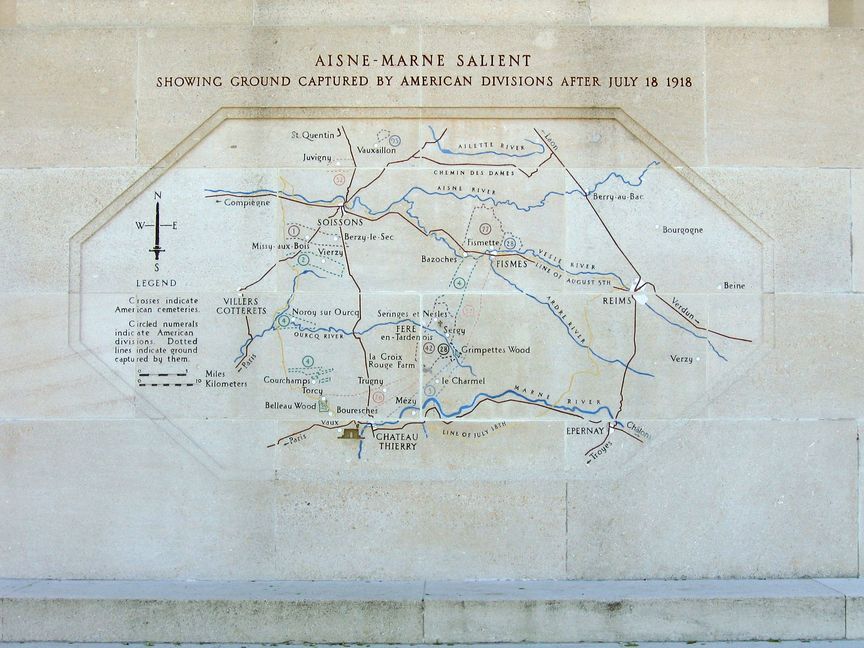
Battle map on the American monument
Battle map on the American monument The map of the Second Battle of the Marne carved on the Château-Thierry American Monument, 2009. Antoine Fleury-Gobert · CC BY-SA 3.0 · source
Operations map, 2nd Division and 4th Marine Brigade
Operations map, 2nd Division and 4th Marine Brigade Annotated map of the operations and battalion movements of the U.S. 2nd Division and 4th Marine Brigade in the Château-Thierry sector, dated 29 July 1918. Pinned at Vaux, which the 2nd Division took on 1 July, at the edge of the area it covers. USMC Archives (Official Map Collection) · CC BY 2.0 · source
American operations, June-July 1918
American operations, June-July 1918 Map of American operations around Château-Thierry, June-July 1918. Pinned at the center of the battle area. U.S. Army · public domain · source

★ Medal of Honor 1 recipient

Links go to the official records: the Congressional Medal of Honor Society and, where they exist, the service's own pages.

Free for everyone every year on its anniversary: May 31 – June 1 and July 15.

Accuracy score: 65/100 (moderate)

How the accuracy score works

Sources and method

Château-Thierry and the Marne, 31 May – 22 July 1918. No U.S. Army staff ride handbook covers Château-Thierry or the 3rd Division on the Marne. Key sources: American Battle Monuments Commission, American Armies and Battlefields in Europe (1938), 'American Operations in the Aisne-Marne Region' (7th Machine Gun Battalion and the bridges, Hill 204, the 15 July defense at Mézy, Fossoy and Moulins ridge, the 21–22 July crossings); U.S. Army Center of Military History, Mark E. Grotelueschen, Into the Fight, April–June 1918 (CMH Pub 77-4, 2018) (companies and guns of the 7th MG Battalion, the 231st Division's war diary, times, Bissell, casualties); Stephen C. McGeorge and Mason W. Watson, The Marne, 15 July – 6 August 1918 (CMH Pub 77-5, 2018) (regiments in line, German divisions and regiments, McAlexander's dispositions, counterattacks, casualties, the French 39th Division in Château-Thierry, the 38th's crossing). Also ABMC, WWI Battlefield Tours: Château-Thierry and Belleau Wood; Michelin, The Americans in the Great War, vol. 1: The Second Battle of the Marne (1920); 'The 3rd U.S. Division in the region of Château-Thierry' (summary of the ABMC narrative); Roads to the Great War, 'The Frustrating Struggle for Hill 204' (after Over the Top, June 2018; used only for the July fighting in the Bois de Courteau). Monument positions: HMdb markers 86789 and 86896; 38th Infantry memorial at Mézy-Moulins from US War Memorials. Village positions are commune coordinates. Positions within each regimental sector, the course of the Marne and the hill and wood outlines are placed from the written descriptions and are accurate only to a few hundred meters. Images from Wikimedia Commons (U.S. Army Signal Corps and official war art, public domain).

Where the positions come from

Further reading