August 479 BC, the first days
Below Kithairon at Erythrai
Having crossed Mount Kithairon from Eleusis, the Hellenic League army under the Spartan regent Pausanias forms up on the lower slopes of the mountain near Erythrai, facing the Persian army of Mardonius in its camp on the Asopus river to the north. The Greeks will not come down to the plain, so Mardonius sends his whole cavalry under Masistius against them, squadron by squadron. The Megarians, posted on the most exposed ground, call for help; only the Athenians volunteer, 300 picked men under Olympiodorus with archers. An arrow strikes Masistius's horse, which throws him; the Athenians cannot pierce his scale armor until one stabs him in the eye, and after a fight over the body the Persian horse draws off (Herodotus 9.19-24). Herodotus gives Mardonius's battle order only after the Greeks move west, so the Persians are shown here simply as an army encamped along the river. Ancient Erythrai's site is itself disputed: Pritchett put it near modern Daphni, Butera 3-4 km east of modern Erythres; the line here is approximate.
A few days later
West to the Asopus ridge and the Gargaphia
Heartened by Masistius's death, and short of water, the Greeks march west along the foothills of Kithairon past Hysiai to the territory of Plataea, where they deploy by nations near the Gargaphia spring and the precinct of the hero Androcrates, 'among low hills and level ground' (Herodotus 9.25). The Lacedaemonians, 10,000 hoplites with their helots, hold the right next to the spring; the Tegeans, after a dispute with the Athenians over the place of honor, stand beside them; the Athenians, 8,000 under Aristides, hold the left, on a low hill (often identified as Pyrgos) by the Asopus. Herodotus gives 38,700 hoplites and about 69,500 light-armed. Mardonius moves his army west to face them across the river, his Persians opposite the Spartans and his Greek allies, led by the Thebans, opposite the Athenians, Plataeans and Megarians (9.31). The spring's location is a proposal: Butera puts it at a large modern spring about 500 m west of the church of Ag. Demetrios; many have placed it at the Alepotrypa (Apotripi) spring nearer Plataea, and Peter Green at the Retsi spring by the chapel of Ag. Dimitrios.
About eight to twelve days of waiting
Standoff: cavalry, the spring and the passes
For days neither side will cross the Asopus; the omens, both sides' seers say, favor whoever defends. On the eighth day, on Theban advice, Mardonius sends horsemen by night to the outlet of the Kithairon pass the Boeotians call Three Heads and the Athenians Oak Heads; they catch a train of 500 pack animals bringing food from the Peloponnese and kill men and beasts (Herodotus 9.38-39). Two more days pass. Then the Persian cavalry, mounted archers and javelin men, ride in among the Greeks, foul and choke the Gargaphia spring, the army's only water, and cut off the supply columns. Herodotus also reports a failed attempt to swap the Spartan and Athenian wings, a story doubted by some modern historians (Hignett among them). The pass outlet and the cavalry's route are not known exactly.
The following night, second watch to dawn
The night withdrawal and Amompharetus's refusal
The Greek commanders agree to fall back by night to the 'Island', ground between two branches of the Oeroe about ten stades in front of Plataea, and to send half the army to relieve the supply trains on the mountain. When the time comes, the center does not stop at the Island but goes on to the temple of Hera in front of Plataea, twenty stades from the spring. On the right, Amompharetus, commander of the Pitanate lochos, refuses to retreat from the barbarians, throwing a stone at Pausanias's feet as his vote; the argument lasts until dawn. The Athenians wait to see what the Spartans will do. At first light Pausanias leaves without him, keeping to the rough ground of the foothills against the cavalry, with the Tegeans following (Herodotus 9.50-56). Whether this was a muddle, as Herodotus tells it, or a deliberate retreat to lure Mardonius over the river is debated.
The next morning
The stand by the temple of Demeter; Mardonius killed
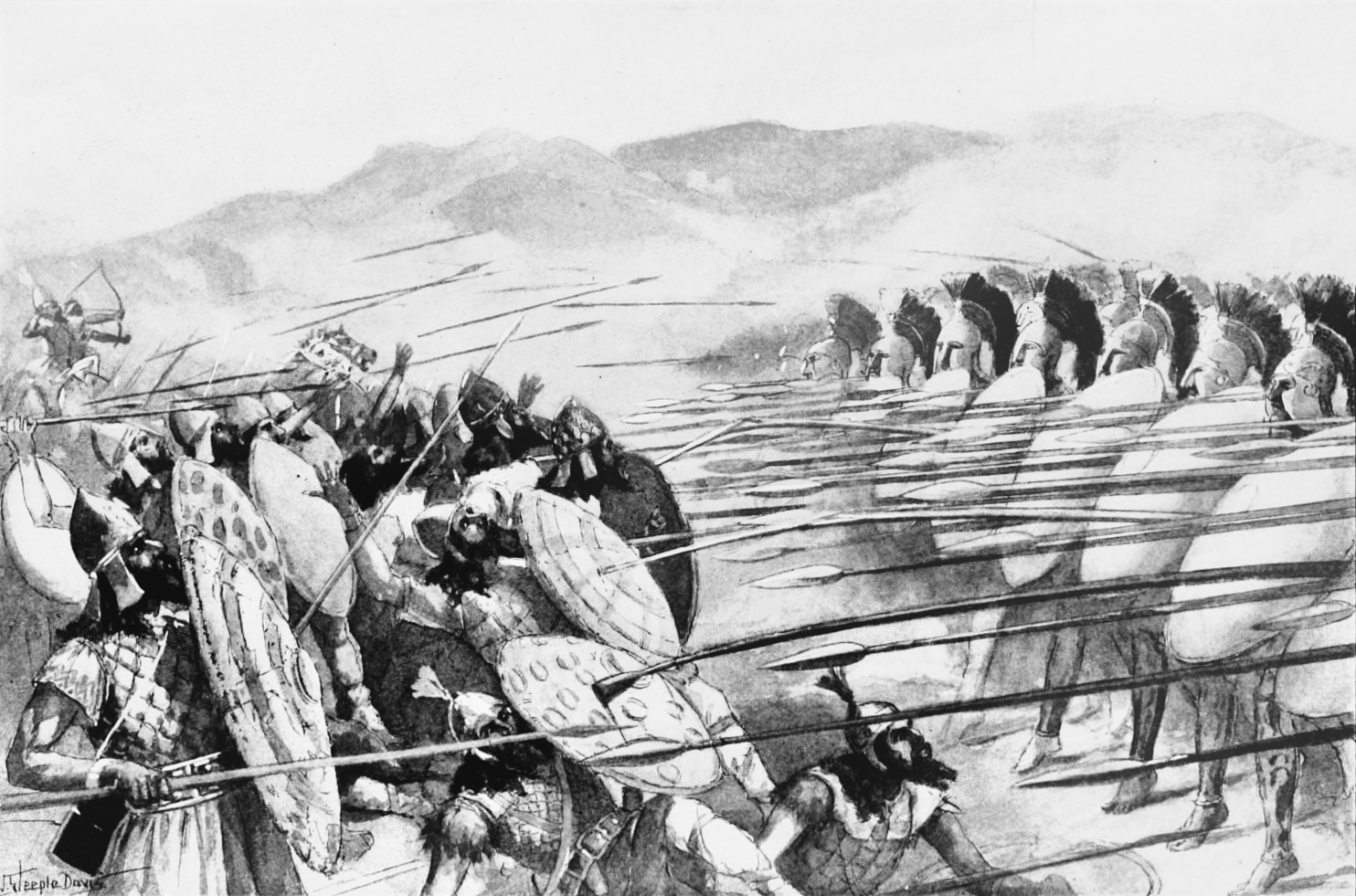
Pausanias halts about ten stades on, by the Moloeis stream at a place called Argiopion, where there was a sanctuary of Eleusinian Demeter, and Amompharetus's men catch up as the cavalry attacks. Finding the ridge empty, Mardonius leads his Persians across the Asopus at a run; the rest of his Asian contingents follow without order. The Persians plant their wicker shields as a wall and shoot volleys of arrows; the Lacedaemonians, 50,000 with their light-armed by Herodotus's count, and 3,000 Tegeans, wait under the arrows for good omens. When they come, the Tegeans charge first and the Spartans follow. The fight at the shield wall and then around the sanctuary goes on a long time; the Persians, brave but without armor, rush out singly or in small groups. Mardonius, on a white horse among 1,000 picked men, is killed, Herodotus says by a Spartan named Arimnestus, and his guard falls around him (9.57-64). Butera notes that most scholars place the sanctuary near Hysiai at the foot of the Pantanassa ridge, where Eleusinian inscriptions were found. Some put it at Ag. Demetrios, but that is only about 500 m from Butera's Gargaphia, too close for Herodotus's ten stades unless the spring lay elsewhere (at Alepotrypa, say).
Later that morning
Rout: the Athenians against the Boeotians
With Mardonius dead, the Persians break and run for their stockade. Artabazus, who had argued against fighting, leads his corps, 40,000 by Herodotus's count, away toward Phocis and the Hellespont. On the plain the Athenians, marching to help the Spartans, have been caught by the Greek allies of Persia; the Boeotians fight hard and lose about 300 of their best men before falling back to Thebes, covered by their cavalry. The Greek center at the Heraion hears of the victory and comes out without order: the Corinthians by the hill road toward the Demeter sanctuary, the Megarians and Phliasians across the plain, where the Theban cavalry under Asopodorus rides them down, killing about 600 (Herodotus 9.66-69). Herodotus's account comes partly from Athenian and Spartan veterans and is hard on the allies of the center.
Afternoon
The storming of the Persian camp
The Persians get inside their wooden stockade north of the Asopus and man its towers. The Spartans, unskilled at siege work, make little headway until the Athenians come up; after a hard fight the wall is scaled and breached, and the Tegeans are first inside, plundering Mardonius's tent (they later dedicated his bronze manger to Athena Alea). Crowded inside, the Persians are slaughtered: Herodotus claims scarcely 3,000 of 260,000 survived, a figure no modern historian accepts. He gives the Greek dead as 91 Spartiates, 16 Tegeans and 52 Athenians, apparently hoplites of those three contingents only; Plutarch, writing about six centuries later, gives 1,360 Greeks killed in all. The stockade outline is conjectural.