Battlefield Atlas
Ancient Greece · 490 BC Members · from $3

Marathon, 490 BC

In late summer 490 BC, a Persian expeditionary force under Datis and Artaphernes, sent by Darius I to punish Athens and Eretria, landed on the plain of Marathon, about 40 km north-east of Athens. After several days of stand-off, the Athenians — about 9,000–10,000 hoplites under ten generals and the polemarch Callimachus, with Miltiades the guiding spirit — and a Plataean levy of perhaps 600–1,000 attacked across about 1.5 km of open plain. Their deliberately thinned center gave way, but both wings routed the Persians and then turned inward to beat the Persian center, and the army drove the enemy to their ships and into the Great Marsh. Herodotus, writing about two generations later and our only near-contemporary source, gives 6,400 Persian and 192 Athenian dead and seven ships captured. The surviving fleet sailed round Sounion for Athens, but the army marched back in time, and the Persians went home. The Soros, the burial mound of the Athenian dead, still stands on the plain. The unit positions on this map are conjectural reconstructions, not surveyed lines.

Open the interactive map7 stages on modern satellite imagery and terrain, with 3D elevation

This battle opens with Battlefield Enjoyer ($3 a month on Patreon), which unlocks every battle in the atlas and every one added later. Free battles include Teutoburg Forest, Hattin, Agincourt, Vítkov Hill, Bosworth, Fort William Henry, Yorktown, Waterloo, The Alamo, Antietam, Little Bighorn, Belleau Wood, Omaha Beach, Inchon, Ia Drang, 73 Easting, Wanat, Najaf.

The Soros
The Soros — Ryvinios — public domain

The battle, stage by stage

  1. Late summer 490 BC, some days before the battle

    Landing at Schinias

    Fresh from the capture of Eretria on Euboea, the Persian expedition under Datis and Artaphernes crosses to Attica and, guided by the exiled Athenian tyrant Hippias, lands at Marathon — the part of Attica best suited to cavalry and closest to Eretria, as Herodotus explains (6.102). The ships are usually placed along the long Schinias beach in the north-east of the bay, sheltered by the Kynosoura promontory, with the camp behind the beach and on firm ground west of the Great Marsh near the Makaria spring (Vanderpool; Hammond). Centuries later Pausanias was shown the stone mangers of Artaphernes' horses above the marsh. Herodotus gives 600 triremes but no figure for the army; later writers inflate it (Nepos: 100,000 foot and 10,000 horse), while modern estimates mostly fall between about 15,000 and 30,000 fighting men. Before the army marched, Athens sent the runner Philippides to ask Sparta for help. Its hoplites, about 9,000–10,000 strong, probably came by the coast road and entered the plain at its southern end, between Mt Agrieliki and the sea; Hammond prefers the inland route by Vrana. All positions on this map are conjectural reconstructions, and the shoreline and marsh of 490 BC were not those of today.

  2. The days of stand-off

    Camp in the precinct of Herakles

    The Athenians camp in a precinct of Herakles (Hdt 6.108, 6.116). Where it stood is still argued over. Soteriades put it in the Vrana valley below St Demetrios. After inscriptions of the Herakleian games turned up at Valaria, just north of the Brexiza (Little) Marsh, Vanderpool and most later scholars placed it at the southern entrance to the plain, as shown here; Matthaiou puts it about 1 km SSW of the Soros. Here the Plataeans join them with their whole levy — 1,000 men according to Nepos and Justin, perhaps nearer 600 (Hammond). For several days neither side moves. Herodotus says the ten generals were split evenly until Miltiades won over the polemarch Callimachus, whose vote decided for battle. The generals who favored fighting handed Miltiades their days of command, but he still waited for his own (6.109–110). Nepos adds that the Athenians felled trees to hamper the Persian horse. Sparta has promised to march only after the full moon.

  3. The day of battle, early morning

    A thinned center

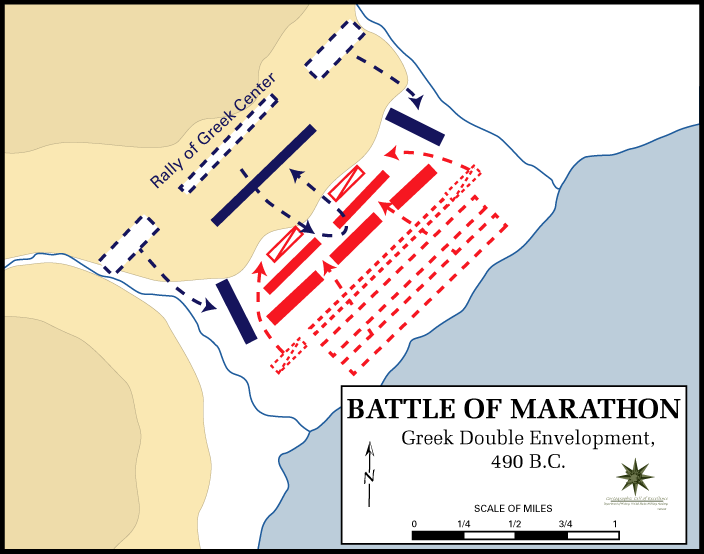
    To match the length of the Persian line, Miltiades thins the Athenian center to a few ranks and keeps the wings strong (Hdt 6.111); the Hellenic Army General Staff's route guide gives four ranks in the center and eight on the wings. As polemarch, Callimachus leads the right, the tribes stand in their order, and the Plataeans hold the far left. Plutarch says the tribes Leontis and Antiochis held the center, with Themistocles and Aristides fighting side by side. The Persians and Sakai hold the center of the Persian line. Herodotus says 'the space between the armies was no less than eight stadia' (about 1.5 km), and both lines are usually drawn at right angles to the shore. A story preserved in the Byzantine Suda has Ionians in the Persian camp signal from trees that the cavalry was away. That would explain both the timing of the attack and Herodotus' silence about horsemen in the fight, but Krentz and others think the cavalry was present. These traces follow the traditional placement around the Soros (Vanderpool; Hammond) and are conjectural.

  4. The day of battle, morning

    At the run

    With the sacrifices favorable, the Athenians and Plataeans go at the enemy at a run (Hdt 6.112). Herodotus calls them the first Greeks known to charge at a run, and the first to stand the sight of Median dress. The Persians, seeing a small force with no horse or archers, think them possessed. Whether they really ran all eight stades is one of the oldest arguments about Marathon. Many scholars think they marched most of the way and ran only the last 150–200 m, inside arrow range. Hammond accepts the full distance, and so does Krentz, who argues that a hoplite's equipment then weighed far less than the 30 kg often claimed and that men could run nearly a mile and still fight — perhaps to close before the cavalry could act.

  5. The day of battle, later that morning

    Center broken, wings close

    The fight is long (Hdt 6.113). In the center the Persians and Sakai break the thin Athenian ranks and chase them inland; Plutarch says Leontis and Antiochis took the worst of it. On both wings the Athenians and Plataeans rout their opponents. Rather than pursue, the victorious wings let the fugitives run, draw together, and turn on the Persians who have broken through the center, defeating them too; then the whole army pursues to the sea. The Athenian dead lie under the Soros, which is usually read as marking where the center fought. Krentz instead takes the trophy by Panagia Mesosporitissa, 3 km to the north-east, as the place where the Persians turned to flee (the tropē) and moves the main fight further north. The positions drawn are one reconstruction among several.

  6. The day of battle, midday

    At the ships and the marsh

    The pursuit ends at the ships, where the Athenians call for fire and lay hold of the vessels (Hdt 6.113). Here the polemarch Callimachus dies and the general Stesilaus is killed. Cynegeirus, brother of the playwright Aeschylus, grips a ship's stern ornament and has his hand cut off with an axe (6.114). Seven ships are taken (6.115); the rest get clear. Pausanias says many Persians, not knowing the ground, ran into the marsh and perished there. Vanderpool notes that the only way to the ships was a narrow strip between the marsh and the sea. The ships are drawn along the modern Schinias beach. Coring of the plain (Baeteman 1985; later work by Pavlopoulos and colleagues) shows that the coast and marsh of 490 BC differed from today's: the marsh, drained in modern times, was then a densely vegetated muddy fen, and where the shoreline ran is still debated.

  7. The day of battle and after

    The Soros and the march to Athens

    Herodotus counts about 6,400 Persian dead and 192 Athenian (6.117); Plataean and slave losses are not given. The Persians pick up the Eretrian captives left on the island of Aegilia and sail round Cape Sounion for Athens; a shield signal was later blamed on the Alcmaeonid family. The Athenians march home with all speed and camp at another precinct of Herakles, at Cynosarges, before the fleet appears off Phaleron. It rides there a while and then sails for Asia (6.115–116). Plutarch says Aristides stayed behind with his tribe Antiochis to guard the prisoners and spoils. The Athenian dead were cremated and buried under the Soros, where Stais found ash and burned bone in 1890–91. Marinatos identified a smaller mound at Vrana, excavated in 1970, as the Plataeans' tomb, though some doubt it. A marble trophy was raised later. Two thousand Spartans arrived after the battle, viewed the Persian dead and went home (6.120). The run from Marathon to Athens is a later tale (Plutarch, Lucian).

Weapons

Persian army (Datis)

Persian bow and spara shield

Persian bow and spara shield

Composite bow, short spear and wicker shield · Achaemenid Persia

At Marathon: Archers behind a wall of wicker shields; Herodotus says Persians and Sakai held the center.

Persian infantry fought behind a wall of wicker shields while archers shot over it, a tactic that won across Asia. Herodotus says the Persians at Marathon took the running Greeks for madmen; once the hoplites were at close quarters, light shields and short spears were at a disadvantage.

Bow
composite, cane-shafted arrows
Shield
large wicker spara, set up as a wall for archers
Close weapons
short spear, akinakes dagger
Photo: Louvre · Public domain

Athenians and Plataeans (Miltiades)

Hoplite panoply

Hoplite panoply

Spear, shield and bronze armor · Archaic and Classical Greece

At Marathon: Athenian and Plataean hoplites, without archers or cavalry, in files thinned in the center and deep on the wings.

The armored citizen-spearman of the Greek city-states fought in a close phalanx, each man's shield half covering his neighbor. At Marathon the Athenians and Plataeans, heavily armored but without archers or cavalry, closed fast to cut down the time under Persian arrows.

Spear (dory)
about 2–2.5 m, iron head and bronze butt-spike
Shield (aspis)
about 90 cm, wood faced with bronze, carried on the forearm
Armor
Corinthian helmet, bronze or linen corslet, greaves
Photo: Walters Art Museum · Public domain

Paintings and photographs

The Soros
The Soros The Soros, the burial mound raised over the 192 Athenian dead, which still stands on the plain. Ryvinios — public domain · source
Les Héros de Marathon (Rochegrosse)
Les Héros de Marathon (Rochegrosse) Georges Rochegrosse's painting of the Greek charge, a 19th-century imagining of the battle. Georges Rochegrosse — public domain · source
The double envelopment (USMA)
The double envelopment (USMA) The U.S. Military Academy's diagram of the classic reading: a thin Greek center gives way while the wings close in. Department of History, U.S. Military Academy — GFDL · source

Free for everyone every year on its anniversary: September 12.

Accuracy score: 52/100 (limited)

How the accuracy score works

Sources and method

Marathon, 490 BC. Ancient sources. Herodotus is the only source written within living memory: Histories 6.110–112, 6.112–116, 6.116–118 (Godley trans., Perseus/Perseids). Later sources: Plutarch, Aristides 5 (Leontis and Antiochis in the center; Aristides guards the spoils); Pausanias, 1.32 (graves, white-marble trophy, the marsh, Artaphernes' mangers, the Makaria spring); Cornelius Nepos, Miltiades (10,000 including 1,000 Plataeans; felled trees); the Suda, 'cavalry away' (chi 444). Modern scholarship. N. G. L. Hammond, 'The Campaign and the Battle of Marathon', Journal of Hellenic Studies 88 (1968) (Cambridge Core); Peter Krentz, The Battle of Marathon (Yale, 2010), as reviewed in BMCR 2010.11.02; J. F. Lazenby, The Defence of Greece (1993); R. A. Billows, Marathon (2010); N. Sekunda, Marathon 490 BC (Osprey, 2002); Jan P. Stronk, 'From Sardis to Marathon, part two', Talanta 51 (2019) (topography, Herakleion debate, shoreline views, strengths); Eugene Vanderpool, 'A Monument to the Battle of Marathon', Hesperia 35 (1966) (trophy at Mesosporitissa, Persian camp and fleet, lines at right angles to the sea) and 'An Archaic Inscribed Stele from Marathon' (Herakleion at Valaria); Hellenic Army General Staff, Military Tourism: Battle of Marathon (10,000 Greeks vs 25,000–30,000 Persians; center four ranks, wings eight); Encyclopaedia Britannica. Landscape. C. Baeteman, 'Late Holocene Geology of the Marathon Plain', Journal of Coastal Research 1 (1985); K. Pavlopoulos et al., 'Paleoenvironmental Evolution of the Coastal Plain of Marathon', Journal of Coastal Research 22 (2006). Date. Plutarch's 6 Boedromion, converted by Böckh to 12 September (Hammond: 11 September); D. W. Olson, R. L. Doescher and M. S. Olson, Sky & Telescope (2004), argue for 12 August from the Spartan calendar. Fixed points. Soros (Vici.org), Plataean tumulus (Pleiades), Marathon Museum (Vici.org), trophy (ToposText), Valaria Herakleion (ToposText, low confidence), Brexiza sanctuary (Vici.org), Kynosoura (Pleiades), Mt Agrieliki (athensattica.com), Mt Kotroni (Mapcarta/OSM). Unit lines are conjectural: Herodotus gives no topography for the fighting, and the Herakleion, the Persian camp, the course of the Charadra and the ancient shoreline are all disputed. Images from Wikimedia Commons.

Where the positions come from

Further reading