Battlefield Atlas
War in Afghanistan · 2001

Fall of Mazar-i-Sharif, 2001

Also known as Fall of Mazar-i-Sharif, Battle of Mazar-e-Sharif, Horse Soldiers

Accuracy77 /100 · good
Stages7
On the map7 photos pinned
Drawing of the units and movements at Mazar-i-SharifStages 1–3 freeOpen the interactive map

The first 3 stages are free. No account needed to start.

In October 2001 the Taliban held almost every city in northern Afghanistan. Mazar-i-Sharif, with its airfield and the road to the Uzbek border, was an early U.S. objective. From 19–20 October Special Forces team ODA 595, with CIA officers and Air Force combat controllers, rode with General Abdul Rashid Dostum's Uzbek cavalry up the Darya Suf valley, calling in close air support from B-52s and carrier aircraft ahead of mounted charges. ODA 534 joined Ustad Atta Mohammed Nur's Tajik forces in the Balkh valley on 2 November, and Mohammed Mohaqiq's Hazaras fought on the right. The decisive day was 5 November at Baluch (the 'Bai Beche' of U.S. accounts), where a cavalry charge went in behind laser-guided bombs. The Northern Alliance then pursued through Keshendeh and Shulgareh, forced the Tangi gap on 9 November and entered Mazar-i-Sharif on 9–10 November, the first city the Taliban lost. Positions follow the Institute for Defense Analyses battle-site survey, which recorded GPS points with veterans of both the U.S. team and Dostum's commanders; team positions are drawn larger than life so they can be seen.

Battlefield Explorer opens stages 4–7 and every other battle. See the free battles.

U.S. Special Forces on horseback, Darya Suf
U.S. Special Forces on horseback, Darya Suf — Master Sgt. Chris Spence, FOB 53 / U.S. Army (USSOCOM) · public domain

The battle, stage by stage

  1. 19–20 October 2001

    Into the Darya Suf

    Two weeks after U.S. air strikes began, a CIA team is already with General Abdul Rashid Dostum in the Darya Suf, the 'River of Caves', 80 km south of Mazar-i-Sharif. On the night of 19–20 October an MH-47E lands Operational Detachment Alpha 595 of the 5th Special Forces Group, under Capt. Mark Nutsch, with Air Force combat controllers, at Landing Zone Albatross near the village of Dehi (about 0200 local, 20 October, by the IDA battle-site survey; the Army history dates it 19 October, the date in Zulu time). Within hours the team meets Dostum and half of it rides with him to his mountain headquarters. Taliban forces hold the valley to the north, from the Bishqab–Chapchal ridges to their stronghold at Baluch.

  2. 21–26 October

    Bishqab, Cobaki and Chapchal

    The team splits; the Bravo team stays at LZ Albatross. The Alpha team goes forward with Dostum to Cobaki and calls in close air support on Taliban positions at Bishqab within about a day of landing; Dostum's cavalry and infantry attack across ridges cut by ravines, and on 22 October, by Defense Media Network's and Doug Stanton's accounts, horsemen charge behind the strikes at Cobaki. Strikes on armor, artillery and a command post near Chapchal follow, and by 25 October Dostum's men have pushed through Chapchal; the Taliban fall back down the valley toward Baluch (IDA survey; Army history). One Northern Alliance commander later put Taliban losses here at about 1,000 killed or captured, mostly Pakistanis — an unverified figure; Capt. Nutsch told the survey the ridge fighting killed approximately 123 Pakistanis, with 2 captured. Cobaki's position is approximate.

  3. 26 October – 4 November

    Spreading out

    On 26 October a three-man team (Tiger 02A) rides west to the heights of Omitak to strike Taliban reserves at the Keshendeh villages and cut reinforcements. A combat controller and a second Air Force controller arrive by helicopter on the night of 28 October, and Nutsch splits the rest into small teams tens of kilometers apart: 02B on the north ridge of the Darya Suf with Commander Lal, 02C near Charsu guarding the northern flank with Ahmad Khan, 02D at Oimatan, south of the Darya Suf. The team's base moves from LZ Albatross to Drop Zone Burro on 31 October, and a battalion command element (ODC 53, 'Boxer') lands there on 3 November. On 2 November ODA 534 and CIA officers land to the west to join Ustad Atta Mohammed Nur, who attacks the Taliban at Aq Kupruk in the Balkh valley (the landing site is approximate; the sources disagree on it). The position of Omitak is approximate.

  4. 5 November

    The charge at Bai Beche

    Dostum's offensive for the Darya Suf. Air drops at DZ Burro and BLU-82 'Daisy Cutter' bombs open the day. Dostum's first charge at about 1400 on the Taliban stronghold at Baluch — unmarked on the maps, which print 'Bai Becha' a few kilometers west; the team heard the name as Bai Beche, the name Doug Stanton's Horse Soldiers uses — stalls. North at Charsu, Taliban counterattack to within about 1,000 meters of Tiger 02C, which pulls back under danger-close bombs. At about 1630 Dostum receives a report (unconfirmed) that the Taliban commander, Mullah Razzaq, has been killed by a 1345 strike on his bunker; he orders Lal to attack. Tiger 02B calls laser-guided bombs from F-18s onto four targets, the radio call '30 seconds' goes out, and Lal's horsemen charge through the dust as the bombs land. Kamal's men come through the Chumka Pass. At Omitak a B-52 strike on a blocking bunker lets Haji Habib's horsemen overrun it. By nightfall the Taliban line has broken; Dostum's men secure Baluch the next day (IDA survey interviews; times as the survey gives them).

  5. 6–8 November

    Through Keshendeh to Shulgareh

    The Taliban defense of the Darya Suf breaks. On 6 November the teams link up northeast of Baluch; Taliban who had feigned surrender ambush the advance and reoccupy bunkers until evening strikes clear the road. On 7 November more than 2,500 fighters gather at the Keshendeh-ye Bala bazaar; the road on past Keshendeh-ye Pain is littered with wrecked tanks, BMPs and D-30 guns. Atta, with ODA 534, takes Aq Kupruk after several days of fighting and comes down the Balkh valley; the commanders meet near Pol-e Baraq and at Shulgareh on 8 November. Tiger 02A walks about 25 miles to rejoin north of Shulgareh, and that night Tiger 02C rides ahead for the heights above the Tiangi. The Taliban fall back to the Tiangi, the gap through the last ridge before Mazar. The map shows the evening of 8 November.

  6. 9 November

    The Tangi gap

    Overnight Tiger 02C climbs the Kafer Qalah above the Tiangi (the 'Tangi' gap, about 20 km south of Mazar). The Taliban — about 2,000 by the Army history's estimate, with Chechen and Pakistani fighters by one commander's account — have given up the heights for the low ground beyond the pass and mined it. Dostum attacks at 0800 as the weather clears and U.S. aircraft strike. At about 1400 his men take Hill 732, northeast of the Kafer Qalah; three Taliban BM-21 rocket salvos hit the attackers and mines kill men and horses. Lal said about 30 horses died crossing, and Dostum and one of his commanders put Northern Alliance dead at about 30. At 1500 Kamal's horsemen charge the positions on the north side, and by 1700 the Northern Alliance holds the pass. (The Army history says the Taliban abandoned the gap on 8 November; the IDA survey and team members describe the fight on the 9th. Atta told the survey he met 'no resistance in Tiangi', having followed through after dark, which may be the source of the Army history's version.)

  7. 9–10 November

    Mazar-i-Sharif falls

    Atta's forces and ODA 534 push through the gap and into the city on the night of 9 November (a second column went by Marmul toward the airport); ODA 534 took care not to bomb the Blue Mosque, the shrine of Ali. On the morning of 10 November Dostum's columns ride in past cheering crowds, and at about 1100 the commanders gather at the Qala-i-Jangi fortress. Some 400–450 Pakistani Taliban volunteers barricaded in the Sultan Razia girls' school refuse to surrender; after talk-ons F-18s destroy the building. The IDA survey says more than 300 were killed; the Army history speaks of 300 fighters 'eliminated'; a UN spokeswoman at the time reported over 100 dead, and Atta later put the number inside at almost 600. The rest of the Taliban fall back east toward Kunduz. Mazar-i-Sharif is the first city the Taliban lose.

At a glance

When
2001
Where
The Darya Suf valley and the Tangi gap south of Mazar-i-Sharif, Balkh Province, Afghanistan.
Forces
A few dozen U.S. Special Forces, Air Force and CIA personnel on the ground, plus air power, backed several thousand Northern Alliance horsemen and infantry against Taliban and foreign fighters of unknown total; only the Tangi…
Casualties
The fall of Mazar-i-Sharif cost the Taliban hundreds of dead, many at the Sultan Razia school, and perhaps well over a thousand captured or defected; Northern Alliance and U.S. losses were light, but no reliable totals exist for…
On the map
7 stages, 7 photos pinned where they were taken

Who fought

  • Taliban and foreign fighters
  • Northern Alliance (Dostum, Atta, Mohaqiq) with U.S. Special Forces, CIA officers and air power

Accuracy score

77/100 · good

Good confidence in where units stood and moved, scored on the quality of the source map, how well independent fixed points agree, the level of detail and corroboration. How scores work

Places on the map

  • LZ Albatross (ODA 595 landing, 20 Oct)
  • Dehi
  • Bishqab (Beshcam)
  • Chapchal
  • Cobaki (approx.)
  • Trail head to Cobaki
  • DZ Burro
  • Chumka Pass
  • Lal's OP (Tiger 02B)
  • Baluch (the 'Bai Beche' of U.S. accounts)
  • Charsu bunker
  • Omitak (approx.)
  • Oimatan
  • Keshendeh-ye Bala
  • Keshendeh-ye Pain (tank wrecks)
  • Pol-e Baraq bridge
  • River crossing (Tiger 02, 7 Nov)
  • Meeting place, 8 Nov
  • Shulgareh
  • Aq Kupruk
  • Dostum's CP, 9 Nov
  • Kafer Qalah (Tiger 02C OP)
  • Tiangi bridge
  • Kopa Kula
  • Qala-i-Jangi
  • Sultan Razia girls' school
  • Shrine of Ali (Blue Mosque)

More from the War in Afghanistan

Forces

A few dozen U.S. Special Forces, Air Force and CIA personnel on the ground, plus air power, backed several thousand Northern Alliance horsemen and infantry against Taliban and foreign fighters of unknown total; only the Tangi (about 2,000, Army history) and Sultan Razia school (400–450, IDA survey; almost 600 by Atta) figures have a named source.

Taliban and foreign fighters

At the Tangi gap, 9 Novabout 2,000

The Army history's estimate, with Chechen and Pakistani fighters by one commander's account; Commander Kamal told the IDA survey he saw more than 1,000. Folse, Operation Enduring Freedom, CMH Pub 70-83-1 (2022); Knarr and Frost, Battle Reconstruction, IDA D-4223 (2010); IDA D-4350, Mazar-e Sharif Battle Site Survey Support Documents (interview transcripts)

In the Sultan Razia school400–450 (300 to almost 600)

Pakistani volunteers. The IDA survey gives 400–450; the Army history says 300; Atta told the survey almost 600. Knarr and Frost, Battle Reconstruction, IDA D-4223 (2010); IDA D-4350, Mazar-e Sharif Battle Site Survey Support Documents (interview transcripts); Folse, Operation Enduring Freedom, CMH Pub 70-83-1 (2022)

At Aq Kupruk, facing Atta1,500–2,000

Atta's own estimate to the IDA survey, with artillery, ZSUs, BMPs and BM-21s but no tanks. IDA D-4350, Mazar-e Sharif Battle Site Survey Support Documents (interview transcripts)

Whole Taliban force in the northunknown (about 5,000–12,000 (unverified))

Wikipedia's infobox gives 5,000 (unlabeled, uncited); its body cites PBS Frontline for 5,000–12,000 withdrawing toward Kunduz. Williams gives 55,000 for the Taliban's entire army in 2001, not the northern front. Wikipedia, 'Fall of Mazar-i-Sharif' (lead only; infobox uncited); Brian Glyn Williams, 'General Dostum and the Mazar i Sharif Campaign'

Northern Alliance (Dostum, Atta, Mohaqiq) with U.S. Special Forces, CIA officers and air power

Dostum's horsemenabout 2,000

Williams says Dostum rallied about 2,000 Uzbek cheriks in the Darya Suf, and the Army history gives 2,300 horsemen; Lal's cavalry is given as 250 by Williams and 600–700 in the IDA survey. More than 2,500 fighters of all the factions gathered at Keshendeh-ye Bala on 7 Nov (IDA survey). Brian Glyn Williams, 'General Dostum and the Mazar i Sharif Campaign'; Knarr and Frost, Battle Reconstruction, IDA D-4223 (2010); Folse, Operation Enduring Freedom, CMH Pub 70-83-1 (2022)

Atta's Jamiat forces1,000–2,000 (about 1,000–2,000)

The Army history gives 1,000; the IDA survey interviews give about 2,000 horsemen, and one commander 1,000–1,500 for Jamiat. Folse, Operation Enduring Freedom, CMH Pub 70-83-1 (2022); Knarr and Frost, Battle Reconstruction, IDA D-4223 (2010); IDA D-4350, Mazar-e Sharif Battle Site Survey Support Documents (interview transcripts)

U.S. Special Forces and CIAabout 12 per ODA

ODA 595 and ODA 534 are twelve-man A-teams; ODA 595 gained two Air Force controllers on 28 October and a battalion command element (ODC 53) landed on 3 November. CIA officers worked with both Dostum and Atta (Wikipedia gives eight in CIA Team Alpha). No checked source gives an exact U.S. total on the ground. Wikipedia, 'Fall of Mazar-i-Sharif' (lead only; infobox uncited); Knarr and Frost, Battle Reconstruction, IDA D-4223 (2010)

Casualties

The fall of Mazar-i-Sharif cost the Taliban hundreds of dead, many at the Sultan Razia school, and perhaps well over a thousand captured or defected; Northern Alliance and U.S. losses were light, but no reliable totals exist for either side. Figures are mostly single-source or uncited, so the picture is poor. Certainty: poor.

Taliban and foreign fighters

Killed at the Sultan Razia schoolmore than 300 (IDA survey) (over 100 to about 800 (disputed))

The IDA survey says more than 300 of the 400–450 Pakistani volunteers barricaded inside were killed after F-18 strikes. The Army history says 300 fighters barricaded themselves there and were 'eliminated', without a separate count of dead. A UN spokeswoman at the time reported over 100 killed and could not confirm their nationality; one of Dostum's commanders told the survey about 200 died in the first strike and most of the rest surrendered. UN and other officials were also reported to allege about 800 deaths (Wikipedia, uncited there). The sources do not settle it. Knarr and Frost, Battle Reconstruction, IDA D-4223 (2010); IDA D-4350, Mazar-e Sharif Battle Site Survey Support Documents (interview transcripts); Folse, Operation Enduring Freedom, CMH Pub 70-83-1 (2022); Dawn, '100 Taliban soldiers killed: UN' (13 Nov 2001); Wikipedia, 'Fall of Mazar-i-Sharif' (lead only; infobox uncited)

Killed or captured, Bishqab–Chapchal (21–25 Oct)about 123 killed, 2 captured (U.S. team's count) (123 to about 1,000)

Capt. Nutsch told the IDA survey the Beshcam–Chapchal ridge fighting killed approximately 123 Pakistanis, with 2 captured. One Northern Alliance commander put the figure at about 1,000 killed or captured, mostly Pakistanis; that is unverified. IDA D-4350, Mazar-e Sharif Battle Site Survey Support Documents (interview transcripts); Knarr and Frost, Battle Reconstruction, IDA D-4223 (2010)

Killed, captured or defected, whole battleunknown

No source in this atlas gives a reliable total. Wikipedia's uncited lead says about 300 killed, 250 captured and about 1,000 defected; a cited body paragraph (Chipman) says about 1,500 captured or defected. Wikipedia, 'Fall of Mazar-i-Sharif' (lead only; infobox uncited)

Early-campaign claimover 125 killed

Capt. Nutsch's early telegram, quoted by Williams, said Dostum's Uzbek fighters had killed over 125 Taliban while losing eight; it covers the first fighting in the Darya Suf, not the whole battle. Brian Glyn Williams, 'General Dostum and the Mazar i Sharif Campaign'

Northern Alliance (Dostum, Atta, Mohaqiq) with U.S. Special Forces, CIA officers and air power

U.S. killednone found in the sources checked

None of the battle's sources records a U.S. death in the Mazar-i-Sharif advance (19 Oct–10 Nov); this was not confirmed against a casualty list. Knarr and Frost, Battle Reconstruction, IDA D-4223 (2010); Folse, Operation Enduring Freedom, CMH Pub 70-83-1 (2022)

Northern Alliance killed (early)8

Nutsch's telegram, quoted by Williams: eight Uzbek fighters lost against more than 125 Taliban killed in the early fighting. Brian Glyn Williams, 'General Dostum and the Mazar i Sharif Campaign'

Northern Alliance killed at the Tangi, 9 Novabout 30 (about 30–35)

Dostum's figure as relayed by Capt. Nutsch, and Commander Fakir's ('30, 35 soldiers'), both in the IDA survey interviews; mines and BM-21 rockets caused most of them. IDA D-4350, Mazar-e Sharif Battle Site Survey Support Documents (interview transcripts); Knarr and Frost, Battle Reconstruction, IDA D-4223 (2010)

Northern Alliance killed, whole battleunknown

No checked source gives a total. At the Tangi on 9 November Dostum and one of his commanders put Northern Alliance dead at about 30 (the commander said 30–35); Kamal counted six of his own horsemen, and Lal said about 30 horses died crossing the mined ground. Atta told the survey eight of his men were killed at the Sultan Razia school. Wikipedia's uncited infobox lists 8 Junbish and 30 Jamiat fighters. IDA D-4350, Mazar-e Sharif Battle Site Survey Support Documents (interview transcripts); Knarr and Frost, Battle Reconstruction, IDA D-4223 (2010); Wikipedia, 'Fall of Mazar-i-Sharif' (lead only; infobox uncited)

Civilians

Deaths in and around Mazar-i-Sharifunknown (about 400–600, all causes)

Wikipedia cites the Los Angeles Times (23 Nov 2001) for an estimated 400–600 dead in the battle, civilians and combatants not separated; no source checked gives a civilian count. Wikipedia, 'Fall of Mazar-i-Sharif' (lead only; infobox uncited)

Equipment and ships

Taliban armor and gunsnot tallied

Tanks, BMPs, D-30 guns and ZSUs were destroyed at Keshendeh (BDA points surveyed by IDA), but the sources checked give no total; Williams describes hundreds of pickup trucks with dozens destroyed in the campaign. Knarr and Frost, Battle Reconstruction, IDA D-4223 (2010); Brian Glyn Williams, 'General Dostum and the Mazar i Sharif Campaign'

Then and now: how the ground has changed

The ground is mountain, steppe and river valley that has changed little in its shape, but the Tangi gap and the Mazar plain have since seen roads, bridges and heavy building; the sources checked say little about what changed, so only a few notes are firm.

Weapons

Taliban and foreign fighters

BMP-1

BMP-1

Infantry fighting vehicle · 1966–present

At Mazar-i-Sharif: Wrecked tanks, BMPs and D-30 guns littered the road past Keshendeh-ye Pain after the air strikes on the Taliban reserves.

The Soviet infantry fighting vehicle that carried Iraqi mechanized infantry. Its thin armor made it easy prey for Bradley 25 mm guns and TOW missiles.

Main gun
73 mm low-pressure gun + AT-3 Sagger missile
Crew
3 + 8 infantry
Weight
about 13 t
Photo: U.S. DoD photo · public domain

Northern Alliance (Dostum, Atta, Mohaqiq) with U.S. Special Forces, CIA officers and air power

Boeing B-52 Stratofortress

Boeing B-52 Stratofortress

Strategic bomber · 1955–present

At Mazar-i-Sharif: A B-52 strike on a blocking bunker at Omitak let Haji Habib's horsemen overrun it on 5 November.

Designed to carry nuclear weapons, the B-52 was adapted in Vietnam for massed conventional bombing under the code name Arc Light. Flying too high to be seen or heard from the ground, a formation could saturate a large box of terrain with bombs.

Crew
6 (Vietnam-era models)
Bomb load (B-52F, 1965)
up to 51 750-lb bombs
Engines
8 jet engines
Photo: USAF · Public domain
M4 / M4A1 carbine

M4 / M4A1 carbine

5.56 mm assault carbine · 1994–present

At Mazar-i-Sharif: The ODA 595 and ODA 534 teams, with combat controllers, rode with the Afghan cavalry and called in the strikes.

A shortened, lighter M16 that became the standard weapon of U.S. Army infantry and special operations forces in Iraq and Afghanistan; Marine infantry in 2003–04 still mostly carried the full-length M16A4.

Caliber
5.56×45 mm NATO
Barrel
14.5 in
Magazine
30 rounds
Photo: U.S. Marine Corps photo · public domain

Paintings and photographs

U.S. Special Forces on horseback, Darya Suf
U.S. Special Forces on horseback, Darya Suf U.S. Special Operations Forces, members of Task Force Dagger, and Afghan commander Abdul Rashid Dostum on horseback in the Dari-a-Souf (Darya Suf) valley, October 2001. Pinned at the Tiger 02B observation post in the valley; exact spot not recorded. Master Sgt. Chris Spence, FOB 53 / U.S. Army (USSOCOM) · public domain · source
Combat controller Bart Decker on horseback
Combat controller Bart Decker on horseback Staff Sgt. Bart Decker, an Air Force combat controller, on horseback with Northern Alliance forces during the opening days of Operation Enduring Freedom, October 2001. He called in B-52, B-1, Navy F-14 and F-18 and AFSOC AC-130 air support for Special Forces ODA 595. Place not recorded; pinned near LZ Albatross, where ODA 595 landed, approximate. U.S. Army photo · public domain · source
Special Forces at the fall of Mazar-i-Sharif
Special Forces at the fall of Mazar-i-Sharif American Special Forces at Mazar-i-Sharif, November 2001. Place not recorded; pinned in the city, approximate. Army Special Forces · public domain · source
Dostum's troops in Mazar-i-Sharif
Dostum's troops in Mazar-i-Sharif Northern Alliance troops under General Dostum's command take a break on a wall in the median of the town's busiest street, Mazar-e Sharif, 15 December 2001 (USAF photo 011215-F-3961R-018 by SSgt. Cecilio Ricardo). Street not named; pinned in the city, approximate. SSgt. Cecilio Ricardo, USAF · public domain · source
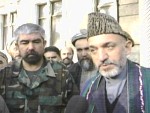
Abdul Rashid Dostum and Hamid Karzai
Abdul Rashid Dostum and Hamid Karzai General Abdul Rashid Dostum (left) with Hamid Karzai, 24 December 2001. Portrait taken after the battle; pinned at Dostum's command post of 9 November. Voice of America · public domain · source
Shrine of Ali (Blue Mosque), Mazar-i-Sharif
Shrine of Ali (Blue Mosque), Mazar-i-Sharif The Shrine of Hazrat Ali, the Blue Mosque, in Mazar-i-Sharif, photographed in November 2009. ODA 534 took care not to bomb it in November 2001. ISAF Headquarters Public Affairs Office · CC BY 2.0 · source
Destroyed Sultan Razia school
Destroyed Sultan Razia school The Sultan Razia girls' school in Mazar-i-Sharif after being destroyed during the war, June 2002. Defense Security Cooperation Agency · public domain · source

Free for everyone every year on its anniversary: November 9.

Accuracy score: 77/100 (good)

  • Sources32/40

    The IDA D-4223 battle-site survey, its D-4350 interview transcripts, the Army's CMH history and team interviews give dates and sequence; they conflict on the insertion date (a time-zone matter), the Tangi date and the Taliban strength and losses.

  • Fixed points25/30

    IDA D-4223 recorded GPS points with ODA 595 veterans and Dostum's commanders at most sites; Cobaki, Omitak, Shamallak, ODA 534's landing site and the Taliban line beyond the Tangi are placed approximately from the narrative.

  • Movement detail13/20

    Stage positions follow the survey timelines, but the routes between fixed points are schematic and the Army history's Tangi fight on 9 November conflicts with Atta's account of finding no resistance.

  • Corroboration7/10

    The U.S. Army history, the survey, team interviews and press reports agree on the outline; the CMH differs from the survey on the Tangi date and distance, and Taliban numbers and the school's dead vary.

How the accuracy score works

Sources and method

Fall of Mazar-i-Sharif, October–November 2001. Fixed points and timings from William M. Knarr Jr. and John Frost, Operation Enduring Freedom Battle Reconstruction: Battle Site Survey and Ground Force Data Reconciliation, IDA Document D-4223 (Institute for Defense Analyses, rev. 2010), chs. III and V and App. L (GPS tables for each site, phase timelines); interview transcripts in IDA Document D-4350, Mazar-e Sharif Battle Site Survey Support Documents (Revised) (Baluch and the maps' Bai Becha; Omitak's bearing from Keshendeh-ye Bala; casualty accounts). Campaign outline and figures: Mark R. Folse, Operation Enduring Freedom, September 2001–March 2002, CMH Pub 70-83-1 (U.S. Army Center of Military History, 2022), pp. 29–32; Charles H. Briscoe et al., Weapon of Choice: U.S. Army Special Operations Forces in Afghanistan (Combat Studies Institute, 2003); team interviews, FRONTLINE, ODA 595 and ODA 534 (PBS, 2002); Defense Media Network, 'Operation Enduring Freedom: The First 49 Days' (Bishqab 21 Oct, Cobaki 22 Oct, Bai Beche 5 Nov); Doug Stanton, Horse Soldiers (2009); Dawn, '100 Taliban soldiers killed: UN' (13 Nov 2001; the school). Accounts differ on the insertion date (19 or 20 October, a matter of time zone), on whether the Tangi was fought for on 9 November or abandoned on the 8th, on where ODA 534 landed, on the school's dead and on Taliban numbers. Cobaki, Omitak, Shamallak, ODA 534's landing site and the Taliban line beyond the Tangi are placed approximately from the narrative; Omitak rests on a single bearing.

Where the positions come from

  • Official record IDA Document D-4223 (Knarr and Frost) GPS tables for Albatross, Dehi, Beshcam, Baluch, Charsu, Keshendeh, Shulgareh, the Tangi bridge and Qala-i-Jangi, recorded with ODA 595 veterans and Dostum's commanders in December 2002
  • Modern map Shrine of Ali (Blue Mosque), the Sultan Razia girls' school and Aq Kupruk from published coordinates; Baluch and the maps' Bai Becha are close but not identical on the 1:100,000 sheet
  • Note Cobaki, Omitak (one bearing), Shamallak, ODA 534's landing site and the Taliban line beyond the Tangi are approximate; routes between points are schematic

Further reading