Battlefield Atlas
War in Afghanistan · 2009 Members · from $3

COP Keating, 2009

On 3 October 2009 an estimated 300 insurgents attacked Combat Outpost Keating, a small U.S. base at the bottom of a valley in Kamdesh District, Nuristan, held by about 53 soldiers of Bravo Troop, 3-61 Cavalry with Afghan soldiers, two Latvian advisers and Afghan security guards, while another force pinned down the supporting OP Fritsche above. The attackers suppressed the mortars, broke in on the Afghan-held east side and at the gate, and set much of the outpost on fire. The defenders fell back to a small perimeter, then counterattacked with heavy air support and retook the compound over about 13 hours. Eight Americans were killed and 22 wounded; about 150 attackers were reported killed. Staff Sgt. Clinton Romesha and Spc. (later Staff Sgt.) Ty Carter received the Medal of Honor. The outpost was abandoned and destroyed three days later.

Open the interactive map8 stages on modern satellite imagery and terrain, with 3D elevation

This battle opens with Battlefield Enjoyer ($3 a month on Patreon), which unlocks every battle in the atlas and every one added later. Free battles include Hattin, Agincourt, Yorktown, Waterloo, The Alamo, Antietam, Little Bighorn, Belleau Wood, Omaha Beach, Ia Drang, 73 Easting, Wanat, Najaf.

COP Keating
COP Keating — U.S. Army (Brad Larson) — public domain

The battle, stage by stage

  1. 3 October 2009, 05:58

    The bottom of the bowl

    Combat Outpost Keating sits at the bottom of a steep, bowl-shaped valley in Kamdesh District, Nuristan, where the Kushtowz (Darreh-ye Kushtaz) and Landay-Sin rivers meet, beside the hamlet of Urmul. About 53 soldiers of Bravo Troop, 3rd Squadron, 61st Cavalry hold it with Afghan soldiers, two Latvian advisers and Afghan security guards; a platoon with 120 mm mortars holds OP Fritsche on the heights to the south. The outpost is due to close within days. At about 05:58 an estimated 300 fighters open fire from the high ground on all four sides — machine guns, recoilless rifles, RPGs and mortars — while about 85 more attack OP Fritsche.

  2. About 06:00–06:45

    Mortars silenced

    The attackers aim first at the guard positions and the mortars. The 60 mm and 120 mm mortar crews at Keating are pinned down, and OP Fritsche, under fire itself, cannot give the support the plan relies on. The first American is killed within minutes. Spc. Ty Carter runs about 100 metres under fire to the LRAS 2 position with ammunition, then back for more, shooting the locks off the ammunition point. SSG Clinton Romesha takes a machine gun to the generator on the south side to engage gunners on the western high ground and the switchbacks; an RPG hits the generator and wounds him.

  3. About 06:48

    Inside the wire

    Within about 48 minutes the perimeter is breached at three points, by the Army investigation's account: on the east side, where the Afghan soldiers do not hold, at the main entrance guarded by the Afghan security guards, and by the latrines. Fighters set buildings on fire. The Americans and Latvians pull back to a tight internal perimeter around the barracks, the operations centre and the aid station; the men at LRAS 2 are cut off outside it.

  4. About 06:45–07:30

    LRAS 2

    RPGs wreck the LRAS 2 gun truck's .50-calibre gun, wounding Carter, Sgt. Brad Larson and SSG Vernon Martin. Sgt. Justin Gallegos decides to break out north to the operations centre; he and Martin are killed, and Spc. Stephan Mace is badly wounded. A second truck sent to help, with Sgt. Josh Hardt, Spc. Christopher Griffin and Pfc. Edward Faulkner, is struck by repeated RPGs; Hardt and Griffin are killed. Carter and Larson hold the position and stop fighters flanking from the Urmul side. At about 07:30, by one account, Carter runs to Mace, applies a tourniquet and carries him back to cover.

  5. Morning to midday

    Retaking the gate

    Air support arrives — eventually Apaches, F-15Es, A-10s and a B-1, 19 aircraft in all. Romesha, despite his wound, leads a small team across open ground to the ammunition point and then to the shura building beside the entry control point, the last approach to the operations centre and aid station. They retake the gate and close it, and Romesha directs mortar fire and air strikes onto Urmul and the Afghan police checkpoint in front of it. Air strikes also destroy the local mosque, a main source of fire. Just before noon a storm closes in and aircraft drop guided bombs on coordinates from the ground.

  6. Afternoon

    Pushing back out

    With the gate secure, the defenders expand the perimeter and win back most of the burning outpost; OP Fritsche regains its mortar pit and fires again. Under covering fire, Carter and Larson carry Mace about 100 metres on a litter to the aid station, where he receives transfusions. Romesha leads a team out to LRAS 2 to recover the fallen. The attackers begin to break off, leaving an estimated 150 dead by U.S. counts.

  7. About 14:00–19:00

    Down from Fritsche

    Unable to land at Keating, a quick reaction force from 1st Battalion, 32nd Infantry, with the troop commander, Captain Stoney Portis, is flown into OP Fritsche in the early afternoon and fights its way down the mountain — a walk of about three hours that takes about five under fire. It reaches Keating around nightfall, roughly 13 hours after the attack began, and finds Sgt. Hardt's body. Spc. Mace is evacuated that night and later dies of his wounds. Eight Americans are killed — Gallegos, Griffin, Hardt, Kirk, Mace, Martin, Scusa and Thomson — and 22 wounded; Afghan soldiers and guards are also wounded.

  8. 6 October 2009

    Abandoned

    Bravo Troop is flown out on 6 October and the outpost, already slated for closure, is destroyed by a B-1 strike so that ammunition and supplies left behind do not fall to the insurgents; by one report Taliban video later showed fighters carrying away material. The Army's 15-6 investigation faulted the outpost's placement and the decline in force protection while closure was awaited. Romesha (2013) and Carter (2013) received the Medal of Honor.

Weapons

Insurgents (Taliban-led fighters)

RPG-7

RPG-7

Shoulder-fired rocket-propelled grenade launcher · 1961–present

At COP Keating: RPGs, machine guns and recoilless rifles fired down from the heights onto the outpost.

The most widespread anti-armour weapon in the world: cheap, simple and effective against light vehicles and buildings. Iraqi soldiers, Fedayeen and later insurgents and militias fired it in volleys from rooftops and alleys in every battle here.

Calibre
40 mm tube, 85 mm warhead (PG-7V)
Effective range
about 200–300 m
Crew
1–2
Photo: U.S. military photo · public domain
AK-47 / Type 56

AK-47 / Type 56

Assault rifle · 1949–present

At COP Keating: About 300 attackers broke through the wire on the Afghan side and at the gate.

Mikhail Kalashnikov's AK-47 became the world's most widespread military rifle thanks to its simplicity and reliability in mud, heat and rain. North Vietnamese and Viet Cong troops carried both Soviet AKs and the Chinese-made copy, the Type 56.

Calibre
7.62×39mm
Rate of fire
about 600 rounds/min
Magazine
30-round box
Effective range
about 350 m
Photo: U.S. Department of Defense · Public domain

U.S. (B Troop, 3-61 Cavalry), Afghan and Latvian forces

M4 / M4A1 carbine

M4 / M4A1 carbine

5.56 mm assault carbine · 1994–present

At COP Keating: The defenders fell back to the Red Barracks, then fought building by building to retake the outpost.

A shortened, lighter M16 that became the standard weapon of U.S. Army infantry and special operations forces in Iraq and Afghanistan; Marine infantry in 2003–04 still mostly carried the full-length M16A4.

Calibre
5.56×45 mm NATO
Barrel
14.5 in
Magazine
30 rounds
Photo: U.S. Marine Corps photo · public domain

Paintings and photographs

COP Keating
COP Keating Combat Outpost Keating at the bottom of its bowl in Nuristan, beneath the surrounding heights. U.S. Army (Brad Larson) — public domain · source
A damaged Humvee after the battle
A damaged Humvee after the battle An armoured Humvee riddled with fire during the battle on 3 October 2009. U.S. Army — public domain · source
SSG Clinton Romesha
SSG Clinton Romesha Clinton Romesha, awarded the Medal of Honor for leading the counterattack that retook the outpost. Monica King, U.S. Army — public domain · source
SSG Ty Carter
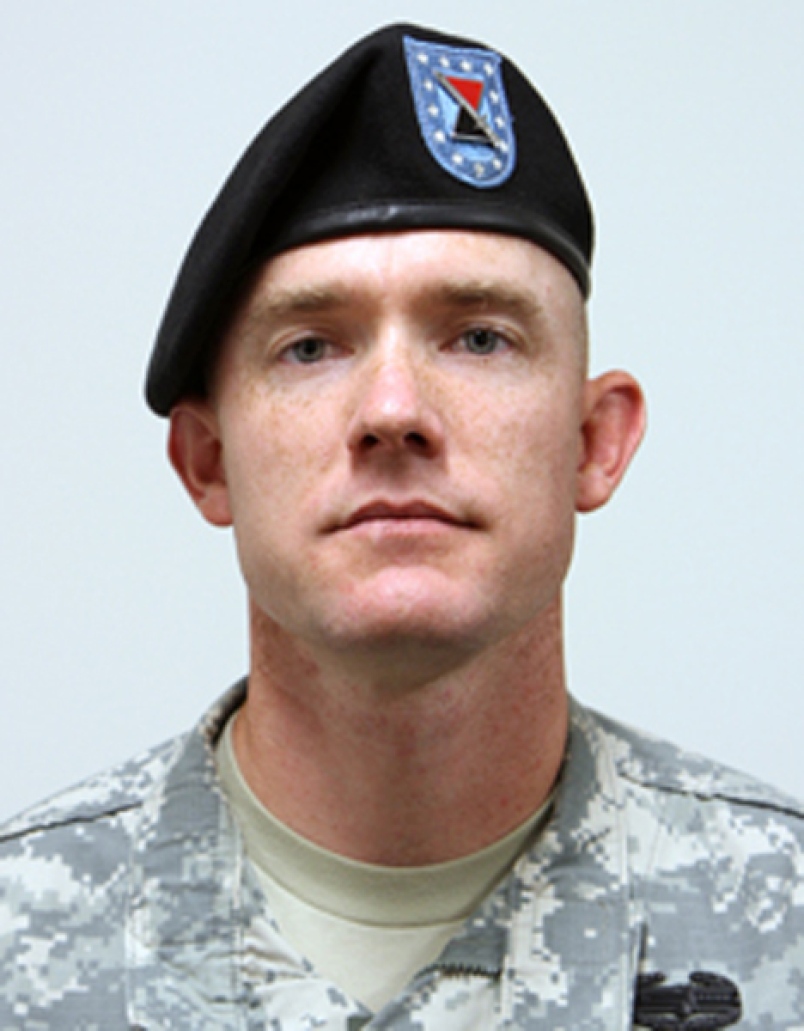
SSG Ty Carter Ty Carter, awarded the Medal of Honor for resupplying positions under fire and rescuing a wounded soldier. SSG Lindsey Kibler, U.S. Army — public domain · source

★ Medal of Honor 2 recipients

Links go to the official records: the Congressional Medal of Honor Society and, where they exist, the service's own pages.

Free for everyone every year on its anniversary: October 3.

Accuracy score: 58/100 (limited)

How the accuracy score works

Sources and method

COP Keating, 3 October 2009. Events follow the U.S. Army Medal of Honor pages for SSG Clinton Romesha and SSG Ty Carter (battlescape); army.mil, 'Medal of Honor nominee Romesha leads charge to retake COP Keating'; the executive summary of the AR 15-6 investigation as reported by Bill Roggio, Long War Journal (Feb. 2010); Air & Space Forces Magazine, 'Saving Outpost Keating' (air support); Defense Media Network (outpost layout); West Point Center for Oral History (QRF, OP Fritsche); SOF Magazine; Jake Tapper, The Outpost (2012); Clinton Romesha, Red Platoon (2016). The outpost and Kamdesh village coordinates are from the Wikipedia 'Battle of Kamdesh' and 'Kamdesh' articles (leads only). Positions inside the wire are schematic, from the descriptions above (barracks in the middle, TOC to the east, LRAS 1 north, LRAS 2 west/south-west, generator south, shura building and gate north-west, Afghan troops east); the mortar pit, latrines and river confluence are approximate. Sources differ on the distance to OP Fritsche (1,500 m to 2.2 km) and on the wounded count (22 to 27).

Where the positions come from

Further reading