Culloden, 16 April 1746
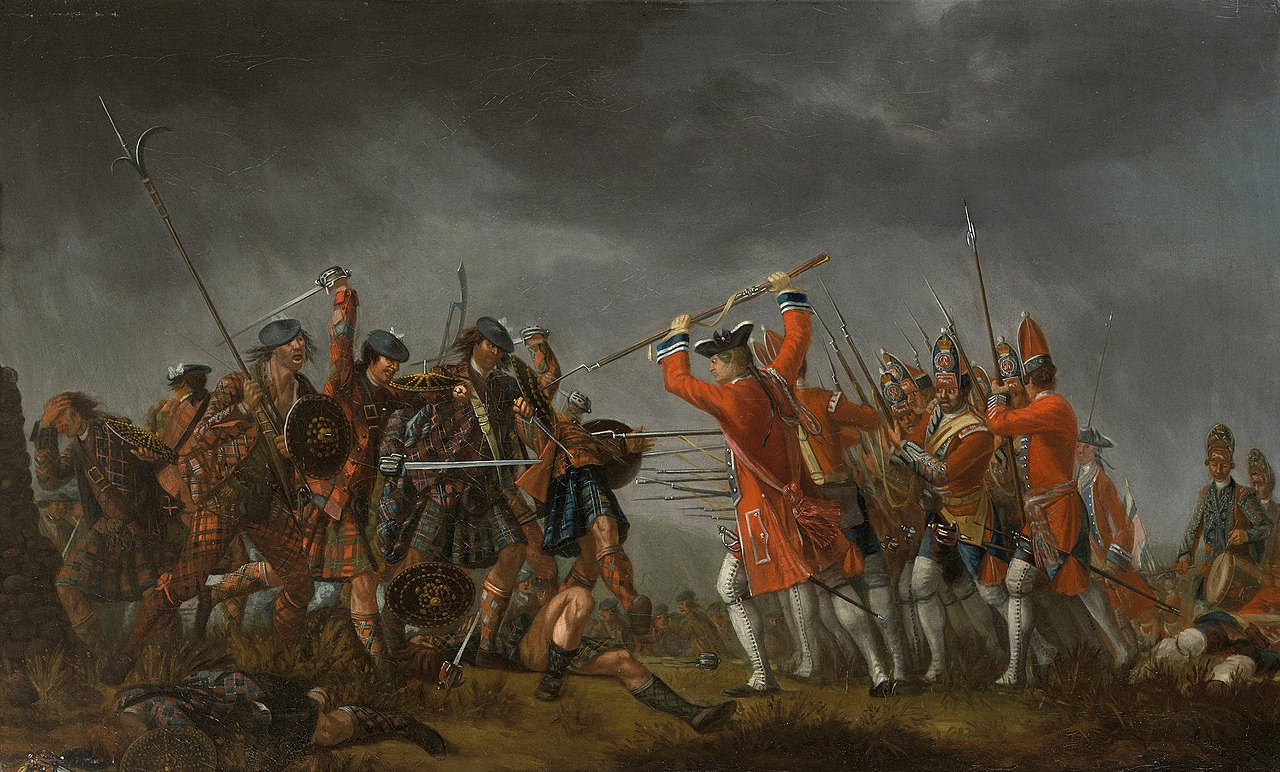
On 16 April 1746, on Drummossie Moor east of Inverness, the Duke of Cumberland's government army — about 7,000 foot and 800 horse with ten field guns — destroyed Prince Charles Edward Stuart's Jacobite army of about 5,000 men in under an hour. After a cannonade the Jacobite clans charged across rough, wet ground; their right and center broke into Barrell's and Munro's regiments on the government left but were shot down between the two government lines, while dragoons came round through the walled enclosures behind them. About 1,200–1,500 Jacobites were killed, against 50 government dead. Culloden ended the last Jacobite rising and was followed by harsh repression in the Highlands. It was the last pitched battle fought on British soil.
Open the interactive map6 stages on modern satellite imagery and terrain, with 3D elevation
This battle opens with Battlefield Explorer ($9.99 a month on Patreon), which unlocks every battle in the atlas and every one added later. Free battles include Thermopylae, Actium, Hattin, Agincourt, Vítkov Hill, Bosworth, Fort William Henry, Yorktown, Waterloo, The Alamo, Antietam, Little Bighorn, Belleau Wood, Omaha Beach, Inchon, Ia Drang, 73 Easting, Wanat, Baghdad Thunder Runs, Battle of Kyiv, Siege of Mariupol, Kharkiv counteroffensive, Bakhmut, Avdiivka.
The battle, stage by stage
- 16 April 1746, about 11 AM to 12:30 PM
Drawn up on Drummossie Moor
After a failed night march to surprise the government camp at Nairn, the hungry and exhausted Jacobite army — perhaps 5,000 foot and a few hundred horse — forms on the open moor southeast of Culloden House. Its front line of clan regiments stretches between two stone-walled enclosures: the Culwhiniac park on the right and the Culloden Parks on the left. Lord George Murray commands the right (Atholl Brigade, Camerons, Stewarts of Appin), the Duke of Perth the left, where the MacDonald regiments stand, by most accounts resentful at losing the right of the line. Behind them, in columns, are Lowland regiments and the French-service Royal Écossais and Irish Picquets. About 700 m to the east, the Duke of Cumberland's army — about 7,000 foot and 800 horse in HES's figures, often rounded to 8,000–9,000 men — deploys in two lines with a reserve. Seeing the Jacobites might overlap his right, Cumberland brings Pulteney's and Battereau's up from the reserve. Placements follow the National Trust for Scotland flag lines and the HES Inventory; the exact line traces are interpretive.
- About 1 PM
The cannonade
The Jacobite guns open first; the government's ten 3-pounders, served by trained gunners in pairs between the battalions, reply far more effectively. Accounts of how long the clansmen stood under fire vary from two or three minutes to half an hour; James Wolfe, then a major on Hawley's staff, reckoned about 15 minutes. Gaps open as Murray shifts the Atholl Brigade; John Roy Stuart's men are brought up near the Stewarts of Appin and Perth's and Glenbucket's to the extreme left. On the government left, the Argyll Militia breach the east wall of the Culwhiniac enclosure, and Hawley's dragoons — Kerr's and Cobham's — begin to pass inside it.
- About 1:10 PM
The Highland charge
The order to charge reaches the center first. Clan Chattan sets off and, by most accounts, veers to its right, away from boggy ground and perhaps following the line of the road, crowding the Frasers, Appin men, Camerons and Athollmen toward the walls on the right; HES notes that survey evidence shows the right charged through the Leanach enclosure rather than around it. The MacDonalds on the left, with the farthest to go, advance slowly. Canister and grapeshot replace roundshot as the clans close. Wolfe's Regiment moves up on the far left beside the enclosure wall, and the Campbells line the inside of the Culwhiniac north wall, firing into the flank of the charge. (HES questions accounts that place Wolfe's at an angle from the start; here it moves up during the charge.)
- About 1:15 PM
Barrell's and Munro's
The weight of the charge falls on Barrell's and Munro's on the government left. After a close-range volley, the clansmen break into Barrell's, which is pushed back with heavy loss — 17 killed and 108 wounded in Reid's tally — while Munro's loses 14 killed and 68 wounded. Highlanders who push through are caught between the first line and the second, where Sempill's, Bligh's and Ligonier's come forward, while Wolfe's pours fire into their flank. To the north the MacDonalds, halted under artillery and musket fire, never close with Pulteney's and the Royals. Behind the Jacobite right, Hawley's dragoons break out of the Culwhiniac enclosure near Culchunaig, where Lord Lewis Gordon's and Lord Ogilvy's battalions and FitzJames's Horse line the crest of a re-entrant to face them.
- About 1:25 PM
The line gives way
Unable to break the second line, the survivors of the Jacobite right and center fall back across ground covered with their dead — the area of today's memorial cairn and the Graves of the Clans. The MacDonalds give way in turn. Kingston's Horse and two troops of Cobham's Dragoons ride out on the government right; the Irish Picquets come forward to cover the MacDonalds' retreat, reportedly losing about half their number. Behind the Jacobite right the dragoons and the crest-line battalions face each other, keeping a line of retreat open.
- About 2 PM
Retreat and pursuit
The battle is over in under an hour. The Jacobite left streams toward Inverness, much of the right south-west toward the River Nairn and Ruthven in Badenoch; FitzJames's Horse, the Royal Écossais and the Irish Picquets cover parts of the retreat, and the French-service troops later surrender as prisoners of war. Cumberland's line advances across the field and the cavalry pursue, killing many of the fleeing and wounded — the start of the reprisals that earned him the name 'Butcher'. HES gives the government loss as 50 killed and 259 wounded; Jacobite dead are estimated at 1,200–1,500. Prince Charles leaves the field and, after five months in hiding, escapes to France.
Forces
About 5,000 hungry and tired Jacobites faced a government army of about 7,800 (HES: 7,000 foot and 800 horse), often rounded to 8,000–9,000; the government also had far better artillery. Army totals are well attested; regimental figures come from Stuart Reid's reconstruction from returns.
Jacobite army (Charles Edward Stuart)
| PresentHES gives about 5,000 foot and 250 horse, Britannica about 5,000, Canmore about 4,500, and the Jacobite Trail 5,000–5,500; British Battles' 7,000 counts men absent on the day. Historic Environment Scotland, Inventory of Historic Battlefields: Battle of Culloden (BTL6); Encyclopaedia Britannica, Battle of Culloden; Canmore, Culloden battlefield (site 14201); Jacobite Trail, Battle of Culloden | about 5,000 (4,500–5,500) |
| Front line (clan regiments)Osprey's summary of Reid: about 3,800 men were expected in the front line, probably several hundred fewer by the start. Osprey Publishing, Culloden 275: the Jacobite charge (2021) | about 3,800 expected |
| Cavalry Historic Environment Scotland, Inventory of Historic Battlefields: Battle of Culloden (BTL6) | about 250 |
| GunsEleven 3-pounders and one 4-pounder (HES). Historic Environment Scotland, Inventory of Historic Battlefields: Battle of Culloden (BTL6) | 12 |
British government army (Cumberland)
| PresentHES gives 7,000 foot and 800 horse (and elsewhere about 9,000); British Battles about 8,000; Britannica about 9,000. Historic Environment Scotland, Inventory of Historic Battlefields: Battle of Culloden (BTL6); British Battles, Battle of Culloden; Encyclopaedia Britannica, Battle of Culloden | about 7,800 (7,800–9,000) |
| Cavalry Historic Environment Scotland, Inventory of Historic Battlefields: Battle of Culloden (BTL6) | about 800 |
| Guns Historic Environment Scotland, Inventory of Historic Battlefields: Battle of Culloden (BTL6) | 10 three-pounders and 6 Coehorn mortars |
Casualties
A very one-sided battle: about 50 government soldiers were killed and some 260 wounded, against an estimated 1,200–1,500 Jacobite dead and hundreds taken prisoner. The government figures come from an official return; the Jacobite figures are estimates. Certainty: fair.
Jacobite army (Charles Edward Stuart)
| KilledHistoric Environment Scotland estimates 1,200–1,500 killed and the National Trust for Scotland about 1,500; Britannica gives about 1,000 killed in the battle itself, with about 1,000 more killed in the weeks of pursuit. No count was made, so all figures are estimates. Historic Environment Scotland, Inventory of Historic Battlefields: Battle of Culloden (BTL6); National Trust for Scotland, Culloden: the battlefield; Encyclopaedia Britannica, Battle of Culloden | about 1,200–1,500 (1,000–1,500) |
| CapturedHES gives 400–500 taken prisoner immediately, with more in the following days; only the Irish and Scottish soldiers in French service were treated as prisoners of war. Historic Environment Scotland, Inventory of Historic Battlefields: Battle of Culloden (BTL6) | 400–500 on the day |
| WoundedNo reliable figure exists; many wounded were killed on the field or in the pursuit, according to HES and Britannica. Historic Environment Scotland, Inventory of Historic Battlefields: Battle of Culloden (BTL6) | unknown |
British government army (Cumberland)
| KilledThe official return as given by HES and British Battles; NTS and Britannica also give about 50. Historic Environment Scotland, Inventory of Historic Battlefields: Battle of Culloden (BTL6); British Battles, Battle of Culloden | 50 |
| WoundedHES gives 259 wounded and one missing, some of whom died later; the regimental rows in British Battles add up to 254. Historic Environment Scotland, Inventory of Historic Battlefields: Battle of Culloden (BTL6); British Battles, Battle of Culloden | 259 (254–259) |
| Missing Historic Environment Scotland, Inventory of Historic Battlefields: Battle of Culloden (BTL6) | 1 |
| Barrell's and Munro's (killed / wounded)The two regiments on the left took most of the government loss, about a quarter of it in Munro's alone according to the Royal Hampshire Regiment museum. British Battles, Battle of Culloden; Royal Hampshire Regiment Museum, Battle of Culloden, 1746 | 17 / 108 and 14 / 68–69 |
Civilians
| CiviliansHES describes the pursuit and the killing of the wounded after the battle; civilians caught up in it are not separately counted in the sources used here. Historic Environment Scotland, Inventory of Historic Battlefields: Battle of Culloden (BTL6) | unknown |
Equipment and ships
| Jacobite gunsHES gives the Jacobite artillery as eleven 3-pounders and one 4-pounder; they are generally said to have been left on the field in the rout, but the sources used here give no capture count. Historic Environment Scotland, Inventory of Historic Battlefields: Battle of Culloden (BTL6) | 12 fielded; reportedly all abandoned |
Then and now: how the ground has changed
The moor is still open, but it has changed a lot since 1746: the stone-walled Culwhiniac and Culloden Parks enclosures that framed the battle were pulled down in the 1840s, 19th-century forestry and drainage dried and disturbed the ground until the National Trust for Scotland cleared most of the trees from 1981, the Inverness road was moved away from the clan graves in 1984, and a visitor center, path network and flag lines have been added.
- In 1746 the Jacobite line was anchored on two high stone-walled enclosures, the Culwhiniac park to the south and the Culloden Parks to the north. Both were demolished in the 1840s; a 2005 walkover found possible foundations, and the Culwhiniac line corresponds to a modern field boundary. Source: Historic Environment Scotland, Inventory of Historic Battlefields: Battle of Culloden (BTL6); Tony Pollard (ed.), Culloden: The History and Archaeology of the Last Clan Battle (2009), introduction
- HES research combining 18th-century maps with airborne laser scanning (lidar) found that the Culloden Parks, and so the Jacobite left flank, lay farther west than had been assumed; a surviving wall corner near the B9006 roughly matches the Parks' southern end on Roy's map. Source: Kevin Munro, Culloden Parks, Archaeology Reports Online 50 (2022); The Scotsman, 'Culloden: battle map review as new position of Jacobite soldiers discovered'
- The Leanach enclosure, a turf dyke between the Jacobite right and the government left, was removed long ago; the National Trust for Scotland recreated its line in 1995–96 and also rebuilt part of the Culwhiniac wall. The present drystone field walls date from about 1845. Source: Highland HER, MHG14723 – Enclosure and boundary bank, Leanach; Historic Environment Scotland, Inventory of Historic Battlefields: Battle of Culloden (BTL6)
- Forestry planted in the 19th century covered much of the field and badly disturbed the ground; the National Trust for Scotland bought the forestry in 1981 and removed most of the trees. Today the moor is a mosaic of gorse, heather, pools and streams. Source: Historic Environment Scotland, Inventory of Historic Battlefields: Battle of Culloden (BTL6)
- The ground is drier than in 1746 because of drainage for forestry and farming, which the Trust is working to reverse; goats and Shetland cattle now graze the moor to restore its 18th-century character. Source: Geograph, 'Battle Lines at Culloden' (David Dixon); National Trust for Scotland, Culloden: the battlefield
- The Inverness road that crossed the field between the armies — and ran just north of Leanach — was widened in the 1830s and, as the B9006, ran through the clan graves until 1984, when it was moved about 200 m north. Source: Historic Environment Scotland, Inventory of Historic Battlefields: Battle of Culloden (BTL6); Tony Pollard (ed.), Culloden: The History and Archaeology of the Last Clan Battle (2009), introduction
- Old Leanach is the only farmstead of the period still standing on the field; it appears on mid-18th-century maps but was rebuilt in the 1880s. Two other buildings shown at Leanach on most maps have gone. Source: Historic Environment Scotland, Inventory of Historic Battlefields: Battle of Culloden (BTL6); Tony Pollard (ed.), Culloden: The History and Archaeology of the Last Clan Battle (2009), introduction
- Memorials were added later: a first cairn near the clan graves in 1858, and Duncan Forbes of Culloden's 6 m memorial cairn and the clan grave stones in 1881. Source: Historic Environment Scotland, Inventory of Historic Battlefields: Battle of Culloden (BTL6); Historical Marker Database, Culloden Battlefield (HMdb 85783)
- A visitor center opened in 1970 and was extended in 1983–84; a new center opened on 16 April 2008, when the red and blue flag lines were re-laid to match the archaeological survey and field fences were removed to restore the sense of scale. Overhead telephone cables were buried in 1962. Source: Historic Environment Scotland, Inventory of Historic Battlefields: Battle of Culloden (BTL6); Tony Pollard (ed.), Culloden: The History and Archaeology of the Last Clan Battle (2009), introduction
Paintings and photographs


Free for everyone every year on its anniversary: April 16.
Accuracy score: 70/100 (good)
- Sources26/40
HES Inventory (BTL6), NTS flag lines and the 2001–2008 GUARD survey give the deployment; no period plan traced directly.
- Fixed points22/30
Cairn, clan graves, Well of the Dead, Old Leanach, Leanach enclosure, King's Stables from Canmore/HER grid refs; enclosure corners conjectural.
- Movement detail15/20
Every regiment shown stage by stage; charge, clash and dragoon route follow HES and Reid, traces interpretive; retreat arrows schematic.
- Corroboration7/10
HES, NTS, Pollard and Reid agree on the order and the left-flank clash; line positions and the Parks corner still debated.
Sources and method
Where the positions come from
- Heritage register Historic Environment Scotland Inventory of Historic Battlefields, Battle of Culloden (BTL6): lines between the Culwhiniac and Culloden Parks enclosures, government lines either side of Leanach, Barrell's at the Leanach enclosure
- Monuments Memorial cairn (1881), Graves of the Clans, Well of the Dead, Field of the English, Old Leanach cottage, King's Stables, Prince Charlie's Stone and Cumberland's Stone (Canmore 14201 and Highland HER grid references)
- Park markers National Trust for Scotland flag lines (red government, blue Jacobite), re-laid after the 2001–2005 survey and corrected in 2008
- Archaeology Pollard (ed.), Culloden: The History and Archaeology of the Last Clan Battle (2009); Munro, Culloden Parks (ARO 50, 2022); NTS 2021 test pits on the government second line
- Order of battle Stuart Reid's order of battle (via Osprey, 2021), British Battles, and Cumberland's draft Order of Battle (Royal Collection RCIN 730019)
Further reading
- Heritage register Inventory of Historic Battlefields: Battle of Culloden (BTL6) — Historic Environment Scotland
- Heritage register Culloden battlefield (site 14201) — Canmore / Historic Environment Scotland
- Heritage register MHG3047 – Battlefield, Culloden — Highland Historic Environment Record
- Heritage register MHG14723 – Enclosure and boundary bank, Leanach, Culloden Battlefield — Highland Historic Environment Record
- Battlefield authority Culloden: the battlefield — National Trust for Scotland
- Archaeology Dig breaks new ground at Culloden (2021) — National Trust for Scotland
- Scholarship Culloden: The History and Archaeology of the Last Clan Battle (introduction) — Tony Pollard (ed.), Pen and Sword, 2009
- Archaeology Culloden Parks (Archaeology Reports Online 50) — Kevin Munro, Historic Environment Scotland / GUARD, 2022
- Scholarship Culloden 275: the Jacobite charge — Osprey Publishing, 2021
- Primary source Order of Battle at Culloden, 16 April 1746 (RCIN 730019) — Royal Collection Trust
- Reference Battle of Culloden — Encyclopaedia Britannica
- Reference Battle of Culloden — British Battles