Battlefield Atlas
Great Turkish War · 1697 First 3 stages free

Zenta, 11 September 1697

On 11 September 1697 Prince Eugene of Savoy, newly in command of the Imperial army in Hungary, caught Sultan Mustafa II's army in the middle of crossing the Tisza on a bridge of boats just below Zenta (Senta, Serbia). The Sultan, most of the cavalry and the artillery were already on the far bank; the Grand Vizier and the janissaries held an unfinished bridgehead on the near side. After a ten-hour forced march Eugene deployed about 50,000 men in a crescent around the entrenchment and attacked in the last hours of daylight. His left wing slipped along a sand bar between the works and the river, the line broke, the bridge jammed and the Ottoman foot was destroyed against the river: the Grand Vizier was killed with perhaps 20,000-30,000 of his men, against Imperial losses of under 3,000. The victory, the last great battle of the Great Turkish War, led to the Treaty of Karlowitz in 1699. The bridge site and the trace of the works are placed from written descriptions; their exact positions on the river are conjectural.

Play the first 3 stages free6 stages on modern satellite imagery and terrain, with 3D elevation

The first 3 of its 6 stages are free to play. The rest opens with Battlefield Explorer ($4.99 a month or $39 a year), which unlocks every battle in the atlas and every one added later. Lifetime access and war packs are one-time options. Free battles include Thermopylae, Plataea, Actium, Viking raid on Lindisfarne, Hastings, Hattin, Agincourt, Vítkov Hill, Kutná Hora, Fall of Constantinople, First St Albans, Lützen, Siege of Buda, Culloden, Fort William Henry, Yorktown, Lake Erie, Waterloo, The Alamo, Monterrey, Antietam, Little Bighorn, Manila Bay, Belleau Wood, Saint-Mihiel, Omaha Beach, Inchon, Ia Drang, Goose Green, 73 Easting, Wanat, Baghdad Thunder Runs, Manbij, Battle of Raqqa, Donetsk Airport, Ilovaisk, Debaltseve, Battle of Kyiv, Battle of Hostomel Airport, Siege of Mariupol, Bilohorivka (Siverskyi Donets crossing), Kharkiv counteroffensive, Kherson counteroffensive, Bakhmut, Vuhledar, Mala Tokmachka and Robotyne, Avdiivka, Kursk incursion.
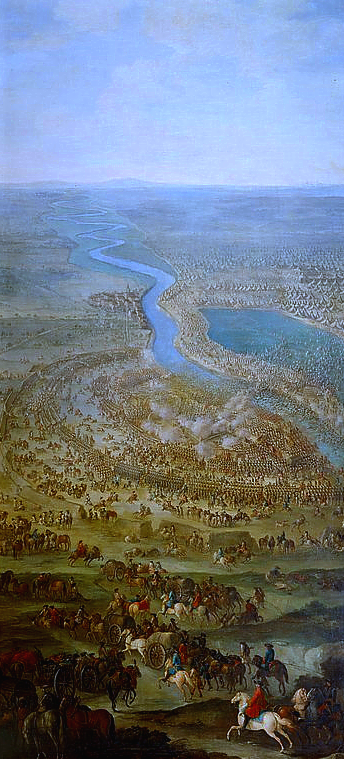
The Battle of Zenta (Franz Eisenhut)
The Battle of Zenta (Franz Eisenhut) — Franz Eisenhut, 1896 - public domain

The battle, stage by stage

  1. 11 September 1697, morning

    Crossing at Zenta

    Sultan Mustafa II's army, marching north along the right (west) bank of the Tisza, has turned to cross into the Banat toward Temesvar. A bridge of boats spans the river about 1.5 km below the village of Zenta (60 boats in Habsburg accounts; 83 wagon-borne pontoons in the Ottoman chronicler Silahdar's). The Sultan, his household and treasury crossed on the 10th; most of the cavalry, the artillery and much of the baggage follow. The Grand Vizier, Elmas Mehmed Pasha, holds the near bank with the janissaries and most of the foot behind a hurried earthwork and a ring of chained wagons, waiting their turn. About 9 AM Eugene's cavalry vanguard, guided by Serbian militia under Jovan Popovic Tekelija, runs into Ottoman horsemen near Zenta, and Pal Deak's hussars capture their commander, Cafer Pasha, who reportedly tells Eugene that the army is in the middle of crossing.

  2. About 3 PM

    Eugene's forced march

    After a march of some ten hours from the south-west, over marshy ground, the Imperial infantry comes up (about 3 PM by the Hungarian Military History Museum's account; one popular account says as late as 6 PM). A courier from Vienna has reportedly brought orders to act with extreme caution; Eugene leaves them unopened. With only a few hours of daylight left and the Ottomans able to finish crossing overnight, he deploys at once. The Hungarian Military History Museum's account puts the army at 51 battalions, 112 squadrons and 60 guns, about 50,000 men by common modern estimates; its own line-by-line order of battle, followed on the map, adds up to more battalions (64) and guns (86), so the counts differ within the source. Contemporary figures of 100,000 or more Ottomans are exaggerated; one modern estimate puts the Ottoman fighting strength at 60,000-70,000, about 35,000 of them in the bridgehead.

  3. About 5 PM

    The crescent

    Within about two hours the Imperial army stands in a crescent around the bridgehead, both ends on the river: Guido Starhemberg's left wing between the entrenchment and Zenta, the center under Commercy with Rabutin's first line and the Saxon and Brandenburg battalions of Reuss behind, and the right wing (under Herberstein by one account, Heister by others) on the river below the bridge, with hussars behind. As the line moves forward, about 4,000 Ottoman horse are said to sortie against the left wing before falling back into the works. The outer earthwork, a rough semicircle anchored on the river at both ends, is unfinished; where the gap lay is disputed (south-west by one Hungarian account, the Szeged or northern side by an Ottoman one).

  4. About 5:30-6 PM

    Storming the works

    Imperial guns are hauled onto the high bank and open on the crowded bridge. Starhemberg's left wing finds the decisive opening: below the high bank a sand bar 30-35 m wide runs along the water, and with the river low his troops push along it into the gap between the end of the entrenchment and the river - by several accounts wading through the shallows - and come in behind the defenders. At the same time the center and right storm the outer line at close quarters; in Eugene's own report, cavalry dismounted and went over the trenches together with the infantry. The janissaries' musketry and the guns of the bridgehead cannot hold them everywhere at once.

  5. About 6:30 PM to nightfall

    The bridge

    Attacked from front and rear, the defense collapses. The janissaries fall back on the wagon fort and then stampede for the bridge, which jams under the press and the Imperial fire; thousands are pushed into the Tisza and drown, or are shot in the water. Sipahis trying to come back across the narrow bridge to help cannot get through. The Grand Vizier, Elmas Mehmed Pasha, is killed, probably by his own men: by the Ottoman account in the TDV Islam Ansiklopedisi (Mucteba Ilgurel), he had two pontoons of the bridge lifted and stood before the gap with drawn sword to stop the fugitives, and his harshness turned them on him (Britannica also says mutinous janissaries killed him). The Sultan's seal, which he carried, is taken from his body. Several beylerbeys, the janissary agha and many pashas die with him. From the far bank, the Sultan watches his army destroyed.

  6. Night of 11-12 September 1697

    Aftermath

    The killing goes on until about 10 PM. Habsburg reports put the Ottoman dead at 20,000-30,000, including perhaps 10,000 drowned, with about 4,000 captured; some Ottoman chronicles give 7,000-8,000. Imperial losses are given as 28 officers and 401 men killed and 1,598 wounded (Habsburg returns as given in the Islam Ansiklopedisi, after Angeli and Arneth), or 699 killed and 1,934 wounded (Hungarian Military History Museum). Mustafa II rides off toward Temesvar with about 1,000 sipahis. The victors take 87 guns, thousands of wagons, camels and oxen, the army's treasury and the seal of the Grand Vizier's office, never before captured. Zenta ended the Sultan's attempt to retake Hungary and opened the way to the Treaty of Karlowitz (1699).

Forces

Eugene brought about 50,000 men (51 battalions, 112 squadrons and 60 guns by the Hungarian Military History Museum's total) against an Ottoman army whose fighting strength one modern estimate puts at 60,000–70,000, only about 35,000 of them in the bridgehead when the attack came. The Imperial order of battle is documented; Ottoman numbers are estimates.

Ottoman army (Sultan Mustafa II; Grand Vizier Elmas Mehmed Pasha)

Army in the field60,000–70,000 (modern estimate) (60,000–150,000)

The Hungarian Military History Museum puts the real fighting strength at no more than 60,000–70,000 and calls contemporary claims of 100,000–150,000 exaggerated; Ciotola, Herman and History Hit give about 100,000. Hungarian Military History Museum (Hadtörténeti Intézet és Múzeum), 'A zentai csata, 1697. szeptember 11.'; Louis Ciotola, 'Turning Back the Turks', Warfare History Network; Mark C. Herman, 'Battle of Zenta', EBSCO Research Starters; History Hit, 'What Was the Significance of the Hapsburg Victory at Zenta?'

In the bridgehead on 11 Septemberabout 35,000

Hungarian Military History Museum. Hungarian Military History Museum (Hadtörténeti Intézet és Múzeum), 'A zentai csata, 1697. szeptember 11.'

Habsburg Imperial army (Prince Eugene of Savoy)

Engagedabout 50,000 (about 44,000–60,000)

Ciotola and Herman give about 50,000. The Hungarian Military History Museum says Eugene found barely 44,000 men in camp instead of the planned 70,000 (History Hit: 70,000 nominal, 35,000 fit), before other contingents joined; the İslâm Ansiklopedisi has him marching with 60,000. Louis Ciotola, 'Turning Back the Turks', Warfare History Network; Mark C. Herman, 'Battle of Zenta', EBSCO Research Starters; Hungarian Military History Museum (Hadtörténeti Intézet és Múzeum), 'A zentai csata, 1697. szeptember 11.'; History Hit, 'What Was the Significance of the Hapsburg Victory at Zenta?'; Erhan Afyoncu, 'Zenta', TDV İslâm Ansiklopedisi 44 (after Angeli, Arneth, Silahdar and the anonymous Ottoman chronicle)

Battalions, squadrons and guns51 battalions, 112 squadrons, 60 guns

The Hungarian Military History Museum's total; its own line-by-line order of battle adds up to 64 battalions and 86 guns (with 112 squadrons), so the counts differ within the source. Hungarian Military History Museum (Hadtörténeti Intézet és Múzeum), 'A zentai csata, 1697. szeptember 11.'

Casualties

The Ottoman army lost perhaps 20,000–30,000 dead by Habsburg counts (7,000–8,000 in some Ottoman chronicles), many of them drowned, plus about 4,000 captured, its guns, baggage and the state seal; Imperial losses were about 430–700 killed and 1,600–1,900 wounded. The Imperial figures are well documented; the Ottoman dead are not. Certainty: fair.

Ottoman army (Sultan Mustafa II; Grand Vizier Elmas Mehmed Pasha)

Killed (including drowned)about 20,000–30,000 (Habsburg figures) (7,000–30,000)

The Hungarian Military History Museum gives about 20,000 killed in the bridgehead and Ciotola some 20,000 dead on the field with up to 10,000 more in the river; the İslâm Ansiklopedisi says Austrian sources put the dead at about 30,000, while some Ottoman sources give total losses of only 7,000–8,000. Hungarian Military History Museum (Hadtörténeti Intézet és Múzeum), 'A zentai csata, 1697. szeptember 11.'; Erhan Afyoncu, 'Zenta', TDV İslâm Ansiklopedisi 44 (after Angeli, Arneth, Silahdar and the anonymous Ottoman chronicle); Louis Ciotola, 'Turning Back the Turks', Warfare History Network

Drowned in the Tiszaabout 2,000 to over 10,000 (2,000–10,000+)

Habsburg reports claimed up to 10,000 or more drowned (Ciotola; History Hit); İlgürel, from the Ottoman side, says about 2,000 of the panicked soldiers fell from the bridge and drowned. Included in the killed figures above, not added to them. Louis Ciotola, 'Turning Back the Turks', Warfare History Network; History Hit, 'What Was the Significance of the Hapsburg Victory at Zenta?'; Mücteba İlgürel, 'Elmas Mehmed Paşa', TDV İslâm Ansiklopedisi 11 (1995)

Senior commanders killedthe Grand Vizier and some 20 pashas

The Hungarian Military History Museum lists Grand Vizier Elmas Mehmed Pasha, the beylerbeys of Anatolia and Bosnia, the janissary agha and 17 more pashas; İlgürel says the Grand Vizier was probably killed by his own soldiers, and Britannica by mutinous janissaries. Hungarian Military History Museum (Hadtörténeti Intézet és Múzeum), 'A zentai csata, 1697. szeptember 11.'; Mücteba İlgürel, 'Elmas Mehmed Paşa', TDV İslâm Ansiklopedisi 11 (1995); Encyclopaedia Britannica, 'Battle of Zenta'

Habsburg Imperial army (Prince Eugene of Savoy)

Killed28 officers and 401 men (429–699)

Habsburg returns as given in the İslâm Ansiklopedisi (after Angeli and Arneth) count 28 officers and 401 men killed; the Hungarian Military History Museum gives 699 killed, and Ciotola about 500. Erhan Afyoncu, 'Zenta', TDV İslâm Ansiklopedisi 44 (after Angeli, Arneth, Silahdar and the anonymous Ottoman chronicle); Hungarian Military History Museum (Hadtörténeti Intézet és Múzeum), 'A zentai csata, 1697. szeptember 11.'; Louis Ciotola, 'Turning Back the Turks', Warfare History Network

Wounded133 officers and 1,465 men (1,598–1,934)

133 officers and 1,465 men in the returns given by the İslâm Ansiklopedisi; 1,934 according to the Hungarian Military History Museum; about 2,000 in Ciotola. Erhan Afyoncu, 'Zenta', TDV İslâm Ansiklopedisi 44 (after Angeli, Arneth, Silahdar and the anonymous Ottoman chronicle); Hungarian Military History Museum (Hadtörténeti Intézet és Múzeum), 'A zentai csata, 1697. szeptember 11.'; Louis Ciotola, 'Turning Back the Turks', Warfare History Network

Equipment and ships

Ottoman guns captured87

The İslâm Ansiklopedisi gives 87 guns; the Hungarian Military History Museum itemizes 80 bronze and 4 iron cannon and 3 five-barreled organ guns. Erhan Afyoncu, 'Zenta', TDV İslâm Ansiklopedisi 44 (after Angeli, Arneth, Silahdar and the anonymous Ottoman chronicle); Hungarian Military History Museum (Hadtörténeti Intézet és Múzeum), 'A zentai csata, 1697. szeptember 11.'

Ottoman standards captured7 horsetail standards and 423 flags

Both the İslâm Ansiklopedisi and the Hungarian Military History Museum give these figures. Erhan Afyoncu, 'Zenta', TDV İslâm Ansiklopedisi 44 (after Angeli, Arneth, Silahdar and the anonymous Ottoman chronicle); Hungarian Military History Museum (Hadtörténeti Intézet és Múzeum), 'A zentai csata, 1697. szeptember 11.'

Ottoman baggage capturedabout 9,000 wagons

The Hungarian Military History Museum and Herman give 9,000 wagons; Herman adds 6,000 camels and 15,000 oxen; İlgürel mentions more than 500 supply wagons with arms and ammunition. Hungarian Military History Museum (Hadtörténeti Intézet és Múzeum), 'A zentai csata, 1697. szeptember 11.'; Mark C. Herman, 'Battle of Zenta', EBSCO Research Starters; Mücteba İlgürel, 'Elmas Mehmed Paşa', TDV İslâm Ansiklopedisi 11 (1995)

The seal1 (state seal)

The Hungarian Military History Museum says the imperial seal was found on the Grand Vizier's neck by Rabutin's commissioner; İlgürel says the seal of Mustafa II fell into enemy hands and is kept in Vienna. Hungarian Military History Museum (Hadtörténeti Intézet és Múzeum), 'A zentai csata, 1697. szeptember 11.'; Mücteba İlgürel, 'Elmas Mehmed Paşa', TDV İslâm Ansiklopedisi 11 (1995)

Then and now: how the ground has changed

The bridgehead lay on the Tisza's right bank just below Zenta (today Senta, Serbia); the river was cut and embanked from the 19th century and has been slowed since 1977 by the Tisa dam at Novi Bečej, and the 1895 battle memorial no longer stands on the battlefield.

Weapons

Ottoman army (Sultan Mustafa II; Grand Vizier Elmas Mehmed Pasha)

Janissary infantry

Janissary infantry

Ottoman standing infantry · 14th–19th century

At Zenta: Janissaries held the entrenched bridgehead.

The Ottoman sultans' professional infantry, among the first standing armies in Europe. They were the core of the final assault at Constantinople in 1453 and manned the siege trenches at Vienna in 1683.

Arms
matchlock musket (tüfek), yatağan sword
Role
the Sultan's household infantry, siege specialists
Recruitment
devşirme levy, later hereditary
Photo: Rålamb Costume Book, 1657 · public domain

Paintings and photographs

The Battle of Zenta (Franz Eisenhut)
The Battle of Zenta (Franz Eisenhut) Franz Eisenhut's 1896 painting of the battle, made for the millennium of Hungary. Franz Eisenhut, 1896 - public domain · source

Free for everyone every year on its anniversary: September 11.

Accuracy score: 52/100 (limited)

How the accuracy score works

Sources and method

Zenta, 11 September 1697. Deployment, order of battle, timings, the unfinished outer earthwork and the sand bar follow the Hungarian Military History Museum's account A zentai csata, 1697. szeptember 11. (Hadtorteneti Muzeum, drawing on Eugene's report to Leopold I). The Ottoman side follows the Islam Ansiklopedisi entry on Zenta (after Silahdar's Nusretname, the anonymous Ottoman chronicle, Cantemir and Rycaut) and Mucteba Ilgurel, 'Elmas Mehmed Pasa', TDV Islam Ansiklopedisi 11 (1995), for the Grand Vizier's death, with Encyclopaedia Britannica. The works, wagon ring, bridge, far-bank redoubt and Sultan's camp follow the 1697 Augsburg broadsheet Warhaffte Beschreibung der jungsten gloriosen Victori ... bey Zenta (Jakob Koppmayer; Library of Congress, Hauslab collection) and the engraved Plan de la Bataille de Zenta (c. 1697, Royal Museums Greenwich). Further: Louis Ciotola, 'Turning Back the Turks' (Warfare History Network); History of War (2019); Zoltan Peter Bagi, 'Szeged visszafoglalasa es a zentai utkozet', Letunk 50 (2020). Standard works: Kriegsarchiv, Feldzuge des Prinzen Eugen von Savoyen (Vienna, 1876-92); Derek McKay, Prince Eugene of Savoy (1977); Nicholas Henderson, Prince Eugen of Savoy (1964); Caroline Finkel, Osman's Dream (2005). Memorial and town: muemlekem.hu, the Senta Institute for Heritage Protection and Vojvodina Tourist Organization. The bridge is placed about 1.5 km below Zenta as the Hungarian account gives; neither it nor the trace of the works has been fixed by survey or archaeology, and unit positions inside the bridgehead are interpretive.

Where the positions come from

Further reading