Battlefield Atlas
Wars of the Roses · 1471 Members · from $3

Tewkesbury, 4 May 1471

On 4 May 1471, three weeks after his victory at Barnet, Edward IV caught the Lancastrian army of Queen Margaret of Anjou at Tewkesbury as it tried to reach Wales across the Severn. The Duke of Somerset's flank attack was beaten off and taken in the rear by 200 spears posted in Tewkesbury Park; the Lancastrian centre collapsed and the army was routed into the Bloody Meadow, the rivers and the town. Edward, Prince of Wales, the only son of Henry VI, was killed, and Somerset and others were taken from the Abbey and beheaded two days later. With Henry VI dead in the Tower before the month was out, the battle ended the Lancastrian cause for a generation.

Open the interactive map8 stages on modern satellite imagery and terrain, with 3D elevation

This battle opens with Battlefield Enjoyer ($3 a month on Patreon), which unlocks every battle in the atlas and every one added later. Free battles include Hattin, Agincourt, Vítkov Hill, Bosworth, Yorktown, Waterloo, The Alamo, Antietam, Little Bighorn, Belleau Wood, Omaha Beach, Ia Drang, 73 Easting, Wanat, Najaf.

The battle (Ghent manuscript)
The battle (Ghent manuscript) — Ghent manuscript · public domain

The battle, stage by stage

  1. 3 May 1471, evening

    A race for the Severn

    Queen Margaret of Anjou, her son Edward, Prince of Wales, the Duke of Somerset and the Earl of Devon landed at Weymouth on 14 April, the day Edward IV won at Barnet. Gathering men in the West Country, they marched by Bath and Bristol for the Severn crossing at Gloucester, hoping to join Jasper Tudor in Wales. Gloucester shut its gates against them, and after a long, hot march up the road beside the river the exhausted army reached Tewkesbury in the evening. Unable to cross before Edward caught them, Somerset chose to stand, camping on the Gastons south of the town. Edward, who had shadowed them along the Cotswold edge by Cheltenham, camped about three miles off — by tradition at Tredington.

  2. 4 May 1471, early morning

    A right evil place to approach

    The Lancastrians — perhaps 6,000 men by Historic England's estimate — drew up in three 'battles' with the town and abbey at their backs: Somerset on the right (west), Lord Wenlock with the young Prince in the centre, Devon on the left reaching to the marshy banks of the Swilgate. The Yorkist Arrivall calls their field 'a right evil place to approach', cut up with lanes, deep ditches, hedges and trees. Edward's army, probably a little smaller but richer in archers and horse, marched up from the south in its three battles. Seeing a park full of wood on his left, where an ambush might lie, Edward detached about 200 spears to watch it.

  3. 4 May, morning

    Guns and arrows

    Edward arrayed his army south of and parallel to the Lancastrians: Gloucester on the left facing Somerset, the King in the centre, Hastings on the right. The Yorkist guns and archers — Gloucester's especially, by Historic England's reading — opened a heavy fire of shot and arrows into the Lancastrian line, which was badly placed to answer it. The 200 spears took post in Tewkesbury Park on the Yorkist left, about a quarter of a mile from the field. Margaret's Camp, a moated site in front of the Yorkist line, may have served as an outpost; its role is uncertain.

  4. 4 May, morning

    Somerset goes round

    Rather than stand under the arrows, Somerset led his ward (or part of it) out of the line by what the Arrivall calls 'certain paths and ways' known beforehand — on Historic England's reading, down the lane through Lincoln Green, east of the park — and came out on the flank of the Yorkist army, falling on the end of the King's own battle. The route and the exact point of attack are conjectural; Somerset may have used the hillock at Southwick Park. Edward's men turned and met him hand to hand.

  5. 4 May, morning

    The 200 spears

    The King's battle held, and drove Somerset's men back across a ditch and hedge and up the slope, where Gloucester's ward joined in. At that moment the 200 spears, seeing no ambush in the park, charged out of the trees into their flank and rear. Somerset's attack collapsed; his men fled in disorder, many toward the park and the meadow below it. Somerset himself got back to the main Lancastrian line. Wenlock's centre, which Somerset had apparently expected to follow him, had not moved.

  6. 4 May, late morning

    The centre breaks

    Encouraged by the rout of Somerset's ward, Edward and Hastings pressed forward against Wenlock and Devon, and the whole Lancastrian line gave way. A story first told in Tudor chronicles (Hall, Holinshed) has Somerset, furious at Wenlock's failure to support him, calling him a traitor and dashing his brains out with an axe; no contemporary account says so, and Wenlock may simply have died in the fighting. Within a short time the Lancastrian army was in flight.

  7. 4 May, midday

    The Bloody Meadow

    The fugitives ran in every direction. Many were funnelled into the narrow valley on the edge of the park, ever since called the Bloody Meadow, where they were cut down; others made for the Severn at Lower Lode, or toward the town, the mill and the Mill Avon, where many drowned, or across the Swilgate to the Abbey. The Earl of Devon, John Beaufort (Somerset's brother) and Wenlock died. Prince Edward, the last hope of the Lancastrian line, was killed — the Arrivall says in the field as he fled toward the town; later writers tell of him crying to Clarence for help, or being murdered after the battle in the King's presence. Perhaps 2,000 Lancastrians died; Yorkist losses were light.

  8. 4–6 May 1471

    Sanctuary and the axe

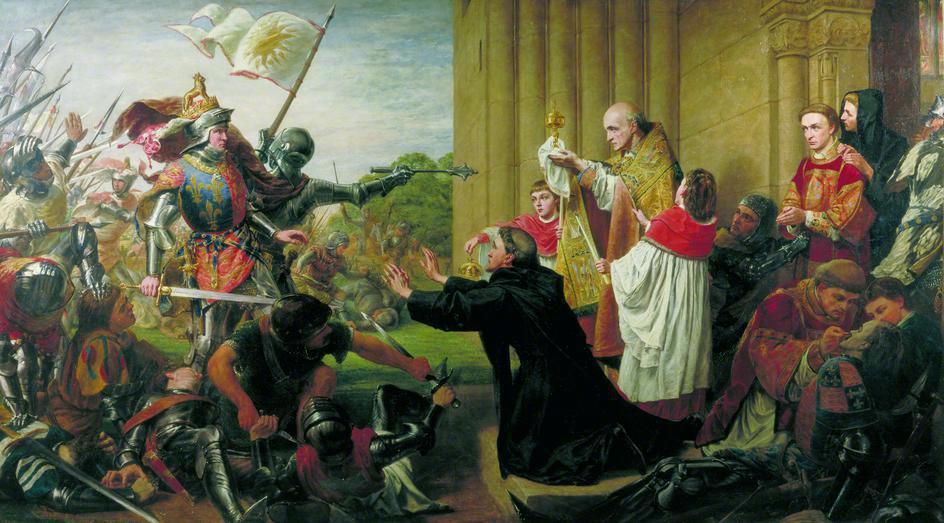
    Somerset, the Prior of the Knights of St John, Sir John Langstrother, and other leaders fled into the Abbey. Edward entered after them; by tradition a priest holding the Sacrament barred his way, and he granted a pardon. But the Abbey had no formal right of sanctuary, and on 6 May Somerset and about a dozen others were brought out, tried before Gloucester as Constable and Norfolk as Marshal, and beheaded in the market place. Margaret was taken a few days later at a religious house nearby; Henry VI died in the Tower on the night Edward returned to London, 21 May. The Prince was buried in the Abbey choir, where a brass marks the place.

Weapons

Lancastrian army (Somerset, Prince Edward, Wenlock, Devon)

English longbow

English longbow

Self bow of yew · about 1250–1550

At Tewkesbury: Both armies opened with archery; the Lancastrians on the Gastons suffered under Yorkist arrows and guns.

A single stave of yew, as tall as a man, that took years of practice to draw. Massed in thousands behind stakes or hedges, English archers broke French charges at Crécy, Poitiers and Agincourt by killing and maddening the horses and pinning men-at-arms in the crush. Bows recovered from the Mary Rose (sunk 1545) show how heavy the draw weights were. In the Wars of the Roses both sides fielded massed longbowmen, as at Towton in 1461.

Draw weight
commonly about 100–150 lb (Mary Rose bows)
Range
about 250–300 yd for volleys with light arrows
Rate
up to 10–12 arrows a minute for a trained archer
Photo: Archer's kit and longbow from the Mary Rose · Tim Sheerman-Chase · CC BY 4.0
English bill

English bill

Polearm · 14th–16th century

At Tewkesbury: Somerset's men attacked down the lanes with bills and poleaxes.

A farm billhook on a long shaft, the standard weapon of English infantry in the Wars of the Roses alongside the longbow. Its hook could pull armoured men down and its spike and blade finish them.

Length
about 1.8–2.4 m
Head
hooked blade with spike
Users
English foot soldiers
Photo: Monstrelet · CC BY-SA 3.0

Yorkist army (Edward IV, Gloucester, Hastings)

Early cannon (pot-de-fer and ribalds)

Early cannon (pot-de-fer and ribalds)

Gunpowder artillery · from the 1320s

At Tewkesbury: Edward IV's guns, stronger than the Lancastrians', galled their line into attacking.

The earliest European guns were small cast vessels firing bolts or balls. The Italian chronicler Giovanni Villani says the English fired guns at Crécy, frightening the horses; English royal accounts show guns were later sent to the siege of Calais, and historians still argue over whether any fired on 26 August 1346. The illustration, from Walter de Milemete's treatise of 1326, is one of the oldest pictures of a gun.

Projectile
iron or lead balls, or large bolts
Charge
black powder
Effect
more noise and shock than killing power
Photo: Walter de Milemete, 1326 · public domain
Poleaxe

Poleaxe

Staff weapon · about 1400–1550

At Tewkesbury: Men-at-arms fought on foot with poleaxes and swords.

The armoured man-at-arms' weapon for fighting on foot: an axe or hammer head with spikes on a long haft, built to crush and pierce plate. At Agincourt dismounted men-at-arms on both sides fought with poleaxes, swords and lances cut down to a manageable length.

Length
about 1.5–2 m
Head
axe or hammer, with a top spike and often a back spike
Use
two-handed, by armoured men on foot
Photo: Italian poleaxe, Metropolitan Museum of Art · CC0

Paintings and photographs

The battle (Ghent manuscript)
The battle (Ghent manuscript) The Battle of Tewkesbury as illustrated in the Ghent manuscript of the Arrivall. Ghent manuscript · public domain · source
Beheading of Somerset
Beheading of Somerset Somerset beheaded at Tewkesbury on 6 May, with Edward IV watching (Ghent manuscript). Ghent manuscript · public domain · source
Sanctuary (Burchett)
Sanctuary (Burchett) Richard Burchett's 'Sanctuary' (1867): a priest begs Edward IV to stop the pursuit into the Abbey. Richard Burchett · public domain · source
The Bloody Meadow
The Bloody Meadow The Bloody Meadow, where fleeing Lancastrians were cut down. Roy Hughes · CC BY-SA 2.0 · source

Free for everyone every year on its anniversary: May 4.

Accuracy score: 58/100 (limited)

How the accuracy score works

Sources and method

Tewkesbury, 4 May 1471. Deployment follows Historic England's Register of Historic Battlefields entry (Battle of Tewkesbury 1471, list entry 1000039): Lancastrians on the Gastons, W–E Somerset, Wenlock, Devon, reaching the Swilgate; Yorkists parallel to the south, W–E Gloucester, Edward, Hastings; about 200 spears in the park; Somerset's detachment by the Lincoln Green lane; strengths about 6,000 and 5,500 (from casualty lists and payment records), Lancastrian dead about 2,000. Historic England notes 'some dispute' over the positions, and the lines here are conjectural. The only near-contemporary narrative is the Yorkist Historie of the Arrivall of Edward IV (1471); the Abbey chronicle (via Leland), Warkworth and the Tudor chroniclers Hall and Holinshed add later detail (Wenlock's death by Somerset's axe is Tudor tradition). Local research: the Tewkesbury Battlefield Society; Tewkesbury Historical Society, Leland and the Site of the Battle, A Fresh Look at the Battle (an alternative eastern Yorkist approach and Walton's Wood for the spears) and Queen Margaret Camp; University of Gloucestershire, The Battle of Tewkesbury; Parks & Gardens UK, Tewkesbury Park. Fixed points from the statutory lists: Margaret's Camp moated site (1018449), Tewkesbury Abbey (1201159), Gupshill Manor (1201237), Tewkesbury Park (1282744) and Tredington church (1304016), with National Grid references converted to latitude/longitude; the Bloody Meadow, the Swilgate, Lincoln Green Lane, Lower Lode and the Cross are placed approximately from OpenStreetMap. Images from Wikimedia Commons.

Where the positions come from

Further reading