Maldon, 10 or 11 August 991
In August 991 a Viking fleet, 93 ships by the Anglo-Saxon Chronicle and possibly led by Olaf Tryggvason, camped on Northey Island in the Blackwater estuary below Maldon, Essex. Ealdorman Byrhtnoth met it with his household troops and the Essex fyrd at the tidal causeway to the mainland. When the guard on the causeway held it, Byrhtnoth let the Vikings cross to fight on open ground. He was killed, part of his army fled, and his household died fighting around his body. The defeat led to the first great payment of tribute to the Danes. Nearly all the detail comes from the Old English poem 'The Battle of Maldon', a heroic work that survives only as an incomplete copy; the site opposite Northey Island is the accepted identification but has never been proven, and every position on this map is interpretive.
Open the interactive map7 stages on modern satellite imagery and terrain, with 3D elevation
This battle opens with Battlefield Explorer ($4.99 a month or $39 a year), which unlocks every battle in the atlas and every one added later. Lifetime access and war packs are one-time options. Free battles include Thermopylae, Actium, Viking raid on Lindisfarne, Hattin, Agincourt, Vítkov Hill, Bosworth, Fort William Henry, Yorktown, Waterloo, The Alamo, Antietam, Little Bighorn, Belleau Wood, Omaha Beach, Inchon, Ia Drang, Goose Green, 73 Easting, Wanat, Baghdad Thunder Runs, Battle of Raqqa, Donetsk Airport, Battle of Kyiv, Battle of Hostomel Airport, Siege of Mariupol, Kharkiv counteroffensive, Kherson counteroffensive, Bakhmut, Mala Tokmachka and Robotyne, Avdiivka.
The battle, stage by stage
- 10 or 11 August 991
The raiders on Northey
According to the Chronicle's A text, a fleet that has plundered Folkestone, Sandwich and Ipswich comes up the Blackwater estuary and lands its crews on Northey Island, about two miles below the burh of Maldon. The same entry, placed under 993, merges the events of 991 and 994; it gives the fleet as 93 ships and names Olaf, probably Olaf Tryggvason, the future king of Norway, though whether he led at Maldon is uncertain. Ealdorman Byrhtnoth of Essex, an elderly, white-haired, very tall veteran by one account, brings his household warriors and the Essex fyrd, the shire levy, down to the mainland shore opposite. In the surviving poem he orders the horses driven off so his men fight on foot. The site itself is a modern identification (Laborde, 1925): likely, accepted by Historic England, but unproven, and no battle finds have been reported. Earlier writers placed it at Heybridge or on the Osea causeway, and Bessinger (1963) disputed Laborde; the case for Northey rests on the poem's tides and topography, not on finds.
- High water
Words across the water
With the tide in, the channel the poem calls Pante (the Blackwater, or the creek between Northey and the mainland) is impassable. A Viking messenger shouts across that the English can buy peace with gold rings. Byrhtnoth, in the poem, answers that they will pay tribute in spears and old swords. Geologists Petty and Petty estimated that relative sea level has since risen by about 2 meters and that the channel was then about half its present width, about 120 yards at high water, close enough for a shouted exchange. The speeches are poetry, not a transcript.
- The ebb
Wulfstan holds the bridge
As the tide goes out, the Vikings mass at the island end of the crossing, which the poem calls the brycg, read today as the causeway (the Heybridge theory read it as a bridge; covered 6 to 8 feet deep at high tide in 991, by the Pettys' estimate). Byrhtnoth sends Wulfstan, son of Ceola, to hold it, with Ælfhere and Maccus beside him. On the narrow causeway a few men can stop an army, and the poem says Wulfstan struck down with his spear the first Viking to step onto it. The timing of the low tide decides everything: the armies can meet only while the causeway is uncovered.
- Low water
'Too much land': the crossing
Unable to force the causeway, the Vikings ask to be allowed across to fight on open ground. Byrhtnoth agrees and pulls his line back from the shore. The poet says he did so 'for his ofermod', usually translated as pride or overconfidence, and that he 'yielded too much land' to a hateful people. Historians debate this: Historic England notes that if he had refused, the fleet could simply have sailed off to raid elsewhere along the coast. The Vikings wade 'west over Pante' and form up on the mainland, possibly south of the causeway. How far the English fell back is not recorded; the distance shown is a guess.
- Later (time unrecorded)
Shield wall; Byrhtnoth falls
The English stand in a shield wall, Byrhtnoth and his household in the center and the fyrd on either side (the Battlefields Trust reading of the poem). Bows and thrown spears give way to close fighting. In the poem Byrhtnoth kills several attackers, is wounded by spears and then in the arm, commends his soul to God, and is cut down. Byrhtferth's Life of St Oswald, written within about a decade, also has him fall, says the rest of the English fled and that the Danes were too badly hurt to man their ships, though it does not name Maldon. The Liber Eliensis, written two centuries later, says his head was carried off; the body was buried at Ely. It tells a very different story: an earlier English victory at Maldon and a final battle lasting a fortnight.
- Later (time unrecorded)
Godric runs
Godric, son of Odda, leaps onto Byrhtnoth's own horse and rides for the wood with his brothers Godwine and Godwig. The poem says many more broke and followed, thinking the man on their lord's horse was Byrhtnoth himself. The poem names them as cowards; the Battlefields Trust report reads it to mean most of the fyrd fled. Where the wood stood is unknown; place-names such as Woodham and Hazeleigh suggest old woodland to the west and south-west. The lines of flight shown are illustrative.
- End of the battle
The last stand of the household
Byrhtnoth's household troops close up around his body and fight on, each in turn, in the poem's telling, vowing not to leave the field: Ælfwine, Offa, Leofsunu, Dunnere, and the Northumbrian hostage Æscferth with his bow. The old retainer Byrhtwold speaks the poem's best-known lines: 'Mind must be the firmer, heart the bolder, courage the greater, as our strength grows less.' Soon after, with a second Godric, son of Æthelgar, fighting to his death ('not the Godric who fled'), the text breaks off. The Chronicle says only that the Danes 'had control of the field'. The A text says peace was then made with Olaf; no source records an attack on Maldon itself. That year, on Archbishop Sigeric's advice, Æthelred's council began paying tribute: £10,000 in 991.
Forces
No source gives either army's strength. Estimates from the Chronicle's 93 ships run from about 2,800 to 5,600 Vikings; the English force is a modern guess of up to 3,000–4,000, and authorities disagree on which side was larger.
Viking army
| Present (modern estimate)Estimates multiply the 93 ships by 30–60 men per ship; English Heritage reckons about 4,900 at the start of the raid and about 4,000 at Maldon. The 93 may itself be a scribal slip for the 94 ships of 994. Battlefields Trust, Maldon battlefield report (Glenn Foard, 2003); English Heritage Battlefield Report: Maldon 991; Encyclopaedia Romana, 'Battle of Maldon, AD 991' | about 2,800–5,600 (2,790–5,580 (Battlefields Trust); about 4,000 at Maldon (English Heritage)) |
| ShipsThe A text records 93 ships under 993 in an entry that mixes the events of 991 and 994. University of Oxford Old English course pack, 'The Battle of Maldon: the history' | 93 (Anglo-Saxon Chronicle, A text) |
English (Essex fyrd and Byrhtnoth's household)
| Present (modern estimate)The Battlefields Trust suggests at most about 3,000–4,000, mostly fyrd with a small core of retainers; English Heritage argues Byrhtnoth almost certainly outnumbered the Vikings. No source gives a figure. Battlefields Trust, Maldon battlefield report (Glenn Foard, 2003); English Heritage Battlefield Report: Maldon 991 | unknown; perhaps up to 3,000–4,000 |
Casualties
Byrhtnoth and most of his household died and the Vikings also suffered heavily, but no source counts the dead on either side; the figures are unknowable. Certainty: poor.
Viking army
| Killed and woundedNo source gives a figure. Byrhtferth's Life of St Oswald says the Danes were badly wounded, the poem says they paid dearly, and the Battlefields Trust report notes they reportedly struggled to man their ships afterward. University of Oxford Old English course pack, 'The Battle of Maldon: the history'; Battlefields Trust, Maldon battlefield report (Glenn Foard, 2003) | unknown; 'heavy' by every account |
English (Essex fyrd and Byrhtnoth's household)
| KilledHistoric England records 'heavy casualties on both sides' and the English Heritage report says there is no record of numbers; the poem has Byrhtnoth's household die almost to a man while much of the fyrd fled. Historic England, Register of Historic Battlefields, 'Battle of Maldon 991'; English Heritage Battlefield Report: Maldon 991 | unknown; heavy |
| Leaders killedRecorded in the Anglo-Saxon Chronicle and Byrhtferth's Life of St Oswald; the poem also names retainers who fell, such as Ælfwine, Offa and Godric son of Æthelgar. The Liber Eliensis, two centuries later, says the Danes took his head. University of Oxford Old English course pack, 'The Battle of Maldon: the history'; University of Oxford Old English course pack, 'The Battle of Maldon' (Killings translation) | Ealdorman Byrhtnoth of Essex |
Then and now: how the ground has changed
The fields opposite Northey Island are still open farmland, but the estuary has changed: relative sea level has risen about 2 meters since 991, the channel to the island has roughly doubled in width, saltings and mudflats have formed, and the low ground now lies behind a sea wall.
- In 991 the shoreline was firm, the land was dry, and the channel between the mainland and Northey Island was about half its present width; Historic England warns that the present creeks give a misleading picture of the battlefield. Source: Historic England, Register of Historic Battlefields, 'Battle of Maldon 991'
- Because south-east England is sinking, relative sea level has risen about 6 feet since the 10th century. Petty and Petty estimated the crossing was then about 120 yards wide at high water (about 240 yards today) and covered 6 to 8 feet deep at high tide. Source: English Heritage Battlefield Report: Maldon 991; Battlefields Trust, Maldon battlefield report (Glenn Foard, 2003)
- Rising water first flooded the low ground; it was later reclaimed behind a sea wall shown on the 1822 tithe map. Much of the coastal land flooded regularly until about 1900, parts of the battlefield as late as 1881, and it now lies below mean high water seaward of the wall. Source: English Heritage Battlefield Report: Maldon 991; Battlefields Trust, Maldon battlefield report (Glenn Foard, 2003)
- The saltings that now edge the shore may not have existed in 991; the Pettys described compacted red soil running almost to the water's edge, and mud has since built up on the seaward side of the wall. Source: English Heritage Battlefield Report: Maldon 991; Historic England, Register of Historic Battlefields, 'Battle of Maldon 991'
- The battlefield area is the lowest ground nearby, rising toward South House Farm; the higher ground to the north is now a reclaimed landfill site, which has altered ground levels. Source: English Heritage Battlefield Report: Maldon 991; Battlefields Trust, Maldon battlefield report (Glenn Foard, 2003)
- The 991 ground surface lies buried under alluvium, which may preserve battle evidence, though no finds have been reported. Source: Battlefields Trust Resource Centre, 'Maldon: the battlefield'
- The poem's wood is lost and its extent unknown; place-names such as Woodham Walter, Woodham Mortimer, Hazeleigh and Purleigh suggest old woodland to the west and south-west. Source: English Heritage Battlefield Report: Maldon 991
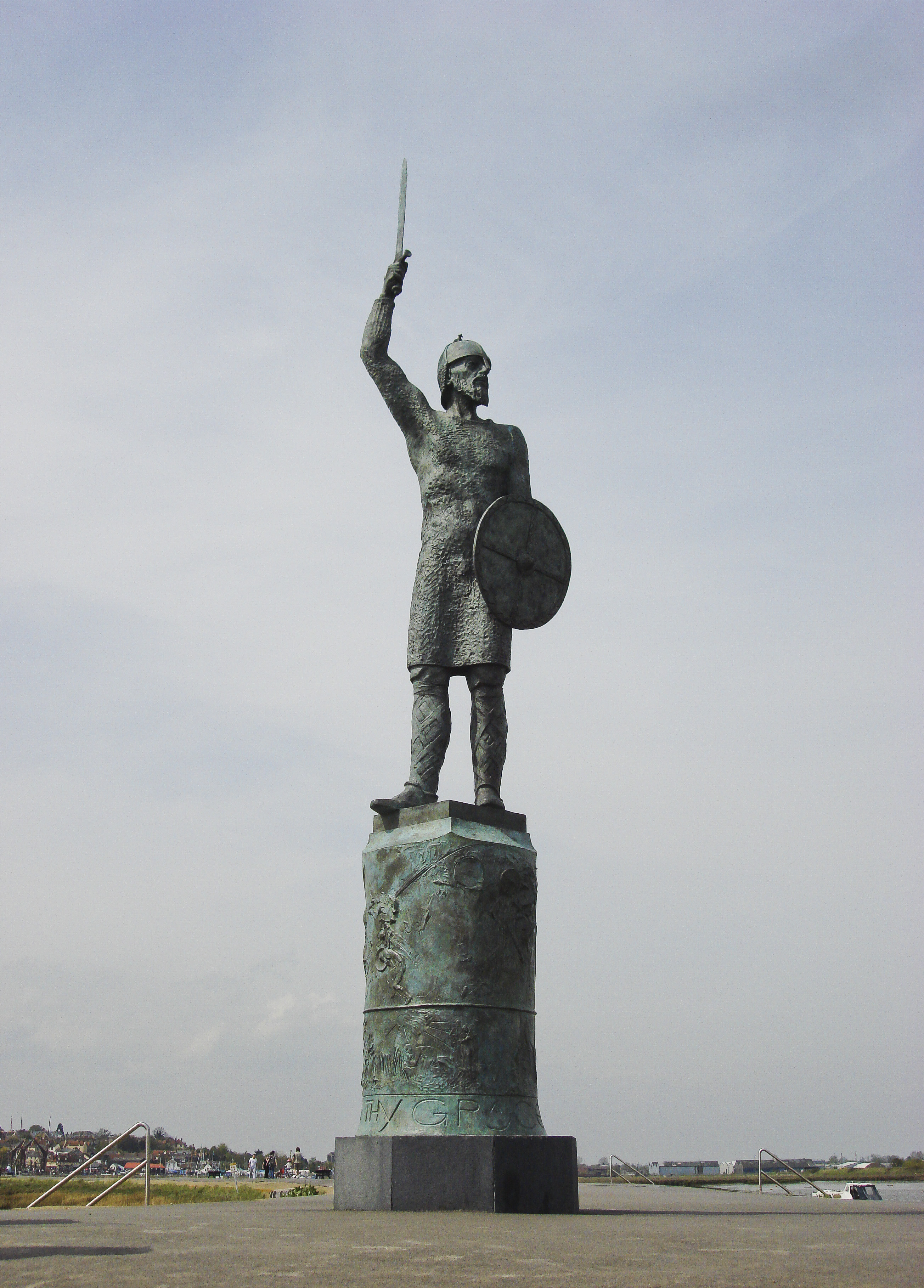
- Today the causeway is covered for about three hours either side of high tide. The fields on either side of the causeway track are the registered battlefield and are reached by the dyke path and the National Trust's circular walk; a statue of Byrhtnoth (2006) stands at the end of Maldon's promenade. Source: National Trust, 'Northey Island circular walk'
The interactive map can show the period landscape (1 shape: Ground lost to the widened channel since 991, mainland side (approximate)) under the units. Open the map.
Paintings and photographs


Free for everyone every year on its anniversary: August 10–11.
Accuracy score: 42/100 (limited)
- Sources15/40
One heroic poem, incomplete and known only from an 18th-century transcript, carries nearly all the detail; the Chronicle and the Life of St Oswald give only the outcome and Byrhtnoth's death.
- Fixed points16/30
Registered battlefield, Northey Island, the causeway line and South House Farm are mapped, but the site is a 1925 identification never confirmed by finds, and the 991 shoreline and causeway are reconstructions.
- Movement detail7/20
The poem gives a clear sequence (exchange at high water, causeway held on the ebb, crossing, shield wall, flight, last stand) but no distances or directions; positions are illustrative.
- Corroboration4/10
Chronicle, Byrhtferth and the Ely tradition agree on the death and defeat; the tactical story rests on the poem alone.
Sources and method
Where the positions come from
- Register Historic England Register of Historic Battlefields, entry 1000019 (TL 86758 05586): fighting around Northey Island and the tidal causeway
- Battlefield report English Heritage Battlefield Report, Maldon 991 (1995): battlefield from mean high water about 800 m inland to South House Farm; causeway about 120 yards long in 991
- Battlefield report Battlefields Trust report (Glenn Foard, 2003): mainland opposite Northey Island, TL 867055; Heybridge and Osea sites rejected as less likely
- Geology Petty and Petty (1976, 1993), via the EH and Battlefields Trust reports: relative sea level up about 6 ft; channel about half its present width
- Modern map South House Farm (listed building 1256370, TL 863054); Geograph aerial 2127238 of the causeway (TL 873 058); Byrhtnoth statue (2006)
- Scholarship Site first proposed by E. D. Laborde (English Historical Review, 1925); still regarded as unproven ('Landes to fela', Oxford Research Archive)
Further reading
- Register Battle of Maldon 991 (list entry 1000019) — Historic England, Register of Historic Battlefields
- Register Battlefield Report: Maldon 991 — English Heritage (1995)
- Battlefield authority Battle of Maldon (battlefield report) — Glenn Foard, Battlefields Trust (2003)
- Battlefield authority Maldon: the battlefield — Battlefields Trust Resource Centre
- Primary source The Battle of Maldon (translation, Douglas B. Killings) — University of Oxford Old English course pack
- Primary source The Battle of Maldon: the history (Chronicle texts, Byrhtferth, Liber Eliensis) — University of Oxford Old English course pack
- Reference Battle of Maldon, AD 991 — Encyclopaedia Romana (University of Chicago)
- Reference The Battle of Maldon — Encyclopaedia Britannica
- Scholarship Landes to fela: Geography, Topography and Place in The Battle of Maldon — Oxford University Research Archive
- Site authority Northey Island circular walk — National Trust