Battlefield Atlas
Norman Conquest · 1066 Locked

Fulford, 20 September 1066

On 20 September 1066 the Norwegian king Harald Hardrada and the exiled earl Tostig Godwinson defeated the northern English earls Edwin of Mercia and Morcar of Northumbria at Fulford (Gate Fulford), about a mile and a half south of York. The earls blocked the road from the Norwegian ships at Riccall where it crossed a ford over Germany Beck, between the River Ouse and a marsh. Their first attack drove back the weaker Norwegian wing, but Harald's counterattack broke the English line, and many men died in the beck, in the marsh and in the river. York surrendered and gave hostages. Five days later Harold II destroyed the Norwegian army at Stamford Bridge, and three weeks after that he died at Hastings. The sources are brief. The Anglo-Saxon Chronicle gives the bare outline, and the battle plan comes from Snorri Sturluson's saga of about 1230. The site at Germany Beck is the most likely one, but it is unproven and is not a registered battlefield. It is now partly covered by a housing development, after a long, contested planning dispute.

Open the interactive map6 stages on modern satellite imagery and terrain, with 3D elevation

This battle opens with Battlefield Explorer ($4.99 a month or $39 a year), which unlocks every battle in the atlas and every one added later. Lifetime access and war packs are one-time options. Free battles include Thermopylae, Actium, Viking raid on Lindisfarne, Hastings, Hattin, Agincourt, Vítkov Hill, Bosworth, Fort William Henry, Yorktown, Waterloo, The Alamo, Antietam, Little Bighorn, Belleau Wood, Omaha Beach, Inchon, Ia Drang, Goose Green, 73 Easting, Wanat, Baghdad Thunder Runs, Battle of Raqqa, Donetsk Airport, Battle of Kyiv, Battle of Hostomel Airport, Siege of Mariupol, Kharkiv counteroffensive, Kherson counteroffensive, Bakhmut, Mala Tokmachka and Robotyne, Avdiivka.
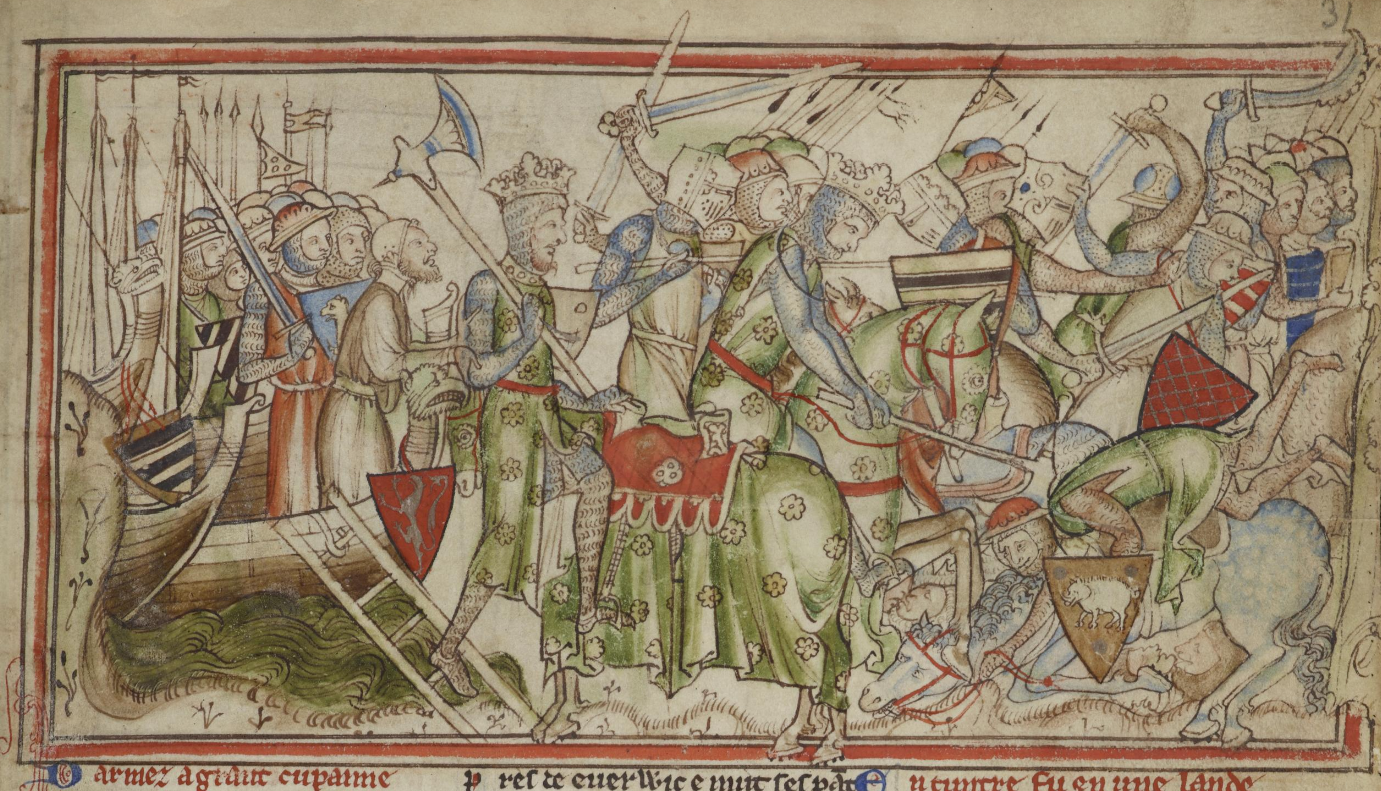
Harald's landing and Fulford (Matthew Paris)
Harald's landing and Fulford (Matthew Paris) — Matthew Paris — public domain

The battle, stage by stage

  1. Mid-September 1066

    The fleet in the Ouse

    Harald Hardrada, king of Norway, has crossed the North Sea with a fleet that Chronicle D puts at about 300 ships (John of Worcester says more than 500). The exiled earl Tostig Godwinson, driven out of Northumbria in 1065, has joined him. After raiding the Yorkshire coast they sail up the Humber and the Ouse and land at Riccall, about nine to ten miles south of York; the exact day is not recorded. In York the northern earls, Edwin of Mercia and his brother Morcar of Northumbria, who replaced Tostig, gather 'as great a force as they could', in the Chronicle's words. King Harold II is far to the south, where he has just stood down the fleet and levies that had waited all summer for William of Normandy.

  2. 20 September 1066 (Wednesday)

    The earls block the road

    The Norwegians march north toward York along the road from Riccall, leaving a strong guard with the ships. About a mile and a half short of the city walls, the earls bar the way where the road crosses Germany Beck at a ford south of Gate Fulford. The English line runs from the tidal Ouse on its right, across the narrow moraine ridge carrying the road (no more than 400 meters wide, by the Battlefields Trust's description), to marshy ground on its left. In Snorri Sturluson's saga, written about 1230, Harald forms his line with his banner (Land-Ravager in Laing's translation, often called Landwaster) beside the river, where the line was thickest, and thinnest along a ditch where the weakest men stood, beside 'a morass, deep, broad, and full of water'. Most modern accounts put Edwin by the river and Morcar toward the marsh, and have the English strike before the whole Norwegian army is up. All positions are interpretive.

  3. 20 September, the opening fight

    Morcar's attack

    Morcar's men go forward against the weakest part of the Norwegian line, the wing along the ditch away from the river, and drive it back toward the marsh. In the saga the English follow the giving wing, 'thinking the Northmen would fly', and Morcar's banner 'advanced then bravely'. The Chronicle (C) says the earls 'made great slaughter' of the invaders, and the Battlefields Trust notes that the English had the early advantage. Where exactly the line broke is not known; the fight is drawn here east of the old road, as most reconstructions place it.

  4. 20 September, later

    The beck fills with dead

    Harald answers by sounding the charge and leading his best troops, with Landwaster carried before him, across the beck from the river side into the English flank. The Battlefields Trust suggests that Norwegians also got round the English left, perhaps along an old Roman road over the marsh several hundred meters east of the ford. The English line collapses. Edwin's men by the river are cut off and fall back toward York, and Morcar's are trapped between the beck and the marsh. Snorri says the ditch was 'so filled with dead that the Norsemen could go dry-foot over the fen', a saga image best taken as literary. The English sources say plainly that many English were 'slain or drowned or driven in flight' (Chronicle C), and John of Worcester writes that more drowned in the river than fell in the field. Snorri also has Morcar killed here, but both earls survived.

  5. 20-24 September

    York submits

    The Norwegians hold the field, and the road to York lies open. Harald does not storm the city. York negotiates its surrender and agrees to give hostages: the Chronicle (C) says the invaders took hostages from the borough and offered 'an abiding peace', and John of Worcester says 150 hostages were exchanged each way. By C's account the Northumbrians were also to march south with Harald to win the kingdom. The army falls back to its ships at Riccall, and further hostages are apparently to be handed over at Stamford Bridge, east of York. The Fulford Battlefield Society argues that the victors spent these days reworking iron gathered from the field at small hearths just south of the beck. That claim is disputed.

  6. 25 September 1066, and after

    Five days to Stamford Bridge

    On 25 September Harald and Tostig go to Stamford Bridge to collect the hostages, leaving about a third of the army at the ships. They are caught there by King Harold II, who has come north at great speed and passed through York that morning. Harald and Tostig are both killed, and the survivors go home in 24 ships (Chronicle D). Edwin and Morcar, whose levies were shattered at Fulford, take no further part in the year's fighting. Three days later, on 28 September, William of Normandy lands at Pevensey, and on 14 October Harold is killed at Hastings without the northern earls' men beside him. How much Fulford's losses cost him there is debated.

Forces

No source gives either army's size at Fulford. The Norwegians came in about 300 ships (D; John of Worcester says over 500) and left a guard at Riccall. Modern guesses run from about 5,000 to 7,000-8,000 a side, and some go higher.

Norwegian army (Harald Hardrada and Tostig)

FleetChronicle D gives 300 ships; John of Worcester more than 500 large ships. Anglo-Saxon Chronicle (C, D, E), 1066, extracts, Fulford Battlefield Society; John of Worcester (Florence of Worcester), 1066, text, Fulford Battlefield Societyabout 300 ships (ASC D) (more than 500 (John of Worcester))
ArmyThe Battlefields Trust says numbers are uncertain; the Engliscan Gesithas suggest no more than 7,000-8,000 a side; Wikipedia's figures (about 6,000 deployed of 10,000) and Schofield's 14,000 (cited by the Fulford Battlefield Society) are estimates. Battlefields Trust, Battle of Fulford; Tha Engliscan Gesithas, '1066 – Fulford and Stamford Bridge'; Fulford Battlefield Society, 'Investigating the locations for the battle of Fulford'; Wikipedia, 'Battle of Fulford' (lead only, for modern estimates)unknown (modern guesses about 6,000-10,000)

Northern English army (Earls Edwin and Morcar)

ArmyThe Chronicle says only that the earls gathered as great a force as they could; modern figures (about 5,000 in Wikipedia; no more than 7,000-8,000 per the Engliscan Gesithas) are guesses. Anglo-Saxon Chronicle (C, D, E), 1066, extracts, Fulford Battlefield Society; Tha Engliscan Gesithas, '1066 – Fulford and Stamford Bridge'; Wikipedia, 'Battle of Fulford' (lead only, for modern estimates)unknown (modern guesses about 5,000-8,000)

Casualties

Both armies lost heavily and the English levies of Mercia and Northumbria were broken, many drowning in the beck and the Ouse, but no source gives a number for either side's dead. Certainty: poor.

Norwegian army (Harald Hardrada and Tostig)

KilledChronicle C says the earls 'made great slaughter' of the invaders before being beaten; no source gives a figure, and modern estimates (for example fewer than 1,000) are guesses. Anglo-Saxon Chronicle (C, D, E), 1066, extracts, Fulford Battlefield Society; Wikipedia, 'Battle of Fulford' (lead only, for modern estimates)unknown; substantial

Northern English army (Earls Edwin and Morcar)

Killed, drowned and fledChronicle C says many English were 'slain or drowned or driven in flight'; John of Worcester says more drowned in the river than fell in the field. No figure survives. Anglo-Saxon Chronicle (C, D, E), 1066, extracts, Fulford Battlefield Society; John of Worcester (Florence of Worcester), 1066, text, Fulford Battlefield Societyunknown; heavy
LeadersSnorri's saga has Morcar killed, but both earls lived and appear later in 1066; they took no further part in the year's fighting. Snorri Sturluson, Heimskringla, King Harald's Saga chs. 87-88 (Laing trans.), Fulford Battlefield Society; History of War, 'Battle of Fulford, 20 September 1066'Edwin and Morcar both survived
ClergyThe Battlefields Trust reports that up to a hundred priests accompanying the army are said to have died; the claim is unsourced and unverified. Battlefields Trust, 'Battle of Fulford: The Battle'up to about 100 priests (said)

Civilians

Hostages from YorkChronicle C says the Norwegians took hostages from the borough; John of Worcester says 150 were exchanged each way. They were hostages, not casualties. Anglo-Saxon Chronicle (C, D, E), 1066, extracts, Fulford Battlefield Society; John of Worcester (Florence of Worcester), 1066, text, Fulford Battlefield Society150 (John of Worcester)

Then and now: how the ground has changed

The ford and the fields along Germany Beck are still partly open, but the beck now passes under the A19 in a culvert, the old ford area is a playing field, the marsh east of the road has largely gone, and a 655-home housing estate covers much of the assumed battlefield east of the road.

The interactive map can show the period landscape (2 shapes: Marsh east of the ford (1066, approximate), Germany Beck housing site (approximate)) under the units. Open the map.

Weapons

Norwegian army (Harald Hardrada and Tostig)

Spear and round shield

Spear and round shield

Spear and shield (the shield wall) · Viking Age and late Anglo-Saxon

At Fulford: Harald formed his line with spear and shield, thickest by the river under the 'Landwaster' banner, in Snorri's account.

The everyday weapons of both armies. Locked shields formed a wall several ranks deep; Snorri describes Harald's army forming a ring of shields with spears set against the English charge.

Spear
about 2–3 m, ash shaft with iron head
Shield
about 80–90 cm limewood board with iron boss
Formation
overlapping shield wall
Photo: Rept0n1x · CC BY-SA 3.0
Viking-age sword

Viking-age sword

Double-edged sword · c. 800–1100

At Fulford: Harald's household led the counterattack that broke the English line.

A costly weapon carried by kings, earls and their household men, used with a shield. Swords were named, inherited and buried with their owners.

Blade
about 75–90 cm, pattern-welded or crucible steel
Grip
one-handed, with heavy pommel
Status
prized heirloom of the wealthy
Photo: JopkeB · CC BY-SA 4.0

Northern English army (Earls Edwin and Morcar)

Spear and round shield

Spear and round shield

Spear and shield (the shield wall) · Viking Age and late Anglo-Saxon

At Fulford: The earls' thegns and levies formed a shield wall behind Germany Beck and attacked first.

The everyday weapons of both armies. Locked shields formed a wall several ranks deep; Snorri describes Harald's army forming a ring of shields with spears set against the English charge.

Spear
about 2–3 m, ash shaft with iron head
Shield
about 80–90 cm limewood board with iron boss
Formation
overlapping shield wall
Photo: Rept0n1x · CC BY-SA 3.0

Paintings and photographs

Harald's landing and Fulford (Matthew Paris)
Harald's landing and Fulford (Matthew Paris) Matthew Paris's 13th-century drawing of Harald of Norway's arrival and the defeat of the Northumbrians, from his Life of Edward the Confessor (sometimes captioned as Stamford Bridge). Matthew Paris — public domain · source
Germany Beck
Germany Beck Germany Beck east of Fulford, the stream most writers take as the line the earls held. Ian S — CC BY-SA 2.0 · source
Main Street, Fulford
Main Street, Fulford Fulford's Main Street (the A19), roughly the line of the old road from Riccall to York. Gordon Hatton — CC BY-SA 2.0 · source

Free for everyone every year on its anniversary: September 20.

Accuracy score: 44/100 (limited)

How the accuracy score works

Sources and method

Fulford, 20 September 1066. No U.S. Army staff ride handbook covers this battle. Narratives: Anglo-Saxon Chronicle C, D and E, 1066 (extracts, Fulford Battlefield Society). C gives the vigil of St Matthew (20 September), the 'great slaughter', the English 'slain or drowned or driven in flight', the Norwegians in possession of the field and the hostages from York. D gives 300 ships and the Norwegian victory. Neither names Fulford. John of Worcester (text, Fulford Battlefield Society) gives Wednesday, 'the northern bank of the river Ouse near York', more drowned than slain, and 150 hostages each way. Snorri Sturluson, Heimskringla, King Harald's Saga chs. 87-88 (c. 1230; Laing translation) gives the banner by the river, the line thinnest at the ditch, the morass, Morcar's advance, Harald's charge and the dead in the ditch. The saga is late and literary, and it wrongly has Morcar killed. Site and terrain: Battlefields Trust, Battle of Fulford (SE 611 489) and 'The Battle' (ford, moraine ridge, marsh, possible outflanking on the old road, the withdrawal to Riccall). York Historic Environment Record MYO4465 (SE 6133 4886; designation 'considered and rejected' in 2012), and the FBS ford and ford-area work EYO5877 and EYO5024, the road search EYO4864 and the developer's evaluation EYO616 ('no significant archaeological activity'). Charles Jones and the Fulford Battlefield Society, Finding Fulford (2011) and the summary of findings (hearth bottoms, slag and iron billets just south of the beck, read as post-battle reprocessing, offered as a hypothesis); 2015 report of the old road through the ford; FBS on the proposed locations. Designation and development: Fulford is not on Historic England's Register of Historic Battlefields. English Heritage declined to register it in November 2012 and July 2013, calling Germany Beck the most likely site but 'insufficiently conclusive'. The 655-home Germany Beck scheme had outline permission in 2007 and reserved-matters approval in 2013, and challenges to the planning approval (dismissed 2013; permission to appeal refused May 2014) and to English Heritage's decision (dismissed July 2014) failed ([2013] EWHC 3924 (Admin); Lexology). City of York Council's 2024 committee report on the Fulford flood scheme says a revised area awaits Historic England's review. The Fishergate, Fulford & Heslington Local History Society summarizes the excavations. Context: Historic England, Stamford Bridge register report (York's surrender, the hostage exchange, the withdrawal to Riccall); History of War; K. DeVries, The Norwegian Invasion of England in 1066 (1999). Fixed points: St Oswald's Hall (old St Oswald's church), York Minster and Riccall (OS references). The courses of the river and beck are approximate, the routes are schematic, and no source fixes any unit's position.

Where the positions come from

Further reading