Battlefield Atlas
English Civil War · 1642 Locked

Edgehill, 23 October 1642

On 23 October 1642 King Charles I's army, marching on London, turned to fight the Earl of Essex's Parliamentarian army in the Vale of the Red Horse below Edge Hill in south Warwickshire, the first pitched battle of the English Civil War. Each side had roughly 13,000-15,000 men, most of them untried. The Royalists came down from the escarpment to form near Radway; in mid-afternoon Prince Rupert's and Henry Wilmot's horse swept away both Parliamentarian cavalry wings, but rode on to plunder the baggage at Kineton. Essex's reserve horse under Balfour and Stapleton then broke into the Royalist foot, reached their guns and captured the royal standard, which was retaken before nightfall. Perhaps 1,000 men were killed. Neither army renewed the fight the next day; Essex withdrew to Warwick, the King went on to Banbury and Oxford, and the war went on. Much of the field now lies inside the Ministry of Defence munitions depot at Kineton and is closed to the public.

Open the interactive map7 stages on modern satellite imagery and terrain, with 3D elevation

This battle opens with Battlefield Explorer ($4.99 a month or $39 a year), which unlocks every battle in the atlas and every one added later. Lifetime access and war packs are one-time options. Free battles include Thermopylae, Actium, Hattin, Agincourt, Vítkov Hill, Bosworth, Fort William Henry, Yorktown, Waterloo, The Alamo, Antietam, Little Bighorn, Belleau Wood, Omaha Beach, Inchon, Ia Drang, 73 Easting, Wanat, Baghdad Thunder Runs, Battle of Raqqa, Battle of Kyiv, Battle of Hostomel Airport, Siege of Mariupol, Kharkiv counteroffensive, Kherson counteroffensive, Bakhmut, Mala Tokmachka and Robotyne, Avdiivka.

The eve of Edgehill (Landseer)
The eve of Edgehill (Landseer) — Charles Landseer — public domain

The battle, stage by stage

  1. 23 October 1642, morning

    The King on Edge Hill

    Two months after Charles I raised his standard at Nottingham, the King's army was marching on London, and the Earl of Essex's Parliamentarian army, coming from Worcester, caught up with it in south Warwickshire. On the night of 22 October the armies found they were only a few miles apart, Essex around Kineton and the Royalists scattered between Edgcote and Wormleighton. The King ordered his army to gather on Edge Hill, an escarpment rising about 300 feet above the Vale of the Red Horse. Essex's army had word that the Royalists were on the ridge that morning; by tradition Essex was at Sunday service in Kineton church when the news came. Rupert was on the hill at dawn, but the Royalist horse took until about 11 AM to arrive and the foot and guns until early afternoon. Essex drew up his regiments in the vale south-east of Kineton. John Hampden's two regiments and much of Essex's artillery were still a day's march behind.

  2. Early afternoon (about 2 PM)

    Down from the escarpment

    Essex would not attack up the slope, so in the early afternoon the Royalists came down and formed at the foot of the hill near Radway; by one later account Rupert's wing descended through Arlescote wood and by the Kineton road. A quarrel over formation had already cost the army its commander: the Earl of Lindsey, preferring the Dutch order, resigned and went to fight at the head of his own regiment, and the Earl of Forth took command. Rupert's horse, about 1,700 by one estimate, took the right; Wilmot's, perhaps 1,000, the left; Sir Jacob Astley's five foot brigades the center in a checkerboard, three in front and two behind, with dragoons on the flanks and six heavier guns on the lower slopes. Facing them, perhaps under a mile away, Essex placed Sir James Ramsey's horse on his left behind a long hedge lined with musketeers, Charles Essex's and Sir John Meldrum's foot brigades in front with Thomas Ballard's behind, horse and about 700 dragoons on his right, and Sir William Balfour's and Sir Philip Stapleton's horse in reserve. Each army had roughly 13,000-15,000 men. Exact positions are disputed; these are a reconstruction.

  3. About 2-3 PM

    Rupert's and Wilmot's charges

    The battle opened with about an hour of artillery fire that did little harm. Royalist dragoons then cleared the hedges on the Parliamentarian left, and Rupert led the right wing forward at a trot and then a gallop. Ramsey's horse fired once, by most accounts out of range, and broke; some of his troopers had already changed sides. The rout swept into Charles Essex's brigade, which also fled. On the other flank Wilmot's horse rode over the Parliamentarian right-wing horse and dragoons. The Royalist foot began to advance.

  4. About 3-4 PM

    The pursuit to Kineton

    Instead of rallying, both Royalist wings galloped after the fugitives, and the second-line horse, Sir John Byron's and Lord Digby's, followed without orders. Rupert's troopers rode at least a mile and a half along the Kineton road into the town and plundered the Parliamentarian wagons. Only about 200 horse under Sir Charles Lucas stayed on the Royalist left. In the center the foot met at push of pike; Ballard's brigade closed the gap left by Charles Essex's, and the Earl of Essex himself fought with a pike. Metal-detector survey finds the densest musket-ball scatter here, with its western edge near Graveyard Coppice, where the dead were later buried.

  5. About 4 PM

    Balfour and Stapleton; the standard lost

    With no Royalist horse left on the field, Essex threw in his untouched reserve. Balfour's horse broke into Richard Fielding's brigade in the Royalist center and routed it, taking Fielding and two other colonels prisoner, then rode on to the Royalist guns on the lower slopes and cut down the gunners. Near King's Ley Barn, by tradition, his troopers came close to the King's sons, Charles and James, without knowing who they were. Balfour and Stapleton then fell on Sir Nicholas Byron's brigade. Sir Edmund Verney, the King's standard-bearer, was killed and the royal standard was taken; Lindsey was mortally wounded and captured, and his son, Lord Willoughby, was taken trying to rescue him.

  6. About 4:30 PM to nightfall

    The standard retaken; stalemate at the ditch

    The standard did not stay lost. Captain John Smith, with Lucas's rallied horse, recovered it and was knighted for it, though another contemporary claim credits Lieutenant Colonel Robert Welch. Gerard's brigade on the Royalist right held firm, and the battered Royalist foot fell back toward their guns, behind a ditch, possibly a stream in the vale east of the long hedge, where they re-formed. Balfour's men were fired on by their own side as they returned. Rupert and Wilmot came back in the failing light, their horses too spent to charge again; by later accounts the approach of Hampden's brigade helped turn the plunderers back from Kineton. Darkness and a shortage of powder and shot ended the fighting.

  7. Night of 23 October and 24 October

    A cold night and a drawn battle

    Both armies spent a bitterly cold night in the open without food; the Royalists drew back toward the hill and lit fires on the slopes. Perhaps 1,000 men were dead and about 2,000 wounded; Historic England's report puts the loss at 3,000 dead and wounded, together with the day's desertions, and Newcastle University's British Civil Wars site about 500 killed on each side. Many were buried near Graveyard Coppice, where a monument now stands inside the Ministry of Defence depot, and a replica stands on the Kineton road. On 24 October both armies formed up but neither renewed the fight, and Essex then fell back to Warwick, leaving the road to London open. The King took Banbury on 27 October and Oxford, which became his capital, but Essex reached London first, and at Turnham Green on 13 November the King turned back. Neither side won, but Edgehill made clear that the war would not be over in one battle.

Forces

The armies were close to even, each about 13,000-15,000; the Royalists were stronger in horse and Parliament in foot. Figures come from later reconstructions and differ by a few thousand.

Royalist army (Charles I, Prince Rupert)

PresentHistoric England's list entry gives some 14,000 on the ridge; the battlefield report's breakdown gives about 11,000 foot, about 2,700 horse and no more than 1,000 dragoons; Newcastle University gives 12,400. Historic England list entry 1000009; English Heritage Battlefield Report: Edgehill 1642; Newcastle University, The British Civil Warsabout 14,000 (12,400-14,000)
Foot / horse / dragoonsBCW Project order of battle (10,000 foot) and Historic England's report (about 11,000 foot in five brigades; Rupert about 1,700 horse, Wilmot possibly 1,000). BCW Project, Edgehill order of battle; English Heritage Battlefield Report: Edgehill 164210,000-11,000 foot; 2,500-2,800 horse; 800-1,000 dragoons
GunsFourteen light guns among the foot and six heavier pieces in a battery on the lower slopes (Historic England); the BCW Project also gives 20 field pieces. English Heritage Battlefield Report: Edgehill 1642; BCW Project, Edgehill order of battle20

Parliamentarian army (Earl of Essex)

PresentHistoric England's report gives about 12,000 foot and 2,850 horse, plus about 700 dragoons; the list entry says almost equal to the Royalists; Newcastle University gives 15,000; the BCW Project's totals are lower (about 12,000 in all). English Heritage Battlefield Report: Edgehill 1642; Historic England list entry 1000009; Newcastle University, The British Civil Wars; BCW Project, Edgehill order of battleabout 14,000-15,000 (12,000-15,000)
Foot / horse / dragoonsRange between the BCW Project order of battle and Historic England's report. BCW Project, Edgehill order of battle; English Heritage Battlefield Report: Edgehill 16429,000-12,000 foot; 2,000-2,850 horse; 700 dragoons
GunsSixteen light field pieces, mainly in a battery on the right; Hampden's two regiments and further guns were a day's march behind and missed the battle. English Heritage Battlefield Report: Edgehill 1642; BCW Project, 'The battle of Edgehill'16

Casualties

Perhaps 1,000 to 1,500 men were killed, about half on each side by the usual estimate, and some 2,000 to 3,000 wounded; no reliable contemporary count survives, so all figures are approximate. Certainty: poor.

Royalist army (Charles I, Prince Rupert)

KilledNewcastle University's British Civil Wars site gives about 500 killed on each side; Britannica gives about 1,000 dead in all and World History Encyclopedia about 1,500 in all, without dividing them by side. Contemporary counts do not survive in a reliable form. Newcastle University, The British Civil Wars: The Battle of Edgehill; Encyclopaedia Britannica, Battle of Edgehill; World History Encyclopedia, Battle of Edgehillabout 500 (about 500 to 750)
WoundedNewcastle University's figure for each side; Britannica gives about 2,000 injured in all. Newcastle University, The British Civil Wars: The Battle of Edgehill; Encyclopaedia Britannica, Battle of Edgehillabout 1,500
Senior officers killed or capturedThe Earl of Lindsey was mortally wounded and taken, his son Lord Willoughby captured trying to rescue him, the standard-bearer Sir Edmund Verney killed, and Colonel Richard Fielding with Colonels Lunsford and Stradling captured by Balfour's horse. BCW Project, 'The battle of Edgehill'Lindsey mortally wounded and captured; Verney killed

Parliamentarian army (Earl of Essex)

KilledNewcastle University's British Civil Wars site gives about 500 killed on each side; overall totals of 1,000 (Britannica) to 1,500 (World History Encyclopedia) dead are not divided by side. Newcastle University, The British Civil Wars: The Battle of Edgehill; Encyclopaedia Britannica, Battle of Edgehill; World History Encyclopedia, Battle of Edgehillabout 500 (about 500 to 750)
WoundedNewcastle University's figure for each side. Newcastle University, The British Civil Wars: The Battle of Edgehillabout 1,500
Dead and wounded (both armies)Historic England's battlefield report: 3,000 dead and wounded were counted, besides the day's desertions; many dead were buried near Graveyard Coppice, where the monument says several hundred lie. English Heritage Battlefield Report: Edgehill 1642; IWM War Memorials Register 57036about 3,000

Equipment and ships

Royal standard (Banner Royal)Taken when Sir Edmund Verney was killed in Sir Nicholas Byron's brigade and recovered the same afternoon; Captain John Smith was knighted for it. BCW Project, 'The battle of Edgehill'captured and retaken
Royalist gunsBalfour's horse reached the Royalist battery, killed gunners and cut the trace ropes; the Battlefields Trust says several pieces were disabled. BCW Project, 'The battle of Edgehill'; Battlefields Trust, Edgehill Survey interim reportseveral disabled
Parliamentarian baggage at KinetonRupert's pursuing horse plundered Essex's wagons at Kineton. English Heritage Battlefield Report: Edgehill 1642plundered

Then and now: how the ground has changed

The ridge, the vale and the villages are recognizable, but the open fields of 1642 were enclosed in the 18th century, the lightly wooded scarp is now covered in trees, and since the late 1940s much of the battlefield has been inside the Ministry of Defence munitions depot at Kineton, closed to the public.

Weapons

Royalist army (Charles I, Prince Rupert)

Culverin and demi-culverin

Culverin and demi-culverin

Long-barreled bronze or iron gun · 16th–17th century

At Edgehill: Fourteen light guns among the Royalist foot and six heavier pieces on the lower slopes opened the battle with about an hour of largely harmless fire; Balfour's horse later cut down the gunners.

Long guns firing a relatively light ball over a long range. The English fleet carried many culverins and demi-culverins and preferred to fight at a distance, while much of the Armada's heavy ordnance was built for close action and boarding. This example, cast by Henry Pitt in 1592, is in the Naval Museum in Madrid.

Shot
About 17 lb (culverin) or 9 lb (demi-culverin)
Range
Effective at a few hundred yards; much farther at extreme elevation
Crew
Several gunners per piece
Photo: Rowanwindwhistler · CC BY-SA 3.0

Parliamentarian army (Earl of Essex)

Culverin and demi-culverin

Culverin and demi-culverin

Long-barreled bronze or iron gun · 16th–17th century

At Edgehill: Essex had 16 light field pieces, mainly in a battery on his right; Hampden's regiments and more guns were a day's march behind.

Long guns firing a relatively light ball over a long range. The English fleet carried many culverins and demi-culverins and preferred to fight at a distance, while much of the Armada's heavy ordnance was built for close action and boarding. This example, cast by Henry Pitt in 1592, is in the Naval Museum in Madrid.

Shot
About 17 lb (culverin) or 9 lb (demi-culverin)
Range
Effective at a few hundred yards; much farther at extreme elevation
Crew
Several gunners per piece
Photo: Rowanwindwhistler · CC BY-SA 3.0

Paintings and photographs

The eve of Edgehill (Landseer)
The eve of Edgehill (Landseer) Charles Landseer's 1845 painting of King Charles I and his commanders the night before the battle. Charles Landseer — public domain · source
Prince Rupert at Edgehill
Prince Rupert at Edgehill A 19th-century engraving of Prince Rupert's cavalry at Edgehill. Joseph Swain — public domain · source
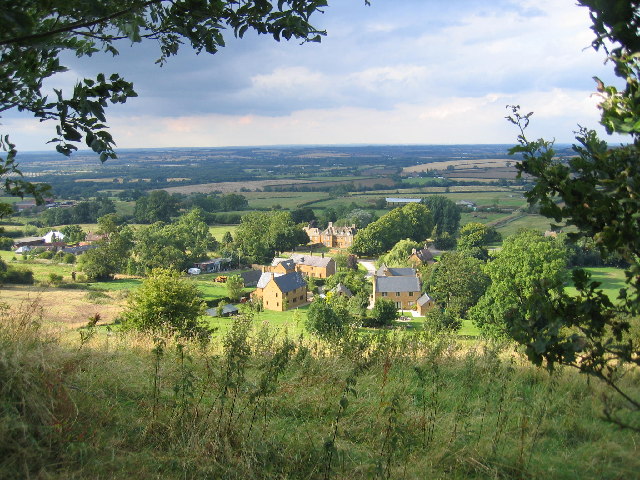
View from Edgehill
View from Edgehill Looking north-north-east from the escarpment toward the battlefield. David Stowell, CC BY-SA 2.0 · source
Edgehill battle monument
Edgehill battle monument The 1949 roadside monument on the B4086. David Stowell, CC BY-SA 2.0 · source

Free for everyone every year on its anniversary: October 23.

Accuracy score: 55/100 (limited)

How the accuracy score works

Sources and method

Edgehill, 23 October 1642. Ground, deployments and the course of the battle follow Historic England's Register of Historic Battlefields: the list entry for the Battle of Edgehill 1642 (1000009) and the English Heritage Battlefield Report: Edgehill 1642 (the timings, the wing and brigade strengths, Parliament half a mile from the foot of the hill and Essex's front 1.5 miles beyond Kineton, the hedges, the open fields, enclosure and the MOD depot). The Battlefields Trust's Edgehill Survey 2004-2006 (interim report, 'The Battlefield' and 'Driving the battlefield') gives the long hedge lined with musketeers, the bullet scatter and Graveyard Coppice, the ditch where the Royalists re-formed, and the depot's effect on the field. Order of battle and narrative: BCW Project, Edgehill order of battle and 'The battle of Edgehill'; figures also from Encyclopaedia Britannica, Newcastle University's British Civil Wars site and World History Encyclopedia. Fixed points: the battlefield monument inside MOD Kineton and its 1949 replica on the B4086 (IWM War Memorials Register 57036, 19344), listed-building grid references for the Castle Inn tower, Radway and Kineton churches, Arlescote House and Sunrising House (Historic England via British Listed Buildings), and the Warwickshire HER records of King's Ley Barn and King Charles's mound. Traditional sites and the descent routes follow Edwin Walford, Edge Hill: The Battle and Battlefield (1904), a later account. Contemporary sources include Essex's official relation, the Royalist 'Official Account', Clarendon's History and the letters of Edmund Ludlow and Nathaniel Fiennes; modern studies include Peter Young, Edgehill 1642 (1967), and Glenn Foard's battlefield archaeology. No U.S. Army staff ride handbook covers this battle. The exact deployment is disputed and much of the field is inside the MOD depot; all block positions are reconstructions, and the King's Ley Barn and hedge positions are estimated from descriptions.

Where the positions come from

Further reading