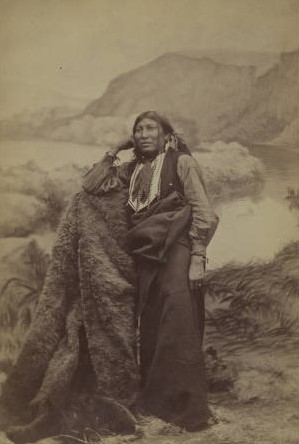
Second Battle of Adobe Walls, 27 June 1874
At dawn on 27 June 1874, several hundred Comanche, Cheyenne, Kiowa and Arapaho warriors led by Quanah Parker and the prophet Isa-tai attacked the buffalo hunters' trading post at Adobe Walls in the Texas Panhandle, determined to stop the slaughter of the herds on their land. Twenty-eight men and one woman, warned by a cracking ridgepole and armed with long-range buffalo rifles, held three sod and picket buildings through a day of charges. On the third day Billy Dixon knocked a warrior from his horse at nearly a mile. The battle opened the Red River War of 1874–75.
Open the interactive map5 stages on modern satellite imagery and terrain, with 3D elevation
This battle opens with Battlefield Enjoyer ($3 a month on Patreon), which unlocks every battle in the atlas and every one added later. Free battles include Yorktown, Waterloo, The Alamo, Antietam, Little Bighorn, Belleau Wood, Omaha Beach, Ia Drang.

The battle, stage by stage
- 26–27 June 1874, before dawn
The camp at Adobe Walls
Since spring, buffalo hunters from Dodge City have been hunting the Texas Panhandle — Indian land under the Medicine Lodge treaty — from a new trading post on East Adobe Walls Creek: Myers & Leonard's store and stockade, Hanrahan's saloon, O'Keefe's blacksmith shop and Rath & Wright's store, all facing east. Twenty-eight men and one woman are there. A war party of Comanche, Cheyenne, Kiowa and Arapaho, perhaps 700 strong, is closing in, led by Quanah and the Comanche prophet Isa-tai, who has promised that his paint will make them bulletproof. At 2 AM the cottonwood ridgepole of Hanrahan's saloon cracks with a report like a rifle shot. Men turn out to prop it up — and many are still awake at dawn.
- 27 June, dawn
The charge
Hanrahan sends Billy Ogg to bring in the horses grazing a quarter mile south-east on the creek. Dixon, rolling up his bedding, sees a dark mass at the edge of the timber beyond them; it fans out with a single war-whoop and comes on at full gallop, the rising sun behind it. Ogg races back and falls through the door of Hanrahan's; Dixon gets in just ahead of him. The men split into the three buildings. The Shadler brothers, asleep in their wagon, are killed with their Newfoundland dog.
- 27 June, morning
Around the walls
For half an hour warriors ride right up to strike the doors with their rifle butts; Quanah tries to back his horse through a door. A bugler with the war party blows the calls, but two ex-soldiers in Hanrahan's know them and warn of every charge. Behind sacks of flour and two-foot sod walls, the hunters' heavy buffalo rifles empty saddles at every rush. Billy Tyler is shot through the lungs at the door of Myers & Leonard's after he and Leonard are driven out of the stockade. A warrior shelters behind the hide stacks at the rear of Rath's until Dixon shoots through the hides.
- 27 June, noon – 4 PM
The siege
By noon the charges stop; the warriors fire from cover around the post. Running short of cartridges, Dixon and Hanrahan sprint from the saloon to Rath's store, where thousands of rounds are stacked; Dixon stays to strengthen the smallest garrison. By 2 PM the war party has pulled back to the foot of the hills, out of range. Late in the day Harry Armitage shoots the bugler as he runs from the Shadler wagon with a can of sugar and a can of coffee. Isa-tai's horse is killed under him, and with it his medicine.
- 29 June, third day
Billy Dixon's long shot
Hunters are coming in from the camps. On the third day about fifteen warriors appear on the bluff east of Adobe Walls Creek. Dixon, with Hanrahan's big .50 Sharps, fires once and a warrior falls from his horse; his companions dash out and carry him off. Dixon called it 'not far from three-fourths of a mile' and 'a scratch shot'; an Army survey later put it at 1,538 yards, and Baker and Harrison's study at about 1,000. The war party soon breaks up. The hunters lost four men — the Shadlers, Tyler, and William Olds, who shot himself by accident on the fifth day; the warriors perhaps 30. The fight opens the Red River War, which ends the free life of the Southern Plains tribes within a year.
Paintings and photographs