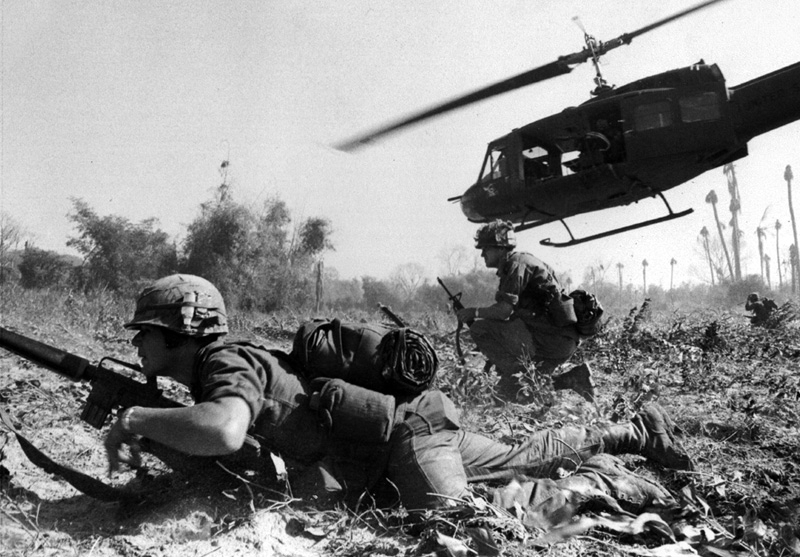
Ia Drang: LZ X-Ray and LZ Albany, 14–17 November 1965
From 14 to 17 November 1965 the US 1st Cavalry Division (Airmobile) fought the first major battle between American and North Vietnamese regular troops, in the Ia Drang valley of the Central Highlands. At LZ X-Ray, Lieutenant Colonel Hal Moore's 1st Battalion, 7th Cavalry held a perimeter for two days against repeated assaults by the North Vietnamese 66th Regiment, supported by artillery, air strikes and the first B-52 strikes in support of ground troops; two days later the 2nd Battalion, 7th Cavalry was ambushed on the march at LZ Albany. The battle proved the helicopter-borne 'air cavalry' concept, convinced both sides they could win a war of attrition, and set the pattern for the American war in Vietnam; it is the subject of the book and film 'We Were Soldiers'.
Open the interactive map6 stages on modern satellite imagery and terrain, with 3D elevation
This battle is free to explore — no account needed.

The battle, stage by stage
- 14 Nov 1965, 10:48
Into the valley
Lieutenant Colonel Hal Moore's 1st Battalion, 7th Cavalry — the first airmobile battalion sent into battle — lands by helicopter at LZ X-Ray, a clearing at the foot of the Chu Pong massif, near the Cambodian border. The first lift, B Company, lands about 200 metres from the 9th Battalion of the North Vietnamese 66th Regiment. Only 16 Hueys are available, so the battalion arrives a company at a time.
- 14 Nov, afternoon
The lost platoon
B Company's 2nd Platoon chases North Vietnamese soldiers across the dry creek bed and is cut off on a small knoll; Lieutenant Herrick is killed and Sergeant Ernie Savage holds the survivors together all night with artillery fire. C Company arrives and meets a head-on assault coming down off the mountain. By nightfall the battalion holds a ring around the clearing.
- 15 Nov, 06:50
Broken Arrow
At first light several hundred North Vietnamese charge C Company's sector on the south side of the perimeter and reach the command post area. Moore's air controller calls 'Broken Arrow' — an American unit about to be overrun — and every available aircraft in South Vietnam is diverted to X-Ray. A Company of the 2nd Battalion, 7th Cavalry flies in to reinforce.
- 15 Nov, midday–afternoon
The relief
The attacks die away by mid-morning. Lieutenant Colonel Tully's 2nd Battalion, 5th Cavalry marches in from LZ Victor, and in the afternoon a relief force fights through to the lost platoon: of its 29 men, 9 were killed and 13 wounded, but the knoll was never taken.
- 16 Nov
Out of X-Ray
After beating off a last assault before dawn, Moore's battalion is lifted out. The 2/5 marches to LZ Columbus, and McDade's 2nd Battalion, 7th Cavalry sets off on foot toward a clearing called LZ Albany. B-52s pound the Chu Pong massif — the first use of strategic bombers in support of ground troops.
- 17 Nov, 13:15
Ambush at Albany
Strung out in a column some 550 yards long in tall elephant grass, the tired 2/7 is ambushed as its head reaches the Albany clearing. The North Vietnamese 8th Battalion, 66th Regiment and units of the 33rd Regiment hit the column from the flank and rear, and the fight breaks into a close-range melee that lasts into the night. Albany cost 155 American dead — more than at X-Ray — and both sides drew lessons that shaped the rest of the war.
Paintings and photographs