Battlefield Atlas
War of 1812 · 1814 Members

Baltimore and Fort McHenry, 12–14 September 1814

On 12–14 September 1814, weeks after burning Washington, a British army and fleet attacked Baltimore. Major General Robert Ross landed nearly 4,700 men at North Point; he was killed in a skirmish before the Battle of North Point, where about 3,200 Baltimore militia under John Stricker were driven back but cost the British some 340 casualties. His successor, Colonel Arthur Brooke, halted in front of the entrenchments on Hampstead Hill, while Vice Admiral Cochrane's bomb vessels shelled Fort McHenry for about 25 hours. The fort held, a night diversion up the Ferry Branch was beaten off, and the British withdrew. Francis Scott Key, watching from the fleet, wrote the verses that became 'The Star-Spangled Banner'.

Open the interactive map8 stages on modern satellite imagery and terrain, with 3D elevation

This battle opens with Battlefield Explorer ($9.99 a month on Patreon), which unlocks every battle in the atlas and every one added later. Free battles include Thermopylae, Actium, Hattin, Agincourt, Vítkov Hill, Bosworth, Fort William Henry, Yorktown, Waterloo, The Alamo, Antietam, Little Bighorn, Belleau Wood, Omaha Beach, Inchon, Ia Drang, 73 Easting, Wanat, Baghdad Thunder Runs, Battle of Kyiv, Bakhmut, Avdiivka.

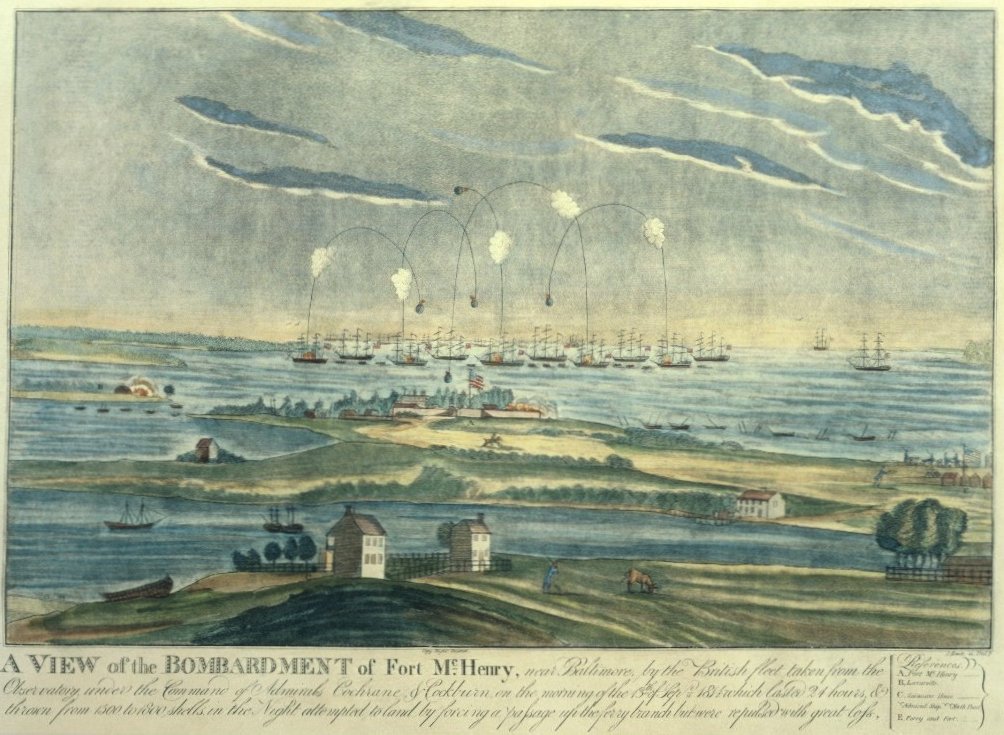
Bombardment of Fort McHenry (Bower)
Bombardment of Fort McHenry (Bower) — John Bower — public domain

The battle, stage by stage

  1. 12 September 1814, about 3 AM–8 AM

    Landing at North Point

    Three weeks after burning Washington, a British fleet under Vice Admiral Sir Alexander Cochrane enters the Patapsco River. From about 3 AM on 12 September boats ferry Major General Robert Ross's army ashore near North Point — by the National Park Service's count nearly 4,700 soldiers, sailors and marines, among them Colonial Marines recruited from formerly enslaved people; the state's 1937 marker says 7,000, other NPS markers about 4,500. Mounted sentries at Todd's farm ride to warn Baltimore. Brigadier General John Stricker's 3rd Brigade of Baltimore militia, about 3,200 men, has marched out the day before and waits across Long Log Lane at the narrowest part of the Patapsco Neck, between Bear Creek and Bread and Cheese Creek, with the 6th Maryland in reserve at Cook's Tavern. Up the river the bomb vessels and frigates work toward Fort McHenry, which guards the harbor with about 1,000 men under Major George Armistead; behind the city, Commodore John Rodgers's sailors and some 15,000 militia hold the earthworks on Hampstead Hill.

  2. 12 September, early afternoon

    Ross falls

    Ross and Rear Admiral George Cockburn breakfast at the Gorsuch farm and push on ahead of the column. Stricker sends forward an advance party under Major Richard Heath — two companies of the 5th Maryland and Captain Edward Aisquith's sharpshooters. In the skirmish that follows Ross is shot through the right arm and into the chest; he dies on the way back to the fleet. Tradition credits two teenage riflemen of the Mechanical Volunteers, Daniel Wells and Henry McComas, both killed in the same fight; the 1817 monument at the spot honors Aquila Randall, who also died there, and some give him the credit. Colonel Arthur Brooke of the 44th takes command.

  3. 12 September, about 2:50 PM

    The Battle of North Point

    Brooke finds Stricker's line strong. His light brigade covers the front; the 44th, the fleet marines and a body of seamen form along the American front, while the 21st and the 2nd Battalion of Royal Marines wait in column on the road. The 4th (King's Own) works around through hollow ground toward the American left. Just before 3 PM Congreve rockets open on the left; one fires the Boulden farm. Stricker orders the 39th to extend the line beyond the 27th and the 51st to form at right angles facing north-east, but the two regiments cross into each other and lose their order. The positions of the flanking moves are interpretive.

  4. 12 September, about 3:30–4 PM

    The 51st breaks; a fighting withdrawal

    As the King's Own comes on, someone shouts that the line is flanked; the 51st fires one ragged volley and runs, taking about half the 39th with it. The 5th and the 27th trade volleys at close range — by one British officer's account the lines were little more than a hundred paces apart — before Stricker orders a withdrawal. The 5th covers the rest of the brigade back about a mile to Cook's Tavern, mostly in good order. The fight has lasted under an hour. The British, without cavalry and with heavy losses, do not pursue; they camp on the field in the rain while Stricker falls back to the Hampstead Hill lines.

  5. 13 September, about 6:30 AM–noon

    Bombs over Fort McHenry

    Shortly before 6:30 AM HMS Terror fires the first shell. The five bomb vessels — Terror, Volcano, Meteor, Devastation and Aetna — and the rocket ship Erebus lie about two miles below the fort, beyond the reach of most of its guns; the fort's shot falls short, and Armistead slows his fire to save powder. A line of sunken merchant hulks, a boom and eleven flotilla gun barges close the channel between the fort and the Lazaretto battery. Ashore, Brooke's army marches up to the heights near the Philadelphia Road, about two miles east of Hampstead Hill, and halts in sight of the earthworks: by Brooke's estimate about 15,000 men with 'considerable artillery'. When rain sets in around noon, the smaller storm flag is probably flown in place of the great garrison flag.

  6. 13 September, about 2–3:30 PM

    A bastion hit; the bombs driven back

    About 2 PM a shell bursts on the southwest bastion, dismounting a 24-pounder and killing Lieutenant Levi Clagett of Nicholson's Fencibles; Sergeant John Clemm is killed moments later. Later in the afternoon Cochrane moves Volcano, Devastation and Erebus in to about a mile and a half. Every gun that can reach opens on them, and within half an hour they draw back out of range. East of the city Brooke probes the American left, and Major General Samuel Smith reportedly shifts Stricker's brigade and Winder's Virginia militia out toward the north-east to threaten his flank. Cochrane writes that the navy cannot help an assault.

  7. 13–14 September, midnight to about 3 AM

    Diversion up the Ferry Branch

    To draw defenders from Hampstead Hill before a night assault, Captain Charles Napier takes about 1,000 men in 20 barges west past the fort in heavy rain. About half the boats go astray and return; Napier presses on up the Ferry Branch with nine. When they fire rockets and signal, Fort Covington, Battery Babcock and the guns of Fort McHenry open on them, aiming by the light of the rockets; at least one barge is sunk, and bodies are later found in the river. Armistead believed the force carried scaling ladders to storm the fort. The barges are back with the fleet by about 4 AM. Brooke and Cockburn, judging an attack on the heights not worth the cost, start the army back toward North Point at about 3 AM.

  8. 14 September, about 7–9 AM

    By the dawn's early light

    The bombardment ends at about 7:30 AM after some 25 hours; Volcano fires the last shell. Armistead estimated 1,500 to 1,800 shells thrown, about 400 inside the works, for four of the garrison killed and 24 wounded. As the fleet gets under way, the storm flag comes down and the great 30-by-42-foot garrison flag made by Mary Pickersgill goes up. Francis Scott Key, detained with the fleet on an American truce sloop — recent research puts it off Colgate Creek about two miles from the fort, not at the four-mile spot the Key buoy marks — sees it still flying and begins the verses printed within days as 'Defense of Fort M'Henry'. The army re-embarks at North Point on 15 September; Baltimore is saved.

Forces

About 4,500–4,700 British soldiers, sailors and marines landed against about 3,200 Maryland militia at North Point, then faced 10,000–20,000 defenders on Hampstead Hill; at sea 16–19 British warships, five of them bomb vessels, bombarded Fort McHenry's garrison of about 1,000. Totals are well attested, with the usual spread between sources.

British (Cochrane, Ross, Brooke)

Landed at North Point (soldiers, sailors and marines)The NPS Fort McHenry history says nearly 4,700; NPS Star-Spangled Banner Trail waysides say about 4,500; the Todd's Inheritance marker about 5,000; the 1937 State Roads Commission marker 7,000. NPS, The Battle of North Point, part 1; NPS wayside 'Proud of Our Stand' (HMdb); 'North Point Battlefield' 1937 marker (HMdb); Todd's Inheritance marker (HMdb)about 4,700 (4,500–5,000 (7,000 on one 1937 marker))
Advanced on Hampstead Hill, 13 September Naval History and Heritage Command, The Battle of Baltimoreabout 4,300
Ships in the bombardment squadronArmistead counted 16 ships, five of them bomb vessels, within about 2.5 miles; the NPS says 17 including five bomb ships and one rocket ship; NHHC about 19. Armistead's report (Smithsonian NMAH transcript); NPS, Bombardment of Fort McHenry, part 116 (16–19)
Ferry Branch diversion (Capt. Napier)The NPS gives about 1,000 men in 20 barges (another NPS page about 1,200); Armistead believed 1,250 men with scaling ladders. NPS, Bombardment of Fort McHenry, part 2; NPS, Bastion 3about 1,000 in 20 barges (1,000–1,250)

American (Armistead, Smith, Stricker)

Stricker's 3rd Brigade at North Point NPS wayside 'Proud of Our Stand' (HMdb); NPS Star-Spangled Banner NHT, Baltimore and North Pointabout 3,200
Fort McHenry garrisonArmistead reported upwards of 1,000 effectives; the garrison return gives 1,010; one NPS page says close to 1,200. Armistead's report (Smithsonian NMAH transcript); The Garrison of Fort McHenry, September 1814 (maryland1812.com); NPS, Bombardment of Fort McHenry, part 1about 1,000 (1,000–1,200)
Hampstead Hill linesNHHC: more than 10,000 with 100 cannon; Baltimore Heritage: about 15,000 militia and 34 field guns; Brooke estimated about 15,000; an NPS page quotes a British estimate of 15,000–20,000. NHHC, The Battle of Baltimore; Baltimore Heritage, History of Hampstead Hill; London Gazette, 17 October 181410,000–20,000
Fort McHenry gunsNPS: 23 in the star fort and ravelin and 20 in each of the two water batteries (the HMdb Water Battery wayside says 26 in two tiers). NPS, Bombardment of Fort McHenry, part 123 in the star fort and ravelin, plus the water batteries

Casualties

The British lost roughly 340 killed and wounded at North Point, including their commander, Maj. Gen. Robert Ross, against about 160 American killed and wounded and some 50 or more captured; the 25-hour bombardment of Fort McHenry killed 4 and wounded 24 of the garrison. Army returns are well documented; losses in the night barge diversion are unknown. Certainty: good.

British (Cochrane, Ross, Brooke)

Killed at North Point (army)The British army return of 12 September (Maj. Henry Debbieg) lists 38 killed including Maj. Gen. Ross; other transcriptions give 39. The National Park Service gives 46 dead, which appears to include the naval brigade's losses. British 'Return of Killed and Wounded … near Baltimore, 12 September 1814' (maryland1812.com, Scott S. Sheads); London Gazette, 17 October 1814 (Brooke's dispatch and return); NPS, The Battle of North Point, part 238–39 (38–46)
Wounded at North Point (army)The army return lists 252 wounded (11 officers), the heaviest losses in the 44th (88) and 21st (81); the NPS figure of 295 wounded appears to add the seamen and marines of the naval brigade. British return, 12 September 1814 (maryland1812.com); NPS, The Battle of North Point, part 2251–252 (251–295)
Naval brigade, 12–14 September (seamen and marines from the ships)Rear Admiral Cockburn's return for the Baltimore operation, published with the army dispatch. London Gazette, 17 October 18147 killed, 44 wounded
Ferry Branch diversion, night of 13–14 SeptemberArmistead reported a sunken barge with two dead men and other bodies seen in the river; the NPS says one barge was overturned and bodies were found for two weeks. No British figure is known. Armistead's report, 24 September 1814 (Smithsonian NMAH transcript); NPS, Bombardment of Fort McHenry, part 2unknown

American (Armistead, Smith, Stricker)

North Point: killedStricker's brigade; the NPS figure. Among the dead were Daniel Wells and Henry McComas, and Aquila Randall in the opening skirmish. NPS, The Battle of North Point, part 224
North Point: wounded NPS, The Battle of North Point, part 2139
North Point: capturedThe NPS gives 50 Americans taken prisoner; Brooke reported carrying off about 200 prisoners when the army re-embarked. NPS, The Battle of North Point, part 2; London Gazette, 17 October 181450 (50–about 200)
Fort McHenry garrison: killed and woundedArmistead's report; the dead included Lt. Levi Clagett and Sgt. John Clemm of Nicholson's Fencibles (southwest bastion), and the NPS names Thomas Beeson and Thomas Messenger killed at the water batteries. Armistead's report, 24 September 1814 (Smithsonian NMAH transcript); NPS Historical Handbook No. 5, Fort McHenry; NPS, Bombardment of Fort McHenry, part 14 killed, 24 wounded

Equipment and ships

British boatsIn the Ferry Branch diversion, per Armistead and the NPS. Armistead's report (Smithsonian NMAH transcript)at least 1 barge sunk
Fort McHenry damageArmistead estimated 1,500–1,800 shells thrown, about 400 falling inside the works. Armistead's report (Smithsonian NMAH transcript); NPS Historical Handbook No. 5one 24-pounder dismounted; two buildings badly damaged
American guns at North PointBrooke's claim in his dispatch; not confirmed in the American sources used here. London Gazette, 17 October 18142 claimed captured

Then and now: how the ground has changed

Almost all of the 1814 ground is now city, suburb or port: the North Point battlefield lies under Dundalk except Battle Acre and a nine-acre state battlefield, the Hampstead Hill lines survive only in Patterson Park, and the Ferry Branch batteries are gone beneath rail yards and I-95. The Patapsco shoreline where the British fleet and Key's sloop lay has been pushed out by port fill. Fort McHenry's star fort survives with its 19th-century layout largely intact.

The interactive map can show the period landscape (2 shapes: North Point battlefield, now built over (approximate), Hampstead Hill lines, now built over except Patterson Park (approximate)) under the units. Open the map.

Weapons

British (Cochrane, Ross, Brooke)

Congreve rocket

Congreve rocket

Rocket artillery · c. 1806-1867

At Fort McHenry and North Point: Fired from HMS Erebus over the fort: the "rockets' red glare".

William Congreve developed his iron-cased rockets from the war rockets Britain had faced in Mysore, India. They were light and could be fired in salvos from simple frames or even the ground, but their flight was famously unpredictable. Britain used them at Copenhagen, Leipzig and Fort McHenry (the 'rockets' red glare') before newer designs replaced them.

Sizes
Light 6- to 18-pounders up to heavy 300-pounders
Range
Up to about 2,000-3,000 yards by size
Guidance
Long wooden stick; notoriously erratic
Photo: Rama · CC BY-SA 3.0 fr
Royal Navy ship's gun

Royal Navy ship's gun

Naval artillery · 1700s-1850s

At Fort McHenry and North Point: The bomb vessels' mortars and the frigates' guns.

Smoothbore cast-iron guns mounted in rows along a warship's decks were the backbone of British sea power. Besides solid shot, crews could fire heated shot and incendiary carcasses to set targets on fire. In coastal campaigns, guns were often landed from ships to arm shore batteries.

Shot
Iron balls, commonly 6 to 32 lb by ship size
Mounting
Wooden truck carriage on a gun deck
Crew
Several men per gun
Photo: Moshi Anahory · CC BY-SA 2.0
Short Land Pattern musket ("Brown Bess")

Short Land Pattern musket ("Brown Bess")

Smoothbore flintlock musket · 1768–1790s pattern

At Fort McHenry and North Point: Musket of the British regiments at North Point.

The British infantryman's musket for most of the 18th century. Accuracy beyond about 100 yards was poor, so the tactics were volleys at close range followed by the bayonet, which the Brown Bess was built to carry.

Caliber
.75 (ball about .69)
Effective range
about 50–100 yd against a formed line
Rate of fire
3 rounds a minute, drilled
Photo: Tower (British Ordnance) · Public domain

American (Armistead, Smith, Stricker)

Heavy siege guns (18- and 24-pounders)

Heavy siege guns (18- and 24-pounders)

Siege artillery · 1600s-1860s

At Fort McHenry and North Point: Heavy guns in the fort and its water batteries.

Siege guns were long, heavy cannon built to smash fortifications from close-range batteries dug behind trenches. They were too heavy for ordinary field maneuver, so they were brought up by road or water and fired for days on end. Paired with mortars and howitzers, they turned a siege into a slow but methodical demolition.

Shot
18 lb or 24 lb iron ball
Use
Battering earthworks from dug-in batteries
Mobility
Very heavy; hauled by large teams
Photo: DrStew82 · CC BY-SA 4.0
French Model 1766 musket ("Charleville")

French Model 1766 musket ("Charleville")

Smoothbore flintlock musket · 1766–1777 pattern

At Fort McHenry and North Point: The pattern behind the American Springfield muskets of the militia.

France shipped tens of thousands of these muskets to the Continental Army from 1777, quietly, before it entered the war. Lighter and slightly smaller-bored than the Brown Bess, it became the pattern for America's first national musket, the Springfield Model 1795.

Caliber
.69
Effective range
about 100 yd
Rate of fire
2–3 rounds a minute
Photo: Charleville Arsenal · Public domain

Paintings and photographs

Bombardment of Fort McHenry (Bower)
Bombardment of Fort McHenry (Bower) A View of the Bombardment of Fort McHenry, aquatint by John Bower, about 1816. John Bower — public domain · source
Francis Scott Key
Francis Scott Key Francis Scott Key, portrait attributed to Joseph Wood, about 1825. Joseph Wood — public domain · source
The Star-Spangled Banner
The Star-Spangled Banner The garrison flag of 1814, made by Mary Pickersgill, on display at the Smithsonian about 1964. Smithsonian Institution — public domain · source
Battle Acre monument
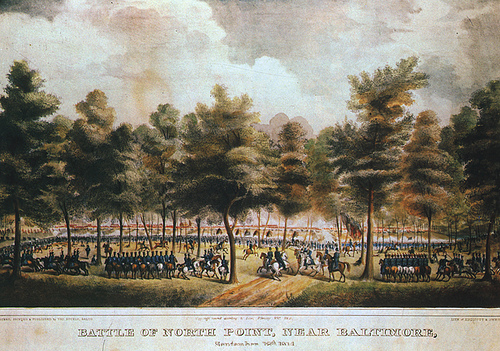
Battle Acre monument Lithograph after militiaman Thomas Ruckle's painting of the Battle of North Point, 12 September 1814. After Thomas Ruckle · public domain · source

Free for everyone every year on its anniversary: September 12–14.

Accuracy score: 66/100 (moderate)

How the accuracy score works

Sources and method

Baltimore and Fort McHenry, 12–14 September 1814. Fixed points are from the Historical Marker Database (hmdb.org): the National Park Service Star-Spangled Banner National Historic Trail waysides at the North Point landing (The Landing), Battle Acre (Delay Tactic, Proud of Our Stand, Battle Acre), the Aquila Randall Monument (1817), Todd's Inheritance, Fort McHenry's Water Battery, Fort Look-Out, the Ferry Branch On Guard wayside and the Lazaretto cannon; Battery Babcock from FortWiki; Fort Covington (location approximate) from 'The Lost Peninsula Forts of the War of 1812' (SoBo Post) and North American Forts. The course of events follows the National Park Service, Fort McHenry National Monument: The Battle of North Point, part 1 and part 2, Bombardment of Fort McHenry, part 1 and part 2, and NPS Historical Handbook No. 5, Fort McHenry; Maj. George Armistead's report of 24 September 1814 (transcript, Smithsonian NMAH); Col. Arthur Brooke's and Cochrane's and Cockburn's dispatches and returns in the London Gazette, 17 October 1814; Naval History and Heritage Command, The Battle of Baltimore; Scott S. Sheads's research at maryland1812.com (garrison return; British at the Gates); Baltimore Heritage, History of Hampstead Hill and Patterson Park; and, for Key's vantage point, 'Pinpointing Where the Star-Spangled Banner Was Born' (SoBo Post, 2025). Strengths are attributed: the British landing force is given as 4,500 (NPS markers), nearly 4,700 (NPS) or 7,000 (1937 state marker). Regimental traces at North Point, the garrison posts inside the fort, the British position on 13 September, Smith's shift of Stricker and Winder, and all ship positions are interpretive or schematic. Images from Wikimedia Commons.

Where the positions come from

Further reading