Battlefield Atlas
Fall of Byzantium · 1453 Members · from $3

Fall of Constantinople, 1453

Between 6 April and 29 May 1453 Sultan Mehmed II besieged Constantinople, capital of a Byzantine Empire reduced to little more than the city. An Ottoman army of perhaps 50,000–80,000, with the heaviest siege artillery yet seen, faced some 7,000–8,000 defenders under Constantine XI, among them Genoese under Giovanni Giustiniani and the Venetian community. Bombardment broke the outer Theodosian wall; a boom kept the Ottoman fleet out of the Golden Horn until Mehmed hauled some seventy ships overland behind Galata. After 53 days of bombardment, mining and repulsed assaults, a final attack on 29 May broke through at the Lycus valley near the Gate of St Romanus. Constantine died in the fighting, the city was sacked, and Constantinople became the Ottoman capital.

Open the interactive map8 stages on modern satellite imagery and terrain, with 3D elevation

This battle opens with Battlefield Enjoyer ($3 a month on Patreon), which unlocks every battle in the atlas and every one added later. Free battles include Hattin, Agincourt, Vítkov Hill, Bosworth, Yorktown, Waterloo, The Alamo, Antietam, Little Bighorn, Belleau Wood, Omaha Beach, Ia Drang, 73 Easting, Wanat, Najaf.
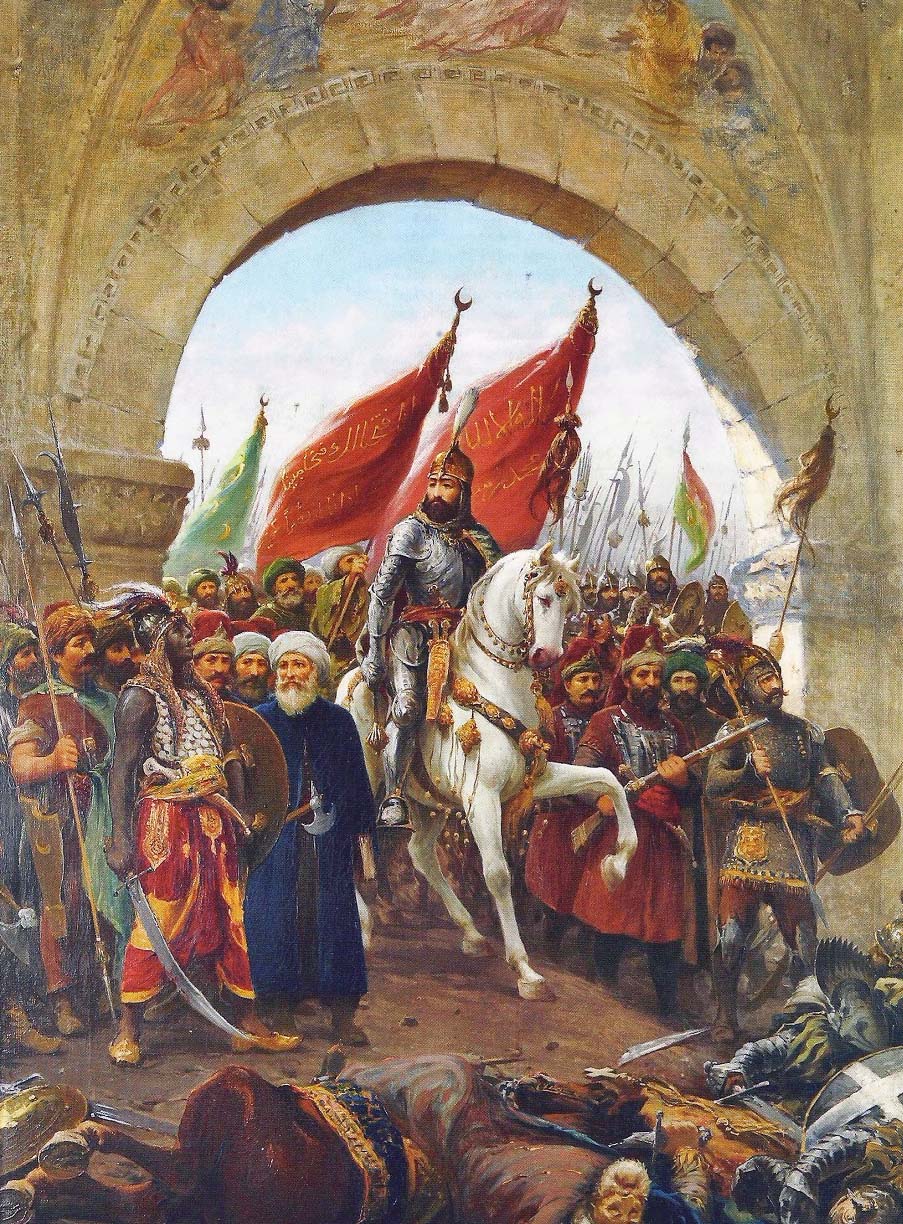
Mehmed II enters Constantinople (Zonaro)
Mehmed II enters Constantinople (Zonaro) — Fausto Zonaro · public domain

The battle, stage by stage

  1. 6 April 1453

    The investment

    Sultan Mehmed II, twenty-one, has spent a year preparing: Rumeli Hisarı, his fortress on the European shore of the Bosphorus, was finished in 1452 and closes the strait above the city. On 6 April his army is camped along the whole length of the land walls — Karaca Pasha's European troops in the north opposite Blachernae, Ishak Pasha's Anatolians in the south toward the Golden Gate, and Mehmed with the Janissaries opposite the Lycus valley; Zaganos Pasha holds the hills behind Galata. Modern estimates put the army at roughly 50,000–80,000; contemporaries gave 160,000 and more. Against it Constantine XI has, by his secretary Sphrantzes' muster, under 5,000 Greeks and some 200 foreigners, rising to perhaps 7,000–8,000 with Giustiniani's Genoese, the Venetians and other volunteers, behind the double Theodosian wall and moat. The Genoese colony of Galata across the Golden Horn stays officially neutral.

  2. 12 – 18 April

    Orban's guns

    The heavy guns are dragged into position and open fire around 12 April, the greatest of them — cast by the Hungarian founder Orban — placed opposite the Mesoteichion, the stretch where the walls dip into the Lycus valley near the Gate of St Romanus, with other batteries opposite Blachernae, the Gate of Charisius, the Gate of Pege and the Golden Gate. The great gun is said to fire only a few times a day, but the outer wall begins to crumble; each night Giustiniani's men and the townspeople fill the gaps with stockades of timber, earth and barrels. On the night of 18 April an assault on the Mesoteichion is beaten back.

  3. 20 April

    The boom and the fight at sea

    A boom of floating timbers and iron chain closes the Golden Horn from the Gate of Eugenius to a tower on the Galata shore, guarded by some two dozen Venetian, Genoese and Byzantine ships; an Ottoman attempt on it fails. On 20 April three Genoese ships and a Byzantine grain transport come up the Marmara. Baltoğlu's much larger fleet of low galleys swarms them off the point of the Acropolis; the wind drops and they drift toward the Galata shore, lashed together, their high sides and heavier missiles holding off boarders for hours while, by one account, Mehmed rides his horse into the shallows shouting orders. When the wind returns, the convoy breaks through; after dark, Barbaro says, Venetian galleys under Gabriele Trevisano tow it inside the boom. The furious sultan dismisses Baltoğlu.

  4. 22 April

    Ships over the hill

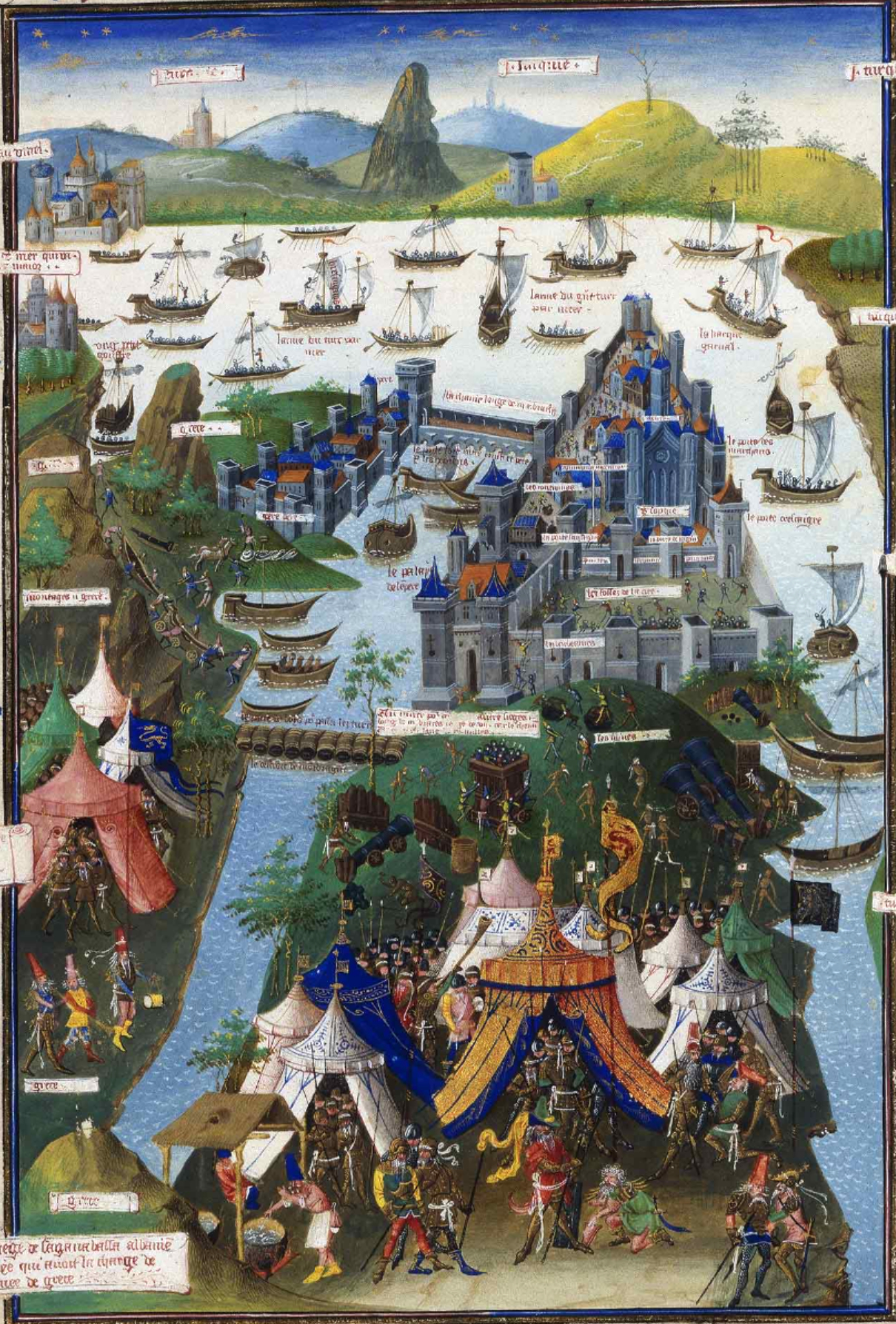
    Unable to break the boom, Mehmed goes round it. Over the hills behind Galata a track is laid with greased timbers; ships are set in cradles and hauled by men and oxen, by Kritoboulos' account with sails set and oarsmen rowing in the air, from the Bosphorus near the Double Columns (Diplokionion) down into the Valley of the Springs on the Golden Horn. Kritoboulos counts about 67 vessels, Barbaro 72 fustae. The route is debated — Kritoboulos gives only about eight stadia (some 1.5 km), shorter than the Beşiktaş line drawn here, and several historians prefer a start near Tophane. The Christian fleet is now flanked inside its own harbour, and men must be pulled off the land walls to guard the long Horn walls; a Venetian fire-ship raid on the Ottoman ships on 28 April is betrayed and fails.

  5. Late April – mid May

    Bridge and battery

    The Ottomans tighten the grip on the Horn. A pontoon bridge of barrels and planks is thrown across its upper reach to carry troops and guns toward Blachernae, and a gun on the hill behind Galata lobs stones over the Genoese town at the ships in the harbour; Barbaro records a merchant ship sunk in early May. The Christian ships shelter close under Galata's walls, and Trevisano's sailors are sent to man the walls. On land the bombardment never stops, with assaults on 7 and 12 May at the Mesoteichion and Blachernae. Galata, nominally neutral, trades with both sides.

  6. 16 – 25 May

    Mines and countermines

    Zaganos Pasha's miners — later writers say Serbian silver-miners from Novo Brdo — tunnel toward the walls, chiefly near the Kaligaria Gate at Blachernae. Barbaro records the first mine found on 16 May; Johannes Grant, an engineer described as German or Scottish, listens for the diggers and drives countermines, smoking, flooding and burning them out, and captured miners reportedly reveal the rest. More mines are destroyed until 25 May. On 18 May the Ottomans push a great wooden siege tower against the wall near St Romanus; the defenders blow it up with gunpowder barrels that night. Within the city, the omens are grim and the talk is of surrender; Constantine refuses.

  7. 29 May, about 01:30 – dawn

    The general assault

    After a day of rest and prayer in the camp, the attack goes in along the whole land front and from the ships in the Horn and the Marmara at about half past one in the morning. At the Mesoteichion Mehmed sends three waves: the başıbozuk irregulars, driven forward with whips and maces; then Ishak Pasha's Anatolians, who break into the stockade for a moment through a gap the bombard opens and are cut down; then, at first light, the Janissaries. Barbaro says the defenders held for hours. Then Giustiniani is badly wounded — by an arrow or a ball, the accounts differ — and is carried from the wall. Barbaro accuses him of deserting and shouting that the Turks were in; others defend him. His Genoese follow him through the inner gate, and the line at St Romanus begins to give.

  8. 29 May, sunrise

    The fall of the City

    A tradition preserved by Doukas says that some fifty Ottomans found the Kerkoporta, a small postern near the Blachernae angle, left unbarred after a sortie, slipped in and raised their banners on the towers; whether or not it happened, the cry that the city was taken spread along the wall. At the Mesoteichion the Janissaries — Ulubatlı Hasan is remembered for planting the first flag — pour over the stockade. Constantine XI is last seen throwing himself into the fighting near the gate; his body was never certainly identified. The defenders break, the Ottomans flood in toward the Holy Apostles and Hagia Sophia, where crowds sheltering in the church are taken, and the city is given over to three days' sack. In the Horn the Venetian and Genoese crews cut the boom and escape to sea; Giustiniani dies of his wound weeks later on Chios. That afternoon Mehmed rides to Hagia Sophia, ordering it made a mosque.

Weapons

Ottoman army and fleet (Mehmed II)

Great bombard

Great bombard

Siege gun · 15th century

At Fall of Constantinople: Orban's great bombard and dozens of smaller guns battered the land walls for seven weeks.

Huge cast-bronze guns firing stone balls. Mehmed II's founder Orban cast a giant bombard for the siege of Constantinople; it was slow and cracked, but with dozens of smaller guns it battered gaps in walls that had stood for a thousand years. The Dardanelles Gun, cast in 1464, is a surviving example of the type.

Bore
up to about 60–90 cm
Shot
stone balls of several hundred kg
Rate
a few shots a day
Photo: Tim Sheerman-Chase · CC BY 2.0
Janissary infantry

Janissary infantry

Ottoman standing infantry · 14th–19th century

At Fall of Constantinople: The Janissaries made the third and decisive wave of the 29 May assault.

The Ottoman sultans' professional infantry, among the first standing armies in Europe. They were the core of the final assault at Constantinople in 1453 and manned the siege trenches at Vienna in 1683.

Arms
matchlock musket (tüfek), yatağan sword
Role
the Sultan's household infantry, siege specialists
Recruitment
devşirme levy, later hereditary
Photo: Rålamb Costume Book, 1657 · public domain

Byzantine defenders (Constantine XI), with Genoese and Venetians

Crossbow

Crossbow

Mechanical bow · about 1100–1500 in Western armies

At Fall of Constantinople: Defenders on the walls used crossbows and early hand-guns.

A short, powerful bow mounted on a stock and spanned with the feet or a hook, shooting a heavy bolt. It took less skill than a longbow and outranged the Turkish horse archer's bow at close quarters, so Crusader armies used crossbowmen to screen their knights.

Draw
spanned by foot stirrup or belt hook
Range
effective to about 150–200 yd
Rate
about 2 bolts a minute
Photo: Metropolitan Museum of Art · CC0
Plate armour

Plate armour

Full harness of steel plates · about 1400–1600 (transitional mail and plate earlier)

At Fall of Constantinople: Giustiniani's armoured Genoese held the breach at the St Romanus gate until he was wounded.

By 1415 a man-at-arms could be enclosed head to foot in steel. It kept most arrows out, but at Agincourt the French men-at-arms advanced across soaked, ploughed ground under arrow fire and arrived exhausted, packed so tightly that many could not lift their weapons. At Poitiers in 1356 armour was still transitional: mail, coats of plates and growing plate limb defences.

Weight
about 20–30 kg, spread over the body
Protection
proof against most arrows except at short range or weak points
Weakness
heat, exhaustion and mud
Photo: Gothic plate armour · Rama · CC BY-SA 2.0 fr

Paintings and photographs

Mehmed II enters Constantinople (Zonaro)
Mehmed II enters Constantinople (Zonaro) Fausto Zonaro's painting of Mehmed II entering the city. Fausto Zonaro · public domain · source
The siege (Le Tavernier)
The siege (Le Tavernier) The siege as painted by Jean Le Tavernier soon after 1455, with the ships dragged overland. Jean Le Tavernier · public domain · source
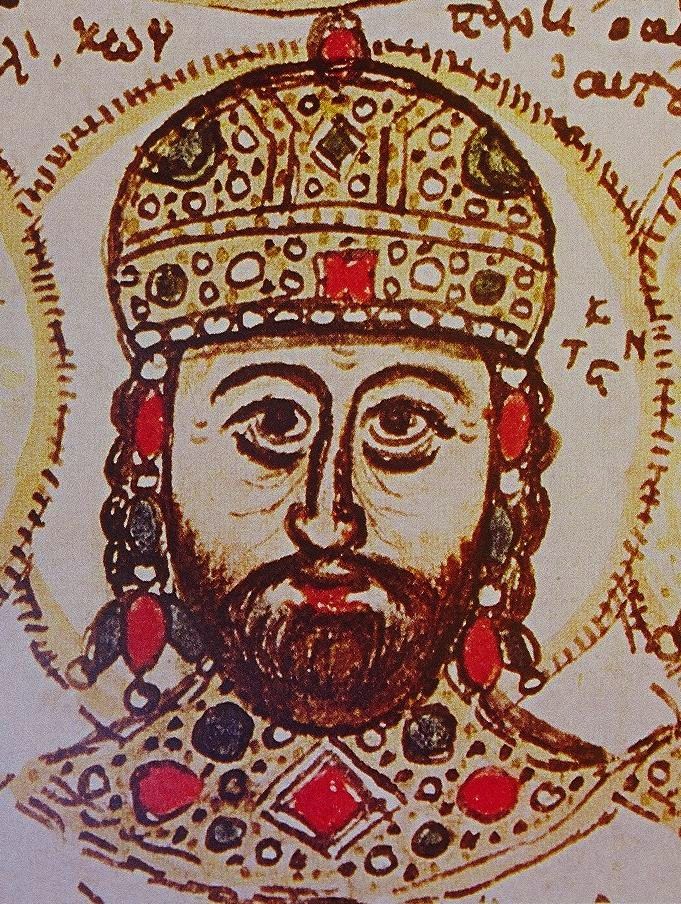
Constantine XI
Constantine XI Constantine XI Palaiologos, the last Byzantine emperor, killed in the final assault. Byzantine miniature · public domain · source
Mehmed II (Bellini)
Mehmed II (Bellini) Gentile Bellini's 1480 portrait of Mehmed II. Gentile Bellini · public domain · source
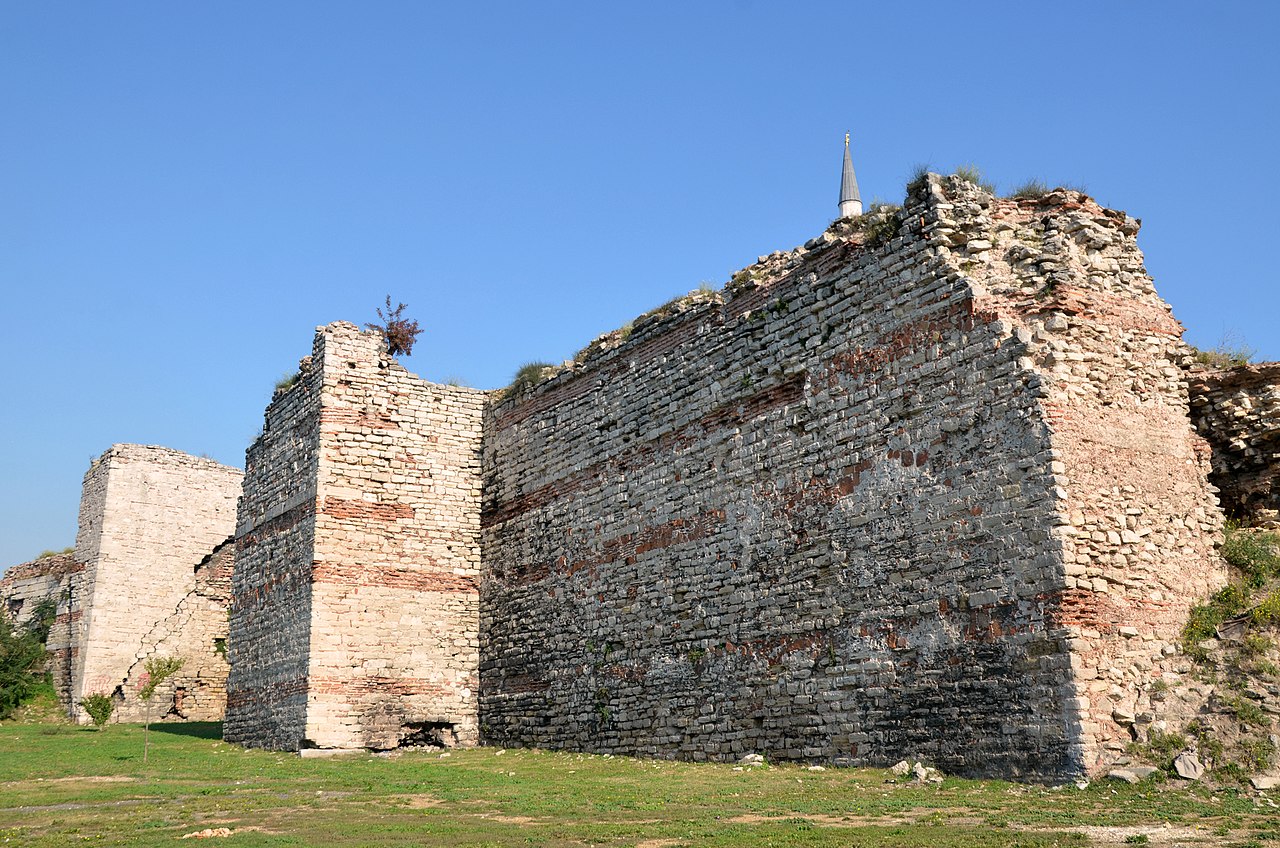
The Theodosian Walls today
The Theodosian Walls today A stretch of the Theodosian land walls today. Carole Raddato · CC BY-SA 2.0 · source

Free for everyone every year on its anniversary: May 29.

Accuracy score: 69/100 (moderate)

How the accuracy score works

Sources and method

Fall of Constantinople, 1453. Primary sources: Nicolò Barbaro, Diary of the Siege of Constantinople, tr. J. R. Melville-Jones (1969), excerpt at De Re Militari — the convoy fight and its towing-in on 20 April, the 72 fustae hauled over the hill above Pera on 22 April, the mines at the Kaligaria from 16 May, the three waves of 29 May and the breach at San Romano; Kritoboulos of Imbros, History of Mehmed the Conqueror, tr. C. T. Riggs, excerpt in Cleveland State University, Premodern Middle East sourcebook — the slipway near the Diplokionion, about eight stadia, about 67 ships; Leonard of Chios, Doukas (the Kerkoporta tradition) and Sphrantzes (the muster) as discussed by Marios Philippides, 'The Fall of Constantinople: Bishop Leonard and the Greek Accounts', Greek, Roman and Byzantine Studies 22 (1981) — the commanders' wall sectors. Modern works: A. A. Vasiliev, History of the Byzantine Empire (final assault, Giustiniani's wound); Encyclopaedia Britannica, 'Fall of Constantinople'; Steven Runciman, The Fall of Constantinople 1453 (Cambridge, 1965); A. van Millingen, Byzantine Constantinople: the Walls of the City (1899). Fixed points: Turkish Archaeological News (Fourth Military Gate, Theodosian and Blachernae walls), Kültür Envanteri (Yedikule, Tekfur Sarayı, Rumeli Hisarı), OpenStreetMap. Strengths are attributed ranges; the Kerkoporta story is a tradition reported by Doukas, not confirmed by other eyewitnesses, and its site is conjectural. Which gate was the 'Gate of St Romanus' — Topkapı or the Fifth Military Gate — is itself debated (N. Asutay-Effenberger). Wall-sector assignments, battery and mine positions, the boom line, the bridge site and the haulage route are approximate. Images from Wikimedia Commons.

Where the positions come from

Further reading