Battlefield Atlas
Scottish Wars of Independence · 1314 Members · from $3

Bannockburn, 23–24 June 1314

On 23–24 June 1314, Robert the Bruce's Scottish army, perhaps 6,000–7,000 spearmen with about 500 light horse, defeated Edward II's much larger English army, perhaps 15,000–20,000 strong with 2,000 or more heavy cavalry, as it marched to relieve Stirling Castle. On the first day the Scots, holding the New Park wood astride the road, repulsed the English vanguard (Bruce killing Sir Henry de Bohun in single combat) and broke a cavalry detachment near St Ninians. The English camped on the low, wet Carse. The next morning the Scottish spearmen attacked them there, and the English army was destroyed in the fighting and in the Bannock Burn and the Forth. Edward II escaped by sea from Dunbar. Stirling Castle surrendered, and Bruce's position as king was secured, though the war went on until 1328. Where the second day was fought is disputed: this map follows the Carse site that Historic Environment Scotland's inventory currently judges the stronger case; the Dryfield, on the terrace just to the south-west, is the main alternative.

Open the interactive map7 stages on modern satellite imagery and terrain, with 3D elevation

This battle opens with Battlefield Enjoyer ($3 a month on Patreon), which unlocks every battle in the atlas and every one added later. Free battles include Thermopylae, Actium, Hattin, Agincourt, Vítkov Hill, Bosworth, Fort William Henry, Yorktown, Waterloo, The Alamo, Antietam, Little Bighorn, Belleau Wood, Omaha Beach, Inchon, Ia Drang, 73 Easting, Wanat, Baghdad Thunder Runs, Bakhmut, Avdiivka.
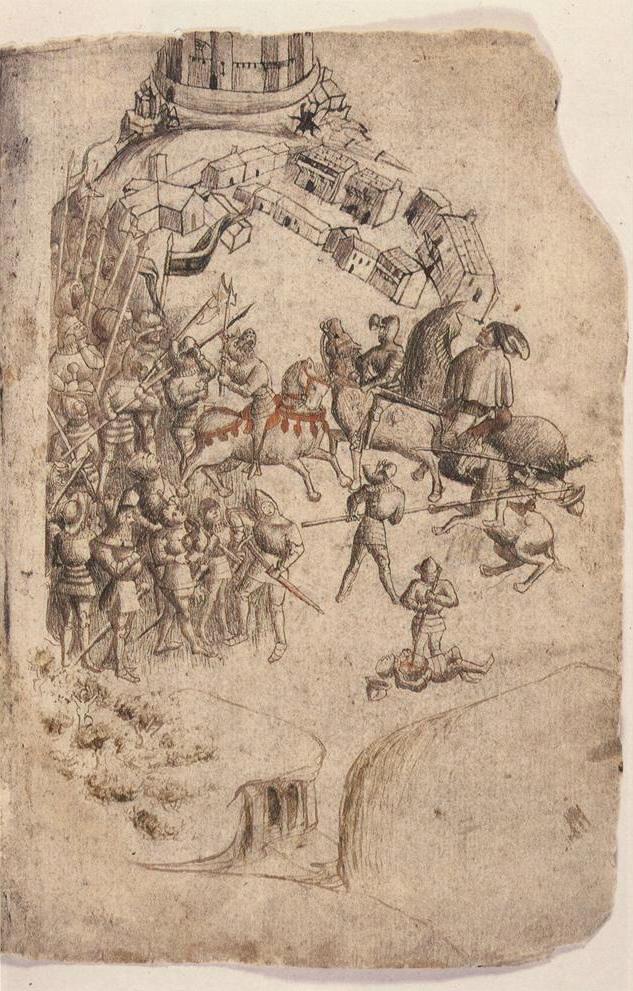
Bannockburn in the Scotichronicon
Bannockburn in the Scotichronicon — Corpus Christi College, Cambridge · public domain

The battle, stage by stage

  1. 23 June 1314, morning

    The road from Falkirk

    Stirling Castle, held for Edward II by Sir Philip Mowbray, has agreed to surrender unless relieved by 24 June (Midsummer). Edward has marched north from Berwick with the largest English army sent into Scotland in his reign, reaching Falkirk on 22 June, and his columns now come up the old Roman road through the Torwood toward Stirling. Robert the Bruce waits in the New Park, a royal hunting wood astride the road south of the town. By John Barbour's account (written about 1375), the king holds the entry to the park by the road, Thomas Randolph, Earl of Moray, the ground by St Ninians kirk, with Edward Bruce and James Douglas in the park; pits have reportedly been dug on either side of the road. Placement of the Scottish divisions within the park is conjectural.

  2. 23 June, afternoon

    Bruce and de Bohun

    The English vanguard under the Earls of Gloucester and Hereford crosses the Bannock Burn and rides at the Scots in front of the New Park wood. Sir Henry de Bohun, Hereford's nephew, spurs ahead at the king himself. According to the Vita Edwardi Secundi, a contemporary English account, Bruce 'struck him on the head with an axe that he carried in his hand'; Barbour adds that the axe-shaft broke. The vanguard is checked at the edge of the wood and Gloucester is unhorsed. The spot is traditionally near the Borestone, where Bruce is said to have raised his standard (a tradition first recorded in the 18th century); the exact place is unknown.

  3. 23 June, afternoon

    Moray stops Clifford

    Meanwhile about 300 men-at-arms under Sir Robert Clifford and Sir Henry de Beaumont ride round the eastern side of the Scottish position on the lower ground, apparently making for the castle. Moray leads his spearmen out from near St Ninians kirk and forms a schiltron across their path. The horsemen cannot break the hedge of spears; Douglas is sent to help, and the English break, some fleeing to the castle and the rest back to the army. Clifford is 'disgracefully routed' (Vita). The clash is placed near St Ninians following the Historic Environment Scotland inventory; its exact site is conjectural.

  4. Night of 23–24 June

    A night on the Carse

    Unable to force the road, the English army turns north-east off it and goes down onto the Carse, the low, wet floodplain of the Forth, crossing the Bannock Burn on a broad front, reportedly using doors and timber from local houses to bridge the pools. Barbour says they 'harboured them that night down in the Carse', among pools and streams; most modern writers place the camp between the Bannock Burn and the Pelstream. The Vita says the men spent the night sleepless, expecting a night attack. In the dark the Earl of Atholl, at odds with Bruce, raids the Scottish supply base at Cambuskenneth Abbey. The camp's extent and the baggage position are conjectural.

  5. 24 June, dawn

    The schiltrons advance

    At first light the Scots come out of the wood on the edge of the high ground (presumed to be Balquhidderock Wood) and advance on foot in divisions of spearmen; the Vita says they came on 'like a thick-set hedge'. Barbour puts Edward Bruce's division on the right, then Moray's, then Douglas's, with the king behind; others describe three schiltrons in line. Gloucester, stung by Edward II calling him a traitor, charges Edward Bruce's division without waiting for the army to form. Squeezed between the burns, the English cannot deploy their numbers. Positions on the Carse follow the HES inventory's preferred site and are interpretive.

  6. 24 June, morning

    'A great ditch engulfed them'

    Gloucester's horse is killed and he is cut down; Giles d'Argentan dies trying to reach him, and Clifford is killed. The English cavalry, packed against their own infantry, cannot get room to charge. Barbour says English archers who began to gall the Scots were ridden down by Sir Robert Keith's light horse (the episode is known only from Barbour). Bruce brings his own division into the line, and the 'sma' folk', the camp followers and irregulars kept apart from the army, appear over the high ground, which by Barbour's account helped to break English morale. Their start point (Coxet Hill or Gillies Hill) is disputed.

  7. 24 June, late morning

    Rout and flight

    The English army collapses. Pembroke and others lead Edward II off the field, reportedly with about 500 horsemen; he rides to Stirling Castle, but Mowbray refuses to admit him, since the castle must now surrender. Edward circles away south toward Linlithgow and reaches Dunbar, pursued by Douglas, and takes ship for Berwick. Behind him, men and horses choke the Bannock Burn: Lanercost says 'a great gorge engulfed many', and Barbour says many drowned trying to cross the Forth. The Earl of Hereford is captured later at Bothwell; the English baggage is plundered.

Casualties

The English army suffered heavy losses in the fighting and the rout, including the Earl of Gloucester and many knights, with hundreds of men-at-arms captured, while Scottish losses were light. No reliable totals exist: chronicle figures are partisan or inflated, and Historic Environment Scotland offers only a rough proportion of about 30% of the English army. Certainty: poor.

English army (Edward II)

Killed (all ranks)Historic Environment Scotland says losses are very difficult to estimate but the English death toll was certainly high, suggests roughly 30% of the army may be a fair proportion (possibly much higher), and rejects John Barbour's 30,000 dead as far too high for an army of no more than about 20,000. Historic Environment Scotland, Inventory of Historic Battlefields: Battle of Bannockburn (BTL4)unknown; heavy (perhaps about 30% of the army (HES); Barbour's 30,000 is far too high)
Men-at-arms killedThomas Walsingham's Historia Anglicana gives about 700 knights and squires killed; Christison notes this is an English figure written long after, and the Annales Londonienses say 'the most part' of the squires and foot were slain. P. Christison, 'Bannockburn, 23rd and 24th June 1314: a study in military history', Proceedings of the Society of Antiquaries of Scotland 90 (1956–57)about 700 (Walsingham)
Named nobles killedThe Earl of Gloucester, Sir Robert Clifford and Sir Giles d'Argentan were killed on 24 June (HES); Sir Henry de Bohun was killed by Bruce on 23 June; Payn Tibetot and William Marshal are among the dead in modern lists (Cornell 2009, cited by Wikipedia). Historic Environment Scotland, Inventory of Historic Battlefields: Battle of Bannockburn (BTL4); Wikipedia, 'Battle of Bannockburn' (lead only; cites W. M. Mackenzie, The Battle of Bannockburn, 1913, and Peter Reese, Bannockburn, 2003)Gloucester, Clifford, d'Argentan and others
CapturedWalsingham says about 500 men-at-arms were spared for ransom (as cited by Mackenzie); the Earl of Hereford and others were taken at Bothwell Castle. HES says noble prisoners were well treated on Bruce's orders, and many were later exchanged. P. Christison, 'Bannockburn, 23rd and 24th June 1314: a study in military history', Proceedings of the Society of Antiquaries of Scotland 90 (1956–57); Wikipedia, 'Battle of Bannockburn' (lead only; cites W. M. Mackenzie, The Battle of Bannockburn, 1913, and Peter Reese, Bannockburn, 2003); Historic Environment Scotland, Inventory of Historic Battlefields: Battle of Bannockburn (BTL4)many knights; about 500 men-at-arms (Walsingham)
Drowned in the routThe Vita Edwardi Secundi, the Lanercost chronicle and Barbour all describe many men and horses lost in the Bannock Burn and the Forth during the flight, without reliable numbers. P. Christison, 'Bannockburn, 23rd and 24th June 1314: a study in military history', Proceedings of the Society of Antiquaries of Scotland 90 (1956–57)unknown; many

Scottish army (Robert the Bruce)

KilledNo figures survive (Christison); HES says Scottish losses were much lower because the schiltrons held formation, and Reese notes only two knights among the Scottish dead. Historic Environment Scotland, Inventory of Historic Battlefields: Battle of Bannockburn (BTL4); P. Christison, 'Bannockburn, 23rd and 24th June 1314: a study in military history', Proceedings of the Society of Antiquaries of Scotland 90 (1956–57); Wikipedia, 'Battle of Bannockburn' (lead only; cites W. M. Mackenzie, The Battle of Bannockburn, 1913, and Peter Reese, Bannockburn, 2003)unknown; light (two knights named among the dead)
Killed on 23 June (Moray's schiltron)HES reports the tradition that Moray's schiltron lost only one man against Clifford and Beaumont on the first day. Historic Environment Scotland, Inventory of Historic Battlefields: Battle of Bannockburn (BTL4)one man (reported)

Then and now: how the ground has changed

Much of the 1314 battlefield is now under Bannockburn, St Ninians and the southern suburbs of Stirling, and the New Park wood has gone. The Carse, a wet floodplain of pools, peat and burns in 1314, was drained and farmed by the 18th century, cut by a main road and the railway, partly stripped of peat and partly built over by industrial estates, though much of it is still open farmland.

The interactive map can show the period landscape (5 shapes: The Carse between the Bannock Burn and the Pelstream (wet ground in 1314), New Park (wooded in 1314, cleared since), Balquhidderock Wood (surviving remnant, smaller than in 1314), The Dryfield (now housing and Bannockburn High School), Springkerse industrial estates on the Carse) under the units. Open the map.

Weapons

English army (Edward II)

Mailed knight and couched lance

Mailed knight and couched lance

Heavy cavalry · 11th–13th centuries

At Bannockburn: English knights and men-at-arms on barded horses.

With the lance couched under the arm, a knight put the weight of man and horse behind the point. A massed charge could break almost any enemy that stood to receive it, so Muslim commanders tried to avoid it, scattering and shooting at the horses instead.

Armor
mail hauberk, helmet, kite or heater shield
Weapon
lance held under the arm, then sword or mace
Weakness
unarmoured horses; heat and thirst
Photo: Morgan Picture Bible, Paris, c. 1250 · Public domain
English longbow

English longbow

Self bow of yew · about 1250–1550

At Bannockburn: English and Welsh archers, scattered by Keith's horse according to Barbour.

A single stave of yew, as tall as a man, that took years of practice to draw. Massed in thousands behind stakes or hedges, English archers broke French charges at Crécy, Poitiers and Agincourt by killing and maddening the horses and pinning men-at-arms in the crush. Bows recovered from the Mary Rose (sunk 1545) show how heavy the draw weights were. In the Wars of the Roses both sides fielded massed longbowmen, as at Towton in 1461.

Draw weight
commonly about 100–150 lb (Mary Rose bows)
Range
about 250–300 yd for volleys with light arrows
Rate
up to 10–12 arrows a minute for a trained archer
Photo: Archer's kit and longbow from the Mary Rose · Tim Sheerman-Chase · CC BY 4.0
Knightly sword (arming sword)

Knightly sword (arming sword)

Straight, double-edged sword · 10th–14th centuries

At Bannockburn: Sword of the mounted men-at-arms.

The knight's sidearm once the lance had broken: a broad, double-edged cutting blade with a simple cross guard and a disc or brazil-nut pommel. Swords were costly, prized and often blessed, and the cross shape of the hilt was not lost on men who had taken the cross.

Blade
about 75–90 cm, broad and fullered
Weight
about 1–1.4 kg
Use
one-handed, with a shield, on foot or horseback
Photo: A 12th–13th-century sword, Kostroma museum-reserve · CC0

Scottish army (Robert the Bruce)

Schiltron

Schiltron

Massed long spears · about 1290–1340

At Bannockburn: The Scots fought in dense spear formations.

The Scottish answer to heavy cavalry: thousands of spearmen packed into close formations bristling with long spears. Wallace's static schiltrons were shot to pieces at Falkirk in 1298; at Bannockburn Bruce trained his to advance, and they drove the English knights back into the burns.

Spear
about 3.5–4 m
Armor
padded jacks, helmets and gloves for most men
Formation
a dense block of spearmen, able to move forward in order
Photo: Bannockburn in a 1440s Scotichronicon manuscript · public domain
Knightly sword (arming sword)

Knightly sword (arming sword)

Straight, double-edged sword · 10th–14th centuries

At Bannockburn: Bruce's few men-at-arms; Bruce killed de Bohun with an axe.

The knight's sidearm once the lance had broken: a broad, double-edged cutting blade with a simple cross guard and a disc or brazil-nut pommel. Swords were costly, prized and often blessed, and the cross shape of the hilt was not lost on men who had taken the cross.

Blade
about 75–90 cm, broad and fullered
Weight
about 1–1.4 kg
Use
one-handed, with a shield, on foot or horseback
Photo: A 12th–13th-century sword, Kostroma museum-reserve · CC0

Paintings and photographs

Bannockburn in the Scotichronicon
Bannockburn in the Scotichronicon The battle as drawn in a 1440s manuscript of Walter Bower's Scotichronicon, the earliest known picture of Bannockburn. Corpus Christi College, Cambridge · public domain · source
The Borestone
The Borestone The remains of the Borestone, where by tradition Bruce raised his standard on the first day. Rosser1954 · CC BY-SA 4.0 · source
The Bannockburn memorial from the air
The Bannockburn memorial from the air The rotunda (1964) and the visitor center at the traditional site of the first day's fighting. Godot13 · CC BY-SA 4.0 · source

Medieval reconstruction. No troop maps survive for this battle. Positions follow the chronicles of both sides and modern studies, numbers are disputed, and the map shows the shape of the battle rather than exact spots.

Free for everyone every year on its anniversary: June 23–24.

Accuracy score: 55/100 (limited)

How the accuracy score works

Sources and method

Bannockburn, 23–24 June 1314. Positions are drawn on Ordnance Survey grid references converted to latitude and longitude: the Borestone/Rotunda, St Ninians Old Parish Church, the Old Bridge at Bannockburn, the Chartershall bridge, Cambuskenneth Abbey, Bannockburn House and Stirling Castle (listed-building records, via British Listed Buildings), and the course of the Bannock Burn and Pelstream from Ordnance Survey grid references. Unit traces are interpretive; the Scottish positions in the New Park, the Clifford clash, the English camp and the day-2 lines are conjectural within the ground the sources describe.

Where the positions come from

Further reading