Battlefield Atlas
Hundred Years' War · 1356 Members · from $3

Poitiers, 1356

On 19 September 1356, near the abbey of Nouaillé about 8 km south-east of Poitiers, Edward of Woodstock, Prince of Wales, with an Anglo-Gascon army of perhaps 6,000 men, defeated the larger army of King John II of France and took the King prisoner. Holding a hedged lane above the Miosson, the Prince's archers destroyed the French mounted vanguard; the French divisions then attacked on foot one after another, and the last, under the King himself, was broken by a counter-attack and a flanking charge led by the Captal de Buch. The capture of the King threw France into crisis and led to the Treaty of Brétigny. This is a reconstruction: no contemporary map exists, numbers are disputed (the chroniclers inflate them), and the exact position of the lines is debated; positions shown are approximate.

Open the interactive map8 stages on modern satellite imagery and terrain, with 3D elevation

This battle opens with Battlefield Enjoyer ($3 a month on Patreon), which unlocks every battle in the atlas and every one added later. Free battles include Hattin, Agincourt, Yorktown, Waterloo, The Alamo, Antietam, Little Bighorn, Belleau Wood, Omaha Beach, Ia Drang, Najaf.

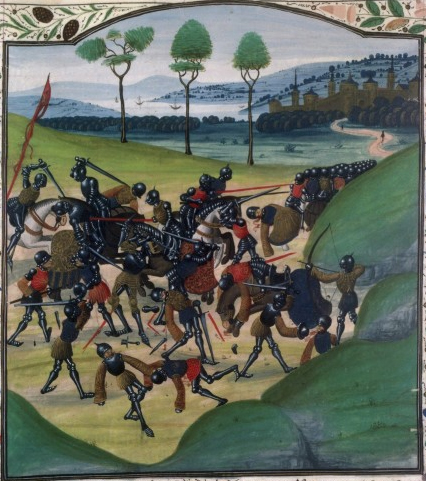
The Battle of Poitiers (manuscript illumination)
The Battle of Poitiers (manuscript illumination) — Master of the Vienna Chronique d'Angleterre — public domain

The battle, stage by stage

  1. 4 August – 18 September 1356

    The chevauchée and the cardinal

    In August 1356 Edward of Woodstock, Prince of Wales (the 'Black Prince'), rides north from Bergerac with an Anglo-Gascon army on a chevauchée, a destructive mounted raid, toward the Loire. Unable to join the Duke of Lancaster across the swollen river, he turns south. King John II of France crosses the Loire at Blois and tries to cut him off, crossing the Vienne at Chauvigny. On 17 September the Prince's scouts run into the French rearguard near La Chaboterie, by Savigny-Lévescault, and kill or capture about 240 men. The French reach Poitiers first, and the Prince halts near the abbey of Nouaillé. On Sunday 18 September Cardinal Talleyrand de Périgord, the papal legate, rides between the camps; by the chronicles the Prince offered to give up his prisoners and plunder and a seven-year truce, and the King refused. Numbers are disputed: modern estimates are about 6,000 Anglo-Gascons and perhaps 11,000–16,000 French.

  2. 19 September 1356, dawn

    Behind the hedge

    The Prince's army holds a low plateau north of the Miosson, behind a sunken, hedged lane — the 'Maupertuis', or 'bad passage' — that runs north from the Gué de l'Omme ford. Warwick and Oxford hold the left, down toward the marshy ground by the river; Salisbury and Suffolk the right; the Prince's own division stands in reserve behind, with the Nouaillé wood at the army's back. The archers are on the wings, dug in behind ditches and carts. According to the chronicles the hedge has only a couple of gaps, wide enough for four or five men abreast. On French advice (Eustache de Ribemont, who had scouted the position), John dismounts most of his men-at-arms and sends forward only two mounted groups under the marshals Clermont and Audrehem, with German knights, to break the archers. At first light English carts are seen moving toward the ford — perhaps a withdrawal, perhaps a ruse.

  3. Morning

    The marshals' charge

    Seeing the English move, Audrehem urges an immediate attack; Clermont, by Froissart's account, suspects a trap, and the two quarrel. Both charge. Clermont's knights ride at the hedge gap held by Salisbury's men and are shot and cut down there; Clermont is killed. Audrehem's charge against Warwick's wing is broken when, as Geoffrey le Baker tells it, the Earl of Oxford leads archers out onto the marsh to shoot into the unarmoured flanks and hindquarters of the barded horses. Audrehem is wounded and taken prisoner; Constable Brienne, attacking with the foot and crossbowmen, is killed. The mounted vanguard — the one force John had kept on horseback — is destroyed in minutes.

  4. Mid-morning

    The Dauphin's division attacks

    The first French division, perhaps 4,000 men-at-arms on foot under the eighteen-year-old Dauphin Charles, Duke of Normandy, comes on through the archers' arrows and reaches the hedge. The fighting there is long and hard — by some accounts two hours — and the Prince feeds men from his reserve into the line. The Duke of Bourbon is killed and the Dauphin's banner is taken. At last the division falls back; the Dauphin's guardians lead him off the field.

  5. Late morning

    Orléans's division leaves the field

    The second division, under the King's brother Philip, Duke of Orléans, does not attack. Seeing the Dauphin's men retreat, it withdraws, and by several accounts leaves the field altogether; the King's other sons are escorted away to Chauvigny. Whether this was panic, misunderstood orders or a deliberate move to save the princes is disputed. The English, exhausted and with the archers running short of arrows, use the lull to drag the dead from the hedge, recover arrows and tend the wounded.

  6. Midday

    The King's division advances

    John will not withdraw. Under the Oriflamme, carried by Geoffroi de Charny, his own division — fresh, and swelled by men rallying from the others — advances on foot toward the hedge. In the English line the archers have shot most of their arrows. The Prince sends the Captal de Buch, a Gascon lord, with a small mounted force round behind a low hill to fall on the French flank and rear, and orders his whole army to mount and go out to meet the King rather than wait behind the hedge.

  7. Early afternoon

    'Banners, advance!' — the King is taken

    The Anglo-Gascons ride out from the hedge and crash into the King's division; the archers, out of arrows, join the mêlée with swords and knives. The Captal de Buch's men appear on the rise behind the French under the banner of St George, and the French rear breaks. Pressed back onto the low ground by the Miosson — the Champ Alexandre — the King fights on with his fourteen-year-old son Philip beside him warning him of blows ('Father, guard yourself right; guard yourself left'). Geoffroi de Charny dies with the Oriflamme. John surrenders, by Froissart's account to Denis de Morbecque, an exiled knight of Artois serving the English, and is nearly torn apart by men claiming him before Warwick and Cobham bring him to the Prince.

  8. 19 September 1356 – 1360

    A king for ransom

    French losses are heavy: about 2,500 men-at-arms killed, among them the Constable, a marshal, the Duke of Bourbon and Charny, and some 2,000–3,000 taken prisoner, with many of the foot killed in the pursuit toward Poitiers. Anglo-Gascon losses are reported as small, though modern historians think the chronicle figures too low. That evening the Prince serves the captive King supper — traditionally at the castle of Chambonneau — and waits on him at table. John is taken to Bordeaux and then London. His ransom, set at three million gold écus, and the Treaty of Brétigny (1360) follow; the gold franc first struck in 1360 for the ransom is the origin of the French franc.

Weapons

French royal army (John II)

Mailed knight and couched lance

Mailed knight and couched lance

Heavy cavalry · 11th–13th centuries

At Poitiers: Only two picked mounted groups under the marshals charged; the rest of the French fought on foot on Ribemont's advice.

With the lance couched under the arm, a knight put the weight of man and horse behind the point. A massed charge could break almost any enemy that stood to receive it, so Muslim commanders tried to avoid it, scattering and shooting at the horses instead.

Armour
mail hauberk, helmet, kite or heater shield
Weapon
lance held under the arm, then sword or mace
Weakness
unarmoured horses; heat and thirst
Photo: Morgan Picture Bible, Paris, c. 1250 · Public domain
Crossbow

Crossbow

Mechanical bow · about 1100–1500 in Western armies

At Poitiers: About 2,000 crossbowmen went in with the first division and were outshot.

A short, powerful bow mounted on a stock and spanned with the feet or a hook, shooting a heavy bolt. It took less skill than a longbow and outranged the Turkish horse archer's bow at close quarters, so Crusader armies used crossbowmen to screen their knights.

Draw
spanned by foot stirrup or belt hook
Range
effective to about 150–200 yd
Rate
about 2 bolts a minute
Photo: Metropolitan Museum of Art · CC0
Knightly sword (arming sword)

Knightly sword (arming sword)

Straight, double-edged sword · 10th–14th centuries

At Poitiers: King John fought on foot on the Champ Alexandre, by Froissart's account with a battle-axe, his son Philip at his side.

The knight's sidearm once the lance had broken: a broad, double-edged cutting blade with a simple cross guard and a disc or brazil-nut pommel. Swords were costly, prized and often blessed, and the cross shape of the hilt was not lost on men who had taken the cross.

Blade
about 75–90 cm, broad and fullered
Weight
about 1–1.4 kg
Use
one-handed, with a shield, on foot or horseback
Photo: A 12th–13th-century sword, Kostroma museum-reserve · CC0

Anglo-Gascon army (Black Prince)

English longbow

English longbow

Self bow of yew · about 1250–1550

At Poitiers: Oxford's archers moved into the marsh and shot the barded horses in their unprotected flanks and hindquarters. By the King's attack they had run out of arrows and joined the melee.

A single stave of yew, as tall as a man, that took years of practice to draw. Massed in thousands behind stakes or hedges, English archers broke French charges at Crécy, Poitiers and Agincourt by killing and maddening the horses and pinning men-at-arms in the crush. Bows recovered from the Mary Rose (sunk 1545) show how heavy the draw weights were.

Draw weight
commonly about 100–150 lb (Mary Rose bows)
Range
about 250–300 yd for volleys with light arrows
Rate
up to 10–12 arrows a minute for a trained archer
Photo: Archer's kit and longbow from the Mary Rose · Tim Sheerman-Chase · CC BY 4.0
Mailed knight and couched lance

Mailed knight and couched lance

Heavy cavalry · 11th–13th centuries

At Poitiers: The Prince's men-at-arms fought behind the hedge, then remounted for the charge while the Captal de Buch struck the French rear.

With the lance couched under the arm, a knight put the weight of man and horse behind the point. A massed charge could break almost any enemy that stood to receive it, so Muslim commanders tried to avoid it, scattering and shooting at the horses instead.

Armour
mail hauberk, helmet, kite or heater shield
Weapon
lance held under the arm, then sword or mace
Weakness
unarmoured horses; heat and thirst
Photo: Morgan Picture Bible, Paris, c. 1250 · Public domain
Plate armour

Plate armour

Full harness of steel plates · about 1400–1600 (transitional mail and plate earlier)

At Poitiers: Armour in 1356 was transitional: mail, coats of plates and growing plate limb defences on both sides.

By 1415 a man-at-arms could be enclosed head to foot in steel. It kept most arrows out, but at Agincourt the French men-at-arms advanced across soaked, ploughed ground under arrow fire and arrived exhausted, packed so tightly that many could not lift their weapons. At Poitiers in 1356 armour was still transitional: mail, coats of plates and growing plate limb defences.

Weight
about 20–30 kg, spread over the body
Protection
proof against most arrows except at short range or weak points
Weakness
heat, exhaustion and mud
Photo: Gothic plate armour · Rama · CC BY-SA 2.0 fr

Paintings and photographs

The Battle of Poitiers (manuscript illumination)
The Battle of Poitiers (manuscript illumination) The battle in a 15th-century copy of Jean de Waurin's Chroniques d'Angleterre. Master of the Vienna Chronique d'Angleterre — public domain · source
The Battle of Poitiers (Delacroix, 1830)
The Battle of Poitiers (Delacroix, 1830) Eugène Delacroix's 1830 painting of King John fighting on with his young son Philip at his side. Eugène Delacroix — public domain · source
Abbey of Nouaillé
Abbey of Nouaillé The fortified abbey of Saint-Junien at Nouaillé, beside the Miosson below the battlefield. Mat.webmiss — CC BY-SA 3.0 · source

Medieval reconstruction. No troop maps survive for this battle. Positions follow the chronicles of both sides and modern studies, numbers are disputed, and the map shows the shape of the battle rather than exact spots.

Free for everyone every year on its anniversary: September 19.

Accuracy score: 51/100 (limited)

How the accuracy score works

Sources and method

Poitiers (Nouaillé-Maupertuis), 19 September 1356. A reconstruction: no troop maps exist. Contingents are placed from the chronicles and the terrain, with the Anglo-Gascon line along the hedged lane running north from the Gué de l'Omme ford of the Miosson. Primary sources: Jean Froissart, Chroniques (the Online Froissart, University of Sheffield/HRI); Geoffrey le Baker, Chronicon (trans. D. Preest and R. Barber, Boydell 2012); Chandos Herald, La Vie du Prince Noir; the Black Prince's letters, in R. Barber, The Life and Campaigns of the Black Prince (Boydell 1979); Jean le Bel, Chronique; the French royal chronicle (Chronique des règnes de Jean II et de Charles V); Matteo Villani. Miniature of the battle, BnF Français 2606 f.424v (Biblissima). Modern: Clifford J. Rogers, War Cruel and Sharp (Boydell 2000) and his 2022 Glasgow War Studies seminar 'The Campaign and Battle of Poitiers, 1356: what can we conclude beyond a reasonable doubt?'; Rogers, 'The Battle of Poitiers, 1356', Desperta Ferro 38 (2016) (Medievalists.net); Jonathan Sumption, Trial by Fire (1999); Peter Hoskins, In the Steps of the Black Prince: the Road to Poitiers 1355–1356 (Boydell 2011); David Green, The Battle of Poitiers 1356 (2002); A. H. Burne, The Crécy War (1955); 'Banners, advance!', Military History Matters; 'Death at the Hawthorn Hedge', Warfare History Network. Site and archaeology: F. Vinet, 'Note archéologique sur la bataille de Poitiers ou Maupertuis' (19th c.; ditch, debris and burial pits reported at the Champ-de-la-Bataille near La Cardinerie), republished by PHystorique, 2021; association Nouaillé-1356 (the hedged lane Beauvoir–Bernon–Les Bordes–Gué de l'Omme); Tourisme Vienne, 'Battlefield 1356' (1938 memorial); Visorando battle trail (altitudes). No modern systematic archaeological survey of the battlefield was found; the battle lines are not fixed by excavated finds. Images from Wikimedia Commons.

Where the positions come from

Approximate locations

Further reading