Battlefield Atlas
War against ISIS (Syria) · 2018 Members · from $3

Khasham, 2018

On the night of 7–8 February 2018, a battalion-sized pro-Syrian-government force — reported by U.S. officials to be made up largely of Russian private military contractors of the Wagner Group, with Syrian troops and militias, tanks and artillery — crossed the Euphrates de-confliction line near Deir ez-Zor and attacked an SDF headquarters at the former Conoco gas plant near Khasham, where about 30 U.S. special operations troops were based. After U.S. calls to Russian officers failed to stop it, more than three hours of U.S. air and artillery strikes, joined by a small reaction force of Green Berets and Marines, broke the attack. No Americans were hurt. The number of attackers killed, and how many of them were Russian, remains disputed; Moscow denied that its forces were involved.

Open the interactive map7 stages on modern satellite imagery and terrain, with 3D elevation

This battle opens with Battlefield Enjoyer ($3 a month on Patreon), which unlocks every battle in the atlas and every one added later. Free battles include Hattin, Agincourt, Vítkov Hill, Bosworth, Yorktown, Waterloo, The Alamo, Antietam, Little Bighorn, Belleau Wood, Omaha Beach, Ia Drang, 73 Easting, Wanat, Najaf.

MQ-9 Reaper
MQ-9 Reaper — U.S. Air Force photo · public domain

The battle, stage by stage

  1. 7 February 2018, before dawn to midday

    Across the de-confliction line

    In late 2017 the Euphrates became the dividing line in eastern Syria: Syrian government forces and their Russian and Iranian-backed allies held the west bank around Deir ez-Zor, while the U.S.-backed Syrian Democratic Forces (SDF) held the east bank, including the former Conoco gas plant, where a small team of U.S. special operations forces lived beside an SDF headquarters. U.S. commanders say they watched a slow build-up of pro-regime men and equipment for a week and reminded Russian officers of the U.S. presence over the de-confliction telephone line. Before dawn on 7 February, by Der Spiegel's account, about 250 fighters tried to cross a pontoon bridge south-east of the city; U.S. warning shots turned them back.

  2. 7 February, about 3 PM to 8:30 PM

    The gathering

    At about 3 PM a pro-regime force begins moving toward the Conoco plant. By early evening, U.S. officials later told reporters, more than 500 men and 27 vehicles, including tanks and armoured personnel carriers, are in position. A larger group, reportedly about twice the size of the morning party, crosses the river after dark by another bridge and gathers near Marrat. U.S. officials say most of the attackers were Russian private contractors, believed to be from the Wagner Group, alongside Syrian troops and militias; the exact mix is disputed. At 8:30 PM three T-72 tanks come within about a mile of the plant. Twenty miles away, Green Berets and a Marine platoon load a quick reaction force.

  3. About 10 PM to 10:30 PM

    Barrage on the SDF headquarters

    At about 10 PM a column of tanks and armoured vehicles comes out of a residential area, where it had gathered unseen, and turns toward the outpost. Around 10:30 PM the attack opens with tank fire, artillery, rocket launchers and mortars; the Coalition later said 20 to 30 rounds landed within 500 metres of the SDF headquarters. The Americans take cover and answer with anti-tank missiles and machine guns from behind dirt berms. U.S. officers call their Russian counterparts and urge them to stop the attack; the Russians say the force is not theirs.

  4. About 10:30 PM to 11:30 PM

    The first strikes

    When the calls fail to halt it, U.S. forces fire warning shots, then strikes begin. F-22s and MQ-9 Reapers are already overhead; by one account a drone fires all its Hellfire missiles at the attackers' artillery. The quick reaction force — about 16 Green Berets and Marines in mine-resistant trucks — drives toward the plant without headlights, using thermal sights, through craters and fallen power lines. At about 11:30 PM it halts short of the plant: the shelling is too heavy to drive through. Its base and route have not been published, and its arrow here is schematic.

  5. About 11:30 PM to 1 AM

    Air and artillery

    For more than three hours, Air Force combat controllers and other terminal attack controllers call in wave after wave of strikes — F-15E Strike Eagles, MQ-9s, B-52 bombers, AC-130 gunships and AH-64 Apaches — together with U.S. ground artillery and Marine rockets. One combat controller of the 24th Special Tactics Squadron, whose name has not been released, later received the Air Force Cross: his citation credits him with keeping 'an isolated force of American and coalition personnel from being overrun' while under artillery, rocket, mortar and tank fire. By the War Horse account, nine of the attackers' ten tanks and all six artillery pieces were destroyed. Some vehicles that turned back west were not targeted.

  6. About 1 AM to 2 AM, 8 February

    The reaction force arrives

    With the artillery silenced, the quick reaction force reaches the plant at about 1 AM, lines its trucks up behind a berm and opens fire on fighters dug in about 1,000 metres away; by its team leader's estimate, it fires several thousand .50-calibre rounds. U.S. strength at the outpost is now about 40. At about 2 AM the attackers fall back and the Americans stop firing. No Americans are hurt; one SDF fighter is wounded. Before dawn the U.S. team watches the other side come back to collect its dead.

  7. 8 February 2018 and after

    Counting the dead

    The toll has never been settled. U.S. officials first said about 100 pro-regime fighters were killed; Pentagon documents seen by the New York Times estimated 200 to 300. Der Spiegel put the dead at more than 250, mostly Syrians, Iraqis, Afghans and tribal fighters, with 10 to 20 Russians; Reuters sources spoke of about 300 men working for the Russian contractor killed or wounded; later Russian and Western tallies of Russian dead range from about 15 to over 100. Moscow said its forces were not involved and acknowledged only that five Russian citizens may have died. Defense Secretary Jim Mattis told Congress the Russian high command had said the fighters were not theirs. On 10 February an MQ-9 destroyed a T-72 near the Tabiya field.

Weapons

Wagner Group contractors and pro-Assad forces

T-72

T-72

Main battle tank · 1973–present (Iraqi Asad Babil and imported Soviet versions)

At Khasham: T-72s led the assault; by one U.S. account nine of ten tanks were destroyed.

The best tank in the Iraqi army in 1991, issued mainly to Republican Guard divisions such as the Tawakalna and Medina. Its older night sights and ammunition left crews unable to see or hit American tanks firing from beyond 2,000 m, and its ammunition stored around the turret ring tended to blow the turret off when penetrated.

Gun
125 mm smoothbore with autoloader
Crew
3
Weight
about 41 t
Photo: Unknown author · public domain
T-55 tank

T-55 tank

Main battle tank (Soviet design) · 1958–present

At Khasham: Older T-55s were reported in the column alongside the T-72s.

A Soviet tank of the 1950s that formed much of the Iraqi armoured force in both 1991 and 2003, including locally upgraded 'Enigma' versions with extra armour. Outranged and outclassed, T-55s were knocked out by Coalition tanks, missiles and aircraft, usually before they could close.

Gun
100 mm D-10T
Crew
4
Weight
about 36 t
Photo: Tech. Sgt. Joe Coleman, USAF · public domain
ZU-23-2

ZU-23-2

Twin 23 mm anti-aircraft gun · 1960–present

At Khasham: Truck-mounted ZU-23s were used against ground targets in the barrage on the SDF headquarters.

A Soviet twin anti-aircraft cannon found in nearly every Middle Eastern army and militia. Mounted on trucks it is widely used against ground targets, where its rate of fire is devastating to light vehicles and buildings.

Calibre
23 mm, twin barrels
Rate of fire
about 2,000 rounds a minute (both barrels)
Mount
towed, or on trucks and carriers
Photo: Public domain

U.S. special operations forces, Marines and SDF

MQ-9 Reaper

MQ-9 Reaper

Armed drone · 2007–present

At Khasham: Reapers tracked the column through the afternoon and fired the first Hellfires on the artillery.

A long-endurance armed drone flown by crews thousands of miles away. Reapers watched over U.S. outposts in Syria and could strike within moments; their full-motion video also let commanders follow a battle as it unfolded.

Weapons
Hellfire missiles, laser-guided bombs
Endurance
about 24 hours
Crew
2, flying remotely
Photo: U.S. Air Force photo · public domain
AC-130H Spectre

AC-130H Spectre

Gunship · 1972–2015

At Khasham: Gunships hammered vehicles and troops in the open after midnight.

A converted C-130 transport that circles a target firing side-mounted guns, a night killer of vehicles in the open. At Khafji the gunship Spirit 03 stayed on station past dawn to support the Marines and was shot down with all 14 crew on 31 January 1991.

Armament
105 mm howitzer, 40 mm Bofors, 20 mm cannon
Crew
14
Role
night close air support
Photo: U.S. Air Force photo · public domain
AH-64A Apache

AH-64A Apache

Attack helicopter · 1986–present

At Khasham: Apaches attacked the attackers as they fell back.

The Army's attack helicopter, built to kill tanks at night. In 1991 Apache battalions struck Iraqi armour ahead of the ground divisions, including the Medina Division's positions on 27 February.

Armament
30 mm chain gun, Hellfire missiles, rockets
Crew
2
Sensors
night-vision and thermal targeting
Photo: NARA · public domain
F-15E Strike Eagle

F-15E Strike Eagle

Strike fighter · 1988–present

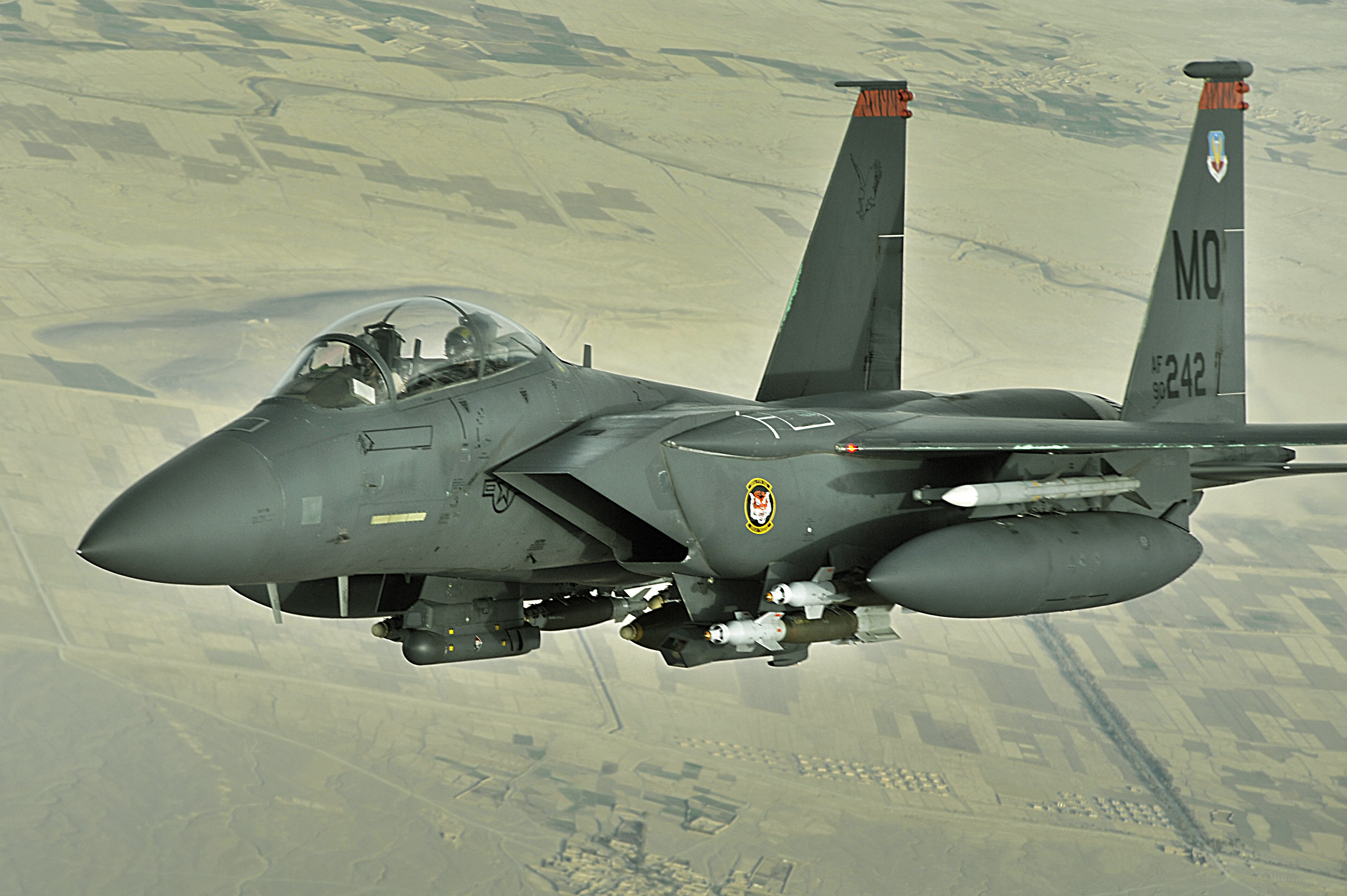
At Khasham: Strike Eagles dropped precision bombs as the air attack built up; B-52s and F-22s were also overhead.

The Air Force's two-seat strike fighter, a mainstay of the air campaign against ISIS in Iraq and Syria, carrying laser- and GPS-guided bombs for close air support.

Crew
2 (pilot and weapons systems officer)
Weapons
precision-guided bombs, 20 mm cannon
Speed
Mach 2.5
Photo: U.S. Air Force photo · public domain

Paintings and photographs

MQ-9 Reaper
MQ-9 Reaper An MQ-9 Reaper of the type that watched the build-up and fired the first Hellfire missiles (photo not of this battle). U.S. Air Force photo · public domain · source
AC-130 gunship
AC-130 gunship An AC-130 gunship. Gunships joined the air attack on the column after about 11:30 PM (photo not of this battle). U.S. Air Force photo · public domain · source
AH-64D Apache
AH-64D Apache Army Apache helicopters struck the attackers as they fell back (photo not of this battle). U.S. Army photo · public domain · source
F-15E Strike Eagle
F-15E Strike Eagle F-15E Strike Eagles dropped precision bombs on the column (photo not of this battle). U.S. Air Force photo · public domain · source

Free for everyone every year on its anniversary: February 7–8.

Accuracy score: 52/100 (limited)

How the accuracy score works

Sources and method

Khasham / Conoco gas plant, 7–8 February 2018. Official U.S. accounts: CJTF-OIR/CENTCOM, 'Unprovoked attack by Syrian pro-regime forces prompts Coalition defensive strikes' (8 Feb 2018; SDF HQ 8 km east of the de-confliction line); DoD press briefing by Lt. Gen. Jeffrey Harrigian (13 Feb 2018: slow build-up, de-confliction calls, battalion-sized dismounted force, F-15E, MQ-9, B-52, AC-130 and AH-64 strikes for more than three hours). Narrative and timings: Thomas Gibbons-Neff, 'How a 4-Hour Battle Between Russian Mercenaries and U.S. Commandos Unfolded in Syria', New York Times, 24 May 2018 (republished by SBS); Kevin Maurer, 'Special Forces Soldiers Reveal First Details of Battle With Russian Mercenaries in Syria', The War Horse, May 2023 (also Military Times). Air Force Cross: Air & Space Forces Magazine on the citation released to the Washington Post under FOIA (2024). Crossings, the Tabiya attack and casualties: Christoph Reuter, 'American Fury', Der Spiegel, 2 Mar 2018 (summarised by Meduza); The Defense Post, 8 Feb 2018; Reuters, 'Russian toll in Syria battle was 300 killed and wounded: sources', 16 Feb 2018 (reprint). Context: New America, Decoding the Wagner Group; Middle East Institute, 'Syria: where the conflict between Wagner and the Russian government began' (2023). Places: Deir ez-Zor airport from SkyVector (OSDZ); Marrat from Airwars' geolocation; the gas plant from its walled compound on satellite imagery; Khasham and Tabiyet Jazira from OpenStreetMap. The crossings, the outpost, the berms, the attackers' positions and the reaction force's route are interpretive — none has been published — and casualty figures are given as attributed ranges.

Where the positions come from

Further reading